


Yesterday morning I watched a barista dump eight pitchers of steamed milk while the morning rush crushed their team. Each pitcher had maybe two ounces left—not enough for another drink, but collectively almost 16 ounces of waste. At $4.50 per half-gallon wholesale, that's basically throwing away a dollar every fifteen minutes during peak.
This wasn't some inexperienced team. These baristas knew their craft. But when you're pulling 60+ drinks an hour and juggling oat, almond, whole, and skim milk across different drink sizes, traditional prep methods just break down.
Most cafe owners think milk waste comes from overordering or storage problems. Sure, those matter. But the silent profit killer happens between 7:30am and 10am when your team is moving too fast to track what they're actually pouring versus what they're dumping.
Peak hours create this weird operational paradox
Your baristas need to move faster, which means prepping more milk ahead of time. But prepping ahead means more partial pitchers sitting around, more temperature cycling, and ultimately more waste.
Watch any busy cafe during morning rush and you'll see the pattern: the lead barista steams a full 20oz pitcher for a large latte. Uses 16oz, leaves 4oz sitting. Next order comes in for a cappuccino—needs 6oz. Can't use the leftover 4oz, so they steam a fresh 12oz pitcher. Now you've got two partial pitchers cooling down.
Multiply this across four milk types and suddenly you've got a dozen partially-filled pitchers scattered across the counter. Some get reused. Most get dumped when they drop below safe serving temperature after sitting for eight minutes.
The temperature window is brutal. Milk starts degrading the moment it hits 140°F. After about five minutes at room temperature, previously steamed milk develops that weird metallic taste. After ten minutes, even if you re-steam it, the proteins are shot and it won't foam properly.
Breaking down the actual waste patterns
I tracked waste patterns across twelve cafes last quarter, focusing specifically on their 7am-11am windows. The numbers were consistent.
Keep every order and shift perfectly aligned.
Coffehq helps you manage orders, inventory, and staff schedules seamlessly.
- Unified order processing
- Real-time inventory updates
- Staff shift coordination
No credit card required
Small cafes (40-80 drinks/peak hour):
-
Average 24-32oz milk waste per hour
-
Roughly $6-8 daily loss
-
Main culprit
poor batch sizing for alternative milks
Medium cafes (80-150 drinks/peak hour):
-
Average 48-64oz milk waste per hour
-
Roughly $12-16 daily loss
-
Main culprit
cross-contamination between milk types forcing fresh pours
High-volume cafes (150+ drinks/peak hour):
-
Average 80-96oz milk waste per hour
-
Roughly $20-24 daily loss
-
Main culprit
temperature timing mismatches between prep and service
One shop in Brooklyn was dumping almost a full gallon during their three-hour morning rush. That's $450 monthly in pure waste, not counting the labor cost of repeatedly steaming milk that never makes it into a cup.
The prep-timing rules that actually work
Forget the generic "prep less milk" advice. During peak hours, you need specific thresholds that match your actual order flow.
Start with the 3-2-1 rule for whole milk (your highest volume):
-
3 minutes out
Steam enough for your next 3 typical orders
-
2 minutes out
Check temperature on existing pitchers
-
1 minute out
Consolidate or dump
This sounds simple but requires your team to mentally track time while juggling orders. Most baristas can't accurately judge three minutes when they're slammed. So instead, tie prep timing to visual cues.
When the grinder hopper drops below half-full, that's your three-minute warning for milk prep. When you see two drinks queued on the espresso machine, that's your consolidation moment. These physical markers work better than trying to watch a clock during rush.
Tie milk prep timing to physical cues like grinder hopper level and queued drinks rather than relying on a clock.
The 2-1-dump approach:
-
Prep maximum 2 drinks worth
-
Use within 1 full service cycle
-
Dump immediately if untouched after second cycle
A service cycle is basically one complete round of taking orders, pulling shots, and serving drinks—usually 90-120 seconds during peak.
Batching thresholds that prevent cascade waste
Most cafes mess up here: they batch prep based on container size, not order patterns.
Your 20oz pitcher holds enough for one large latte or three cappuccinos. But if your morning rush is 70% large drinks, prepping for cappuccinos creates automatic waste. You need dynamic batching thresholds.
Track your drink distribution for one week. Not just drink types, but size distribution within each type. If 80% of your lattes are 16oz, never prep less than 16oz of milk at once. If 60% of your cappuccinos are 8oz, your standard cappuccino prep should be 8oz, not 12oz.
Build a batching matrix:
| Drink Type | Peak Size Distribution | Optimal Batch Size | Max Hold Time |
|---|---|---|---|
| Latte | 80% large (16oz) | 18-20oz | 4 minutes |
| Cappuccino | 60% small (8oz) | 8-10oz | 3 minutes |
| Flat White | 90% standard (10oz) | 10-12oz | 3 minutes |
| Cortado | 95% standard (4oz) | 8oz (for 2) | 2 minutes |
The "Max Hold Time" is critical. This isn't about food safety—it's about quality perception. Customers can taste when milk has been sitting, even if it's technically safe.
Cross-utilization swaps to maximize every pitcher
Most baristas treat each milk type as completely separate. But during peak hours, smart cross-utilization can cut waste by 30%.
The hierarchy works like this:
-
Whole milk can substitute in any dairy-tolerant drink
-
Oat milk can substitute for almond in most drinks (except allergies)
-
Almond and soy are generally non-substitutable
When a customer orders a whole milk latte and you have 14oz of unused oat milk sitting there, ask if they'd like to try oat today. Frame it as an upgrade, not a substitution. About 40% will say yes, especially if you mention it's the same price.
Build a substitution protocol:
Acceptable swaps (with customer permission):
-
Whole milk → Any non-dairy (positioned as "trying something new")
-
Oat → Almond (for non-allergy customers)
-
2% → Whole milk (most won't notice)
Never swap:
-
Non-dairy → Dairy (allergy risk)
-
Soy → Anything else (distinct taste)
-
Skim → Whole (too noticeable)
Train your team to suggest swaps during high-waste periods. Not pushily, just: "We've got fresh-steamed oat milk ready right now if you'd like to try that instead?"
Quick waste metrics managers can track without complex systems
You don't need fancy software to track milk waste. You need three simple metrics that take 30 seconds to capture.
The pitcher count method:
Put a hash mark on a napkin every time someone dumps milk. At the end of peak hour, multiply marks by average pitcher remainder (usually 2-3oz). This gives you total waste volume.
The weight check method:
Weigh your milk supplies before and after peak hour. Compare weight loss to drinks sold. The gap is your waste plus some evaporation. Not perfect, but directionally accurate.
The dollar jar method:
Every time someone dumps milk, they drop a quarter in a jar. Sounds punitive but it's actually just awareness building. End of the week, count the quarters and multiply by 4 for approximate waste cost.
One cafe owner in Portland started tracking with the pitcher count method and discovered they were wasting 44oz during their 3-hour morning rush. That's $5.50 daily, or about $1,650 annually. From milk alone. During just morning rush.
Building a waste-reduction sequence for morning rush
Instead of trying to fix everything at once, implement changes in this order:
-
Week 1
Establish baseline
- Track current waste using the pitcher count method. Don't change anything yet. Just measure. -
Week 2
Implement prep-timing rules
- Start with whole milk only. Use the 3-2-1 rule. Measure the difference. -
Week 3
Add batching thresholds
- Calculate your optimal batch sizes based on actual order patterns. Implement for top two milk types. -
Week 4
Introduce cross-utilization
- Train team on acceptable swaps. Track acceptance rate and waste reduction. -
Week 5
Tighten alternative milk windows
- Implement the 2-1-dump rule for almond and soy. Adjust oat milk based on your specific volume.
Here's a simple visual of the weekly sequence.
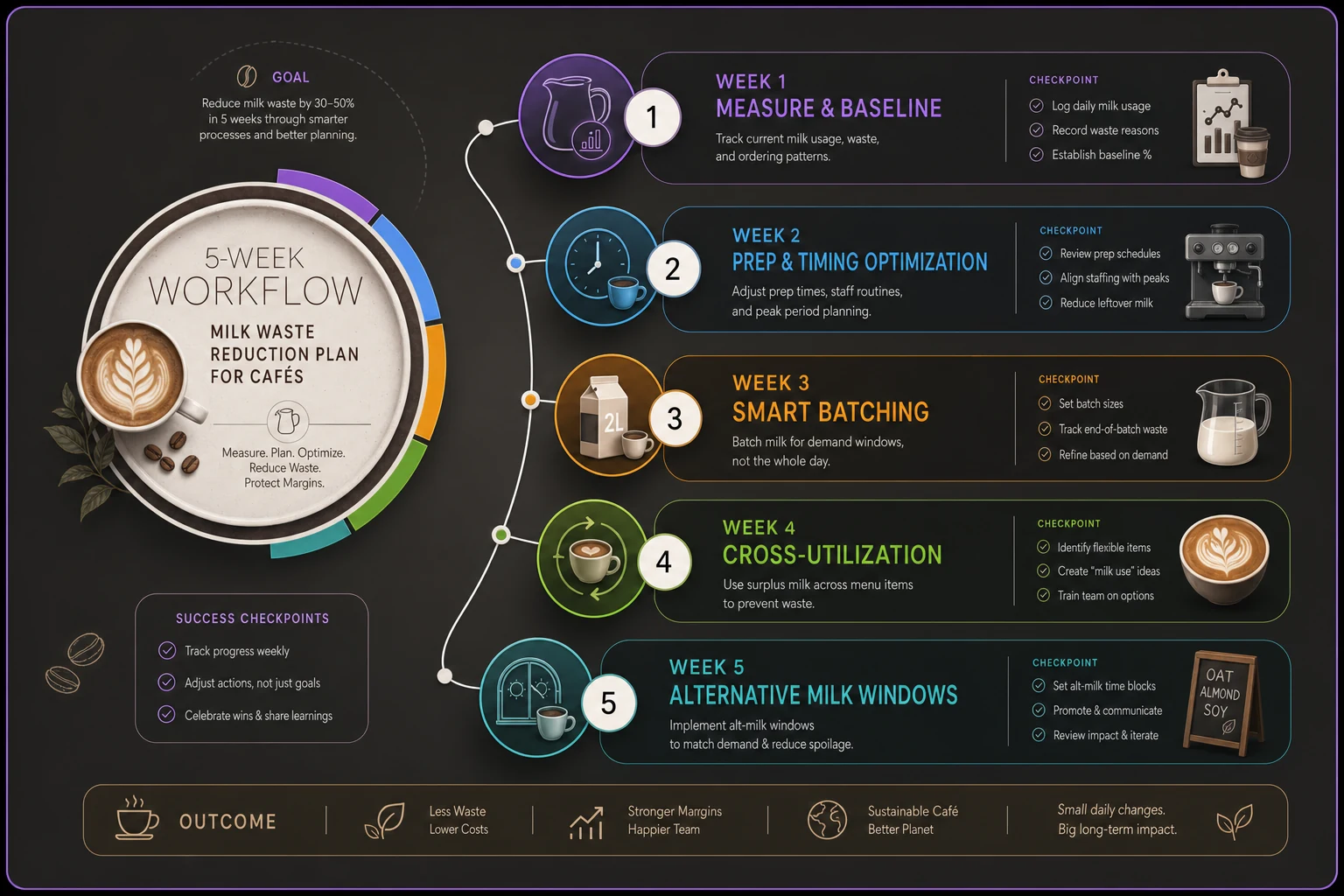
This sequence works because each week builds on the previous improvements. Your team isn't overwhelmed trying to remember eight new procedures while serving 60 drinks an hour.
When waste reduction actually costs you money
Sometimes accepting milk waste is actually more profitable than preventing it.
If reducing waste means your service drops from 50 drinks per hour to 45 drinks per hour, you're losing money. Each lost drink during peak represents $5-7 in revenue. That's way more than the $0.50 of milk you saved.
Calculate your waste tolerance threshold:
-
Average drink price
$5.50
-
Average profit margin
60% = $3.30 per drink
-
Cost of 3oz wasted milk
$0.35
-
Break-even point
Can't lose more than 1 drink per 10 served
If your waste reduction efforts slow service by more than 10%, you're actually losing money.
This is where AI-powered operational software becomes genuinely useful—not as a magic solution, but as a way to track these trade-offs in real-time. Systems that monitor both waste metrics and service speed can alert you when waste reduction efforts are actually hurting profitability. They can also identify patterns humans miss, like specific baristas who consistently nail the balance between speed and waste reduction.
What improvement actually looks like
A coffee shop in Austin implemented these exact methods over six weeks. Their morning milk waste dropped from 52oz to 31oz daily. Not zero—that's unrealistic during peak hours—but a 40% reduction.
At $4.50 per half gallon, they saved about $2.60 daily, or $78 monthly. Not life-changing money. But there was more.
Their milk ordering became more predictable. They stopped running out of oat milk on Thursdays. Their morning shift stress dropped because baristas weren't constantly searching for clean pitchers. Customer complaints about lukewarm drinks basically disappeared.
The owner told me the biggest change wasn't the money saved on milk. It was that their operation felt tighter. Less chaos. More control.
Making it stick when your team is already overwhelmed
The hardest part isn't knowing what to do—it's getting an already-stressed team to actually do it during the breakfast rush when everything's on fire.
Start with just your shift leads. Get them comfortable with the new approach during slower afternoon hours. Once they've internalized the rhythm, they'll naturally model it during morning rush.
Post a simple three-line reminder card at each espresso station:
-
Batch by actual orders, not pitcher size
-
3-minute rule for whole/oat, 2-minute for others
-
Suggest swaps when waste is imminent
Don't make it more complex than that during service. Save the detailed training for slower periods.
Some cafes find that operational platforms with built-in training modules and automatic reminders help reinforce these practices without constant manager oversight. The key is choosing tools that integrate into existing workflows rather than adding another layer of complexity.
The bottom line on peak-hour milk waste
Milk waste during peak hours isn't really about milk. It's about the collision between speed requirements and quality standards, complicated by the short lifespan of steamed milk.
You can't eliminate it entirely. But with proper prep-timing rules, smart batching thresholds, and strategic cross-utilization, you can cut waste by 35-45% without slowing service.
The cafes that succeed at this don't try to be perfect. They just aim to waste less today than yesterday, and they track it simply enough that the data actually gets collected.
Start with the pitcher count method tomorrow morning. Put a napkin and pen next to your main espresso machine. Make a mark every time milk gets dumped. Do this for one week. Then implement one change from this guide.
That's how you reduce milk waste in your cafe. Not through some complex system overhaul, but through small operational adjustments that match your actual service patterns. The money you save might not transform your business. But the operational discipline you build will.
Start with the pitcher count method tomorrow morning. Put a napkin and pen next to your main espresso machine. Make a mark every time milk gets dumped. Do this for one week. Then implement one change from this guide.
That's how you reduce milk waste in your cafe. Not through some complex system overhaul, but through small operational adjustments that match your actual service patterns. The money you save might not transform your business. But the operational discipline you build will.
Ready to brew operational excellence?
Join hundreds of coffee shops using Coffehq to boost efficiency, reduce waste, and elevate customer satisfaction.