

Last Thursday morning, I watched a barista literally sprint between the espresso machine and the mobile pickup shelf while three confused customers stood at the wrong counter. One guy had been waiting 12 minutes for a simple cold brew that was actually sitting on the pickup shelf the whole time—just hidden behind a stack of other orders.
This wasn't some understaffed hole-in-the-wall cafe either. They had five people working, decent equipment, and a solid location. Their problem? No clear system for handling mobile orders alongside walk-in customers.
The mobile order queue cafe setup has turned into an operational nightmare for most independent coffee shops. Orders come from multiple channels, staff don't know who should handle what, and customers grab the wrong drinks. Meanwhile labor costs climb because everyone's running around inefficiently.
The hidden complexity of mixed-channel operations
Running a cafe with both mobile and in-store orders isn't just about having two separate workflows—it's about managing the collision points between them. Most owners think adding mobile ordering means installing an app and designating a pickup shelf. Then reality hits during the morning rush.
Your espresso station becomes a bottleneck because the barista can't tell which drinks are urgent walk-in orders versus mobile orders placed 20 minutes ago. The register person keeps getting interrupted by mobile customers asking about their order status. Despite having more orders than ever, actual throughput drops because of confusion.
The operational complexity multiplies when you realize each order type has different timing expectations. Walk-in customers expect drinks in 3-4 minutes. Mobile customers might order 15 minutes ahead but show up in 5. Some mobile orders sit unclaimed for an hour. Each scenario requires different handling, but most cafes treat them all the same.
Traditional cafe workflows were built around linear service—customer orders, pays, waits, receives. Mobile ordering breaks this pattern completely. Now you've got parallel workflows that need to merge at specific points without creating chaos.
Why standard queue systems fail with mixed channels
The typical first-come-first-served approach falls apart when mobile orders enter the mix. A mobile order placed at 7:45 AM for 8:15 AM pickup shouldn't jump ahead of the walk-in customer who's been waiting since 8:10 AM. But it also shouldn't sit behind ten walk-in orders and end up late.
Keep every order and shift perfectly aligned.
Coffehq helps you manage orders, inventory, and staff schedules seamlessly.
- Unified order processing
- Real-time inventory updates
- Staff shift coordination
No credit card required
Most cafes try to solve this with a simple "mobile orders here" shelf, but that creates new problems. Staff don't know when to prioritize mobile drinks. Customers can't find their orders among the crowd. Wrong drinks get taken constantly.
Mobile and in-store orders have fundamentally different service patterns:
Walk-in orders:
-
Immediate preparation expected
-
Customer present for clarification
-
Payment already complete
-
Single touchpoint interaction
Mobile orders:
-
Scheduled preparation time
-
Customer absent during prep
-
Potential modifications after ordering
-
Multiple interaction points
When you force both through the same workflow, you get operational gridlock. The barista making drinks doesn't know if that mobile order is for immediate pickup or scheduled for later. The expediter doesn't know if they should call out mobile orders or just place them silently. Nobody knows who's responsible for remaking drinks when mobile customers claim they're wrong.
Building queue rules that actually work
The solution isn't complicated—it's about creating clear prioritization rules that everyone understands. Here's a framework that works during peak hours:
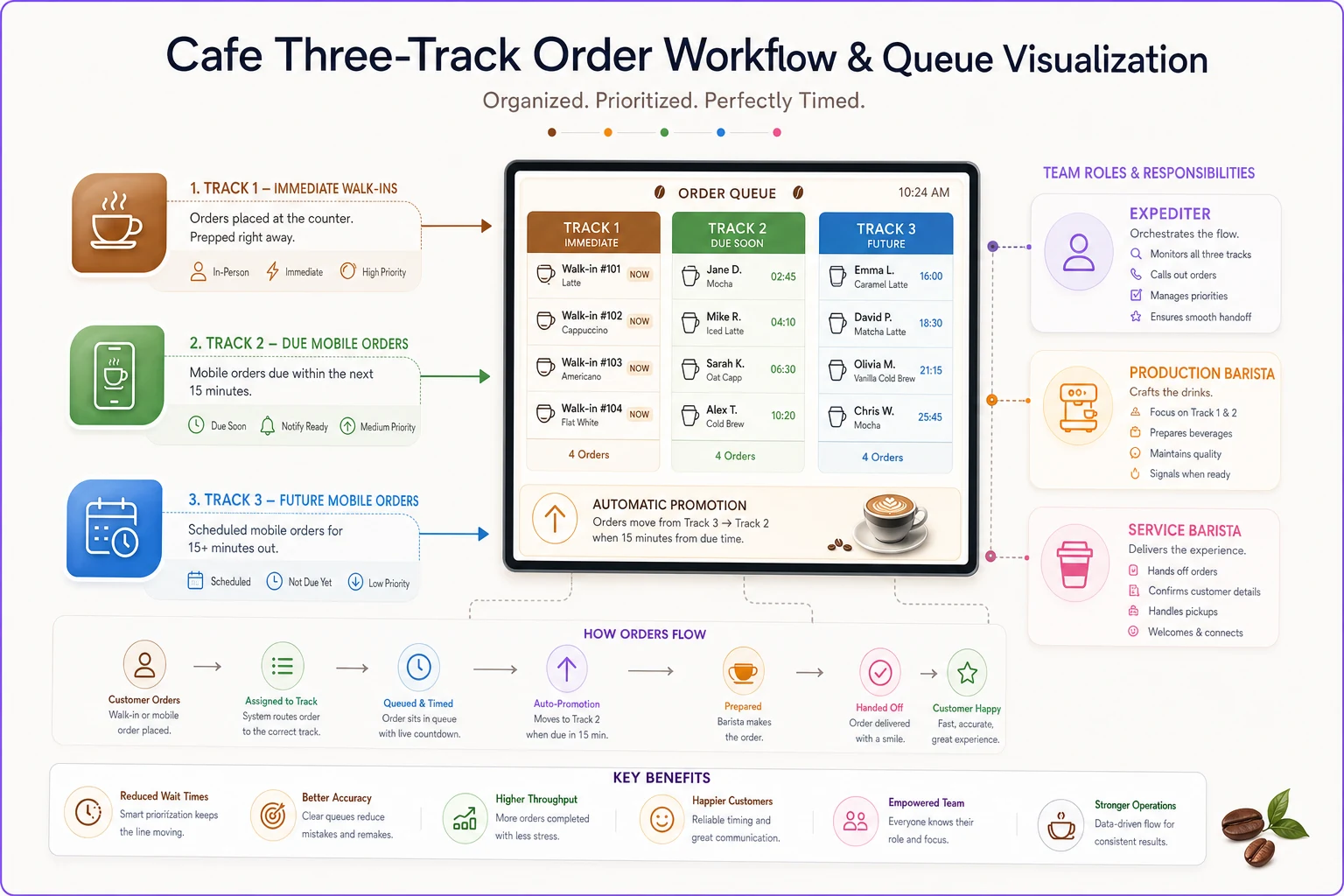
The Three-Track System
-
Track 1
Immediate walk-ins (0-5 minute window)
-
Track 2
Due mobile orders (within pickup window)
-
Track 3
Future mobile orders (5+ minutes out)
Drinks get made in this priority order, with one key rule: never let Track 1 exceed three drinks waiting. This keeps walk-in customers happy while ensuring mobile orders hit their pickup times.
For actual implementation, you need specific trigger points. When mobile orders enter the "due window"—usually 5 minutes before pickup time—they automatically shift from Track 3 to Track 2. If a mobile customer arrives early, their order immediately jumps to Track 2 regardless of scheduled time.
The barista workstation needs a clear view of all three tracks. This doesn't require fancy screens—even a simple three-section rail system with order tickets works. Left rail for immediate, center for due mobiles, right for futures.
During extreme rush periods (typically 7:30-9:00 AM), you might need to modify the rules. Some cafes switch to alternating ratios—two walk-ins, one mobile, repeat. This prevents either channel from completely stalling.
Staff roles that eliminate confusion
Generic positions like "barista" and "cashier" don't work when you're juggling multiple order channels. You need specific roles with clear responsibilities:
Order Expediter (morning rush only)
-
Monitors mobile order queue
-
Moves tickets between tracks based on time
-
Calls mobile customer names
-
Handles wrong order claims
-
Prevents drink theft
Production Barista
-
Focuses solely on drink creation
-
Follows the three-track priority system
-
Doesn't interact with customers
-
Marks drinks complete in system
Service Barista
-
Handles register and walk-in orders
-
Answers mobile order questions
-
Floats to production during lulls
-
Manages order modifications
During slow periods, combine expediter and service barista duties but keep responsibilities distinct.
Each person owns specific parts of the workflow. The expediter never makes drinks. The production barista never handles payments. This clarity eliminates the constant "who's supposed to handle this?" confusion.
For smaller cafes with limited staff, you can combine roles but keep the responsibilities distinct. During slow periods, one person might handle both expediter and service barista duties. But even then, they should mentally switch between roles rather than trying to do everything simultaneously.
Physical layout modifications that reduce errors
Your current layout probably wasn't designed for mixed-channel service. Small changes to physical setup can dramatically reduce mistakes and delays.
The Separation Principle
Mobile pickup needs complete separation from the main counter. Not just a different shelf—a different zone entirely. Customers picking up mobile orders shouldn't cross paths with customers placing walk-in orders.
Creating this separation can be as simple as a tall plant or a rope barrier. The goal is preventing mobile customers from crowding the register area while looking for their drinks.
Clear Sightlines
-
The current order queue (both channels)
-
The pickup area
-
The expediter position
Most layouts fail because the barista faces away from where drinks get picked up. They can't see when orders are taken incorrectly or when the pickup area gets overcrowded.
Smart Shelving Systems
Standard pickup shelves create chaos because drinks get hidden behind each other. Better approach: use angled stadium-style shelving where each row sits slightly higher than the one in front. Every drink stays visible.
-
Left to right
alphabetical by name
-
Front to back
order time (oldest in front)
This lets customers find their drinks quickly and lets staff spot old orders that need attention.
Signage that actually guides behavior
Most cafe signage tries to explain everything. Customers don't read paragraphs of instructions while holding up the line. Effective signage uses positioning and visual hierarchy to guide behavior automatically.
The Three-Zone Approach
-
Zone 1
Order Here (walk-ins only)
-
Zone 2
Wait Here (walk-ins after ordering)
-
Zone 3
Mobile Pickup
Each zone needs distinct visual identity. Different floor colors work better than signs. A simple vinyl floor strip creating a yellow "mobile lane" to the pickup area prevents 90% of confusion about where to go.
Name Display Systems
Those "ORDER READY: JOHN" displays seem helpful but create problems. Multiple Johns. Misspelled names. Customers who don't notice their name appeared.
Better approach: display the last four digits of order numbers alongside first names. "JOHN - 7823" eliminates confusion without requiring customers to remember complex order numbers.
Status Indicators
-
Red
In queue
-
Yellow
Being prepared
-
Green
Ready for pickup
The production barista switches the collar when starting each drink. Customers can see their drink progressing through the system.
Managing the 8 AM collision point
Every cafe has that moment when everything converges. Usually around 8 AM. Mobile orders scheduled for pickup, walk-ins rushing to work, previous mobile orders running late. This is when your system either works or completely breaks down.
The solution isn't trying to go faster—it's controlling the flow.
Batch Processing Windows
Instead of making drinks purely by order time, create 5-minute batch windows. All mobile orders for 8:00-8:05 get made together. Then walk-ins. Then the next mobile batch.
This feels counterintuitive but actually speeds things up. The barista isn't constantly switching between different drink types and can get into a rhythm.
The Early Bird Problem
Mobile customers who arrive 10 minutes early expecting their drink immediately will destroy your queue system. You need clear communication: "Mobile orders prepared at scheduled time. Arriving early? Order at the counter for immediate service."
Some cafes offer a "Fast Track" option—mobile customers can pay an extra $0.50 to have their drink made immediately upon arrival regardless of scheduled time. This generates extra revenue while giving impatient customers an option besides complaining.
When drinks go wrong: the remake protocol
Remakes kill productivity, especially during rush periods. Mobile orders have higher remake rates because customers can't verify their drink was made correctly before leaving.
Standard remake policy: drop everything and remake immediately. This disrupts workflow and frustrates other waiting customers. Better approach: The Remake Window.
Designate specific remake windows every 15 minutes. Customer claims wrong drink at 8:07? Their remake goes into the 8:15 window. This might seem harsh, but it maintains workflow integrity and discourages false remake claims.
For genuine mistakes (completely wrong drink, dairy allergy issue), you obviously remake immediately. But for preference issues ("not sweet enough," "too much foam"), the window system works.
Track your remake patterns. If certain mobile customers consistently claim wrong drinks, you might have a scammer. If certain baristas have higher remake rates on mobile orders, they might need training on reading mobile tickets correctly.
Metrics that reveal broken workflows
You can't fix what you don't measure, but most cafes track the wrong things. They obsess over total orders or average ticket size while ignoring operational metrics that actually matter.
| Metric | Target | Red Flag |
|---|---|---|
| Mobile Order Abandonment Rate | Under 5% | Over 8% |
| Channel Collision Score | Under 10/hour | Over 15/hour |
| Queue Time Variance | Under 3 minutes | Over 5 minutes |
| Remake Rate (Mobile) | Under 3% | Over 7% |
Mobile Order Abandonment Rate
How many mobile orders never get picked up? If it's over 5%, you've got a problem. Either your preparation timing is off, your pickup system is confusing, or your location isn't actually convenient for mobile ordering.
Track by time slot. High abandonment during lunch might mean office workers can't leave their desks. High abandonment weekend mornings might mean people ordering from bed then falling back asleep.
Channel Collision Score
Count how many times per hour mobile customers interrupt the walk-in flow. Every time someone asks "Is my mobile order ready?" at the register, that's a collision. More than 10 per hour means your separation isn't working.
Queue Time Variance
Track the difference between fastest and slowest service times within each hour. If some walk-ins get drinks in 2 minutes while others wait 8 minutes during the same period, your prioritization rules aren't being followed.
This variance matters more than average service time. Customers can handle consistent 5-minute waits. They get angry about unpredictable waits where they watch others who ordered after them get served first.
Technology and workflow integration
The dream of seamless automation where orders flow perfectly from app to cup rarely matches reality. But strategic use of operational software can eliminate specific friction points without requiring massive investment.
The biggest win comes from automatic queue visualization. Instead of baristas mentally juggling multiple order types, a simple screen showing the three-track system with countdown timers removes all guesswork. Mobile orders automatically promote from future to due status. Walk-in orders display expected completion times.
Here's a simple workflow visualization of how the three-track system and queue visualization interact during a morning rush.
Order modification handling is where AI-powered operational software really helps. When mobile customers message about changes, the system can automatically determine if the drink is already made, still in queue, or hasn't started. It routes the modification to the right person and updates the queue accordingly.
Some cafes have started using intelligent batching algorithms that group similar drinks together while respecting time windows. The system might recognize that three mobile lattes scheduled for different times could be made together if shifted by 2-3 minutes, improving efficiency without impacting service.
Choose software that enhances your existing workflow rather than forcing you to completely rebuild operations. Start by fixing one specific problem—maybe it's queue visibility or modification handling—then expand from there.
Preventing the downward spiral
Once your mobile order queue cafe system starts failing, it tends to spiral quickly. Delays create more delays. Confusion breeds more confusion. Staff get frustrated and make more mistakes.
Have clear escalation triggers. When mobile orders back up beyond 10 drinks, automatically shift to batch mode. When walk-in wait times exceed 5 minutes, the expediter jumps to production support. These aren't panic reactions—they're planned responses to predictable situations.
Recovery protocols matter too. After a rush period breakdown, don't just push through to the next shift. Take 5 minutes to reset. Clear old mobile orders. Reorganize the pickup area. Let staff catch their breath. This prevents problems from carrying forward into the next rush.
Build in safety valves for extreme situations. Maybe that means temporarily closing mobile orders during unexpected rushes. Or offering free drinks to customers who've waited over 15 minutes. Better to lose some revenue than have angry customers trash your reputation online.
The real cost of queue chaos
Poor queue management doesn't just frustrate customers—it directly impacts your bottom line. Every remake costs you $2-4 in product. Every confused customer at the wrong counter wastes 30 seconds of staff time. Every abandoned mobile order is lost revenue plus wasted product.
The hidden costs are worse. Stressed staff make more mistakes and quit sooner. Your turnover rate climbs. Training costs increase. Service quality becomes inconsistent.
Customers stop trusting your mobile system and revert to calling orders in or just going elsewhere. Your investment in mobile ordering technology gets wasted because the operational execution fails.
Once you implement clear queue rules and staff roles, these problems largely disappear. Orders flow predictably. Staff know exactly what to do. Customers get their drinks on time. The same rush that created chaos before becomes manageable, even smooth.
The difference between a cafe drowning in mobile orders and one that handles them profitably isn't about working harder or having more staff. It's about having clear systems that everyone—staff and customers—can follow without thinking. Your mobile order queue cafe system should make life easier for everyone involved. When it's adding complexity and confusion instead, that's not a technology problem. It's an operations problem.
Operations problems can be fixed with clear rules, defined roles, and smart layout choices. The cafes that thrive with mixed-channel service aren't the ones with the fanciest apps or the most baristas. They're the ones that recognized the operational complexity early and built systems to handle it. They turned potential chaos into predictable workflows. Their reward is higher throughput, happier customers, and significantly better margins than competitors still figuring it out through trial and error.
Ready to brew operational excellence?
Join hundreds of coffee shops using Coffehq to boost efficiency, reduce waste, and elevate customer satisfaction.