



Last Tuesday, I watched a cafe owner nearly lose it when their morning shift ran like clockwork—7-minute ticket times, perfectly dialed espresso, zero customer complaints—only to walk in at 3 PM to find the afternoon crew pulling 18-minute tickets with a line out the door. Same cafe. Same equipment. Same menu. Completely different operation.
This happens everywhere. Not because afternoon crews are worse or morning managers are magical. It happens because most cafes run on memory and mood instead of systems. Your opener remembers to check the grinder settings. Your mid-shift lead forgets the milk fridge temp check. Your closer has their own creative interpretation of "clean."
The gap between your best shift and worst shift probably costs you several hundred in lost sales weekly, plus whatever customers don't come back. But watching good managers burn out trying to be everywhere at once, mentally tracking dozens of different things that should be written down? That's the real killer.
Why shift consistency breaks down (it's not about finding better people)
Most cafe owners think inconsistent shifts mean they need better training or stronger managers. Wrong problem.
Watch what actually happens during shift transitions. Your morning manager has been there since 5:30 AM, knows exactly where everything is, has the muscle memory for every task. Then at noon, they hand over to someone who walked into a running operation, missed the context of three equipment adjustments, and doesn't know the morning crew already tried moving that problematic grinder and it made things worse.
Morning shift makes mental notes about equipment quirks, adjusts workflows based on what broke yesterday, knows which register button sticks. None of this gets documented. Afternoon shift walks in blind, makes different adjustments, creates new workarounds. Evening shift inherits chaos from both previous shifts, makes more changes. By Tuesday, you're running three different cafes in the same location.
Then your best morning manager gets offered a job elsewhere. Takes weeks of undocumented knowledge with them. New manager starts from scratch, creates their own systems. Three months later, your operation barely resembles what worked before.
The solution isn't better people or more training. It's modular playbooks that work regardless of who's running the shift.
Building modular shift systems that actually get used
A working cafe shift playbook isn't a binder nobody opens. It's a living system built in modules that adapt to different situations while maintaining core standards.
Keep every order and shift perfectly aligned.
Coffehq helps you manage orders, inventory, and staff schedules seamlessly.
- Unified order processing
- Real-time inventory updates
- Staff shift coordination
No credit card required
Start with three core modules: opening, peak, and closing. Not because these are the only important times, but because they're the pressure points where consistency failures hurt most. Each module needs three components that actually matter:
Must-happen tasks - The non-negotiables that break the shift if missed. Not "check bathrooms" but "verify espresso grind at 14.5 seconds extraction before first customer." Specific, measurable, tied directly to service quality.
Decision rules - What to do when things go sideways. Not policies, but actual if/then scenarios. "If ticket times exceed 9 minutes for three consecutive orders, pull register person to bar until caught up." Real situations, clear actions.
Handoff requirements - What the next shift needs to know. Not novels, but critical info. Equipment adjustments made, inventory issues discovered, customer complaints received. The stuff that matters four hours from now.
Start with the module that's easiest to control (usually closing) so you build trust in the system before tackling peak complexity.
Here's a quick visual of the modular shift workflow to map responsibilities and handoffs.
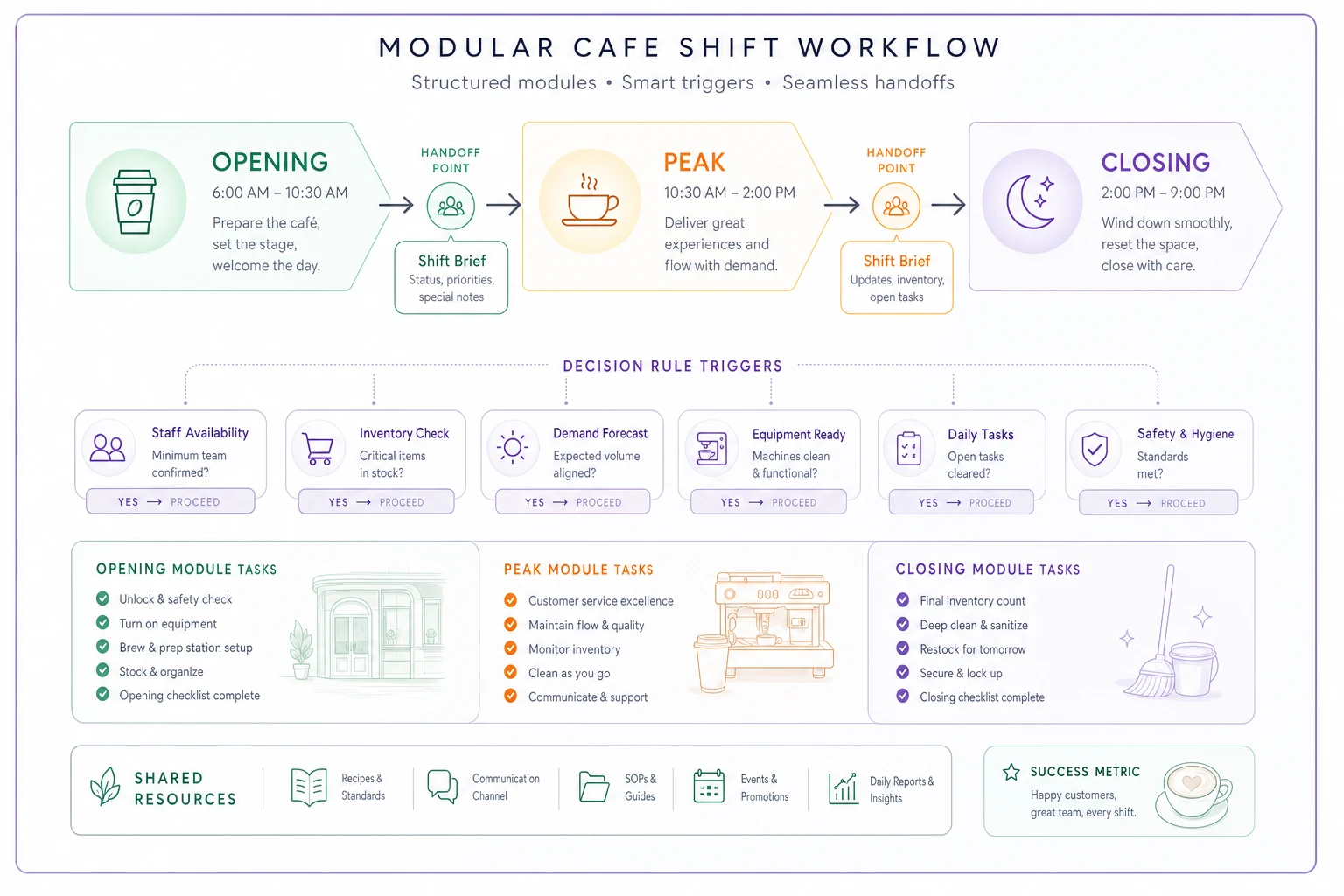
Most playbooks fail by trying to document everything. Your crew won't follow a 47-step opening checklist. They will follow a 12-point critical path with clear outcomes.
The opening module: setting the trajectory for the entire day
Your opening module determines whether you're playing catch-up all day or running ahead. Most cafes focus on unlocking doors and making coffee. Wrong focus.
The opening module should answer three questions before any customer walks in:
Equipment status - Not just "is it working" but "is it calibrated." Your espresso machine might be on, but if the pressure's running low instead of standard, every shot pulls wrong all day. Your grinder might be running, but if someone adjusted it yesterday afternoon and didn't reset it, your first twenty drinks taste burnt.
Inventory positioning - Not just "do we have milk" but "is everything positioned for speed." Yesterday's closer might have reorganized the pastry case. Looks pretty. Kills your flow when you're reaching across yourself fifty times during morning rush.
Team deployment - Not just "who's here" but "who's doing what based on actual skill." Sarah might be scheduled for register, but if she's your fastest bar person and Tom's better with customers despite being scheduled for bar, make the switch before you open, not after the rush starts.
-
6
00 AM - Equipment dial-in (about 20 minutes)
- Pull three test shots, adjust grind to hit extraction time - Steam temperature check on all wands (thermometer reading should be consistent) - Run cleaning cycle on batch brew, test brew one pot - Document any adjustments on shift board -
6
20 AM - Inventory and positioning (15 minutes)
- Count pastry case, compare to POS inventory - Position high-movement items (croissants, muffins) at hip level - Stock bar with enough milk for morning rush - Flag any items below par level on shift board -
6
35 AM - Final prep and assignments (10 minutes)
- Review yesterday's close notes - Assign positions based on morning schedule and skills - Set timer systems: batch brew (every hour and a half), pastry rotation (every few hours) - Quick team huddle: review specials, any equipment issues, expected rush time -
6
45 AM - Pre-open test (10 minutes)
- Each person makes one drink at their station - Test all POS stations for card reader function - Verify music at correct volume (should hear conversation at normal distance) - Unlock doors close to opening time
Notice what's not here? Lengthy explanations. Philosophy about coffee. Forty-seven sub-steps. Just clear actions with measurable outcomes.
Peak module: controlling chaos when it hits
Peak isn't about speed. It's about flow maintenance when speed matters most.
Most cafes treat rush periods like emergencies. They're not. They're predictable pressure periods that need predetermined responses. Your peak module isn't about working faster—it's about working smoother when fast matters.
-
Pressure triggers and responses When ticket times hit 8-9 minutes: - Shift lead stops all non-customer tasks - Designated "float" person moves to bottleneck position - Register person suggests batch brew to anyone ordering regular coffee When line reaches door: - Deploy "line ambassador" with tablet for pre-ordering - Shift simple drinks (iced coffee, cold brew) to register-side prep - Pause all food prep except pre-made items When remake rate gets high: - Bar person calls drinks back to register for confirmation - Double-check every modifier before sending - Shift lead quality-checks next several drinks before handoff
These aren't suggestions. They're automatic responses that kick in regardless of who's managing. The trigger hits? Float moves. No discussion, no manager decision needed.
-
Call patterns that prevent mistakes - Size first, always: "Large iced vanilla latte" - Modifications called twice: at order and at handoff - Any drink over 4 modifications gets written on cup - Names called with drink: "Medium cappuccino for Alex"
During one afternoon rush at a busy downtown spot, communication failures led to twenty-something remakes in two hours. Most were modification errors that proper call patterns would have prevented. That's real waste plus frustrated customers.
The closing module: setting up tomorrow's success tonight
Your close determines whether tomorrow's open is smooth or scrambled. Most cafes treat closing like cleanup. It's actually reset and preparation.
Bad closes cascade. Tonight's missed grinder cleaning means tomorrow's first shots taste metallic. Tonight's forgotten milk order means tomorrow's 10 AM rush runs out of oat milk. Tonight's skipped equipment check means tomorrow's steamer breaks during peak.
The closing module should prepare three things:
Equipment for immediate morning use - Not just clean but ready. Grinders at standard settings, not wherever the afternoon shift left them. Espresso machine backflushed AND pressure checked. Batch brewers descaled regularly, not "whenever someone remembers."
Inventory for next day's demand - Check tomorrow's delivery schedule. Thursday close means Friday morning delivery? Don't overstock. Sunday close with no Monday delivery? Double-check milk levels for Monday rush. Position Tuesday's pastry delivery items for easy receiving.
Information for morning manager - Not essays. Critical handoffs. "Grinder 2 running hot, kept adjusting coarser all afternoon." "Register 1 card reader failed twice, seemed to work after restart." "Customer complained about bathroom at 3 PM, maintenance contacted."
-
8
00 PM - Pre-close reset (during service)
- Start breaking down unused equipment - Consolidate pastry case to single display - Count and record waste - Switch to close music playlist (subtle customer signal) -
8
30 PM - Customer wind-down
- Lock one entrance if you have two - Start putting up chairs in back section - Turn off menu boards for non-available items - Last call announcement at 8:45 PM -
9
00 PM - Full close sequence
- Customers out, doors locked - Equipment breakdown in order: espresso machine, grinders, brewers - Count register, record in POS - Final inventory count of high-value items - Set all equipment to standard positions - Leave three notes for opener: must-know, should-know, nice-to-know
The difference between good and great closing? Great closing makes decisions for tomorrow. Moving that wobbly table to the back before it breaks during morning rush. Pulling expired retail bags before a customer finds them. Charging all tablets tonight instead of scrambling tomorrow.
KPIs that actually predict shift quality
Most cafes track sales and labor. Those tell you what happened, not what's happening.
| KPI |
|---|
| Opening KPIs: - First drink time: minutes from unlock to first customer served (target: under 3) - Dial-in shots: number of test shots before acceptable (target: under 4) - Ready-state completions: percentage of opening checklist done before first customer (target: everything) |
| Peak KPIs: - Ticket time consistency: how much variation, not just average (target: staying under 2 minutes difference) - Remake rate: remakes per 50 drinks (target: under 2) - Flow breaks: times line exceeded door (target: none lasting over 10 minutes) |
| Closing KPIs: - Reset percentage: equipment returned to standard positions (target: everything) - Handoff completeness: critical info documented for morning (target: at least 3 items) - Time-to-close: minutes from lock to team exit (target: under 45) |
These aren't vanity metrics. Each one predicts next-shift quality. High dial-in shots at opening means your grinder needs service—catch it before it fails during rush. Consistent flow breaks mean your deployment model needs adjustment—fix it before you lose customers. Long time-to-close indicates process problems—solve them before staff burnout.
Decision rules that eliminate manager paralysis
The hardest part of shift management isn't knowing what to do—it's deciding when to do it. Your shift lead shouldn't be weighing options during service. They should be executing predetermined responses.
Build decision rules for common scenarios:
-
The "call-in sick" decision tree - One person out: existing crew covers, no replacement called - Two people out: call in closest available backup - Three people out or bar lead out: manager comes in, even on day off - More than three: reduced menu, notify customers at door
-
The "equipment failure" response matrix - Espresso machine down: switch to pour-over bar, offer discounts - One grinder down: consolidate to house blend only - POS system down: switch to paper tickets and cash only - Blender broken: 86 all blended drinks, offer alternatives
-
The "running out" protocol - Milk shortage: send someone to grocery store if before 3 PM - Coffee shortage: borrow from neighbor cafe (pre-arranged agreement) - Pastry shortage: discount day-olds from freezer - Cup shortage: offer for-here mugs with incentive
Each rule removes decision time during crisis. Your shift lead doesn't wonder whether to call someone in—they check the tree and execute. No paralysis, no delay, no inconsistency between managers.
Real playbook templates you can steal and modify
Stop starting from scratch. Here's a working template structure:
-
Basic Shift Playbook Template Pre-Shift (15 minutes before): - [ ] Review previous shift notes - [ ] Check staff positioning against skill matrix - [ ] Verify all equipment operational - [ ] Count starting cash drawer - [ ] Brief team on specials/86'd items
-
Shift Start
- [ ] Document time first customer served - [ ] Set hourly check timers - [ ] Position float person - [ ] Begin tracking KPI board
-
Hourly Checks
- [ ] Ticket time sample (3 orders) - [ ] Bathroom status - [ ] Inventory levels (milk, cups, lids) - [ ] Equipment performance - [ ] Team energy/break needs
-
Shift Transitions
Must communicate: - Equipment adjustments made - Inventory concerns - Customer issues - Staff performance notes - Predicted rush times
-
End of Shift
- [ ] Complete KPI tracking - [ ] Document any equipment issues - [ ] Note inventory needs - [ ] Reset all positions to standard - [ ] Create three handoff notes
Customization points:
-
- Adjust check frequencies for your volume
-
- Add specific equipment to your checklist
-
- Include your unique menu items
-
- Set your own KPI targets
-
- Add local factors (parking issues, event schedules)
The template is a starting point. A downtown cafe needs different hourly checks than a suburban shop. Summer requires different inventory positioning than winter. Modify based on your reality, but keep the structure.
Making the playbook stick when everyone's "too busy"
The best playbook means nothing if nobody uses it. Implementation fails when you dump a manual on your team and expect adoption.
Start with one module, probably closing since it's less chaotic. Run it for a week. Get feedback. Adjust. Once closing works smoothly, add opening. Then peak.
Give each shift lead ownership of their module. Let the morning manager modify the opening checklist (within reason). Let the night lead adjust close procedures. When people own the process, they follow the process.
Make the playbook visible. Not a binder in the office—a laminated sheet at each station. Opening checklist by the espresso machine. Peak triggers by the register. Close sequence by the back door. Information where it's needed, when it's needed.
Track adoption through spot checks, not surveillance. Drop by randomly and see if the 7 AM tasks actually happened at 7 AM. Check if yesterday's close notes exist. Verify if peak triggers activated when needed. Recognition for consistency beats punishment for misses.
The playbook becomes habit through repetition and results. When your morning manager sees their opens run smoother, they'll protect the system. When your afternoon crew stops inheriting chaos, they'll maintain standards. When closes take less time instead of more, the playbook sells itself.
When operational software should handle the coordination
At some point, paper checklists and mental tracking hit their limit. Usually around 150-200 transactions daily, or when you have more than three shift leads trying to maintain consistency.
The breaking point signs: handoff notes getting lost, different managers interpreting rules differently, KPI tracking becoming sporadic, equipment maintenance falling through cracks, inventory surprises during rush.
This is where AI-powered operational software makes sense. Not to replace judgment, but to standardize execution. The software tracks who completed what task when. It reminds about time-based triggers. It documents equipment adjustments automatically. It surfaces patterns humans miss—like how Tuesday afternoons always need extra bar coverage, or how that one grinder needs adjustment after certain volumes.
The afternoon shift lead doesn't need to remember to check milk temp—the system prompts them. The morning manager doesn't manually track dial-in shots—the system logs them. The closer doesn't write lengthy handoff notes—they check boxes and the system creates the summary.
Modern operational platforms can even predict pressure points. They learn your patterns and alert before problems hit. "Based on last few Fridays, you'll need extra oat milk by 11 AM." "Grinder 2 typically needs cleaning after tomorrow's volume." "Schedule indicates understaffing for predicted Saturday rush."
But software isn't magic. It amplifies good systems. If your playbook is scattered and your team isn't following basic protocols, adding software just digitizes the chaos. Build the foundation first, then let technology handle the coordination and tracking you can't manage manually.
Ready to brew operational excellence?
Join hundreds of coffee shops using Coffehq to boost efficiency, reduce waste, and elevate customer satisfaction.