


Last Tuesday, a coffee shop owner told me their pastry supplier missed a delivery. No warning. Just an empty bakery case at 7am and a line of regulars expecting their usual croissants. The supplier's excuse? "We thought you ordered monthly, not weekly."
This wasn't some new vendor either. They'd been ordering from them for eighteen months. Supplier issues tank café operations constantly. It's not about finding "better" suppliers—it's about building supplier cadence that matches how your café actually operates. Most owners try to force all suppliers into the same ordering schedule, then wonder why deliveries arrive at weird times and critical items run out mid-week.
Why supplier cadence breaks down in cafés
Cafés operate differently than restaurants. Your milk turnover happens in days, not weeks. Coffee beans move predictably but in large volumes. Pastries have a 48-hour window. Yet most ordering systems treat everything the same—weekly orders placed Monday, delivered Wednesday.
The mismatch creates constant friction. You're either over-ordering perishables to avoid stockouts, or running emergency orders that blow up your COGS.
Suppliers don't understand café operations. They're used to restaurants that order proteins weekly and produce twice weekly. When you explain needing milk every other day but coffee beans monthly, they default back to their standard restaurant cadence within weeks.
Nobody tracks what cadence actually works for each category. Owners react to stockouts and hope next week goes better.
Building category-specific ordering rhythms
Separate templates for different product categories, each with their own rhythm. This stabilizes supplier cadence better than any single ordering schedule.
Keep every order and shift perfectly aligned.
Coffehq helps you manage orders, inventory, and staff schedules seamlessly.
- Unified order processing
- Real-time inventory updates
- Staff shift coordination
No credit card required
Start with milk and dairy. These need the tightest cadence—usually every 2-3 days depending on volume. A 40-drink-per-day café might order milk Monday/Thursday. An 80-drink shop probably needs Monday/Wednesday/Friday. The template stays simple: gallons of whole, 2%, oat, almond, heavy cream. Same quantities each time unless you're adjusting for holidays.
Coffee beans follow a completely different pattern. Most cafés order every 2-4 weeks. Cadence depends on your roaster's minimum order and storage capacity. If you're moving 40 pounds weekly but your roaster requires 100-pound minimums, you're on monthly cycles. Templates include espresso blend, batch brew options, retail bags.
Pastries create their own challenge. Fresh pastries need daily or every-other-day delivery. Frozen might be weekly. Some cafés split this—fresh items Tuesday/Thursday/Saturday, frozen backup Monday. Templates track standing orders (12 croissants, 8 muffins) plus variable seasonal items.
Paper goods and supplies work best monthly. Cups, lids, napkins don't spoil and eat storage space. Order enough for 4-5 weeks, giving yourself buffer for delays. Templates should include par levels for each item so you're not guessing quantities.
Match cadence to shelf life and turnover. Milk spoils in days, so you order multiple times weekly. Cups last forever, so monthly works. Beans fall between.
Creating your ordering templates
Templates eliminate the mental load of remembering what to order. Generic templates miss the nuances of your specific operation.
Daily/bi-daily orders (milk and fresh items) need:
-
Standard quantities based on average daily usage
-
Adjustment triggers (if yesterday's sales were 20% above average, increase today's order by X)
-
Delivery window requirements (must arrive before 6
30am)
-
Backup supplier information if primary fails
Weekly orders (produce, some pastries) need different structure:
-
Day-of-week consistency (always order Mondays for Wednesday delivery)
-
Seasonal adjustment notes (increase cold brew supplies May-September)
-
Quality check reminders (reject produce delivered more than 3 days from harvest)
Monthly orders (supplies, coffee) require:
-
Storage capacity limits (max 15 cases of cups)
-
Price break thresholds (order 12+ cases for 10% discount)
-
Lead time buffers (order 10 days before you'll run out, not 3)
Here's what a milk ordering template looks like for a café doing 250 drinks daily:
Monday/Thursday Standing Order:
-
Whole milk
8 gallons
-
2% milk
4 gallons
-
Oat milk
6 gallons
-
Almond milk
3 gallons
-
Heavy cream
2 quarts
-
Half & half
4 quarts
Adjustment rules:
-
If weekend sales exceeded 300 drinks/day, add 2 gallons whole, 1 gallon oat to Monday
-
If Thursday inventory shows more than 6 gallons total remaining, reduce next order by 25%
-
Holiday weeks
increase all quantities by 40%
Put delivery window requirements at the top of each template so suppliers see them first.
The template removes guesswork while allowing flexibility for demand changes.
Negotiation points that prevent surprises
Most café owners never negotiate with suppliers beyond price. Delivery reliability matters more than saving 3% on milk costs.
Start every supplier relationship by establishing lead time commitments. Not "usually 24 hours" but written confirmation that orders placed by 2pm deliver by 7am next day. Get specific about what happens when they can't meet that window—do they call, text, or just not show up?
Lock in delivery windows that work for your operation. A 5am-7am window for dairy means you're ready for morning rush. An 11am delivery disrupts lunch service. Most suppliers have flexibility here but won't offer it unless pushed.
Credit terms matter more than most owners realize. Net-30 might be standard, but if a supplier consistently delivers late or shorts orders, you need leverage. Negotiate Net-45 or Net-60 terms so you're not paying before confirming product actually supports operations. Some suppliers offer 2% discounts for quick payment—ignore these if delivery reliability is questionable.
Minimum order quantities kill café cash flow. That 5-case minimum on oat milk means storing $400 of inventory in your tiny back room. Push for lower minimums or mixed-case options. Many suppliers budge if you commit to consistent weekly orders rather than sporadic large orders.
Ask about allocation priority during shortages. When oat milk disappeared during the shortage two years ago, some cafés never missed a delivery while others went weeks without. Prior agreements about who gets product first when supply tightens make the difference. Get this in writing before you need it.
Tools for tracking what's actually working
Supplier performance isn't just about on-time delivery. You need to track whether the cadence you've built actually serves your operation.
Build a simple scorecard for each supplier:
-
Delivery accuracy (requested vs received quantities)
-
Time reliability (within promised window)
-
Quality consistency (returns/credits needed)
-
Communication (advance notice of issues)
-
Billing accuracy (matches what was delivered)
Track these weekly. Patterns emerge fast—that produce vendor who's "usually reliable" might miss 30% of morning windows. The coffee roaster might nail delivery timing but consistently short you on retail bags.
More important than tracking problems is tracking what cadence works. If you're ordering milk Monday/Wednesday/Friday but consistently run out Sunday nights, the cadence needs adjustment. If monthly coffee orders mean you're sitting on 8 weeks of inventory, switch to bi-weekly.
| Column | Description |
|---|---|
| Column A | supplier |
| Column B | current cadence |
| Column C | stockout incidents |
| Column D | overstock incidents |
| Column E | notes on adjustments |
After three months, patterns become obvious. That Tuesday/Friday pastry schedule leaves you short Mondays. The monthly cup order is too large for storage. The milk cadence is perfect except for holiday weeks.
Supplier communication that prevents disasters
Half of supplier problems stem from unclear communication. Your idea of "early morning delivery" might be 5am. Theirs might be 9am.
Create standard communication templates for common scenarios:
Standing order confirmation (sent monthly):
"Confirming our standing orders for [month]:"
-
Milk
Monday/Thursday, 6am delivery, quantities attached
-
Pastries
Tuesday/Thursday/Saturday, 5:30am delivery
-
Coffee
First Monday of month, any time
Please confirm receipt and any changes needed.
Order adjustment (sent as needed):
"Adjusting tomorrow's dairy order:"
-
Increase whole milk from 8 to 10 gallons
-
Reduce oat milk from 6 to 4 gallons
-
All other items remain standard
Please confirm receipt by 5pm today.
Service issue escalation:
"This morning's delivery arrived at 8:15am, outside our agreed 5am-7am window. This is the third late delivery this month. We need to discuss permanent solutions or we'll need to switch suppliers. Please call me today to discuss."
These templates prevent vague back-and-forth that creates confusion. When everything's documented, suppliers can't claim they "didn't know" about requirements.
Red flags that signal cadence problems
Running to restaurant supply stores more than once weekly means your ordering rhythm is off. Emergency runs kill productivity and usually cost 40% more than regular deliveries.
Throwing away milk every few days indicates over-ordering or wrong delivery frequency. Even with 7-day shelf life, milk shouldn't expire if your cadence matches consumption.
Inconsistent product availability frustrates customers and signals poor supplier coordination. Out of oat milk every Sunday or never having fresh pastries on Mondays means broken cadence.
Storage areas completely full or completely empty show mismatched order sizing. You should have 3-7 days of supply on hand for most items—never more than 14 days or less than 2.
Staff confusion about what's arriving when means your templates aren't clear enough. Everyone should know that milk comes Monday/Thursday, pastries arrive Tuesday/Thursday/Saturday.
Building redundancy without complexity
Every café needs backup suppliers, but most approach this wrong. They wait until their primary vendor fails, then scramble to find alternatives while customers wait.
Smart redundancy means having pre-negotiated relationships with secondary suppliers before you need them. For critical items like milk and coffee, establish accounts with backup vendors even if you rarely use them. Place a small monthly order—maybe just retail bags of coffee or a case of alternative milk—to keep the relationship active.
Document backup supplier procedures in your templates:
-
Primary milk supplier missed delivery
Call backup by 8am for same-day emergency delivery
-
Coffee roaster can't fulfill
Backup roaster has our standard blend specs, 48-hour turnaround
-
Pastry vendor closed unexpectedly
Frozen backup stock covers 2 days, grocery bakery for day 3+
The goal isn't regularly using multiple suppliers for the same items—that creates complexity. It's having tested relationships ready when problems hit.
When to adjust vs when to switch suppliers
Not every delivery problem means finding a new supplier. Sometimes your cadence just needs tuning.
Adjust your cadence when:
-
Delivery timing is reliable but quantities are wrong
-
Seasonal patterns change your needs
-
Your volume grows or shrinks by less than 30%
-
Storage constraints change
-
Product mix shifts (more oat milk, less dairy)
Switch suppliers when:
-
Delivery reliability drops below 80% for two consecutive months
-
Communication is consistently poor despite direct conversations
-
Pricing increases exceed 15% without quality improvements
-
Food safety issues appear more than once
-
They can't accommodate your growth
The decision usually comes down to whether the supplier wants to support your operation. A vendor who actively helps you dial in the right cadence is worth keeping even through rough patches. One who treats your café like an afterthought needs replacement.
Making cadence work with operational software
Manual ordering templates work initially, but they don't scale well. Once you're juggling 8-10 suppliers with different cadences, mistakes multiply. Orders get missed, quantities get confused, and you're back to emergency supply runs.
AI-powered operational software transforms supplier management. Instead of maintaining separate spreadsheets and calendar reminders, the system tracks your cadence patterns and automatically generates orders based on actual consumption data.
The software monitors inventory levels, predicts when you'll run out based on recent sales patterns, and creates purchase orders that match your established supplier cadences. If milk consumption jumps 20% during a heat wave, the system adjusts your next order automatically. If a supplier consistently delivers late, you get alerts before it affects operations.
It maintains your negotiated terms and delivery requirements for each vendor. No more explaining your 6am delivery window every week or reminding suppliers about minimum order agreements. The system enforces these automatically and flags violations for follow-up.
The real value comes from pattern recognition. AI automation identifies which cadences actually work versus which ones create problems. If you're consistently over-ordering coffee but under-ordering alternative milks, the system suggests adjustments based on real data, not guesswork.
Building your cadence system this week
Don't try to fix every supplier relationship at once. Start with your highest-volume, most-critical category—usually milk for cafés.
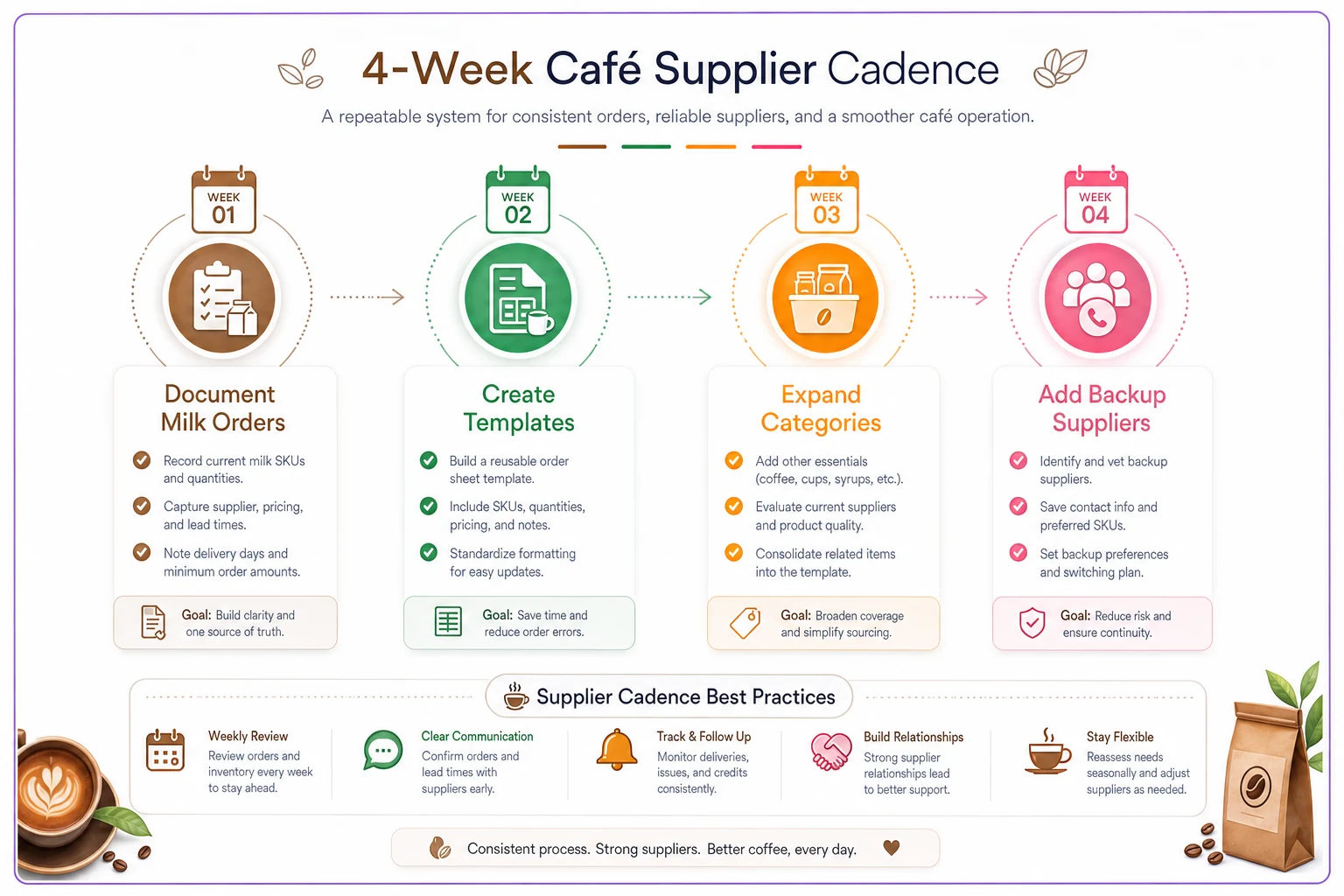
Week 1: Document your current milk ordering pattern. Track every order, delivery, and stockout for seven days. Note when you place orders, when they arrive, and when you run out or throw product away.
Week 2: Create your milk ordering template based on what you learned. Set specific days, quantities, and delivery windows. Share this with your supplier and get written confirmation they can meet these requirements.
Week 3: Expand to your next category—probably pastries or coffee. Same process: document, template, confirm.
Week 4: Add backup supplier information to each template. Place small test orders to establish relationships.
By month two, you'll have templates for all major categories and backup plans for each. By month three, the system runs itself with only minor adjustments for seasons or growth.
Here is a simple visual of the week-by-week workflow.
The difference between cafés that struggle with suppliers and those that run smoothly isn't about finding perfect vendors. It's about building supplier cadence that matches how your café actually operates, then holding everyone—including yourself—accountable to that rhythm.
Supplier management isn't about negotiating better prices. Cafés who focus on cadence and reliability consistently outperform those chasing the lowest costs. When your deliveries arrive predictably and match your needs, everything else flows better.
Your morning shift knows milk will be there. Your afternoon team isn't dealing with emergency orders. Your customers get consistent product availability. And you're not losing sleep wondering if tomorrow's delivery will actually show up. That's what proper supplier cadence creates—predictability in an industry where chaos is the default.
Ready to brew operational excellence?
Join hundreds of coffee shops using Coffehq to boost efficiency, reduce waste, and elevate customer satisfaction.