


Your café's profitability lives in the gap between what you think you're spending and what actually walks out the door. Most owners track revenue religiously but treat their purchase-to-stock process like disconnected tasks. Order supplies Monday, receive them Wednesday, somehow they end up in storage, eventually they get used... or don't.
This broken pipeline kills more cafés than bad coffee ever will.
The problem isn't that owners don't care about costs. Nobody connects the dots between that damaged bag of beans stuffed behind the freezer, the prep cook who eyeballs portions, and why food costs jumped from 28% to 34% last quarter. Each piece looks fine in isolation. The system fails at the handoffs.
Why standard ordering systems create profit leaks
Walk into most cafés during receiving and you'll see the same scene. Driver drops boxes at the back door. Someone (whoever's free) signs the invoice without checking. Products get shoved wherever there's space. Three days later, you're 86ing croissants because nobody realized half the delivery went into the wrong cooler and spoiled.
The typical café loses 4-7% of gross margin through ordering and receiving failures alone. Not theft. Not spoilage from sitting too long. Just pure operational breakdown between placing an order and getting products ready to sell.
Monday morning ordering: Manager pulls up last week's order on their phone, adjusts quantities based on gut feel, sends to three different vendors. No cross-check against current inventory. No verification against projected sales. Just "we usually order 12 cases of oat milk."
Wednesday receiving: Barista on duty signs for deliveries between customers. Two cases of milk are damaged—noted nowhere. Produce order is short three items—driver says "credit will show up." Paper goods got substituted for a more expensive brand—nobody catches the 20% price increase.
Thursday storage: Night shift puts everything away. Cold items in walk-in (somewhere), dry goods in storage room (wherever fits), paper products under counter (if there's room). No organization system. No date labeling. First-in-first-out is a nice theory.
Weekend prep: Saturday prep cook grabs whatever's closest. Uses new products first because they're in front. Portions by feel. Makes 40 sandwiches when sales data shows you sell 25 on average. The extra 15 become tomorrow's waste.
Each step looks minor. Together they compound into thousands in monthly losses. A purchase-to-stock playbook isn't about perfection—it's about connecting these pieces so mistakes become visible before they become expensive.
The four handoff points where money disappears
Money doesn't vanish during tasks—it disappears between them. The handoffs kill you.
Keep every order and shift perfectly aligned.
Coffehq helps you manage orders, inventory, and staff schedules seamlessly.
- Unified order processing
- Real-time inventory updates
- Staff shift coordination
No credit card required
Handoff 1: Order to Receiving
Your manager orders 5 cases of strawberries at $32 per case. Invoice says 5 cases. Delivery has 4 cases. But the receiving barista is slammed with morning rush and signs anyway. That $32 never gets credited. Multiply this by 3-4 incidents weekly across all vendors.
Most cafés run 15-20 vendors. If each vendor has one discrepancy monthly that goes uncaught, you're losing $400-600 in ghost charges. Not huge individually. Devastating annually.
Handoff 2: Receiving to Storage
Driver delivers at 6 AM. Morning shift receives. Afternoon shift stores. Nobody owns the full process. Result: that $180 cheese order sits on the loading dock for 3 hours in July heat. Still gets stored. Gets served. Three customers get sick. Your reputation takes months to recover.
Temperature abuse during receiving-to-storage handoff causes more quality issues than any other single point. Yet most cafés treat it as "whenever someone has time."
Handoff 3: Storage to Prep
Your prep list says "make 30 portions." But nobody specifies portion size. Cook A makes 4oz portions. Cook B makes 6oz portions. Same ingredient cost, 50% variance in yield. Your theoretical food cost assumes 5oz portions. The math never works.
Without clear prep specifications linked to storage organization, every prep shift becomes a creative interpretation of what "should" happen. Inconsistency becomes policy.
Handoff 4: Prep to Service
Kitchen preps 40 sandwiches based on last Tuesday's sales. But last Tuesday was rainy. Today is sunny. You sell 55 sandwiches, run out at 2 PM, and lose the entire afternoon revenue. Meanwhile, those 40 quiche portions from yesterday's overprep get tossed.
The prep-to-service handoff requires predictive intelligence most cafés never build. They prep based on history without context, then wonder why waste stays high.
Building accountability without creating bureaucracy
Small cafés resist systems because they picture corporate-style procedures. Twenty-page manuals. Four signatures per invoice. Hours of documentation. That's not what works at this scale.
Actual accountability in a 5-12 person team means clarity, not complexity. Each person knows exactly what they own and what triggers escalation. The system works because it's simple enough to follow during a Saturday morning rush.
The Owner owns:
-
COGS target (defining what "good" looks like)
-
Vendor relationships and payment terms
-
Monthly P&L review and adjustment triggers
The Manager owns:
-
Weekly ordering based on par levels
-
Daily COGS tracking against target
-
Escalation when variance exceeds 2% weekly
The Shift Lead owns:
-
Receiving accuracy (count, quality, temperature)
-
Storage organization and rotation
-
Waste logging and pattern identification
The Prep Cook owns:
-
Portion standardization
-
Prep quantities based on provided pars
-
Dating and labeling everything
The Barista owns:
-
Service-level waste tracking
-
Product rotation during service
-
End-of-day inventory counts for key items
But what makes this actually work: automatic escalations.
When receiving discrepancies exceed $50: immediate text to manager. When daily waste exceeds $30: photo documentation required. When COGS variance hits 2% weekly: owner joins next ordering session. When any refrigeration goes above 41°F: service stops until resolved.
These aren't suggestions. They're automatic triggers that bypass the "I didn't want to bother you" paralysis that lets small problems become huge ones.
The ordering matrix that actually works
Forget the complex inventory management systems designed for restaurants doing $3M annually. Your café needs something that works on a phone screen while you're standing in the walk-in at 6 AM.
| Item Category | Par Level Method | Order Frequency | Storage Location | Prep Ownership |
|---|---|---|---|---|
| Milk/Dairy | 3-day supply max | 2x weekly | Walk-in Zone A | N/A - direct use |
| Coffee Beans | 7-day supply | Weekly | Dry storage shelf 1-2 | Barista lead |
| Pastries (fresh) | Daily sales +15% | Daily | Display + backstock | Morning shift |
| Sandwich ingredients | 2-day supply | 3x weekly | Walk-in Zone B | Prep cook |
| Paper goods | 2-week supply | Bi-weekly | Under counter/back room | Shift lead |
| Syrups/sauces | 10-day supply | Weekly | Bar area + backstock | Barista lead |
The key isn't the specific numbers—it's that everyone knows them. Your morning barista can check if you need milk without asking. Your prep cook knows exactly how much turkey to pull. Your manager can order without guessing.
Real par levels come from actual depletion rates, not industry averages. Track for two weeks, identify patterns, set pars at peak usage plus 20%. Then adjust monthly based on waste logs.
From receiving chaos to predictable workflow
Most receiving processes fail because they're interruption-driven. Delivery shows up whenever, whoever's free handles it, storage happens eventually. This guarantees mistakes.
The solution isn't complicated scheduling—drivers won't follow it anyway. It's creating a receiving workflow that takes 10 minutes maximum and catches 95% of problems.
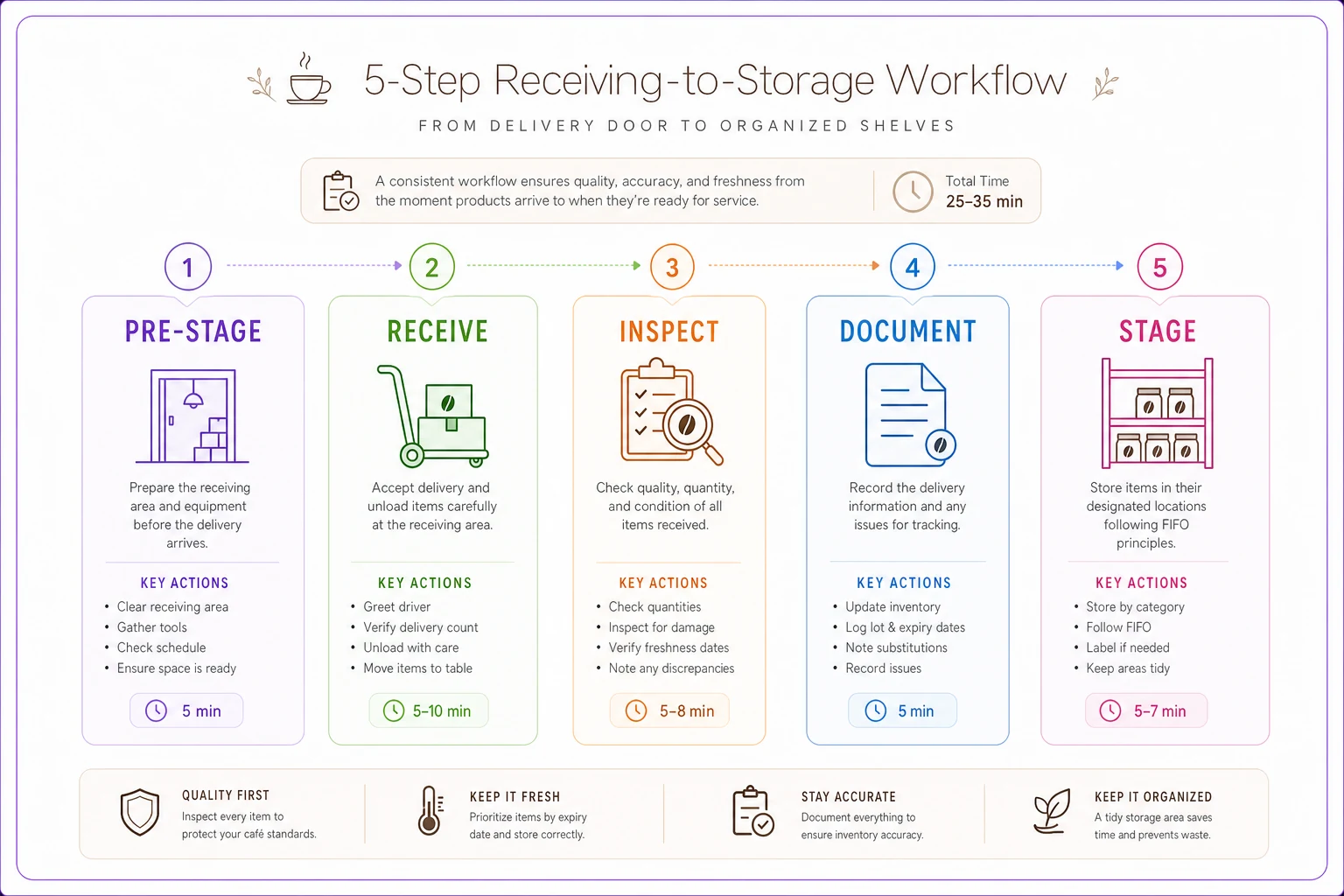
The 10-minute receiving protocol:
-
Pre-stage (night before) Clear receiving area, print day's expected deliveries
-
Receive (2 minutes) Check invoice against expected, note discrepancies
-
Inspect (3 minutes) Open 2 random boxes, check temperature of cold items
-
Document (2 minutes) Photo invoice, text discrepancies over $20
-
Stage (3 minutes) Sort by storage location, mark priority items
This isn't about perfection. It's about catching the expensive mistakes. That $200 seafood order at 50°F. The missing case worth $80. The wrong product that costs 40% more.
Storage then follows zones, not "wherever fits":
Zone A (closest to prep): Daily use items, this shift's prep Zone B (middle access): 2-3 day items, tomorrow's prep Zone C (back/bottom): Weekly items, backstock, bulky goods
New deliveries go to back of each zone. Old product moves forward. Simple enough that a brand-new employee can follow it.
Here's a quick visual of that receiving workflow.
If a delivery looks temperature-abused, photograph it, refuse acceptance, and escalate—don't risk safety for convenience.
Simple enough that a brand-new employee can follow it.
Where traditional prep systems break at scale
A single prep cook making everything works until about $40k monthly revenue. Above that, prep becomes distributed. Morning shift starts pastries. Mid-shift handles lunch prep. Evening restocks basics. Nobody owns the full picture.
Distributed prep without coordination creates compound waste. Morning overpreps because they don't know evening already made extra. Evening tosses morning's prep because it wasn't labeled. Weekend assumes weekday patterns and preps double what sells.
The breakdown accelerates as you add locations or extend hours. What worked when one person handled everything fails when five people share the responsibility.
Under $40k monthly: One person preps everything, knows all patterns intimately $40k-65k monthly: 2-3 people prep, verbal handoffs, some written notes $65k-100k monthly: 4-5 people prep, requires written systems or waste explodes Over $100k monthly: Prep becomes specialized, requires digital coordination
Most cafés hit the $65k wall and either stay there or watch COGS spiral as they grow. They think they need better people. They need better handoffs.
Building prediction into daily operations
Your prep shouldn't react to yesterday—it should predict tomorrow. But prediction doesn't mean complex algorithms. It means paying attention to patterns most cafés ignore.
Weather drives 30-40% variance in café sales. Sunny Saturday versus rainy Saturday can mean 100 transaction difference. Yet most cafés prep the same regardless.
Local events create 50-70% spikes. The farmers market two blocks away. The college graduation weekend. The annual 5k run that routes past your door. These aren't surprises—they're predictable if someone's watching.
Day-of-week patterns stay remarkably consistent. Your Tuesday is probably within 10% of last Tuesday, adjusted for weather and events. Your Sunday morning rush hits the same 90-minute window every week.
Simple prediction beats complex systems:
-
Check weather for next 3 days
-
Note any events within 4 blocks
-
Compare to same day last week
-
Adjust prep by 20% based on signals
That's it. No fancy software needed initially. Just someone paying attention and adjusting prep accordingly.
The escalation triggers that prevent meltdown
Small problems compound in café operations because nobody wants to be the person who escalates. The new barista notices the milk smells off but assumes they're wrong. The shift lead sees invoice discrepancies but figures accounting will catch it. The prep cook knows portions look wrong but doesn't want to criticize colleagues.
Clear escalation triggers remove the emotional component. It's not about judgment—it's about protecting the business.
Immediate escalation (call/text within 5 minutes):
-
Any refrigeration above 41°F
-
Missing items over $50
-
Any customer illness claim
-
Spoiled/damaged product over $30
Same-day escalation (before shift ends):
-
COGS variance over 3% daily
-
Waste exceeding $40
-
Vendor quality issues
-
Storage organization breakdown
Next-day escalation (morning briefing):
-
Repeated portion inconsistencies
-
Chronic overprep patterns
-
Vendor service issues
-
Staff training needs
Weekly escalation (manager meeting):
-
COGS trending above target
-
Vendor relationship problems
-
Process breakdown patterns
-
Menu item profitability concerns
The magic happens when escalation becomes routine, not exceptional. Problems surface before they compound. That slightly off milk gets caught before it ruins 50 drinks. The invoice error gets fixed before payment. The overprep pattern gets adjusted before you throw away hundreds in product weekly.
Technology's role without overwhelming operations
Every café owner has downloaded three inventory apps, tried them for a week, and gone back to paper. Not because paper is better—because the apps were designed for restaurants with full-time managers and dedicated receiving staff.
The right technology enhances your existing workflow rather than replacing it. A photograph of today's invoice beats manual entry. A shared spreadsheet beats complex software that requires training. Voice notes beat written logs nobody fills out.
Start with the highest-impact problems:
Receiving accuracy: Have staff photograph every invoice, text to shared folder. Takes 5 seconds. Creates permanent record. Catches discrepancies immediately.
Prep consistency: Create phone-friendly prep sheets with photos of correct portions. Visual beats written every time.
Waste tracking: Simple voice recorder app. "Tossed 8 sandwiches, expired." Upload daily. Pattern identification happens weekly.
Inventory counts: Focus on five key items that drive COGS. Count daily. Everything else can be weekly.
AI-powered operational software can coordinate these pieces without requiring everyone to learn new systems. Automated systems can identify patterns in your waste logs, predict ordering needs based on weather and events, flag invoice discrepancies automatically. But start simple. Fix the broken handoffs first, then add technology to scale what's working.
The profitability difference of connected operations
A café doing $75k monthly with disconnected operations typically runs 32-35% COGS. The same café with connected purchase-to-stock processes drops to 27-29%. That's $3,750-5,250 monthly difference. Straight to bottom line.
But the impact goes beyond COGS. Connected operations mean:
-
Less emergency ordering (saving 2-3 hours weekly)
-
Fewer stockouts (protecting revenue)
-
Consistent quality (building reputation)
-
Reduced stress (keeping good staff)
-
Scalability potential (enabling growth)
The difference shows up everywhere. Your morning shift stops playing refrigerator Tetris because storage has logic. Your afternoon team stops running out of popular items because prep matches demand. Your evening crew stops wondering what expires when because everything's labeled.
Most importantly, problems become visible before they become expensive. That vendor slowly raising prices gets caught. That new prep cook using double portions gets corrected. That recurring Tuesday shortage gets fixed.
Making the playbook stick
Creating the playbook is easy. Making it stick through busy Saturday mornings, new employees, and seasonal rushes—that's where most cafés fail. The playbook becomes a dusty binder nobody opens.
Implementation happens through daily habits, not grand rollouts:
-
Week 1-2 Fix receiving only. Nothing else changes. Focus on the 10-minute protocol until it's automatic.
-
Week 3-4 Add storage zones. Clear labels. Everything has one home. Still not touching prep or ordering.
-
Week 5-6 Implement prep portions with photos. Just top 10 items. Everything else continues as before.
-
Week 7-8 Add daily waste tracking. Voice notes are fine. Analysis comes later.
-
Week 9-10 Connect ordering to actual depletion rates. Adjust pars based on data, not feelings.
-
Week 11-12 Add escalation triggers. Start with the top 3 most expensive problems.
By week 12, you're running a completely different operation. But nobody felt overwhelmed because each change was tiny and built on the last.
Starting tomorrow morning
Your purchase-to-stock playbook doesn't need to be perfect. It needs to exist. Start with the highest-impact, lowest-effort fix: receiving accuracy.
Tomorrow morning, clear your receiving area. Print expected deliveries. When they arrive, actually check them. Photo the invoice. Note problems. That's it. Do this for one week before changing anything else.
Once receiving works, add storage zones. Then portion control. Then waste tracking. Each layer makes the next one easier.
The cafés that survive long-term aren't the ones with perfect coffee or Instagram-worthy spaces. They're the ones where ordering, receiving, storage, prep, and service connect into a predictable system that delivers consistent COGS regardless of who's working.
Your profitability isn't hiding in some complex strategy. It's sitting in that walk-in cooler, scattered across three vendor invoices, and walking out the door in inconsistent portions. Build the playbook that connects these pieces, and watch your COGS become predictable instead of mysterious. The gap between ordering chaos and operational profit isn't huge. It's just a series of small, connected steps that compound into sustainable success.
Ready to brew operational excellence?
Join hundreds of coffee shops using Coffehq to boost efficiency, reduce waste, and elevate customer satisfaction.