

Your health inspector doesn't care about your 47-point temperature log if you're serving undercooked egg sandwiches at 11am. Most small cafes get buried in HACCP documentation that misses the actual danger zones while creating mountains of useless paperwork.
Building operational systems for cafes — from 30-cover spots to multi-location chains — the same pattern keeps showing up: traditional HACCP programs overwhelm small teams with compliance theater while missing the real contamination points. Your barista checking freezer temps every two hours won't prevent that batch of sandwich filling from sitting at room temperature during morning rush.
The reality gap between HACCP theory and cafe operations
Traditional HACCP comes from industrial food manufacturing where dedicated quality teams monitor continuous production lines. Apply that same framework to a cafe with three staff members juggling espresso, sandwiches, and customer service, and you get checkbox compliance without actual safety improvement.
Think about what happens during a typical morning rush. Your team preps egg salad at 6am, portions it into containers, then focuses entirely on the coffee queue from 7-9am. The HACCP manual says check holding temperatures every hour. In reality, nobody's touching that thermometer until the rush dies down — and by then you've already served 40 sandwiches from product that may have crept into the danger zone.
The inspection-friendly documentation you're maintaining — color-coded binders, laminated check sheets, initialed logs — creates an illusion of control. Meanwhile, real risks are sitting in plain sight: the milk pitcher left on the counter between rushes, the sandwich station where gloves get changed maybe twice per shift, or the grab-and-go case where temperatures fluctuate as doors open and close all day.
Why traditional HACCP fails in small cafe environments
Standard HACCP assumes you have dedicated personnel for food safety monitoring. In manufacturing, that works fine. In your cafe, the person responsible for temperature checks is also pulling shots, taking orders, and restocking the pastry case.
Keep every order and shift perfectly aligned.
Coffehq helps you manage orders, inventory, and staff schedules seamlessly.
- Unified order processing
- Real-time inventory updates
- Staff shift coordination
No credit card required
The documentation burden alone kills operational flow. Checking and recording temperatures for every piece of equipment, every batch of food, at prescribed intervals means someone's constantly walking away from customer-facing tasks. Staff start pencil-whipping the forms just to keep up with service.
Worse than that: generic HACCP templates don't account for cafe-specific risk patterns. Your highest contamination risks aren't in the walk-in cooler that gets checked religiously. They're at the milk steaming area where dairy residue builds up on steam wands, the sandwich prep zone during rushed assembly, and the holding areas for grab-and-go items sitting at questionable temperatures for hours.
The 8 critical control points that actually matter
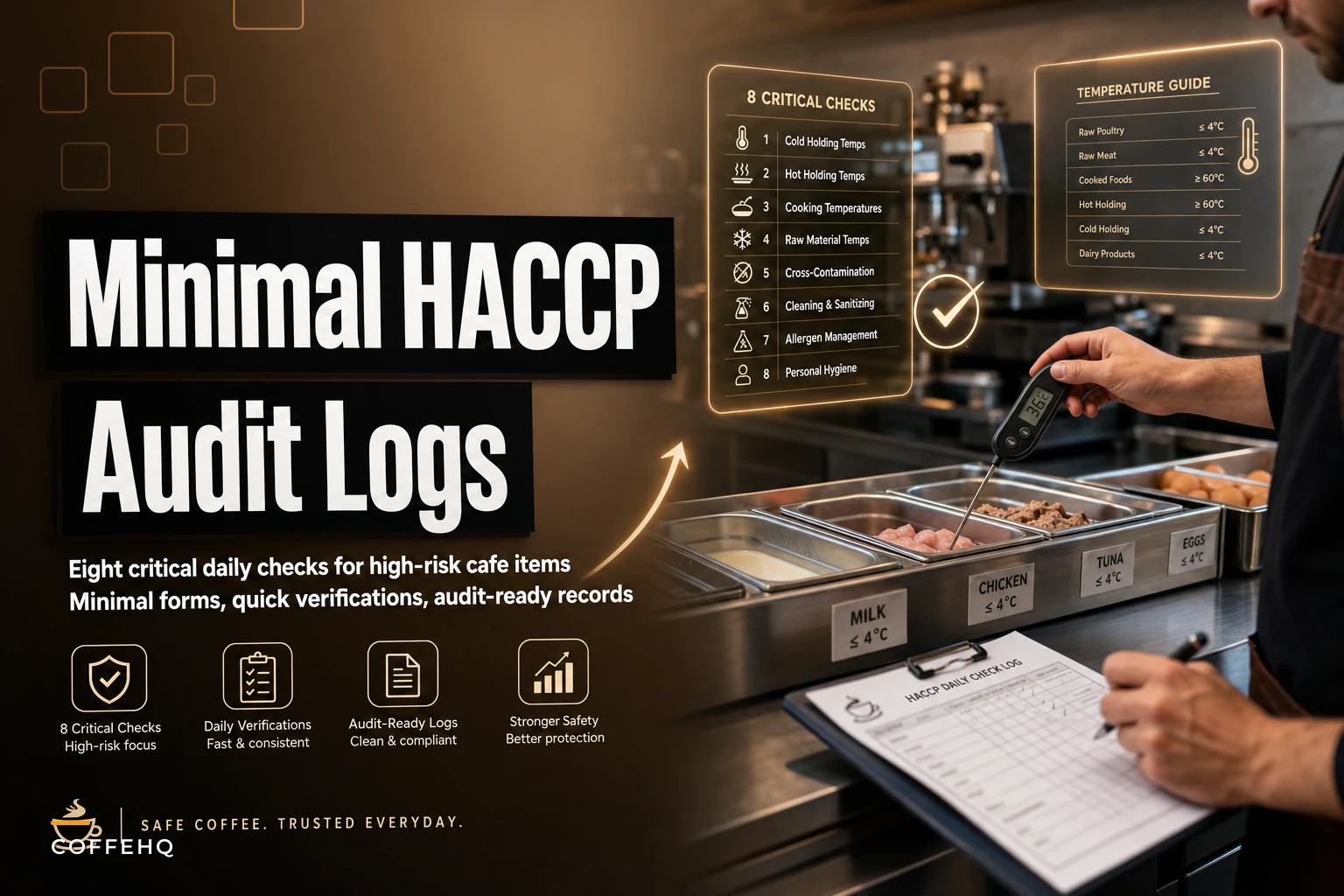
Strip away the compliance theater and focus on where contamination actually happens in cafe operations. These eight checks cover the vast majority of your real food safety risk.
1. Morning dairy receive and rotation (6am) Check incoming milk temps at delivery. Anything above 41°F gets rejected. Rotate existing stock forward. Mark opened containers with use-by dates. Takes about 3 minutes but prevents the cascading contamination that happens when bad milk enters your system unnoticed.
2. Cold sandwich prep zone setup (6:30am) Before any prep begins: sanitize all surfaces, confirm refrigerated ingredients are below 41°F, verify the handwashing station is stocked. Document surface sanitization with test strips. Most sandwich contamination traces back to improper setup, not the assembly itself.
3. Grab-and-go case temperature (7am, 12pm, 4pm) Not the air temperature — the actual product temperature. Pick three items at random, probe them, document. If anything reads above 41°F, pull the entire section. These cases fluctuate a lot, especially near doors and pass-through areas.
4. Hot hold verification (whenever items go into hold) Every batch of soup, quiche, or hot sandwich filling gets probed when it enters holding. Must be 135°F or above. No exceptions. Mark the container with time and temp. After 4 hours, it goes out regardless of temperature reading.
5. Milk pitcher management (ongoing) Pitchers get rinsed and swapped every 2 hours during service, or immediately if they contact non-dairy milk. Steam wands get purged and wiped after every use, deep cleaned with dedicated solution every 4 hours. This isn't traditional HACCP territory, but it's where a lot of cafe contamination actually originates.
6. Glove change triggers (ongoing) Not time-based — task-based. New gloves when moving from register to food, after touching your face, phone, or door handles, between raw and ready-to-eat items, and after cleaning tasks. Post the trigger list where staff can see it. Track glove usage as a rough proxy — if you're not going through at least 40 pairs per shift, compliance is probably slipping.
7. Time stamps for all prepped items (ongoing) Everything prepared in-house gets labeled with prep time and discard time. No exceptions. Egg salad: 3 days. Cut fruit: 24 hours. Opened milk: 7 days. Prepped sandwich components: 48 hours. When something gets prepped, the timer starts.
8. End-of-day discard sweep (closing) Check every date label, temp-check all refrigerated cases, confirm nothing exceeded hold times. Document what got tossed and why. This creates accountability and reveals patterns — if you're constantly throwing out expired product from the same spot, you've found an operational failure point worth fixing.
Building daily verification into existing workflows
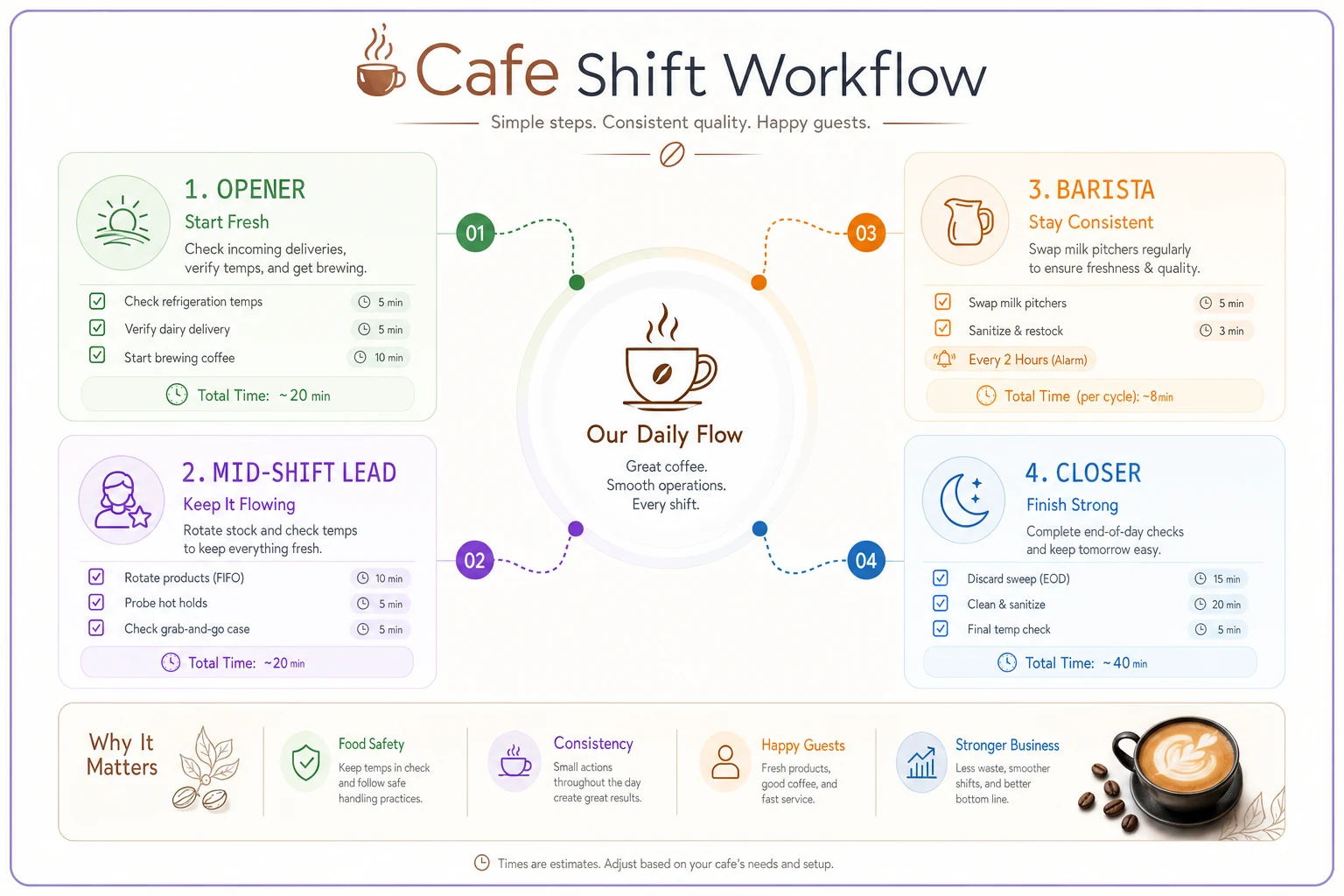
The trick isn't adding new checks — it's embedding them into tasks your team already does. Your opener already walks through the cafe turning on equipment. Add temperature probes to that walkthrough. Your closer already wraps and labels prep for tomorrow. Make date verification part of that process.
Opening manager handles all refrigeration checks while brewing the first coffee batch. Five minutes total, before customers arrive. They're already in the back — adding temp checks doesn't disrupt anything.
Sketch this workflow to show how checks fit into each shift without adding more than a few minutes to routine tasks.
Put the temperature probe on the opener's key ring so it's always available during the initial walkthrough.
Mid-shift leads verify hot holds and grab-and-go temps during their product rotation walks. They're already checking stock levels and freshness. Temperature verification adds maybe 30 seconds per check.
Closers handle the discard sweep as part of prepping for tomorrow. They're already in every refrigerator pulling items for morning prep — checking dates and documenting disposal fits naturally into that routine.
The milk pitcher rotation runs on a timer. Every 2 hours, an alarm goes off. Whoever's on bar swaps pitchers, documents the time, keeps going. Takes under a minute and prevents the gradual contamination that builds up over an 8-hour shift.
Creating incident response templates that actually get used
When something goes wrong — and eventually it will — your team needs clear, specific steps, not a 20-page contamination protocol. Three simple templates cover most scenarios:
Temperature excursion response:
-
Product above 41°F (cold) or below 135°F (hot)?
-
Determine how long (if unknown, assume 4 hours)
-
Under 2 hours
rapid chill or reheat
-
2-4 hours
discard and document
-
Over 4 hours
discard entire batch, check related products
-
Log
time discovered, product affected, corrective action, who was notified
Customer illness report:
-
Get
name, contact, what they ate, when they ate it, symptom onset
-
Pull and hold all related product
-
Check temps on all storage containing those ingredients
-
Document everything in the illness log
-
Notify the owner/manager immediately
-
Save samples of suspect product if available
Failed inspection point:
-
Stop using the affected area or equipment
-
Discard any potentially affected product
-
Clean and sanitize everything involved
-
Retest and verify the correction
-
Document
what failed, why it failed, corrective action taken, verification method
-
Review with all staff at next shift change
Keep these as single-page documents posted somewhere accessible. During an actual incident, nobody's digging through a binder.
The audit-friendly logging system that takes 5 minutes daily
Inspectors want consistent documentation that proves you're monitoring critical points. They don't need novels — they want clear, scannable logs that show patterns and accountability.
| Section | Checks |
|---|---|
| Morning section (opener initials each): | Refrigeration temps (all units) Dairy receive temps Prep zone sanitization verified Hot hold equipment at temp |
| Midday section (afternoon lead initials): | Grab-and-go case temps Hot hold temps (if applicable) Milk pitcher rotation completed |
| Evening section (closer initials): | Final temp checks (all units) Discard log (what was tossed) Sanitization completed Next day's prep labeled |
Each entry gets time, temperature or verification result, and initials. No narratives. If something's out of range, it goes on the incident log, not the daily sheet.
Keep 90 days of logs in a binder at the sandwich station. Inspectors can flip through quickly, spot patterns, and confirm consistent monitoring without wading through excessive paperwork.
Common inspection failures and their 10-minute fixes
Most cafe inspection failures aren't catastrophic food safety disasters — they're documentation and procedure gaps that are easy to fix once you know where inspectors focus.
Thermometer calibration: Inspectors almost always check whether your thermometers are accurate. Weekly ice bath calibration takes 2 minutes. Log it. Keep the calibration log taped inside the thermometer storage area. If your thermometer can't be calibrated, replace it — they're around $15.
Hand washing signage: Seems minor but it's an automatic violation in many jurisdictions. Proper hand washing signs are required at every sink used by food handlers — not just employee restrooms, but prep sinks, bar sinks, anywhere hands might be washed.
Sanitizer concentration: Your three-compartment sink needs sanitizer at the correct concentration. Test strips should be visible and in use. Log concentration checks twice daily. Quaternary sanitizer typically runs 200-400 ppm — confirm with your local health code.
Date marking gaps: Inspectors consistently catch unmarked containers. Everything needs a date. Day dots, masking tape, whatever your team will actually use — but date everything. Label the container when you open it, not when it's nearly empty.
Personal item storage: Employee drinks, phones, and jackets can't be stored near food prep areas. Install a shelf specifically for personal items away from any food contact surfaces. Label it clearly. Eliminates the "whose coffee is this" violation.
When traditional HACCP actually makes sense vs. when it's overkill
Full HACCP with exhaustive documentation makes sense if you're doing any of these:
-
Manufacturing products for wholesale
-
Cooking sous vide
-
Running commissary operations for multiple locations
-
Serving high-risk populations (hospitals, schools)
-
Processing raw proteins beyond simple cooking
For a typical cafe serving espresso drinks, pastries, and simple sandwiches? Adding that complexity doesn't meaningfully reduce your actual risk. Your food safety hazards cluster around temperature abuse and cross-contamination during service — not complex processing failures.
That said, the core HACCP principles still apply. The idea of critical control points — identifying where contamination is most likely — is genuinely useful. The emphasis on corrective actions when things go wrong provides real structure. The documentation habit, even simplified, creates accountability.
The key is proportional response. A 50-seat cafe doesn't need the same food safety infrastructure as a food processing facility. Focus on the genuine risk points, build systems your actual team can run, and maintain enough documentation to prove you're monitoring what matters.
Converting this system to digital tracking
Paper logs work, but they're inflexible and hard to analyze for patterns. Moving these checks into a simple digital system makes monitoring more consistent and surfaces trends that paper hides.
Start with time-stamped digital forms on a tablet. Staff can complete checks faster, out-of-range temps get flagged immediately, and you can spot things like "the grab-and-go case always reads warm after 2pm" — the kind of pattern that's invisible across handwritten sheets.
AI-powered operational software takes this further by automating reminders for critical checks, analyzing temperature patterns to predict equipment issues before they become failures, and generating inspection-ready reports without manual compilation. Instead of copying data from daily logs into monthly summaries by hand, the system does it and flags anomalies. The same cycle count principles that prevent inventory shrinkage apply here — consistent digital tracking reveals what paper logs miss.
Some platforms integrate with smart thermometers that log automatically, removing manual recording entirely. Others connect to your purchasing workflows to track product age from receipt through service. The goal isn't technology for its own sake — it's making critical safety checks harder to skip and easier to verify when an inspector walks in.
Realistic implementation timeline
Don't try to roll out all eight control points at once. Your team will struggle to keep up and compliance will be inconsistent. Three weeks works well:
Week 1: Temperature checks only. Morning refrigeration, grab-and-go checks, hot holds. Get the team comfortable with probing and logging before adding anything else. Focus on building the habit.
Week 2: Add time-based controls. Date marking, milk pitcher rotation, discard sweeps. These require more attention to detail but don't add significant time. The timer system for pitcher swaps might feel disruptive at first — push through it, it becomes automatic within a few days.
Week 3: Layer in procedural controls. Glove change triggers, sanitization documentation, incident response templates. By now the team understands why the system exists and can handle the added complexity without pushback.
After a month, run a mock inspection. Use your local health department's inspection form, grade yourself honestly. Where you fall short, add targeted training. The goal isn't perfection — it's consistent execution of the things that actually prevent contamination.
Most cafes see inspection scores improve noticeably within 60 days of implementing a focused, simplified HACCP approach. More importantly, customer complaints tied to foodborne illness drop off. When you're monitoring the right things at the right frequency, problems get caught before they reach customers.
The system here requires around 15 minutes of total documentation daily, spread across shifts. Compare that to traditional HACCP programs that can demand hours of daily paperwork with questionable safety benefit. Your team can actually execute this. Your inspectors will see consistent compliance. Your customers get safer food. That's the whole point — practical food safety that works in real cafe operations, not theoretical compliance that looks good in a binder.
The system here requires around 15 minutes of total documentation daily, spread across shifts. Compare that to traditional HACCP programs that can demand hours of daily paperwork with questionable safety benefit. Your team can actually execute this. Your inspectors will see consistent compliance. Your customers get safer food. That's the whole point — practical food safety that works in real cafe operations, not theoretical compliance that looks good in a binder.
Ready to brew operational excellence?
Join hundreds of coffee shops using Coffehq to boost efficiency, reduce waste, and elevate customer satisfaction.