
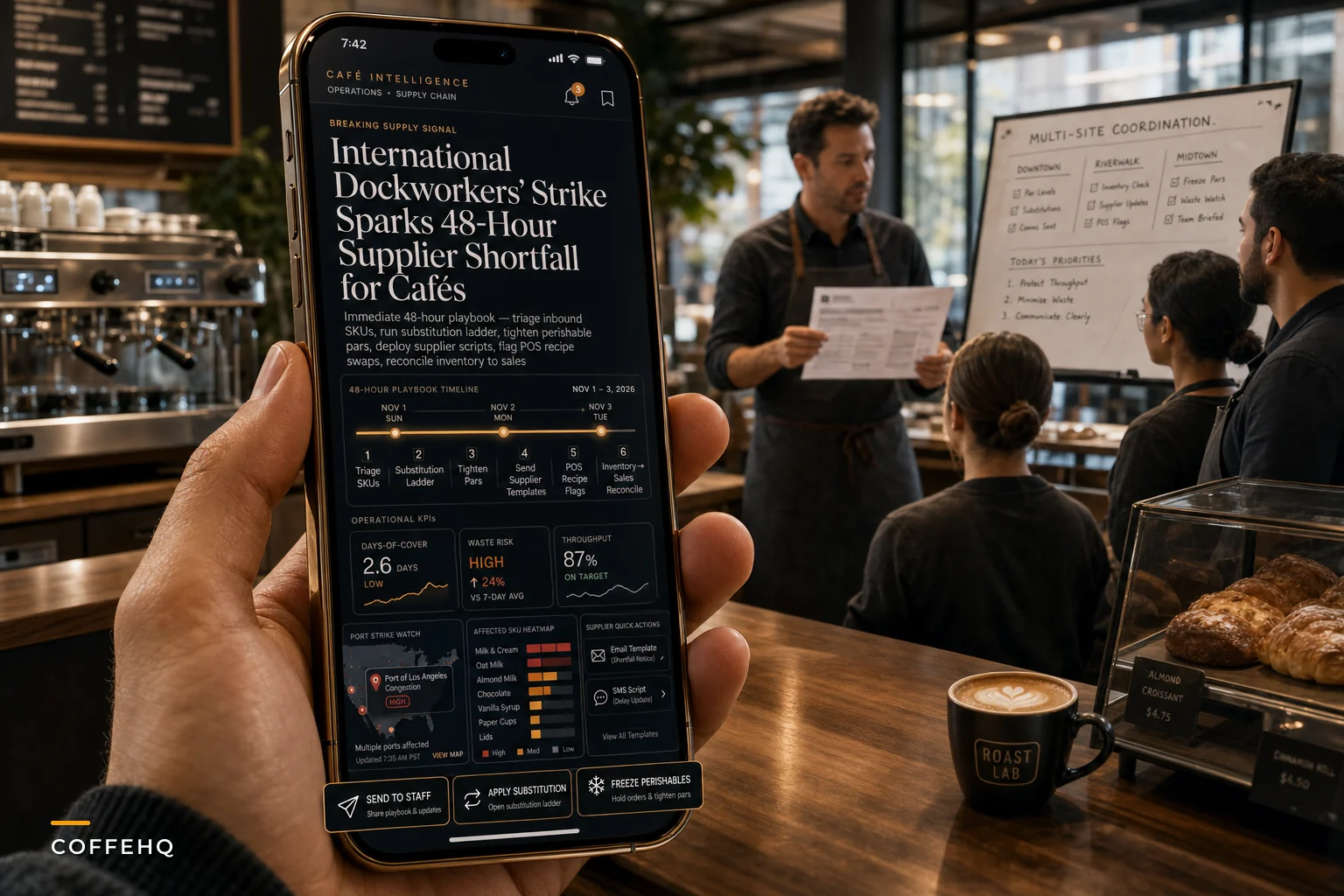

The coordinated one-day dockworker action across more than 100 ports in 22 countries on October 29–30 wasn't a long strike. It lasted a day. But if you run a café, duration almost doesn't matter — what matters is the backlog it creates. When that many ports pause at once, carriers and 3PLs issue congestion advisories, berth slots back up, and the ripple shows up two to three weeks later as a late green-bean container or a specialty syrup with a new ETA nobody warned you about.
Reuters reported a coordinated action across ports worldwide, and ABC News noted that freight firms quickly moved to warn clients about localized delays. For a small café, the useful takeaway isn't the headline. It's that your next two or three inbound cycles just got less predictable — right as holiday demand is climbing.
This is a 48-hour checklist. Not a strategy doc. Something a single-site owner or a small multi-site manager can actually run in two days to limit the damage before it hits the counter.
The real exposure isn't the strike — it's your lead-time blind spot
Most café owners miss the same thing in moments like this. The strike didn't create your risk. It just made it visible.
What a disruption like this exposes is how little visibility most cafés have into where their inventory actually sits in the pipeline. You know what's on your shelf. You might know what's "on order." But very few operators can answer the question that actually matters right now: which of my open POs are sitting on a vessel or in a port, and which are already domestic and essentially safe?
A typical scenario looks like this. A two-site café orders green beans from an importer, oat milk from a regional distributor, and a seasonal syrup line manufactured overseas but sold through a domestic broker. The owner thinks of all three as "my suppliers." But only one has real port exposure. The oat milk is domestic. The syrup — even though it feels local because it ships from a broker's warehouse — is the one sitting on a delayed container.
When you can't tell these apart quickly, you end up doing the worst possible thing: panic-ordering everything, or panic-ordering nothing. Both cost you.
So the first move isn't ordering. It's sorting.
Hour 0–4: Sort your SKUs by actual port exposure
Pull your current open purchase orders and your top-moving SKUs. Put each one into one of three buckets. Spreadsheet, paper, doesn't matter — it needs to be fast, not fancy.
Keep every order and shift perfectly aligned.
Coffehq helps you manage orders, inventory, and staff schedules seamlessly.
- Unified order processing
- Real-time inventory updates
- Staff shift coordination
No credit card required
| Exposure tier | What it means | Example SKUs | Action window |
|---|---|---|---|
| Direct import risk | Crosses a port on its way to you; delay is likely | Green coffee (import origin), imported syrups, imported packaged goods, certain teas | Act in first 24h |
| Hidden import risk | Feels domestic but has an overseas input or component | Broker-sold syrups, some paper/packaging, specialty chocolate | Verify ETA in first 24h |
| Domestic / low risk | Sourced and stored regionally, no port dependency | Local dairy, regional pastry supplier, local roaster (already roasted) | Monitor only |
The mistake is treating "domestic distributor" as automatically safe. A surprising number of café ingredients are domestically distributed but internationally produced. Chocolate, certain syrups, some to-go packaging, specialty teas — these routinely land in the hidden-risk tier. If you don't check, you'll find out when the invoice says "backordered."
Check broker invoices for origin lines to catch hidden import risk quickly.
Once you've sorted, you only have to do real work on two tiers instead of scrambling across your whole order sheet.
Hour 4–12: Call the suppliers that actually matter and ask better questions
Call only the direct-risk and hidden-risk suppliers. Most owners waste this window asking the wrong question. "Are you affected by the strike?" gets you a vague "we're monitoring it," which tells you nothing useful.
-
"What's the current confirmed ETA on my open POs, and has it changed in the last 48 hours?" You want a date, not a vibe.
-
"Is the product already in-country, or still inbound through a port?" This is the single most useful question. In-country means mostly fine. Still inbound means you plan around it.
-
"If it slips, what's your substitute SKU and is it in stock now?" Lock the alternative before everyone else calls asking the same thing.
-
"What's your allocation policy if demand spikes?" Small accounts often get quietly deprioritized. Better to know now.
Suppliers who can answer the "already in-country?" question immediately are the ones with solid internal visibility — and the ones worth leaning on during a squeeze. The ones who stall on that question are telling you something about how exposed they actually are.
Write down every answer with a date. You'll need the dates for the next step.
Hour 12–24: Rebuild your par levels for a two-week wobble, not a crisis
Don't rebuild your whole inventory system. You're adjusting a handful of SKUs for a short window of unreliability.
For each direct-risk and hidden-risk SKU, run a quick three-part calculation:
-
Daily burn rate. How much do you actually use per day? Pull from a recent normal week, not a guess.
-
Revised lead time. Take the supplier's new ETA and add a buffer. If they said "about a week late," plan for ten days. Congestion clears unevenly.
-
Coverage gap. Current stock ÷ daily burn = days of cover. If that number is shorter than your revised lead time, you have a gap to close.
A realistic version: a single-site café burns roughly 4–5 kg of green beans a day across its roast cadence. They've got about 55 kg on hand — a little over ten days of cover. Normal lead time was a week. Revised ETA is now closer to two weeks out. That's a gap of three to four days. Not a disaster, but enough that they need to either pull a partial order forward from a backup roaster or stretch their roast schedule slightly. Knowing the gap is three to four days instead of just "we might run out" completely changes how calmly you can respond.
The point isn't to stockpile. Over-ordering perishables during a scare is how you turn a shipping delay into a spoilage loss. You're closing a specific, measured gap — nothing more.
Hour 24–36: Pre-stage your substitutions before you need them
This is the part that separates cafés that stay calm from the ones scrambling at the espresso machine on a Saturday morning. Decide your swaps now, while you have time to taste-test and brief staff — not mid-rush when a syrup runs dry.
Every café should walk into a disruption with a pre-built substitution ladder: a ranked list of what replaces what, in what ratio, and at what cost difference. If you've never formalized this, the supplier shortfall playbook with a substitution ladder and recipe-swap rules covers the ratio and recipe logic in more depth than fits here.
For the 48-hour window, keep it tight. For each at-risk SKU, define:
-
The first-choice substitute — closest match, minimal customer-noticeable difference
-
The fallback substitute — works, but you'd adjust the recipe or price
-
The "we just 86 it" line — the point where it's better to pull the item than serve a bad version of it
That last one matters more than most people admit. A mediocre substitute served to a regular who knows your drink is worse for the business than a polite "we're out of that this week." Protecting the experience sometimes means removing an item, not faking it.
Hour 36–48: Brief the floor and set the customer-facing story
The operational work is done. Now make sure the people actually running shifts know what changed. A disruption handled perfectly in the back office still goes sideways if a barista improvises a substitution nobody approved.
Keep the briefing to one page per site:
-
Which items might run short this week
-
The approved substitute and the exact ratio
-
How to handle the price — absorb it, or adjust. Decide this. Don't leave it to the register.
-
The line staff says to customers — short, honest, no over-explaining
Here's a quick visual of the briefing workflow.
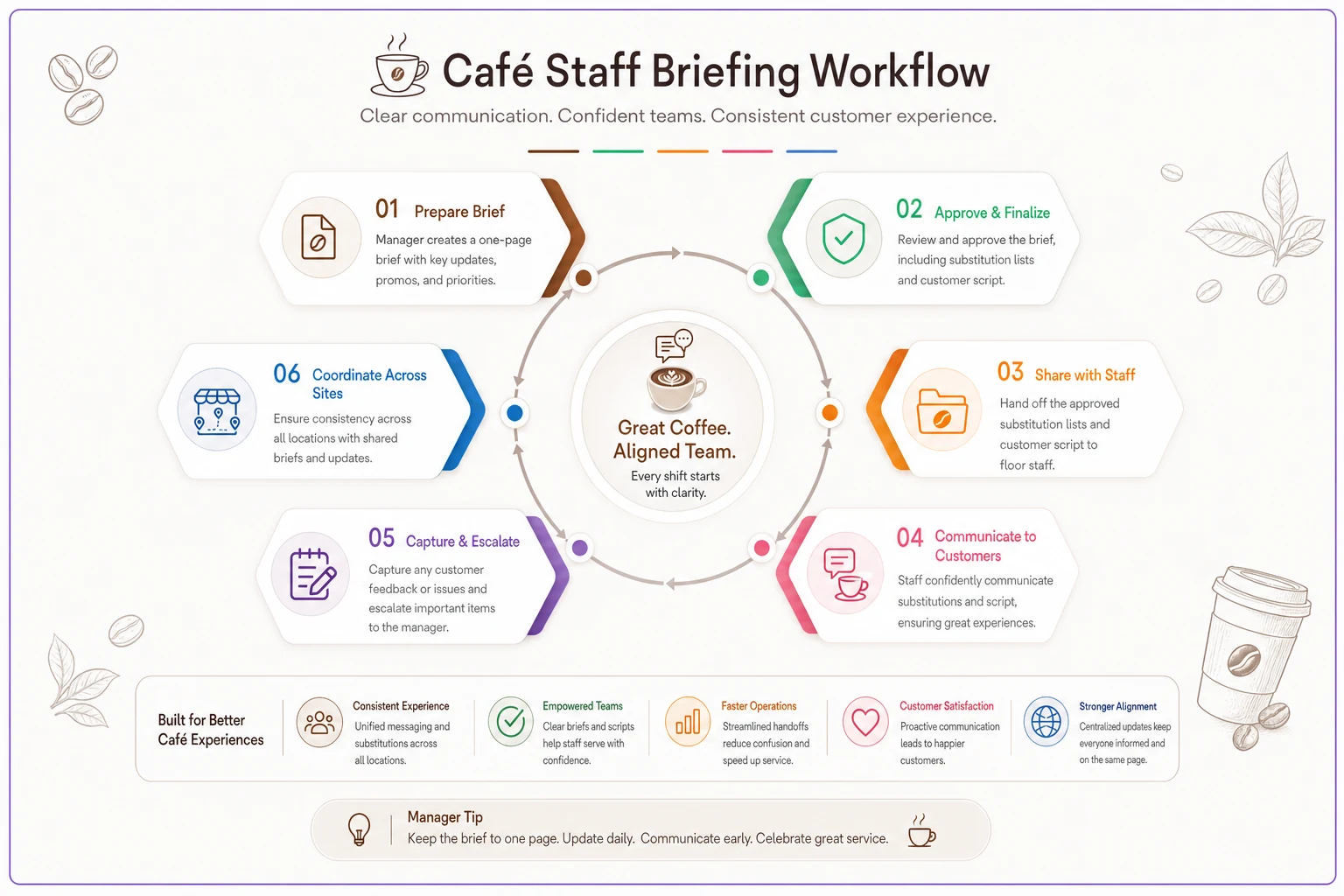
The customer line matters more than it seems. "We're out this week" with no context reads as disorganized. "There's a shipping delay on that right now, but [substitute] is really close — want to try it?" reads as a café that has its act together. Same shortage, completely different impression.
One thing worth flagging for multi-site operators: if you don't standardize the substitution across locations, you end up with one café charging more than another for the same swap. Regulars notice. Keep it consistent even if it costs you a little margin on paper.
When this full checklist is overkill — and when it isn't
Not every café needs to run all 48 hours of this.
You can skip most of it if nearly everything you buy is sourced and stored domestically, your roaster is local and roasting from beans already in-country, and your dairy and pastry are regional. Do the SKU sort, confirm you have no hidden-risk items, and move on. Running a full crisis playbook for a café with zero port exposure just burns a manager's afternoon for no reason.
You should run the whole thing if you import green coffee directly, you carry imported specialty lines, or you're a small multi-site operator where a shortfall at one location gets masked by stock at another until it's suddenly a problem everywhere at once. Multi-site cafés are especially prone to discovering a shortage late — inventory feels "available somewhere" right up until it isn't.
Who can genuinely skip it: a brand-new single-site café with one local roaster and a short menu. Your exposure is tiny, and your time is better spent on daily consistency. Note the risk, revisit it next time you add an imported SKU, and leave it there.
A short real scenario
A two-location café, somewhere in the $70k–$80k a month range in combined revenue, got a congestion advisory from its freight forwarder the week after the strike. Their instinct was to expedite everything — which the forwarder quoted at a few hundred dollars in rush fees per shipment.
Instead they ran the SKU sort first. Turned out only two lines had real exposure: their direct-import green beans and one imported syrup. Everything else was domestic. They expedited only the green beans, pulled a partial backup order from a secondary roaster to cover the four-day gap, pre-staged a substitute for the syrup, and briefed both floors on one shared page. The syrup slipped by about nine days. Because the swap was already approved and staff were briefed, the transition was invisible to customers — a couple even said they preferred the substitute. They avoided somewhere around $600–$800 in unnecessary expedited freight on the low-risk items they'd almost rushed out of panic, and they didn't take a single spoilage loss from over-ordering. The whole response took one manager most of a day across both sites.
The exact numbers aren't the point. Sorting before reacting turned a scramble into a manageable, cheap adjustment.
The takeaway
A one-day strike at a hundred ports won't close your café. What it does is stress-test how well you understand your own supply pipeline — and most cafés discover, in the middle of it, that they were treating hidden-risk SKUs as safe and reacting to everything at once instead of the two or three things that actually mattered.
The 48-hour window after any disruption advisory is enough time to sort by real exposure, ask suppliers sharper questions, close measured gaps instead of panic-stockpiling, pre-stage substitutions, and brief the floor. Do that, and the next delay — because there's always a next one — becomes a scheduling footnote instead of a Saturday-morning fire.
Ready to brew operational excellence?
Join hundreds of coffee shops using Coffehq to boost efficiency, reduce waste, and elevate customer satisfaction.