

Your distributor emails at 6:47am: the oat milk order got cut, the almond is backordered until Thursday, and they're short two cases of 12oz cups. You open at 7. There's no time to think, so you either wing it at the register or you have a system. Most cafes wing it — and it costs them more than they realize. Not in missed sales exactly, but in the messy, inconsistent way the shortage gets handled.
The real problem with supplier shortfalls isn't finding a replacement. Any manager can drive to a grocery store and buy oat milk at retail. The harder call is deciding fast whether to substitute, pause the item, or pre-sell it — and then making sure every barista on shift communicates the same thing to customers, so you don't quietly train regulars to stop trusting your menu.
This is a playbook for that decision, plus the swap rules and staff scripts that keep service moving.
Why cafes handle shortages badly (even good ones)
The failure isn't laziness. Shortage decisions get made at the worst possible moment — mid-rush, by whoever's on bar — with no pre-agreed rules. So the same missing item gets handled three different ways in one week.
A typical sequence: Monday, the almond milk is out, so a barista silently swaps in oat and says nothing. Wednesday it's out again, a different barista tells the customer "we're out of almond, sorry" and the customer leaves. Friday the shift lead decides to keep charging the almond premium but pour whole milk because "it's basically the same." Now you've got inconsistent quality, an allergen risk, and a customer who got charged for something they didn't get.
The shortage itself rarely damages a business. The improvised, inconsistent response does. The fix is moving the decision out of the rush and into a set of rules you write once and don't think about again.
The core decision: substitute, pause, or pre-sell
Before you build any substitution ladder, you need a decision rule for what to even do with the missing item. Three options, and they're not interchangeable.
Keep every order and shift perfectly aligned.
Coffehq helps you manage orders, inventory, and staff schedules seamlessly.
- Unified order processing
- Real-time inventory updates
- Staff shift coordination
No credit card required
Substitute — swap in a comparable ingredient and keep selling. Best when the swap is close enough that most customers won't notice, and the item is a volume driver you can't afford to drop.
Pause — pull the item (POS 86, chalkboard note) and stop selling until stock returns. Best when there's no acceptable substitute, or when substituting creates an allergen or quality problem you can't defend.
Pre-sell — keep taking orders but tell the customer it's coming later that day or tomorrow, sometimes with a small incentive. Best for known regulars, subscriptions, or catering where the relationship carries the delay.
Here's the matrix worth handing to managers:
| Factor | Lean Substitute | Lean Pause | Lean Pre-sell |
|---|---|---|---|
| Substitute quality gap | Small / unnoticeable | Large / obvious | N/A |
| Allergen or dietary risk | None | Any risk at all | None |
| Item's share of daily sales | High (top 10 items) | Low (rarely ordered) | Medium |
| Restock ETA | Doesn't matter | Unknown / >3 days | Same day or next day |
| Customer type | Walk-in volume | Walk-in volume | Regulars, catering, subs |
| Price impact | Neutral or you absorb it | N/A | Can offer small credit |
The one line most people get wrong: anything involving an allergen or a stated dietary claim goes straight to pause. You do not quietly substitute whole milk for a customer who ordered oat. That's not a service decision — it's a safety decision, and it's the fastest way to turn a supply hiccup into a real incident. The same discipline that applies to counter-side allergen handling applies here.
``
Shortfall identified (email / shelf count / POS alert)
        ↓
Is an allergen or dietary claim involved?
    YES → Pause immediately, no substitution
    NO → Continue
        ↓
Is there an acceptable substitute on the ladder?
    NO → Pause item
    YES → Continue
        ↓
Is restock ETA same day or next day + customer is a regular or catering?
    YES → Consider pre-sell with incentive
    NO → Substitute and apply staff script
        ↓
Update POS / board, brief staff, document the gap
``
Flowchart of that logic:
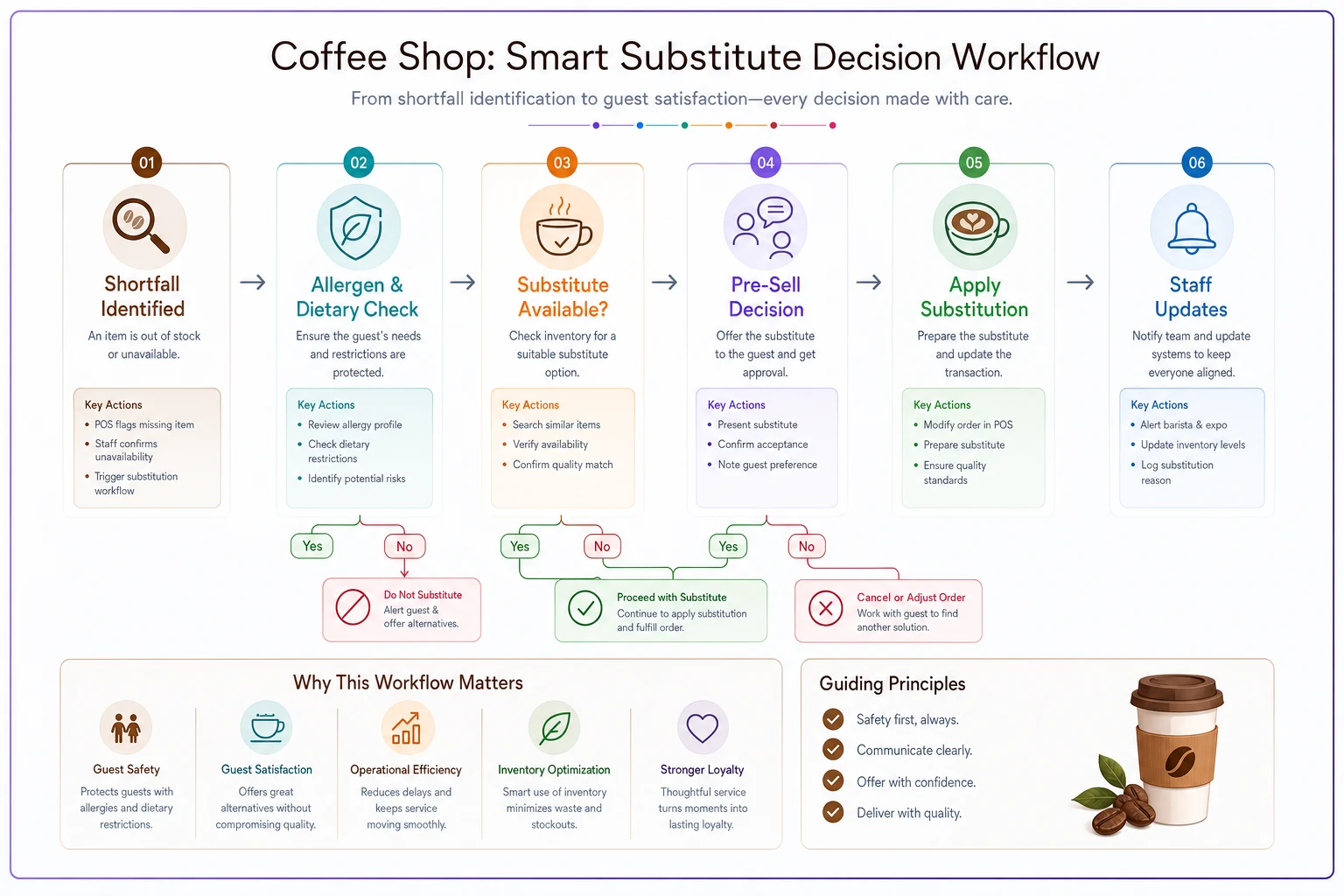
That sequence isn't meant to be followed step-by-step mid-rush. It's the logic your substitution ladder should already encode — so whoever's on bar isn't making it up.
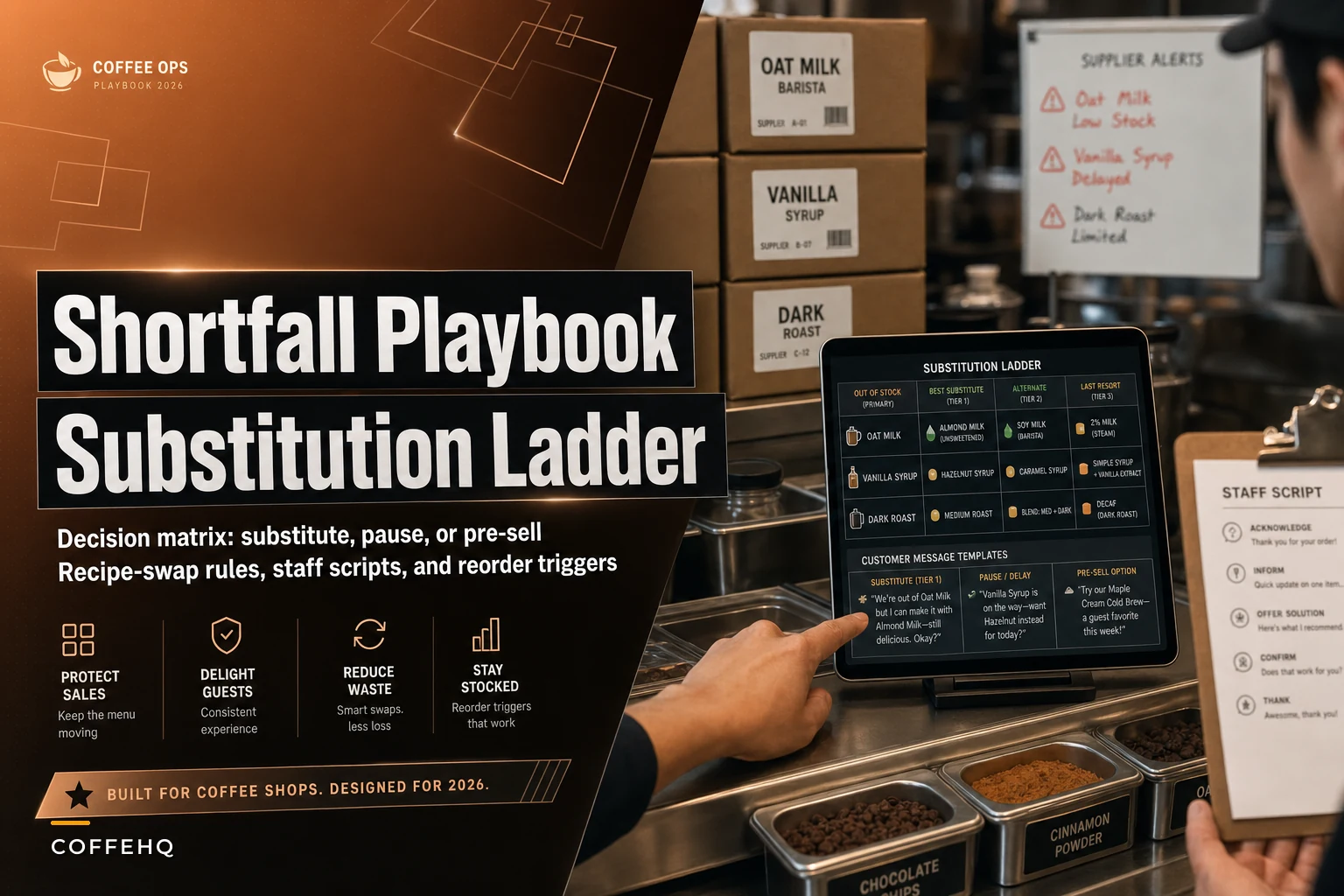
The substitution ladder
When the matrix says substitute, you don't want a barista guessing. You want a pre-written ladder: first choice, second choice, then the stop point where substitution turns into a pause.
For each critical ingredient, list acceptable replacements in order, and write down the one rule that ends the ladder. A milk alternative ladder might look like this:
Oat milk out:
-
Barista-blend oat from backup brand (if in stock) — pour normally, say nothing unless asked
-
House-stocked retail oat (grocery run) — pour normally, absorb any cost difference
-
No acceptable oat available → pause oat, do not substitute dairy or nut milk
12oz hot cups out:
-
Use 16oz cup, fill to 12oz line, keep the price the same
-
Use 8oz + verbal upsell to 16oz if customer agrees
-
Neither available → pause 12oz size, offer 8oz or 16oz only
The ladder does two things: it removes the mid-rush judgment call, and it defines the point where substitution becomes irresponsible. Notice the milk ladder stops rather than crossing categories. That stop point is the most important line on the page.
One thing worth flagging on cost: retail substitutes eat margin, and if you're doing grocery runs multiple times a week for the same item, that's a sourcing problem, not a shortage problem. Worth tracking how often it happens — it ties directly into how you set buffer stock. The small-cafe hedging playbook covers the numeric thresholds for when to hold extra stock versus riding it out.
Recipe-swap rules that protect the drink
Substituting an ingredient sometimes means the recipe has to change too, not just the pour. If your dirty chai uses a specific concentrate and it's out, swapping brands 1:1 can throw the whole drink off. Swaps need rules, not just permission.
Three rules that keep this from getting sloppy:
-
Ratio rule. Write the adjusted ratio for each likely swap. If the backup vanilla syrup is thinner, the swap card says "3 pumps instead of 2" so the drink still tastes right.
-
No-stacking rule. Only one substitution per drink. If oat and the vanilla are both out on the same order, that drink goes to pause — not double-substituted. Two swaps at once is where quality falls apart and customers notice.
-
Name rule. If the swap materially changes the drink, it gets a verbal heads-up. "Our seasonal latte is running with a house vanilla today" is honest and takes two seconds.
What to avoid is silent recipe drift — each barista compensating differently until the same drink tastes like three different things across a week. Write the ratios down once. It's the difference between a controlled swap and a slow quality slide nobody catches until reviews start changing.
Reorder triggers so you're not doing this every week
Shortages that repeat aren't emergencies — they're planning failures. The playbook only works when it's paired with reorder triggers that catch the shortfall before it hits the bar.
Set a trigger point per critical SKU that fires an order before you're out. A workable rule for fast-moving perishables: reorder when on-hand drops to your average daily usage multiplied by your lead time, plus a one-day buffer. If you go through 3 cartons of oat a day and delivery takes two days, your trigger sits around 7 cartons on hand — not 2.
Track how often you use retail substitutes so you can decide whether to adjust your par and sourcing rather than rely on grocery runs.
The manual version is a shelf tag and a morning count. The mistake is trusting memory during a rush — the count gets skipped, the trigger gets missed, and you're back at the 6:47am email. Whatever system you use to track pars, it needs to flag the trigger without relying on someone remembering to check. The supplier cadence templates piece covers the weekly and monthly ordering structure that keeps these trigger points from sneaking up on you.
For cafes managing multiple locations or a broader menu, AI-powered operational software can automate par tracking and flag reorder triggers without manual counts — reducing the chance that a busy Saturday wipes out your buffer without anyone noticing until Monday morning.
Staff scripts: communicating a shortage without breaking service
This is where most playbooks stop — and it's the part that actually saves the customer relationship. Baristas need exact words, because "sorry, we're out" said with an apologetic shrug reads as chaos, and the same information delivered with a clear alternative reads as competence.
The rule for scripts: name the swap, keep it short, don't over-apologize. Long apologies make a small thing feel like a bigger problem than it is.
When substituting (customer won't notice, no dietary flag):
> Nothing to say. Pour it.
When substituting and it's visible or the customer asks:
> "Heads up — we're pouring [X] today instead of [Y], on the house on the price difference. Still tastes great, want me to go ahead?"
When pausing an item:
> "We're out of [item] until [tomorrow/Thursday] — can I get you [nearest alternative] instead? It's the closest thing we've got."
When pre-selling to a regular or catering order:
> "That one's landing this afternoon — want me to set yours aside and text you when it's in? I'll knock a dollar off for the wait."
When it's an allergen/dietary item and you have to decline:
> "I don't want to swap something you can't have, so I'm going to hold off on that one today rather than guess. Here's what I can safely make you instead."
That last script is the most valuable one on the list. A customer who hears you refuse to guess with their dietary needs trusts you more, not less.
A real scenario
A two-location cafe kept running short on oat milk on Mondays because weekend volume drained the par and the trigger count got skipped during the Saturday rush. The handling was all over the place — sometimes a silent whole-milk swap, sometimes a flat "we're out," sometimes a last-minute grocery run at retail cost.
They did three things. Wrote a milk substitution ladder with a hard stop at dairy. Set the oat reorder trigger to fire Friday morning based on lead time plus a buffer. Taped the five scripts by the register.
Over the next couple months the Monday shortage basically stopped. On the rare occasion oat did run low, the pause-and-offer script meant customers got a clean answer instead of a shrug. The owner estimated around $200–$300 a month in recovered oat-drink sales that used to walk out the door — plus the harder-to-quantify win of regulars not getting quietly downgraded. Nothing dramatic, just fewer small repeated losses adding up.
When this playbook is overkill
If you run a single espresso bar with six menu items and one reliable distributor, you don't need a laminated ladder for every SKU. Write triggers and a couple scripts for your top three critical ingredients and stop there. The ladder pays off when your menu has real breadth, when you're juggling multiple suppliers, or when you're running more than one location and can't personally handle every shortage call.
Where it genuinely goes wrong is treating substitution as the default response. Some owners get so comfortable swapping that they stop fixing the ordering problem underneath. If you're improvising a substitute more than once a week for the same item, the playbook isn't what needs fixing — your pars and reorder triggers are, and that's the thing to address first.
The takeaway
A supplier shortfall is going to happen. What separates cafes that shrug it off from the ones that leak customers is whether the response was decided in advance or invented at the register. Write the decision matrix, build the ladder with a hard stop, set triggers that fire before you're empty, and give your baristas the exact words they need. Do that once, and the next 6:47am email becomes a five-minute adjustment instead of a bad morning.
Ready to brew operational excellence?
Join hundreds of coffee shops using Coffehq to boost efficiency, reduce waste, and elevate customer satisfaction.