

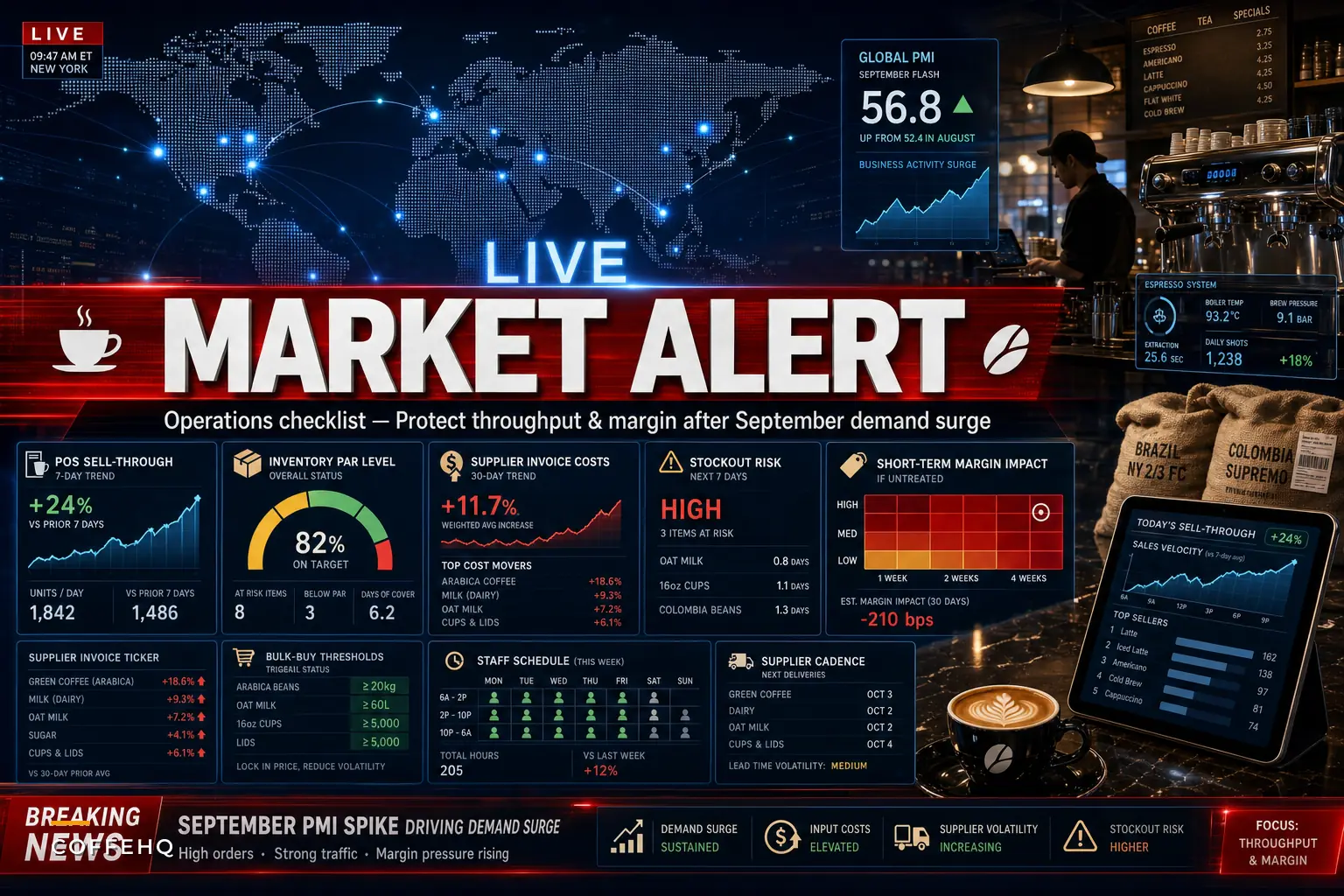

The data coming out of late September handed a lot of small operators a weird mix of good and bad news at the same time. U.S. business activity hit its highest level in more than five years, driven by a jump in new orders — but those same reports flagged input costs and price pressures building underneath. Reuters covered the S&P Global PMI figures in a late-September report that basically described two trends colliding: more demand, and more expensive inputs feeding that demand.
For a café, that collision is where things get dangerous. Not because busy days are bad — busy days are great. The problem is that a demand surge hides cost problems. When your tickets are flying, you don't notice that your milk cost crept up 9% or that you're buying premium pastries at retail because your supplier shorted you again. You just feel busy, you feel the energy, and three weeks later the P&L tells you that you worked twice as hard for the same money. Sometimes less.
So this isn't a "ride the wave" piece. It's a "ride the wave without getting pulled under" piece.
Why a demand surge is actually a margin trap
The counterintuitive part most operators miss: your worst margin days are often your busiest ones.
Think about what happens mechanically during an unexpected rush. You run out of primary milk and grab whatever's at the grocery store down the block at full retail. Your barista forgets to log the comp'd drinks because the line is eight deep. You throw an extra person on the floor for a shift you didn't budget for. You run out of your house pastry and start selling the high-cost premium ones you normally hold back. None of these feel like decisions in the moment — they feel like survival. But each one quietly shaves points off your margin.
Across a lot of small food-service operations, a 20–25% jump in volume rarely produces a 20–25% jump in profit. It usually produces something closer to 8–12%, and in bad cases, flat. The gap is almost entirely operational slippage: emergency buys, waste from over-prepping, labor overruns, and portion creep when staff stop measuring because they're slammed.
A surge doesn't fix a leaky operation. It accelerates the leak.
The underlying problem: your controls were built for normal days
Most café systems — par levels, order cadence, staffing templates, portioning habits — are calibrated for a predictable week. They work fine when Tuesday looks like last Tuesday. The moment demand breaks pattern, those same systems start producing wrong answers fast.
Keep every order and shift perfectly aligned.
Coffehq helps you manage orders, inventory, and staff schedules seamlessly.
- Unified order processing
- Real-time inventory updates
- Staff shift coordination
No credit card required
Your par levels assume a sell-through rate that's now too low, so you stock out mid-afternoon. Your supplier order window assumes a lead time that's tightening because everyone's ordering more. Your pricing assumes input costs that were true last month. Every one of these is a static assumption running into a moving market.
The real exposure isn't the surge itself. It's that most cafés don't have a fast way to detect when their assumptions have gone stale. They find out at month-end, from the accountant, long after the damage is done.
A practical checklist to run this week
Before you touch pricing or ordering, get visibility on where you actually stand right now. This is a one-sitting exercise — maybe 45 minutes with your POS reports and your last three invoices open.
-
Recalculate your top 5 drinks' true cost using this week's invoice prices, not your menu-build assumptions from whenever you last did this
-
Flag any input that's moved more than ~6–8% since your last recipe cost — those are your margin bleeders
-
Check your three fastest-moving SKUs for stockout frequency over the past 10 days — if you're running dry before close, your pars are stale
-
Pull your emergency/retail purchases from the last two weeks — any milk, pastries, or supplies bought at non-wholesale pricing is a signal, not a one-off
-
Review comp and void rates by daypart — rushes usually show a spike worth investigating
-
Confirm your supplier's current lead time by actually asking, not assuming — tight supply chains stretch quietly
The point of this list isn't to fix everything. It's to find the two or three things actually hurting you so you don't waste energy on the stuff that's fine.
Deciding what to do about rising costs: a quick decision guide
Once you know which inputs moved, you've got roughly four levers. The mistake is reaching for pricing first every time — it's the most visible, but it's not always the right first move.
| Lever | Best when | Risk | Speed to act |
|---|---|---|---|
| Reprice the item | Cost jump is structural and the item sells on value, not price-sensitivity | Customer pushback on signature items | Fast |
| Swap/substitute an input | A comparable input exists at better cost | Quality drift if not tested | Medium |
| Resize the portion | The item has generous portions with room to trim | Noticeable shrink annoys regulars | Fast |
| Absorb it temporarily | The spike looks short-term and the item is a traffic driver | Margin pain if the spike lasts | Immediate |
The decision that trips people up most is absorb vs. act. If an input spikes for what's likely a short-term reason, aggressively repricing can cost you more in customer goodwill than you'd save. If it's structural, absorbing it is just slow bleeding. One question usually cuts through it: has this cost moved more than once in the last quarter? Repeated moves mean it's structural. Act on it.
For the numeric side of this — specific thresholds on when to bulk-buy, when to swap recipes, and how to protect margin without panicking — there's a full framework in the small-café hedging playbook. That piece covers the math behind the moves; this one is about reacting to the surge itself.
The staffing side nobody budgets for
Rising demand and rising labor almost always show up together, and labor is the lever operators manage worst during a surge because it feels forced. A line forms, you call someone in, done. But reactive staffing is expensive staffing.
A better approach during an unpredictable stretch is to build flex blocks rather than full shifts. Instead of adding a 6-hour shift when you sense a busy day coming, add a 2.5–3 hour mid-shift person who covers your known peak window. You get coverage where throughput actually breaks down without carrying labor through the slow back half of the day.
Pro-tip: schedule 2.5–3 hour peak blocks rather than full shifts to cover surges.
Worth watching: during surges, service quality drops before your sales do. Wait times stretch, drinks get inconsistent, regulars notice. If you're protecting margin so hard that you understaff the peak, you can win on labor cost this month and quietly lose repeat customers for the next three. Margin protection that costs you retention isn't really protection.
A short real scenario
A two-location café in a mixed office-and-residential neighborhood saw a sharp order jump over about five weeks — foot traffic up meaningfully, especially the morning rush. The owner was thrilled until the first monthly numbers came in nearly flat on profit despite the obvious sales lift.
Once they dug in: they'd stocked out of standard oat milk twice a week and were buying it at a grocery store for close to double wholesale. Their best-selling pastry sold out by 10am most days, so staff pushed customers toward a premium item with a much thinner margin. And they'd been adding an extra barista to full 6-hour shifts to handle the rush, when the actual pressure was a 90-minute window. Nothing dramatic — just four or five small leaks running at once. After recalculating pars for the two fast-movers, locking in a standing order for the oat milk, and swapping reactive full shifts for short peak-window coverage, their margin on the same elevated volume recovered noticeably over the following month. The sales were always real. The profit just needed the operation to catch up to the demand.
Where faster visibility actually matters
None of this requires fancy software, but it does require faster visibility than month-end accounting gives you. The cafés that handle surges well tend to be the ones that catch cost and sell-through drift in days, not weeks.
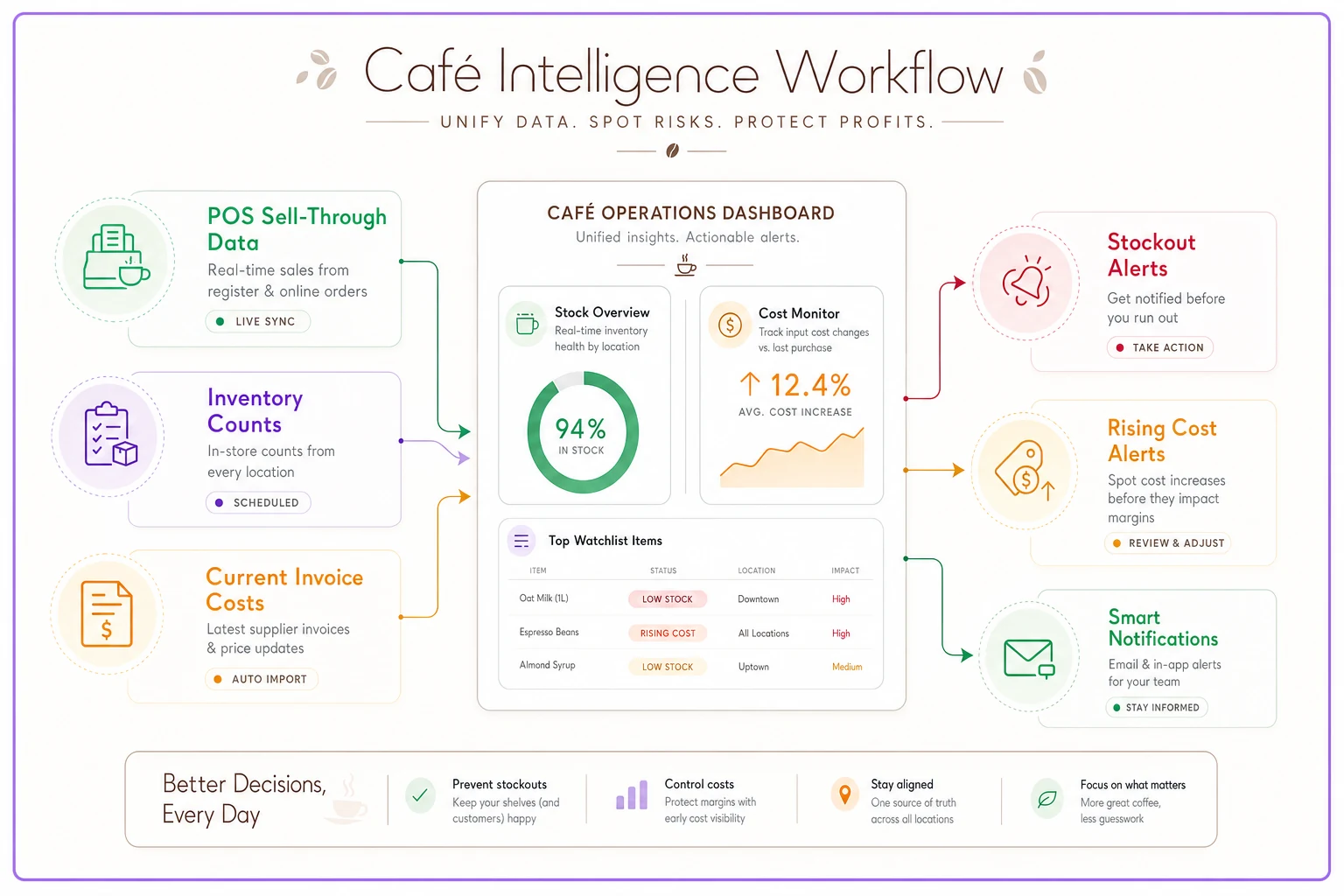
This diagram shows how POS, inventory, and invoice data connect to surface problems quickly.
That's where a connected operational setup earns its keep. When your POS sell-through, inventory counts, and current invoice costs live in one place, stale pars and creeping input costs surface on their own instead of waiting for you to go hunting. The value isn't automation for its own sake — it's that you catch the oat-milk problem in three days instead of finding it in the P&L a month later. During a normal week that's a nice-to-have. During a demand surge, it's the difference between the surge paying off and the surge just making you tired.
The takeaway
A business-activity surge is an opportunity, but one that punishes sloppy controls. The cafés that come out of this stretch ahead won't be the ones that worked the hardest — they'll be the ones whose assumptions stayed current while demand and costs were both moving. Run the checklist. Find your two or three real leaks. Decide deliberately between absorbing and acting on each cost move. Staff the peak, not the whole day. And give yourself a way to see drift early, because the one thing a surge guarantees is that whatever was quietly wrong in your operation is about to get louder.
Ready to brew operational excellence?
Join hundreds of coffee shops using Coffehq to boost efficiency, reduce waste, and elevate customer satisfaction.