

Coffee shops live and die on a handful of volatile inputs: green coffee, milk, oat milk, and increasingly cocoa and vanilla. When one spikes, most owners do one of two things — panic-buy way too much, or freeze and eat the margin hit for months. Neither is a plan.
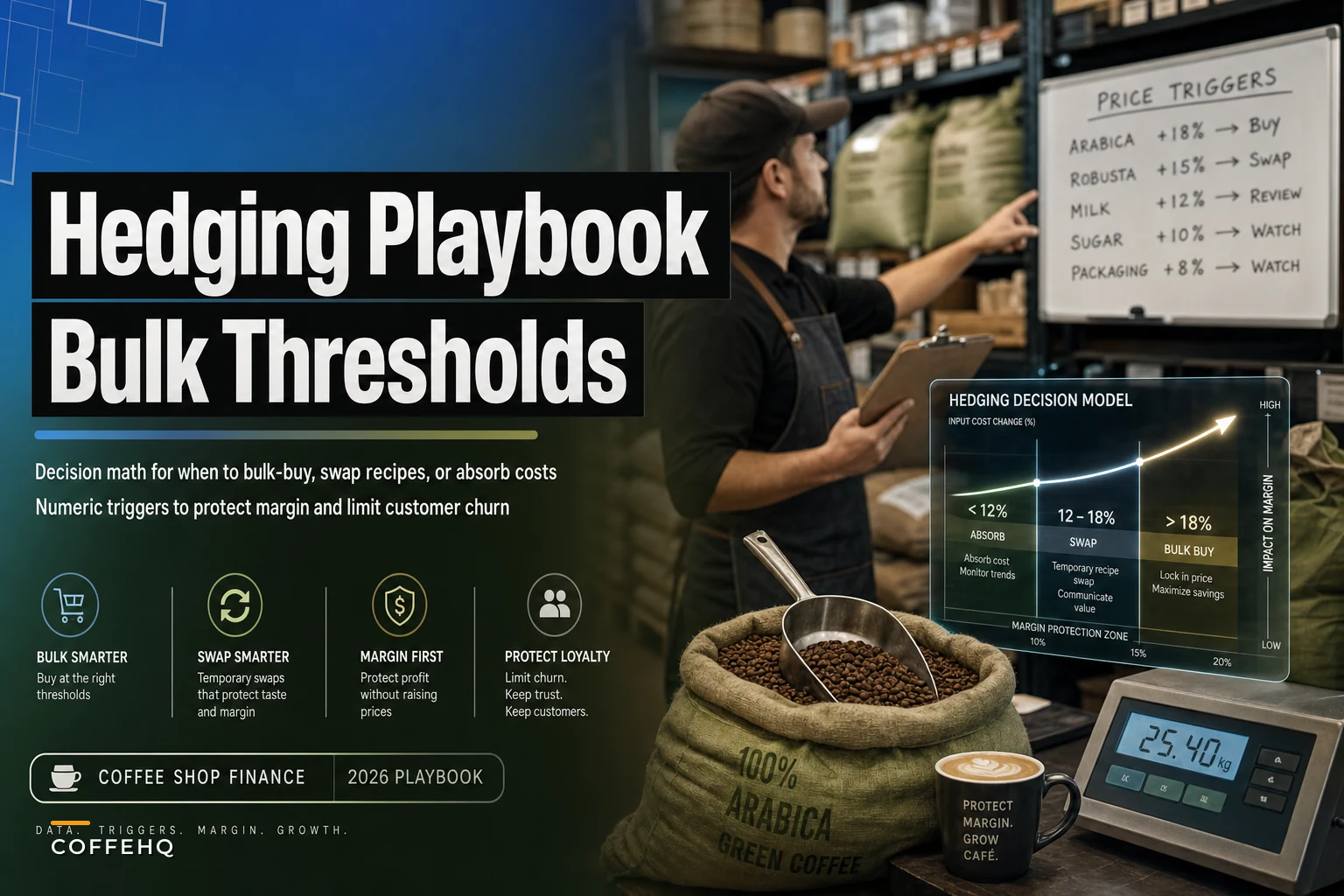
What's missing is a set of triggers. Real numbers that tell you this is the point where bulk-buying makes sense, this is where you swap a recipe temporarily, and this is where you have to touch the menu price. Without thresholds, every price shock turns into a gut-feel argument between you and whoever runs your ordering.
This is a decision playbook for cafe raw material hedging built around specific triggers, not vibes. It assumes you already track COGS and know your rough usage. If you don't have that baseline yet, the purchase-to-stock playbook is worth fixing first — hedging on top of shaky inventory data just amplifies mistakes.
First, the number everything hangs on: your input's share of the drink
Before any threshold works, you need to know what each input actually costs you per unit sold, not per case. This is where most cafes get their hedging math wrong — they react to a "40% price jump on beans" without knowing that beans are only, say, 18% of the cost of a latte.
| Input | Cost per latte | Share of drink cost |
|---|---|---|
| Espresso (beans) | $0.32 | 34% |
| Milk | $0.28 | 30% |
| Cup + lid + sleeve | $0.19 | 20% |
| Labor allocation | $0.12 | 13% |
| Misc (sweetener, etc.) | $0.03 | 3% |
A 25% jump in green coffee moves that latte cost up about $0.08. A 25% jump in milk moves it $0.07. Individually, neither is a crisis. But when two hit in the same quarter — which is exactly what tends to happen — you're suddenly $0.15 heavier on a drink you sell for $4.75, and if that drink is a third of your volume, the drip adds up fast.
The insight most owners miss: the input's price change matters far less than its share of the drink. A scary-sounding vanilla spike on a syrup that's 2% of a mocha barely registers. A quiet 12% milk creep across your entire café is a real problem. Rank your inputs by share, not by how loud the price move sounds.
The three levers and their trigger points
You've got three tools. Each has a cost, and each has a threshold where it starts making sense.
Keep every order and shift perfectly aligned.
Coffehq helps you manage orders, inventory, and staff schedules seamlessly.
- Unified order processing
- Real-time inventory updates
- Staff shift coordination
No credit card required
Lever 1 — Bulk buy / forward purchase. Lock in current pricing by buying ahead. Costs you cash flow and storage, and risks spoilage on anything perishable. Lever 2 — Temporary recipe swap. Substitute a cheaper equivalent input, or reformulate slightly, while a price is elevated. Costs you consistency risk and some prep friction. Lever 3 — Price change. Pass the cost to the customer. Costs you goodwill and, potentially, churn.
| Situation | Trigger | Lever to pull |
|---|---|---|
| Input is <10% of drink cost, spike is temporary | Any spike under ~30% | Absorb it. Don't touch anything. |
| Input is shelf-stable, price up 15%+, expected to hold 2+ months | Forward-buy price beats current by 12%+ after storage cost | Bulk buy |
| Input is perishable OR spike likely short (<6 weeks) | Drink-cost impact 3–6% | Temporary recipe swap |
| Blended COGS up 4%+ and holding, multiple inputs hit | Sustained 60+ days | Price change |
The point of the table isn't to follow it religiously. It's to force the conversation into numbers so you stop debating whether a spike "feels" big enough to act on.
When bulk-buying actually makes sense
Forward-buying is the most overused lever because it feels proactive. But it only pays off under fairly narrow conditions.
-
Confirm shelf life covers the buy. Green coffee
fine for months. Roasted beans: 3–4 weeks of freshness realistically, so bulk-buying roasted is usually a trap. Oat milk shelf-stable cartons: months. Dairy: no.
-
Calculate the real forward discount. Take the price you're locking, subtract current price, then subtract storage and spoilage risk. If you're not netting at least ~10–12% savings, the cash tie-up isn't worth it.
-
Cap the buy at demonstrated usage. Never forward-buy more than you sold of that input in the same window last year, plus maybe 15%. Overbuying "because it's cheap" is how cafés end up throwing out $600 of stale beans.
-
Check your cash cushion. If the buy pushes your operating cash under about three weeks of expenses, skip it. A good deal that strangles payroll is not a good deal.
A realistic example: a café goes through roughly 40 lbs of green coffee a month. Their roaster offers a 90-day forward lock at $6.10/lb versus a spot price trending toward $7. Locking 120 lbs costs about $732 up front and saves close to $110 over the quarter versus buying spot. Green stores fine, the usage is proven, and the cash hit is manageable. Clean yes.
Now flip it: the same café is tempted to lock 200 lbs "to be safe." That extra 80 lbs sits past its freshness window, quality dips, and they're pulling shots off flat beans by week ten. The savings evaporate into complaints. The discipline is in the cap, not the deal.
When to swap a recipe temporarily (and how to do it quietly)
Recipe swaps are the underused lever, mostly because owners worry customers will notice. In practice, the swaps that survive are the ones customers don't notice — and there are more of those than you'd expect.
-
Shifting a single-origin house espresso to a blend when the origin spikes, keeping the flavor profile close
-
Moving one syrup brand to an equivalent when a specialty flavor jumps
-
Adjusting oat milk brand during a supply crunch (test the steaming behavior first — this one does get noticed if the foam changes)
Swaps that backfire:
-
Cutting espresso dose to stretch beans — regulars taste a weak drink immediately
-
Watering down or reducing a signature ingredient
-
Swapping milk fat content on drinks where texture is the whole point
The operational rule: a temporary swap needs an end date and a taste check on day one. Write the swap, its trigger price, and its review date on the same sheet where you track the input. If the price falls back under threshold, you revert. Swaps that quietly become permanent are how a café's quality erodes without anyone consciously deciding it should.
One thing worth flagging — swaps and forward-buys interact. If you can bulk-buy your way through a short spike on a shelf-stable input, do that instead of swapping. Save recipe swaps for perishables and for spikes too long to buy through.
When you actually have to raise the price
Price changes are the last lever, but delaying them too long is more expensive than most owners admit. If blended COGS is up 4%+ and holding for 60 days, absorbing it isn't a strategy anymore — it's a slow leak that usually shows up as a mysteriously shrinking cash balance nobody can quite explain.
The goal is to move price with minimal churn. A few things that consistently reduce pushback:
-
Round to friendly numbers, less often. One $0.25 move once a year annoys people far less than three $0.10 nudges. Frequent small bumps make customers feel nickel-and-dimed.
-
Move the right items. Raise price on high-volume, low-elasticity drinks (your house latte, drip) before touching the emotional stuff like a $3 drip that regulars anchor to.
-
Don't raise everything. Hold two or three "anchor" prices flat and let customers see them. It signals you're not just gouging.
-
Time it with something visible. A seasonal menu refresh gives price changes cover. A random Tuesday increase feels like a cash grab.
Tie the price move back to your model so you know the actual margin recovery before you touch anything. If you've built the kind of spreadsheet-first P&L model where every lever connects to the bottom line, you can see whether a $0.25 bump on lattes actually closes the gap or whether you need to touch a second item.
Communicating the change without triggering churn
Most churn from a price increase doesn't come from the increase itself — it comes from customers feeling surprised or disrespected. A small tent card that says the espresso price reflects current bean costs, done a week ahead, does more to protect your regulars than any amount of over-explaining. Keep it short, factual, and don't over-apologize — it signals guilt and makes people wonder what else changed.
When hedging is a bad idea
A few situations where you should not run this playbook:
-
You don't know your per-drink input costs yet. Fix that first. Hedging on guessed numbers loses money faster than doing nothing.
-
Your cash is thin. Forward-buying with no cushion turns a pricing problem into a payroll problem.
-
The spike is genuinely temporary and small. Under ~30% on a minor input for a few weeks — just absorb it. The operational effort of swapping or announcing a change costs more than the spike.
-
You're a brand-new café. You don't have the usage history to size buys or the customer trust to move prices. Get six months of clean data first.
Get six months of clean data first.
A real scenario
A two-barista neighborhood café — roughly 220 drinks a day — hit a quarter where milk crept up about 14% and their house espresso origin jumped near 30% at the same time. Blended drink cost rose around 5%. They'd been absorbing it for about seven weeks and their monthly cash was drifting down by something like $700–$900 with no obvious cause.
They ran the thresholds. Milk: perishable, can't bulk-buy, so no direct lever there. Espresso: shelf-stable green, so they forward-locked about 100 lbs at a rate that saved close to $90 over the quarter and stabilized the bigger input. For the milk, they did a small price move — $0.25 on lattes and cappuccinos only, held drip and their signature seasonal drink flat, and timed it with the fall menu.
Over the next two months, margin recovered to roughly where it had been, cash stopped bleeding, and they lost maybe a handful of complaints but no measurable drop in traffic. The thing that made it work wasn't the specific moves — it was having a rule that said when to make them, so they acted at week seven instead of month five.
Keeping the thresholds alive
Thresholds only work if someone's watching the inputs against them week to week. This is where a lot of cafés fall down — the plan exists, but nobody's checking milk and bean prices against trigger points during a busy shift.
A simple monitoring workflow looks like this:
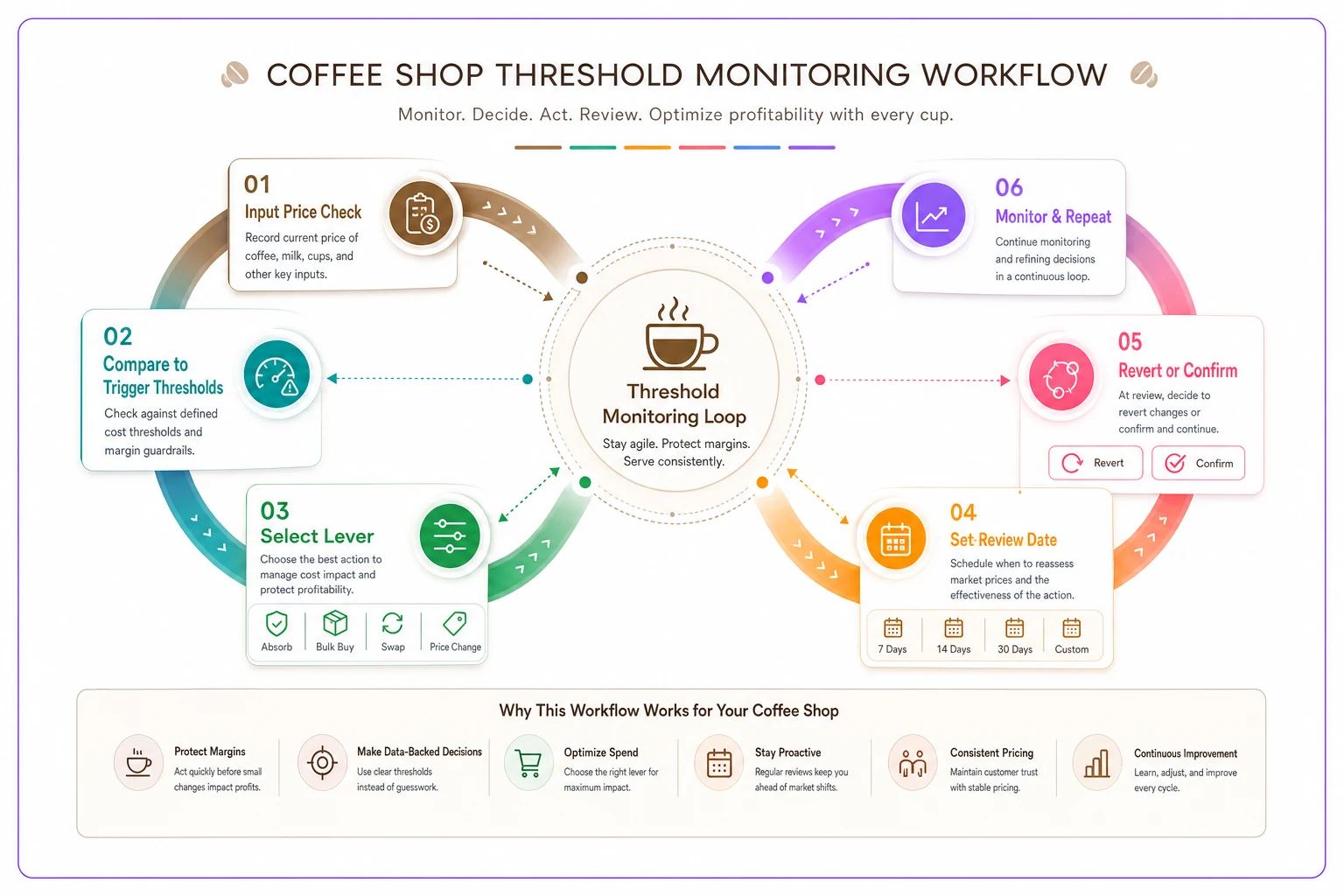
Check supplier quotes first thing Monday morning and log them — small weekly checks catch trends before they compound.
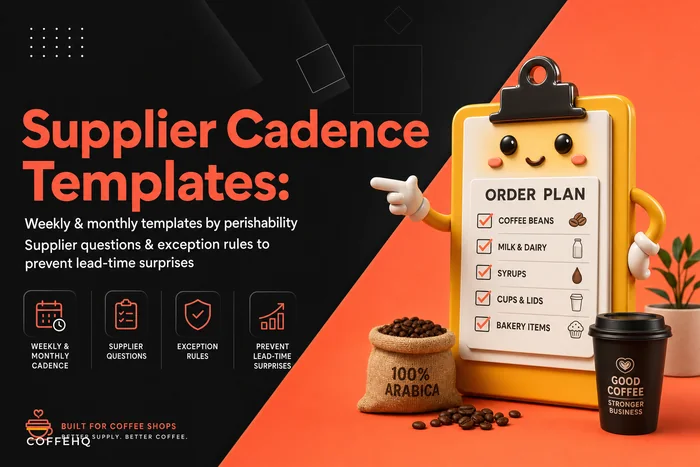
Building this into your regular supplier review, the same rhythm covered in the supplier cadence templates, is what keeps hedging from becoming a once-a-year panic instead of a routine. The review doesn't need to be long — five minutes on a Monday morning comparing current quotes to your trigger sheet is enough. The cadence matters more than the depth.
Turning hedging into numbers takes the emotion out of it. You stop arguing about whether a spike is "bad enough." You look at the input's share of the drink, check how long the spike is expected to hold, and pull the lever the thresholds point you to. The discipline is boring, and boring is exactly what protects your margin when three inputs decide to move at once.
Ready to brew operational excellence?
Join hundreds of coffee shops using Coffehq to boost efficiency, reduce waste, and elevate customer satisfaction.