

Most cafés measure pastry waste the wrong way. The closer counts what's left, writes a number on a clipboard, tosses the croissants, and goes home. The number sits in a drawer. Nobody reads it. And the next morning, the opener orders the exact same amount as always because that's what the standing order says.
That gap — between counting waste and acting on it — is where real money leaks. Not dramatically. Quietly. Two extra almond croissants a day at roughly $1.10 cost each works out to about $800 a year on that one SKU alone, and most cafés have eight to twelve pastry SKUs doing the same thing.
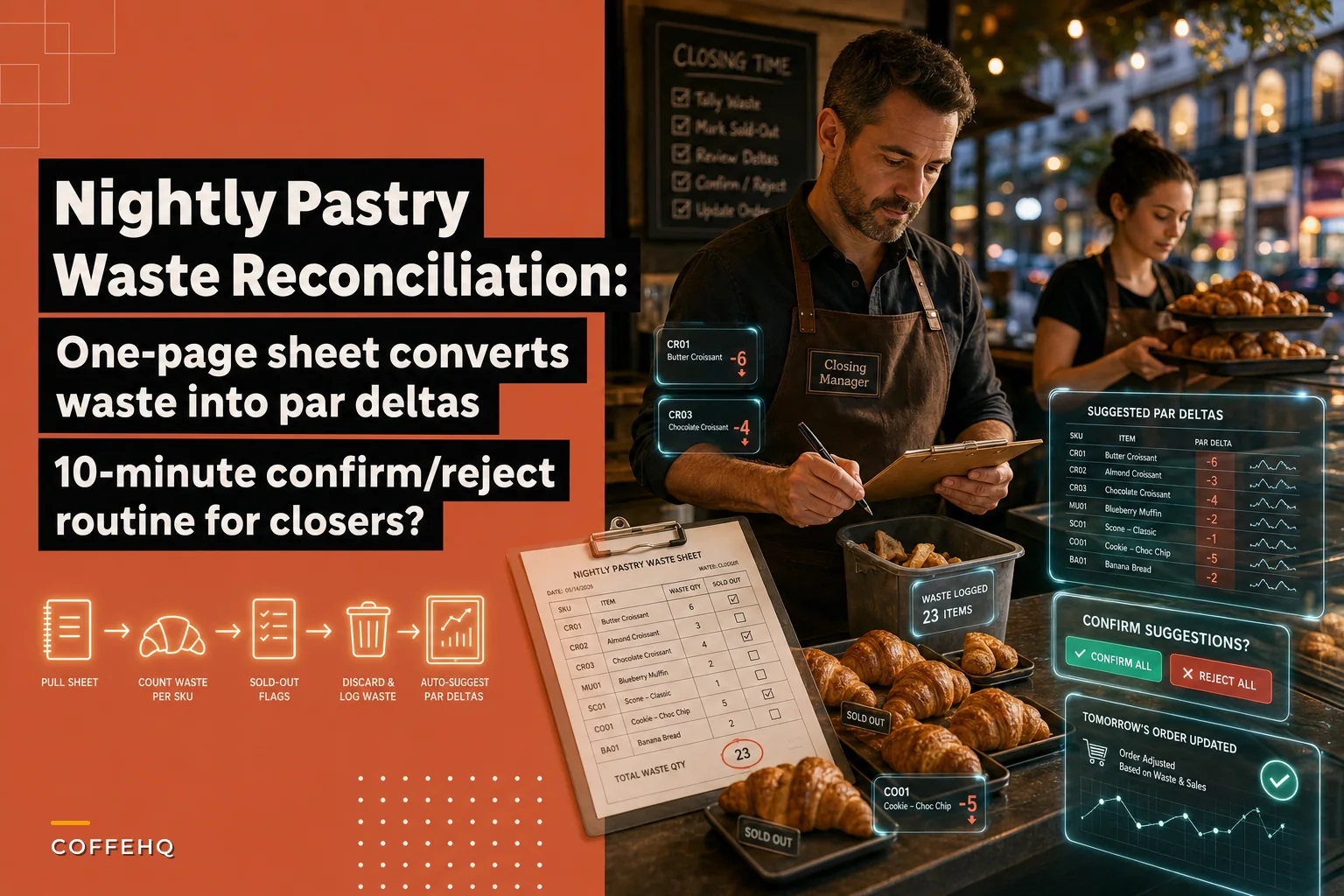
This is a tight routine for fixing that gap in about ten minutes a night. It converts the evening waste count directly into a par adjustment suggestion, gives the closer (or you) a simple confirm-or-reject decision, and feeds a cleaner number into tomorrow's order. No spreadsheets at midnight. No "we'll review it at the end of the month."
Why the counting-but-not-acting pattern is so sticky
It's not laziness. The waste count and the ordering decision live in two different heads, at two different times, with no real connection between them.
The closer counts waste at 8:45 PM. The order gets placed by the opener at 6:15 AM, or auto-submits overnight. By the time anyone could act on last night's numbers, the window has already closed and the standing par is locked in. So the count becomes a logging ritual with no feedback loop attached to it.
-
Par levels get set once and never revisited. Someone picked "12 blueberry muffins" during the first month and it's been 12 ever since — through seasonal swings and a menu that's changed twice.
-
Waste counts round up emotionally. Closers hate throwing away food, so they under-count or quietly take some home, which hides the real signal.
-
Weather and day-of-week get ignored. Monday waste and Saturday waste get averaged into one meaningless number.
-
The person who orders doesn't see the waste. Classic separation of information. The decision-maker is flying blind.
If you've already tightened up how you set baseline pars, this routine is the daily layer on top of that. Getting the foundation right first matters — our breakdown on how to calculate perishable par levels and reorder points covers the starting-point math. This article is about the nightly nudge that keeps those pars honest as reality drifts.
The core idea: a par delta, not a raw count
The whole routine hinges on one shift in thinking. Don't write down "6 muffins wasted." Write down what the waste implies you should do to tomorrow's par.
Keep every order and shift perfectly aligned.
Coffehq helps you manage orders, inventory, and staff schedules seamlessly.
- Unified order processing
- Real-time inventory updates
- Staff shift coordination
No credit card required
A raw count is data. A par delta is a decision. The sheet should handle the small bit of thinking in between so the closer doesn't have to.
The logic is straightforward:
-
Consistent small waste (1–2 units, several days running) → drop par by 1
-
Zero waste AND you sold out before close → raise par by 1–2
-
Big one-off waste from an obvious cause (rain, event cancelled) → no change, note the reason
-
Zero waste but you didn't sell out → hold par, you're dialed in
That's it. The closer isn't forecasting. They're pattern-matching against four clear rules and writing the suggested delta.
The one-page evening sheet
Here's the layout. Built to be filled in standing up, at the counter, in under ten minutes. One row per pastry SKU.
Below is how the sheet looks in practice — five SKUs, one night's data:
| SKU | Par today | Made/received | Sold out? (Y/N) | Waste count | Suggested par delta | Confirm / Reject | Reason (if reject) |
|---|---|---|---|---|---|---|---|
| Butter croissant | 18 | 18 | N | 3 | −1 | ||
| Almond croissant | 12 | 12 | Y | 0 | +2 | ||
| Blueberry muffin | 12 | 12 | N | 1 | hold | ||
| Pain au chocolat | 15 | 15 | N | 5 | −2 | ||
| Scone (seasonal) | 10 | 10 | Y | 0 | +1 |
The "Suggested par delta" column is the heart of it. The closer reads their waste count and the sold-out flag, applies the four rules, and writes the suggestion. Then — and this is the part that actually makes it work — they make a conscious confirm or reject decision for the next order.
Reject is not a failure. Reject is where the human context lives. "Rejected −2 on pain au chocolat because a tour bus cancelled, not a real demand drop." That one note prevents a knee-jerk par cut that would've left you short the next busy day.
Why confirm/reject beats auto-adjusting
You might be tempted to skip the human step and just auto-apply the deltas. Don't. Not at first.
Pure automation on pastry pars breaks in predictable ways: it over-reacts to one bad-weather day, it doesn't know a local event is happening tomorrow, and it slowly starves a growing SKU because it only sees waste — not the sold-out demand you never captured. The confirm/reject gate keeps a human in the loop for exactly the judgment calls that are easy to get wrong.
What the sheet does well is the boring part — surfacing the suggestion so the person doesn't have to remember the rules or dig through old counts. What the human does well is catch the exceptions. Keep both.
Once you've run this for a few weeks and your reject rate on a given SKU drops near zero, that's the signal that SKU is stable enough to trust tighter automation on. Earn the automation; don't assume it.
A realistic example of the delta compounding
A neighborhood café running about 10 pastry SKUs started this routine mostly to stop the recurring "why are we still throwing out five pain au chocolat every night" conversation.
Before: standing par of 15, averaging 4–5 wasted daily. Nobody had touched the number in over a year.
Running the nightly sheet, the closer logged the delta three nights in a row: −2, −1, −1 (one night rejected because a confirmed catering pickup hadn't materialized). Over about two weeks the par settled at 11. Waste on that SKU dropped to roughly one a day — which is actually the healthy buffer you want. Enough that you're not running out, but not hemorrhaging margin either.
On the flip side, almond croissants had been selling out by 2 PM for weeks — pure lost revenue nobody flagged because there was no waste to count. The +2 suggestions nudged par from 12 to 15 over the same period, and those extra three sold through most days.
Net effect across all SKUs after a month: waste down by something like a third, and a couple of previously-capped sellers finally moving to their actual demand. Not a dramatic turnaround. Just steadily less money in the bin. That's the whole point — small, repeated corrections.
The 10-minute closer routine, step by step
Most of the time spent on this routine is just the waste count itself. Everything else takes under two minutes once the habit is set. Here's the sequence:
-
Pull the sheet with today's pars already filled in (or print it fresh each evening with current pars).
-
Count waste per SKU. Actual units, honestly. Pair this with your markdown pass so you're not double-counting things that got discounted and sold — if you don't have a markdown step yet, the pastry display rotation and markdown SOP handles that upstream.
-
Mark sold-out flags. Did any SKU hit zero before close? That's your hidden-demand signal.
-
Apply the four rules to write a suggested delta per row.
-
Confirm or reject each delta. Reject gets a one-line reason.
-
Update tomorrow's order from the confirmed deltas, then leave the sheet where the opener will see it.
The sold-out flag in step 3 is the piece most waste logs miss entirely. Waste tells you where you ordered too much. Sold-out tells you where you ordered too little. You need both, or you'll only ever shrink — never grow the right SKUs.
Here's a quick visual of the workflow to keep on the wall while you're training.
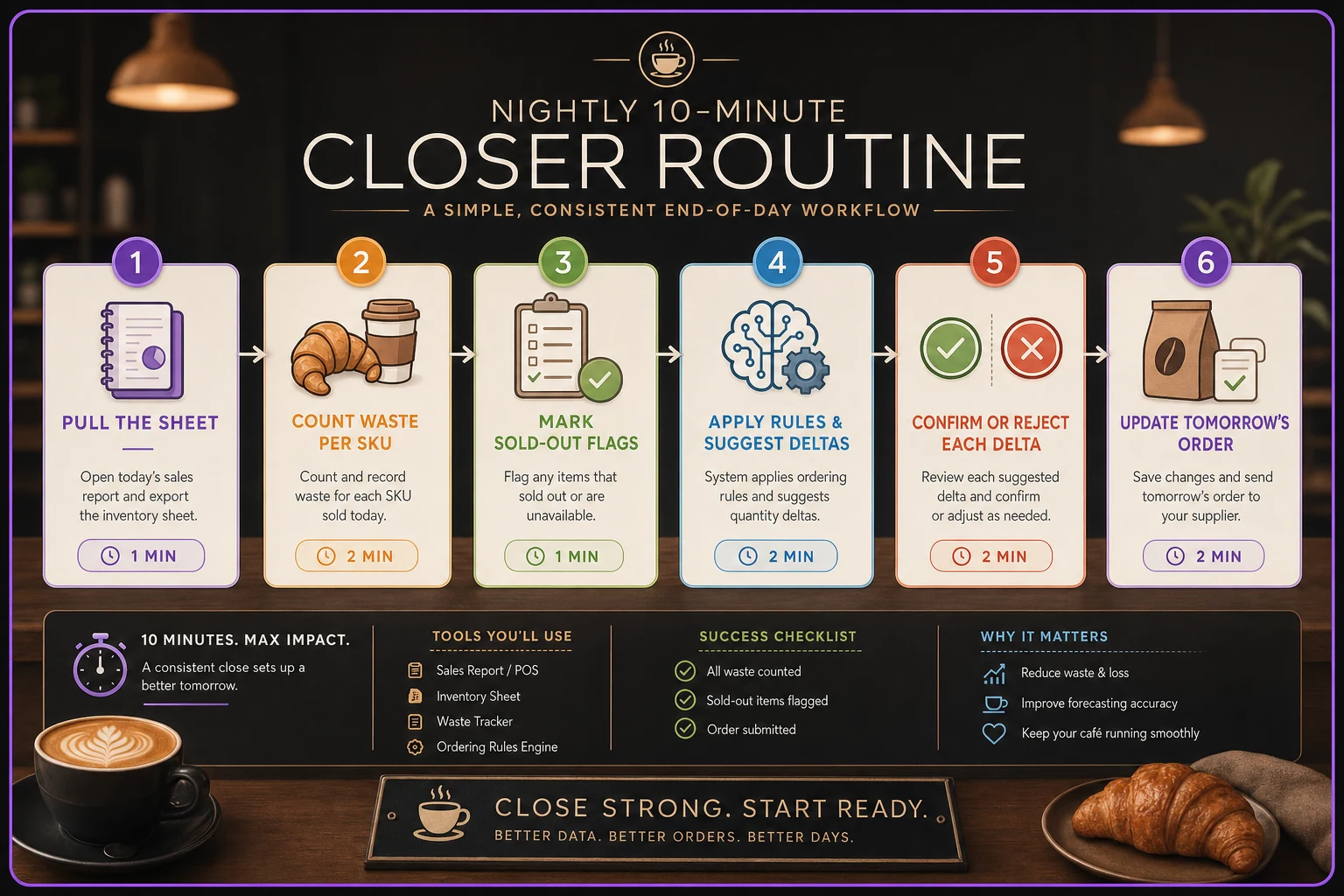
Keep this near the register as a reminder while the closer gets the hang of it.
Quick training notes for closers
Hand this to anyone who closes. It fits on a sticky note:
-
Count real units. Under-counting to feel better hides the problem and keeps over-ordering alive.
-
Sold out = a signal, not a win. If it's gone before close, we probably left money on the table. Flag it.
-
One weird night isn't a trend. Rain, a cancelled event, a slow Tuesday — reject the delta and write why.
-
Deltas are small on purpose. Move by 1–2 units, never 5. Slow and steady finds the right number without whiplash.
-
When unsure, hold and note it. "Hold + reason" is always a safe answer.
When unsure, hold and note it.
The training goal is consistency, not precision. A closer who applies the rules the same way every night produces a trustworthy trend line. A closer who improvises produces noise.
When this routine makes sense — and when it doesn't
Do this if you have a handful to a dozen pastry SKUs, a standing order that rarely gets questioned, and recurring waste you've been meaning to address but never systematically have. This is squarely for the café that's been "going to look at pastry waste" for months.
Skip or simplify if your pastry program is tiny — three SKUs, baked in-house to order — you probably already have an intuitive feel and the sheet is overhead. Same goes if you're running high volume with a dedicated inventory system already pushing par recommendations. The manual sheet is a step backward in that case.
Don't let the closer run it alone forever. For the first couple of weeks, the manager should review the sheets each morning. Not to second-guess every call, but to calibrate the four rules to your actual patterns and catch a closer who's quietly rejecting every suggestion to avoid changing anything.
Where this is heading
Run the sheet by hand first. Genuinely — do a few weeks on paper. You'll learn which SKUs are volatile, which closers count honestly, and how fast your demand actually shifts. That knowledge is worth more than any tool.
Once the routine is second nature and your reject reasons start repeating ("always short on Saturdays," "always over on rainy Mondays"), those patterns are exactly what AI-powered operational software can take off your plate — pre-filling the suggested delta, carrying forward sold-out signals, and flagging the SKUs that have earned tighter control. The manual version teaches you what to trust before you let anything run on its own.
Do the manual version first. The win available tonight is simpler than any software: stop letting the waste count die in a drawer. Turn it into a delta, make a confirm-or-reject call, and let tomorrow's order be a little bit smarter than today's. Ten minutes, one page, done before you lock up.
Ready to brew operational excellence?
Join hundreds of coffee shops using Coffehq to boost efficiency, reduce waste, and elevate customer satisfaction.