


Every morning around 6:45am, your opening barista faces the same decision: which pastries from yesterday's case get marked down, which get tossed, and how many fresh ones go out. Most cafés handle this with gut instinct—maybe the almond croissant "looks fine" or the blueberry muffin "still feels soft." By noon, you've either thrown away $40 in perfectly sellable product or you're serving day-old items at full price while fresh ones sit in back. The real problem isn't freshness judgment. It's the absence of a pastry display rotation SOP that connects individual SKU lifecycles to markdown triggers, staffing cues, and actual sales patterns. When you're tracking 12-15 different pastries without clear display windows and markdown thresholds, you're basically guessing at thousands of dollars in monthly pastry revenue.
Why pastry rotation breaks down in real café operations
Most café owners think pastry management is straightforward—bake or receive, display, sell, repeat. Operational reality hits different when you're dealing with multiple delivery schedules, varying shelf lives, and inconsistent customer patterns.
Take a typical Tuesday morning. Your wholesale bakery delivers at 5:30am: pain au chocolat (2-day shelf life), berry Danish (1.5 days), morning buns (3 days). Meanwhile, yesterday's house-made scones still have 8 hours left, and Saturday's cookies technically expire today but still taste fine. Your morning barista needs to arrange all this in a case that holds maybe 60% of total pastry inventory, decide what gets marked down, update labels, and open by 7am.
Without clear per-SKU rules, every barista makes different calls. One tosses anything over 24 hours old. Another keeps items until they look stale. A third invents their own markdown system with hand-written tags. By Thursday, you're out of popular items while three-day-old lemon bars occupy prime display space.
The financial hit compounds weekly. Excessive waste runs around $280-350 per week for a typical 40-seat café. But the opportunity cost of not marking down properly? That's another $180-220 in lost recovery revenue when customers skip full-price day-old items that would've moved at 40% off.
Per-SKU display windows that actually match operations
Building display windows for each pastry SKU starts with understanding three things: actual shelf life versus perceived freshness, peak selling windows, and markdown recovery potential.
Keep every order and shift perfectly aligned.
Coffehq helps you manage orders, inventory, and staff schedules seamlessly.
- Unified order processing
- Real-time inventory updates
- Staff shift coordination
No credit card required
-
Croissants and laminated pastries
- Display window: 0-18 hours - Markdown trigger: 18 hours from bake time - Markdown depth: 40% off - Final pull: 28 hours - Label requirement: "Baked [time] on [date]"
-
Muffins and quick breads
- Display window: 0-36 hours - Markdown trigger: 24 hours from delivery/bake - Markdown depth: 30% off first day, 50% second day - Final pull: 48 hours - Label requirement: "Fresh until [date + time]"
-
Cookies and bars
- Display window: 0-72 hours - Markdown trigger: 48 hours from packaging - Markdown depth: 25% off - Final pull: 96 hours - Label requirement: "Best by [date]"
-
Danish and filled pastries
- Display window: 0-16 hours - Markdown trigger: 12 hours from delivery - Markdown depth: 50% off - Final pull: 20 hours - Label requirement: "Made fresh [date]"
The key is matching these windows to your actual prep and delivery schedule. If your bakery delivers at 5:30am and you prep house items at 6am, your markdown checks happen at predictable times: 11:30am for morning Danish, 5:30pm for croissants, and during tomorrow's opening for muffins.
Markdown triggers tied to forecasted demand
Static markdown rules fail because demand fluctuates. Marking down croissants at 40% every day at 6pm makes no sense when you know tomorrow's 8am meeting order needs 30 pieces. This is where simple forecasting templates become essential for pastry operations.
Your markdown triggers should adjust based on three factors:
Tomorrow's forecast: If you expect 20% higher traffic tomorrow morning—maybe it's payday Friday—delay markdowns by 2-3 hours today. Those croissants might still sell full price to evening customers grabbing tomorrow's breakfast.
Current inventory depth: When you have 8 chocolate croissants at 4pm on a day that typically moves 2-3 evening pastries, mark down aggressively. But if you're down to 2 pieces, hold full price.
Historical recovery rate: Track what actually sells at markdown prices. If your 40%-off croissants have an 85% sell-through rate but 30%-off only moves 45%, the deeper cut pays off despite the lower per-unit margin.
A practical markdown decision matrix:
| Current Stock | Tomorrow's Forecast | Time Until Close | Markdown Action |
|---|---|---|---|
| >6 pieces | Below average | >3 hours | 40-50% off now |
| >6 pieces | Average/above | >3 hours | 30% off now |
| 3-5 pieces | Any forecast | >3 hours | 25% off |
| <3 pieces | Below average | <3 hours | 30% off |
| <3 pieces | Average/above | Any time | Hold full price |
A practical markdown decision matrix:
Printable labels that eliminate confusion
Hand-written markdown tags create operational chaos. Different handwriting, inconsistent information, missing details—it all leads to register confusion and customer complaints. A proper pastry display rotation SOP needs standardized, printable labels that any staff member can generate.
Your label templates need four elements:
-
Primary information (large, bold)
- Product name - Current price (crossed out if marked down) - Markdown price (if applicable)
-
Time-based data (smaller but visible)
- "Baked/Made: [date + time]" - "Markdown expires: [time]" - "Remove by: [date + time]"
-
Visual coding
- Color bands: Green (fresh), Yellow (markdown today), Red (final hours) - Shape coding: Rectangle (regular), Circle burst (special/markdown)
-
Register reference
- SKU or button name for POS system - Markdown code if your system requires it
Use a consistent time format (e.g., "5:30am Tuesday") across all label templates to avoid staff confusion during shift changes.
A working example: a Danish delivered at 5:30am gets a green-banded label reading "Cherry Danish - $4.50 - Made 5:30am Tuesday." At 5:30pm—the 12-hour markdown trigger—staff prints a yellow-banded replacement: "Cherry Danish - ~~$4.50~~ $2.25 - Made 5:30am Tuesday - Remove by 1:30am Wednesday."
The operational value here is visual. Staff can scan the case at a glance—too much yellow means you need to push markdowns harder, all green means waste risk is building, a healthy mix means you're roughly on track.
Staffing cues that sync with rotation schedules
Pastry rotation tasks cluster at predictable times, but most cafés spread them randomly throughout shifts. This creates two problems: critical rotation moments get missed during rushes, and slow periods have no structured tasks to fill them.
-
Opening (6
30-7:30am)
: - Pull expired items from case and back stock - Receive/prep fresh items - Generate fresh labels for all new products - Arrange case with fresh in front, older behind - Count waste for tracking -
Mid-morning check (10
30-11am)
: - Evaluate morning pastry movement - Identify slow-moving SKUs for early markdown - Adjust afternoon delivery quantities if needed - Print markdown labels for afternoon trigger times -
Afternoon rotation (2
30-3pm)
: - Execute primary markdowns for morning-baked items - Consolidate partial trays to maximize display space - Update case arrangement for afternoon traffic - Prep labels for evening markdowns -
Evening assessment (6
30-7pm)
: - Final markdowns for recovery - Pull unsellable items - Set aside tomorrow morning's display candidates - Note par level adjustments for ordering
Build these into your shift handoff sheets. When the morning barista knows they own the 11am markdown assessment, it happens consistently. When "someone" should check pastries "when they have time," you find three-day-old Danish at full price.
Connecting display rotation to [par levels](/blog/stop-costly-par-mistakes-how-to-calculate-perishable-par-levels)
Your pastry pars shouldn't exist in isolation from your rotation SOP. Most cafés set pars based on average daily sales, but that ignores the display and markdown lifecycle entirely.
Display maximum: How many of each SKU fit in prime case position? No point in paring 24 muffins if only 8 fit in visible display.
Markdown recovery rate: If chocolate croissants have a 90% sell-through at 40% off but plain croissants only hit 60%, you can run higher pars on chocolate knowing markdowns will clear excess.
Day-of-week patterns: Monday pars might run 30% lower than Friday, but your markdown triggers stay consistent. Build pars that assume some markdown volume on slower days.
Shelf life overlap: When items have 48-72 hour shelf lives, you might have three "generations" in rotation simultaneously. Your par needs to account for display spots, back stock, and incoming delivery.
A working example: blueberry muffins typically sell 12 per day, display maximum is 6, markdown recovery rate is 75%, shelf life is 36 hours. Your rotation par becomes: 6 (display) + 6 (afternoon refresh) + 4 (next morning's opening stock) + 2 (markdown buffer) = 18 pieces, delivered in two batches.
Building visual cues into case arrangement
Physical case layout drives rotation success more than any written SOP. When the display itself guides rotation behavior, even new staff execute properly.
-
Prime zone (eye level, front-center)
- Today's fresh deliveries - High-margin signature items - First 8 hours of shelf life only
-
Standard zone (lower front, sides)
- 8-16 hour products - Regular sellers - Items approaching markdown triggers
-
Markdown zone (designated section, clearly marked)
- All discounted items together - "Today's Deals" signage - Timer or clock showing markdown expiration
-
Exit zone (back corner or separate basket)
- Final-hour sales - "Manager's Special" pricing - Clear "Expires by [time]" marking
This physical structure means anyone can identify what needs rotation just by looking at the case. When markdowns cluster in one designated spot, customers know where to find deals and staff know what needs aggressive selling.
The rotation workflow in practice
[Delivery Arrives / Prep Completed] ↓ [Label Generation + Case Load] ↓ [Mid-Morning Demand Check] ↓ [Markdown Trigger Evaluation] ↓ [Case Consolidation + Label Swap] ↓ [Evening Recovery Markdowns] ↓ [Pull Unsellables + Waste Log] ↓ [Par Adjustment Note for Next Order]
Here's a simple visual of the daily rotation workflow.
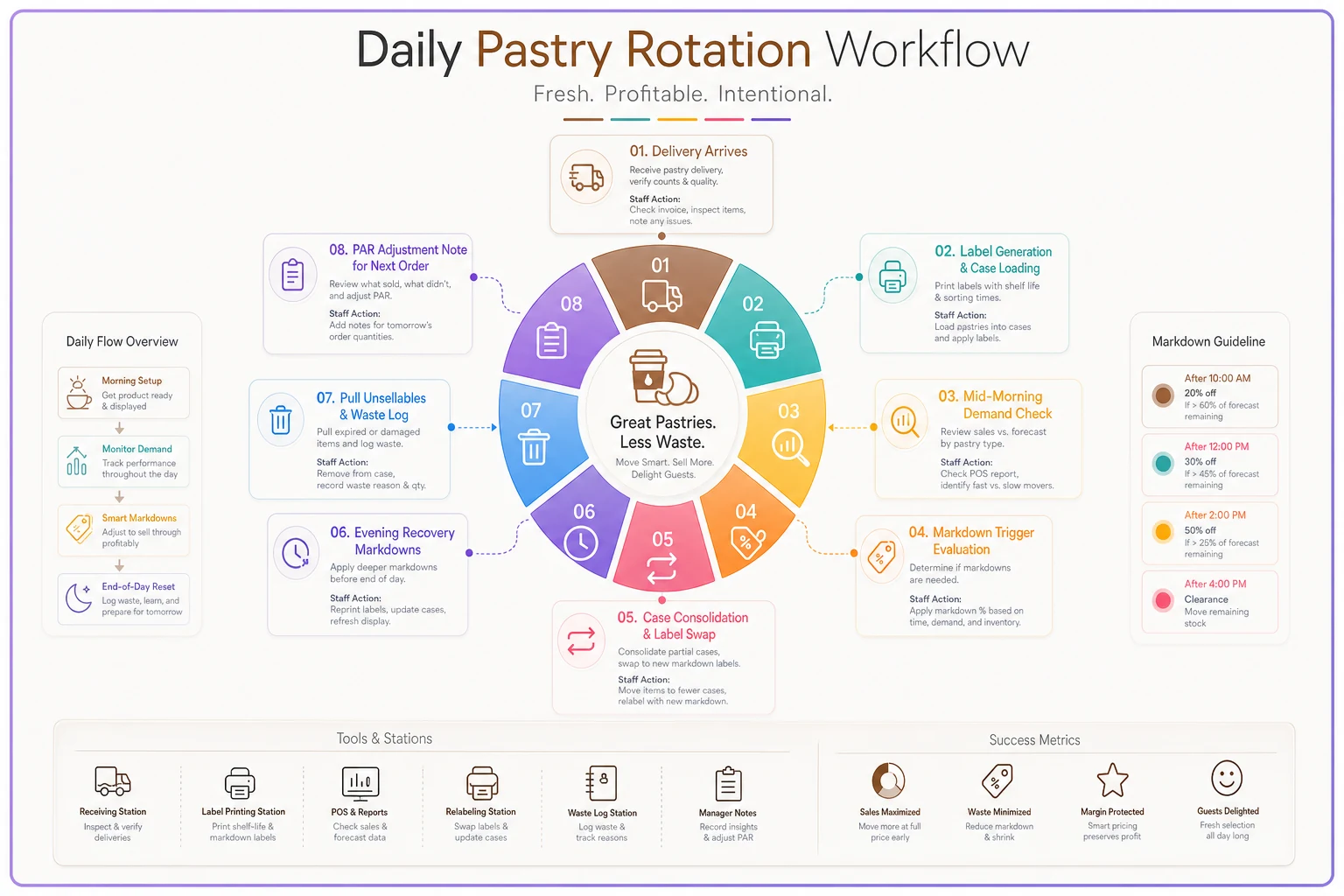
Running through this sequence consistently—even manually—is what separates cafés that recover margin from ones that just throw product away at close.
Real metrics from structured pastry rotation
A neighborhood café with 12 pastry SKUs implemented this exact rotation framework. Previous system: barista judgment, irregular markdowns, roughly $320 in weekly waste. After implementing per-SKU display windows and markdown triggers, here's roughly how it played out:
Weeks 1-2: Waste temporarily increased to around $380 as staff learned to pull items at exact trigger times instead of waiting to see if they'd sell.
Weeks 3-4: Markdown recovery started working. Waste dropped to $240 while markdown revenue added roughly $140 weekly.
Weeks 5-8: Pattern stabilized. Weekly waste settled around $180-200. Markdown recovery came in at $160-180. Net improvement landed somewhere between $260-300 weekly in recovered margin.
The bigger win was customer perception. Reviews mentioning stale pastries dropped to zero. Comments about fresh selection increased. The afternoon markdown section became a legitimate traffic driver, with regulars timing visits around it.
When structured rotation makes sense (and when it doesn't)
This level of rotation structure works when:
-
You carry 8+ pastry SKUs
-
Daily pastry sales exceed $200
-
You source from multiple suppliers with different delivery schedules
-
Your case turnover varies significantly by day
-
Staff consistency is a recurring problem
Skip the full system if:
-
You only carry 3-4 pastry types
-
Everything comes from one supplier with synchronized shelf life
-
Your volume means everything sells same-day
-
You have one experienced manager handling all pastry decisions
For micro-cafés or kiosks, simplified rules work fine: everything gets marked down at 3pm, pulled at close, single-supplier delivery daily.
Turning rotation tasks into operational software
Manual rotation tracking works, but it's exhausting to maintain. Checking timestamps, calculating markdown triggers, printing labels—it adds 30-45 minutes of daily task time spread across shifts. AI-powered operational software can shift pastry management from constant manual vigilance into something that mostly runs in the background.
Modern café management platforms can track individual SKU timers from receipt, flag items approaching markdown triggers, and batch-generate label prints at optimal times. Instead of someone mentally tracking every pastry timestamp, staff get a notification: "3 items need markdown in 30 minutes" with pre-generated labels ready to print.
The real value comes from connecting rotation to other systems. When the platform knows tomorrow's catering order needs 20 croissants, it adjusts today's markdown recommendations accordingly. When it sees slower-than-expected morning sales, it triggers earlier markdowns to ensure recovery before close. When waste patterns emerge for specific SKUs, it flags par adjustments before they become a cost problem.
For multi-location operations, centralized rotation rules mean every location follows the same SOP while still allowing local adjustments for traffic differences. Over time, the platform learns from actual waste and recovery data, refining trigger points and markdown depths for each SKU.
The compound effect of systematic rotation
Most café owners treat pastry as a low-margin convenience category. Structured rotation changes that math considerably. When you recover 60-70% of potential waste revenue through strategic markdowns while maintaining freshness perception, pastries stop being a daily guessing game and start behaving more like a reliable profit center.
The operational discipline required—per-SKU tracking, timed markdowns, standardized labels—seems like a lot upfront. But once it's embedded in daily workflow, it mostly runs on autopilot. Your morning barista doesn't decide what to mark down; they execute predetermined triggers. Your afternoon shift doesn't guess at case arrangement; they follow zone-based placement rules.
Start with your top three selling pastries. Build their display windows, set markdown triggers, create label templates. Run that for two weeks, track the results, then expand to the rest of your SKUs. Within 6-8 weeks, you'll have a complete pastry display rotation SOP that recovers real margin while actually reducing the daily decision burden on staff.
The alternative—continuing with gut-feel rotation—means leaving roughly $15,000-20,000 in annual margin on the table for a typical café. That's pure profit lost to inconsistent markdowns, excessive waste, and missed recovery opportunities. Worth fixing with some printable labels and a few clear trigger rules.
Ready to brew operational excellence?
Join hundreds of coffee shops using Coffehq to boost efficiency, reduce waste, and elevate customer satisfaction.