

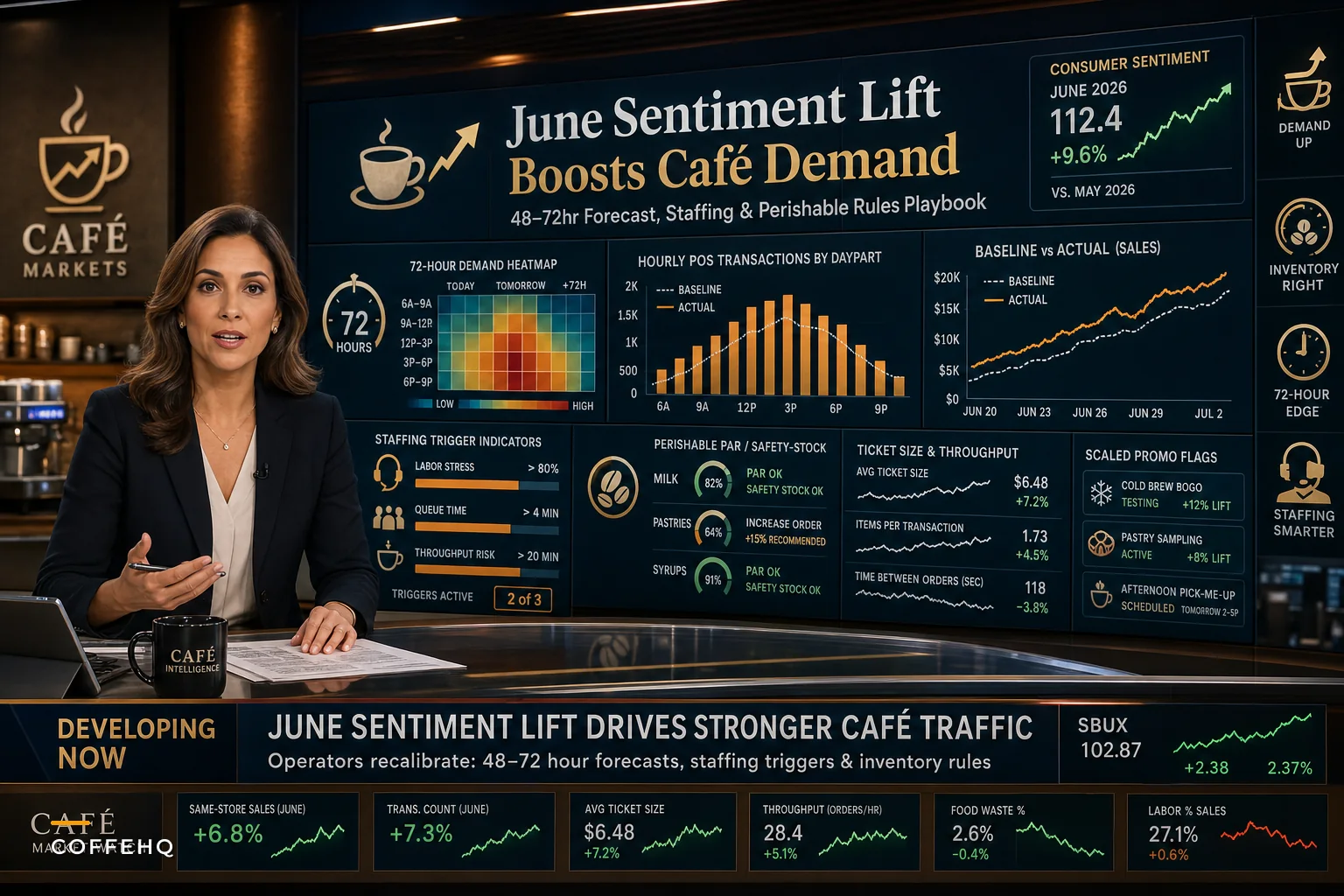

Consumer confidence jumped roughly 10% month-over-month according to the University of Michigan's final June data, hitting 49.5 after bottoming out at 44.8 in May. The Conference Board's index moved in the same direction. Gas prices finally eased off from their spring highs, and people are loosening up a bit heading into July.
For coffee shops, this creates an immediate operational puzzle. After months of tighter consumer spending, you've probably been running lean—minimal perishable inventory, skeleton crews during slow periods, conservative ordering. Now you're staring at a potential foot traffic uptick right as summer peaks, and you need to adjust fast without overcommitting.
The problem with consumer sentiment demand planning isn't really the forecasting. It's that coffee shops typically react to these signals either too aggressively or not at all. I watched three cafes in the same neighborhood handle the last confidence bounce completely differently—one tripled their milk order and watched half of it spoil, another kept status quo and ran out of cold brew concentrate by noon three days in a row, and the third made measured adjustments that captured the upside without the waste.
Why standard forecasting breaks during sentiment shifts
Most cafe forecasting relies on trailing averages and seasonal patterns. You look at last Tuesday's numbers, factor in weather and local events, maybe adjust for the month-over-month trend. Works fine when consumer behavior stays relatively stable.
Sentiment shifts create discontinuities that break your historical patterns. That 10% confidence jump doesn't translate to 10% more customers or 10% higher tickets. The impact shows up unevenly—certain dayparts surge while others stay flat, specific menu categories outperform, and customer mix shifts in ways that affect both throughput and average spend.
There's also the lag problem. Confidence improvements typically take two to three weeks to show up consistently in transaction data. By the time your POS reports confirm the trend, you've already missed the initial surge or overreacted to a few anomalous days.
Small cafes on thin margins can't afford either mistake. You need a framework that lets you test the waters without drowning in spoiled product or angry customers staring at an understaffed counter.
The 72-hour adjustment window
Instead of overhauling your entire operation based on confidence data, use a rolling 72-hour adjustment cycle. Enough data to spot real trends without committing to major changes.
Keep every order and shift perfectly aligned.
Coffehq helps you manage orders, inventory, and staff schedules seamlessly.
- Unified order processing
- Real-time inventory updates
- Staff shift coordination
No credit card required
-
Transaction count by daypart
-
Average ticket size
-
Items per transaction
-
Time between orders
Compare against your baseline from the previous two weeks. Look for patterns that hold across multiple days, not single-day spikes. A Tuesday afternoon rush that repeats Wednesday and Thursday signals something real. One busy Tuesday followed by a normal Wednesday means nothing.
The point is making micro-adjustments based on what you actually observe. If morning transactions jump 15% for three consecutive days, add one extra opener for days four through six. If afternoon tickets increase but transaction count stays flat, people are treating themselves to upgrades—adjust your display case and upsell prompts, not your staffing.
Use this quick workflow to visualize the 72-hour cycle and decision triggers.
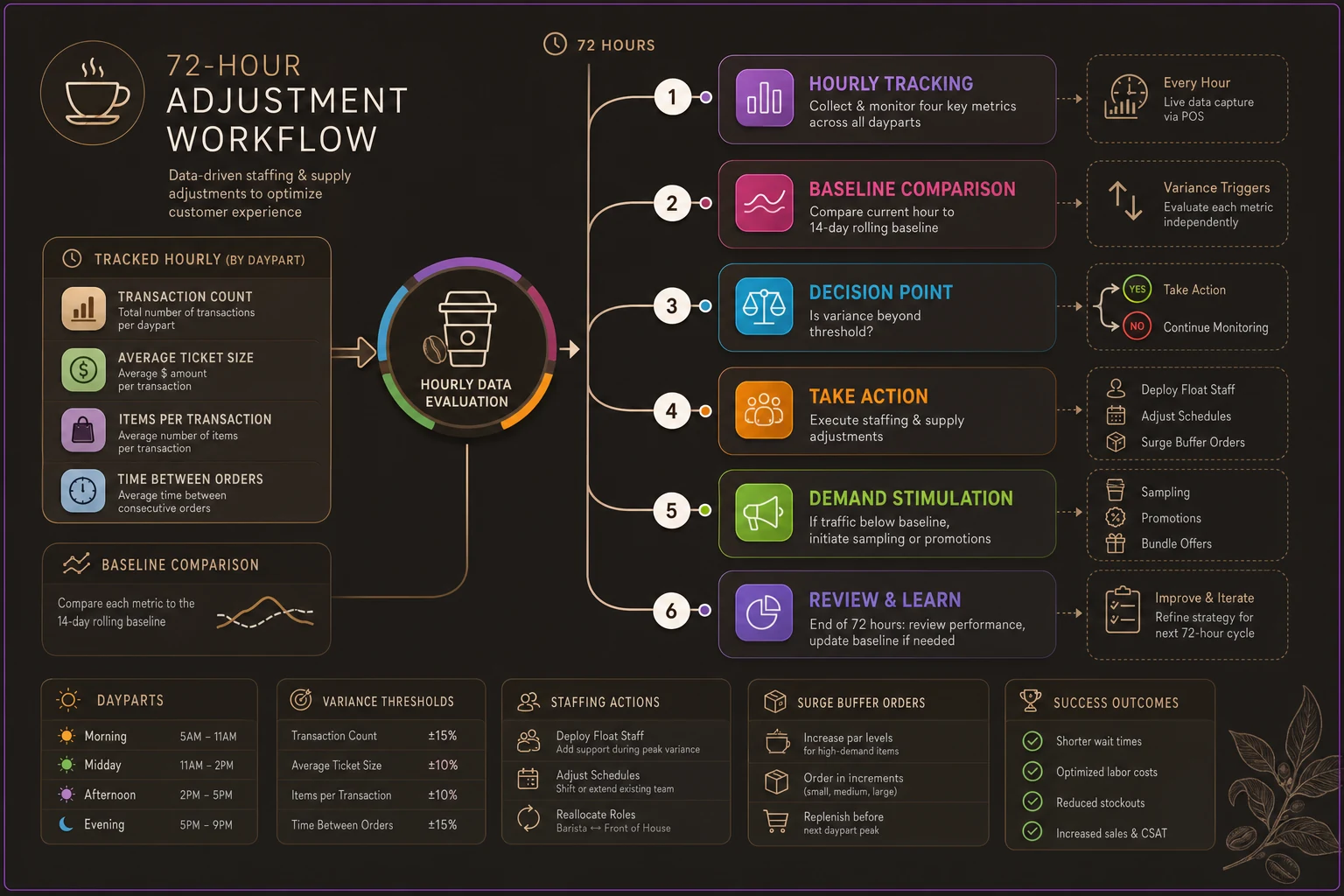
Apply those triggers after the 72-hour review to make measured, reversible changes rather than big bets.
Perishable par levels that flex without breaking
Inventory adjustments during demand uncertainty require a different approach than steady-state operations. Instead of recalculating all your pars based on projected increases, build a two-tier system.
Your base par stays at normal levels—covers typical demand with minimal waste risk. Then add a surge buffer of 15-20% for your highest-velocity perishables only. Milk, popular syrups, grab-and-go items that move regardless of the day.
Order surge buffer with the shortest feasible lead time and plan immediate rotation strategies to minimize spoilage.
The surge buffer follows different rules than base inventory. Order it with shorter lead times, even if it costs slightly more. Use it first during service to ensure rotation. And have a plan for redirecting it if demand doesn't show up—staff drinks, sampling, promotional giveaways.
One cafe I worked with built a simple tracking sheet with three columns: base par, surge amount, actual usage. After a week, the picture was pretty clear. Their milk buffer got used completely, their alternative milk buffer sat untouched, and their pastry buffer showed demand went up for croissants but not muffins. That kind of specificity is hard to get any other way.
Staffing pivots that don't blow your labor budget
Adding staff for anticipated demand sounds simple until you're paying people to stand around during a rush that never materializes. The answer isn't adding full shifts—it's modular coverage that can expand or contract.
Build your schedule with overlapping float blocks during potential surge periods. Instead of scheduling someone 7am-3pm, schedule them 7am-11am with the option to extend based on morning traffic. Text them at 10am with the call. Most staff would rather know they might go home early than get called in last minute.
For consumer sentiment demand planning specifically, put float blocks on mid-morning (9-11am) and mid-afternoon (2-4pm). These periods show the most volatility during confidence shifts as discretionary visits tick up. Morning rush and lunch tend to stay more stable since they're habit-driven, not discretionary.
Track your deployment rate. If you're extending more than 70% of float blocks, convert some to permanent coverage. If you're releasing more than half, scale back the number of float positions.
Testing premium products without premium risk
Rising confidence usually means customers will finally try that $7 seasonal drink or the $12 sandwich they've been skipping. But rolling out new premium items requires some confidence in sustained demand—which you don't have yet.
Start with ingredient overlaps. If your surge buffer includes oat milk for increased alternative milk demand, build a featured oat milk drink around ingredients you already stock. Test the premium price point without adding new inventory risk.
Position these as limited availability rather than permanent additions. Creates urgency and gives you an exit if demand doesn't hold. One shop ran a small "Confidence Collection"—three drinks priced $1-2 above their normal range, available while supplies lasted. They sold through the test batch in four days and made them permanent.
The failure pattern here is cafes that immediately expand their whole menu. Six new drinks, three new food items, prep complexity explodes, order times slow. Customer confidence might be up, but their patience has a ceiling.
Real-time adjustments that actually work
Traditional cafe metrics update too slowly for volatile periods. Weekly labor reports and monthly food cost calculations won't help you navigate daily sentiment-driven swings.
-
Running hourly sales vs. same day last week
-
Current day waste vs. typical
-
Average wait time vs. standard
If hourly sales beat last week by 20%+ for two consecutive hours, trigger your preset responses: deploy float staff, start batch brewing instead of pour-over, pull one person from cleaning tasks into production.
If waste exceeds typical by 15%, stop surge ordering for that category immediately and create samples or promos to move the excess.
If wait times climb more than 90 seconds above normal, simplify—pre-batch cold brew, pause complicated modifications, guide customers toward faster items.
Write these triggers down before you need them. During a rush, you won't have time to think. You need responses you can execute without deliberating.
The profitability math most cafes miss
What usually happens: sentiment rises, sales increase 15%, and the owner assumes they're making 15% more profit. Then the P&L arrives and margins actually compressed.
The hidden dynamic is that confidence-driven traffic often skews toward less profitable customer segments. More complex drink orders, heavy customization, longer dwell times, more operational friction that slows overall throughput. Revenue rises but costs rise faster.
To avoid this, track contribution margin by category during surge periods. A simple spreadsheet—drink type, price, estimated COGS, time-to-make—shows you which demand actually helps your bottom line.
Point your promotional energy at high-contribution items. If iced lattes run 70% contribution margin while blended drinks run 45%, your signage and samples should push lattes. Guide the sentiment surge toward products that actually improve profitability.
One counter-intuitive thing I've noticed: food often generates better surge margins than beverages. A $9 sandwich at $3 COGS beats a $6 latte at $2.50 COGS once you factor in labor time. Yet most cafes plan their sentiment response almost entirely around drink optimization.
Common overcorrection mistakes
The biggest error is treating a sentiment bounce like a permanent new baseline. Owners staff up, order heavy, expand hours, then get crushed when confidence wobbles again—which it usually does.
The second mistake is assuming sentiment affects all customer segments equally. Your morning regulars grabbing their daily coffee don't shift much. It's the afternoon browsers, weekend visitors, and occasional customers who respond to confidence changes. Plan for that, not for uniform behavior across your whole customer base.
The third mistake is confusing correlation with causation. Sales might jump the same week confidence rises, but maybe school also let out, or the office building next door returned to full capacity. Verify the connection before committing resources to it.
Building your adjustment checklist
When consumer sentiment data shows a meaningful shift, run through this within 24 hours:
| Phase | Actions |
|---|---|
| Immediate (Day 1): | - Review next 3 days of staff schedules for flex opportunities - Check current inventory levels against base pars - Identify which suppliers can handle rush orders - Update your POS quick-keys for likely popular items - Brief your team on potential traffic changes |
| Short-term (Days 2-3): | - Place surge buffer orders for proven movers - Schedule float blocks for anticipated busy periods - Create simple tracking sheets for the four key metrics - Prepare "limited time" marketing materials - Set up hourly sales notifications on your POS |
| Assessment (Day 4): | - Compare actual vs. expected traffic patterns - Calculate surge period contribution margins - Review waste levels by category - Gather team feedback on operational stress points - Decide which changes to maintain, modify, or reverse |
This connects directly to avoiding costly overorders through simple forecasting templates. The daily demand patterns you track for normal operations become your baseline for measuring sentiment-driven deviations. Without that foundation, you're guessing at what's real change versus normal variation.
Making it systematic without making it complicated
The cafes that handle sentiment shifts well aren't always the ones with sophisticated systems. They're the ones with clear triggers and predetermined responses that everyone on the floor understands.
Write your adjustment rules on a single page and post it where managers can see it during shifts. Specific thresholds: "If afternoon transactions exceed 110% of normal for two or more days, add a second afternoon barista the following week." Removes decision fatigue when things get busy.
Operational software can automate a meaningful chunk of this tracking and triggering. AI-powered platforms can monitor your POS data, compare it against baseline patterns, and flag when preset thresholds are hit—which means your ordering suggestions adjust based on observed demand rather than gut feel. The point isn't replacing judgment with algorithms. It's freeing up mental bandwidth for customer experience while the system handles the numbers.
Conclusion
Consumer sentiment shifts create opportunities and risks that arrive quickly and disappear just as fast. The Reuters coverage of June's confidence data noted that labor market perceptions are still deteriorating even as overall sentiment improves—a reminder that these bounces can be fragile.
The cafes that benefit from this kind of uptick are the ones that adjust quickly without overcommitting. They capture extra revenue from increased foot traffic and higher tickets while avoiding the inventory spoilage and labor waste that quietly kills margins.
Your operational response doesn't need to be perfect. It needs to be measured, reversible, and grounded in actual observation rather than hopeful projection. Start small, measure the impact, and scale what works. The goal isn't maximizing every possible sale—it's optimizing the profitable ones while staying flexible enough to pull back when conditions shift.
The next sentiment move is always coming. Whether it's up or down, how fast you can recalibrate determines whether you take advantage of it or get caught overextended.
Ready to brew operational excellence?
Join hundreds of coffee shops using Coffehq to boost efficiency, reduce waste, and elevate customer satisfaction.