

Most café owners find out about shrink the wrong way. You reconcile at month-end, the milk numbers don't match the pours, the pastry count is short again, and the register is light by amounts too small to prove anything. So you either stew about it or call a staff meeting where everyone gets a little defensive and nothing changes.
The problem with shrink in a small café isn't that it's invisible — it hides inside normal variance. A little waste, a little over-pour, a comped drink that never got rung in, a few grams of beans dumped from a bad shot. None of it looks like theft, and most of it isn't. But when you can't separate honest variance from the stuff worth investigating, you end up treating everything like a mystery and solving none of it.
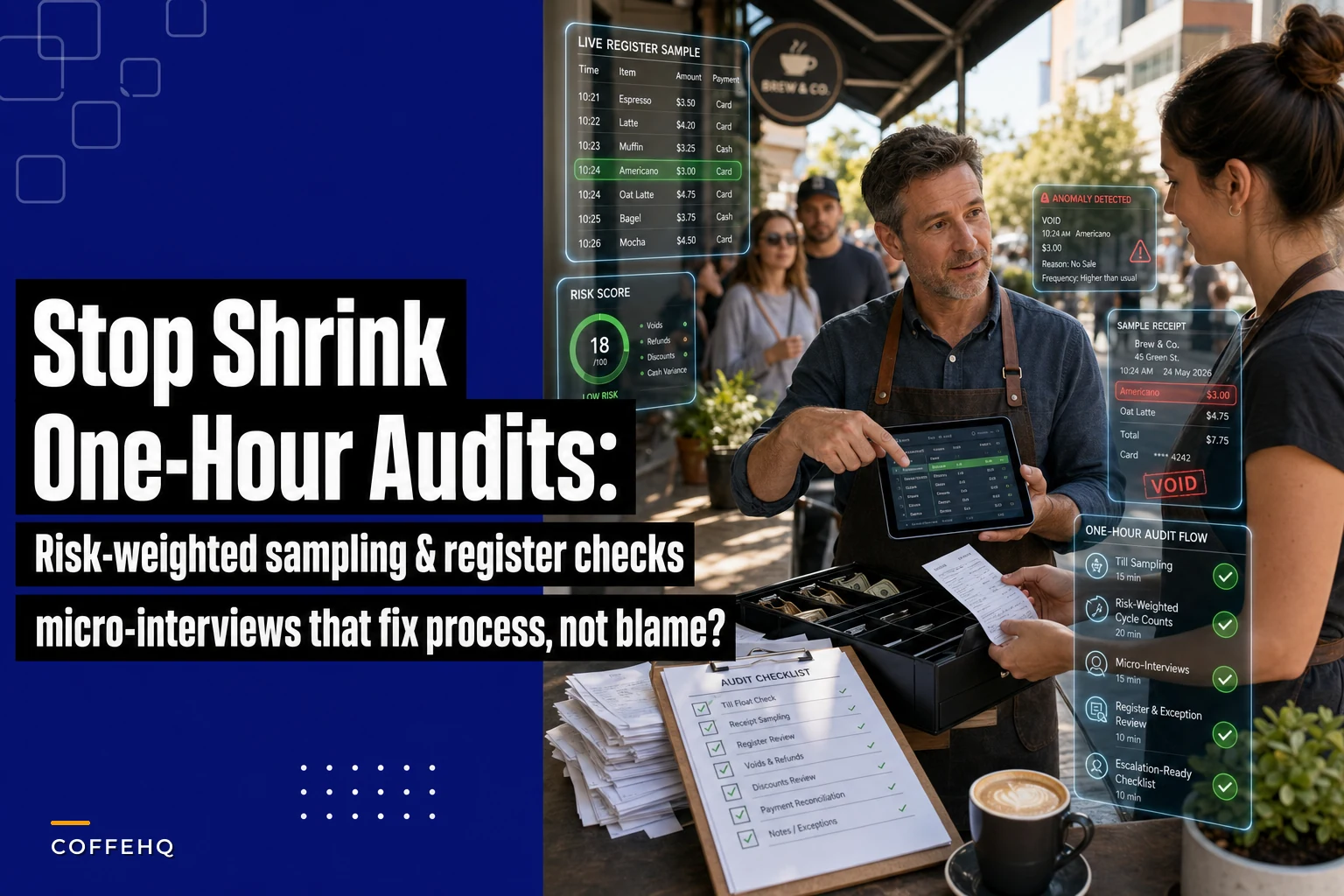
This post is about a specific fix: a light-touch audit rhythm you can run in about one manager-hour a week. Sampling audits that don't accuse anyone, cycle counts weighted toward the items that actually cost you money, small shift-rotation experiments to isolate patterns, and short non-threatening conversations that surface process problems instead of blame. No cameras-in-every-corner energy. Just a repeatable way to see where product and cash slip out.
Why the "count everything once a month" approach fails
The standard advice is to do a full inventory count monthly and compare it to sales. On paper that catches shrink. In a real café it mostly generates a number you can't act on.
By the time you count on the 31st, you've had roughly 30 days of pours, comps, waste, deliveries, and staff turnover mixed together. If your milk usage is 8% over theoretical, which of the last 200 shifts caused it? You have no idea. The signal is buried under a month of noise.
Shrink is almost never uniform across small food operations. It clusters — around specific shifts, specific people (sometimes innocently, through bad training), specific SKUs, or specific times of day. A monthly aggregate flattens all of that into a single percentage that tells you something is wrong but nothing about where. That's why owners keep tightening the wrong screws: they buy new lids, lecture about waste, switch milk suppliers — and the number barely moves, because the actual leak was a register procedure or an untrained closer.
The other failure mode is emotional. A big month-end miss feels like betrayal, so the response gets accusatory. The moment staff feel accused, they stop volunteering the small process truths — "the grinder was throwing double doses all week," "we ran out of small cups so we gave everyone mediums" — that would actually explain the gap. You lose your best information source right when you need it most.
The core idea: sample small, sample often, stay boring
Shrink prevention works better as a steady, unremarkable habit than as a dramatic investigation. The goal is to make counting so routine and low-drama that nobody performs differently when it happens, and frequent enough that variance points to a time window you can actually investigate.
Keep every order and shift perfectly aligned.
Coffehq helps you manage orders, inventory, and staff schedules seamlessly.
- Unified order processing
- Real-time inventory updates
- Staff shift coordination
No credit card required
-
Risk-weighted cycle counts — you count a rotating handful of high-value or high-variance items, not the whole store.
-
Non-accusatory sampling audits — you spot-check transactions and voids against a simple expectation, framed as process QA.
-
Micro-interviews — 3–5 minute, structured, curious conversations that treat staff as witnesses, not suspects.
Layered on top, occasionally, are shift-rotation experiments — deliberately changing who works which shift for a short window to see whether a variance pattern follows a person or stays with a time slot.
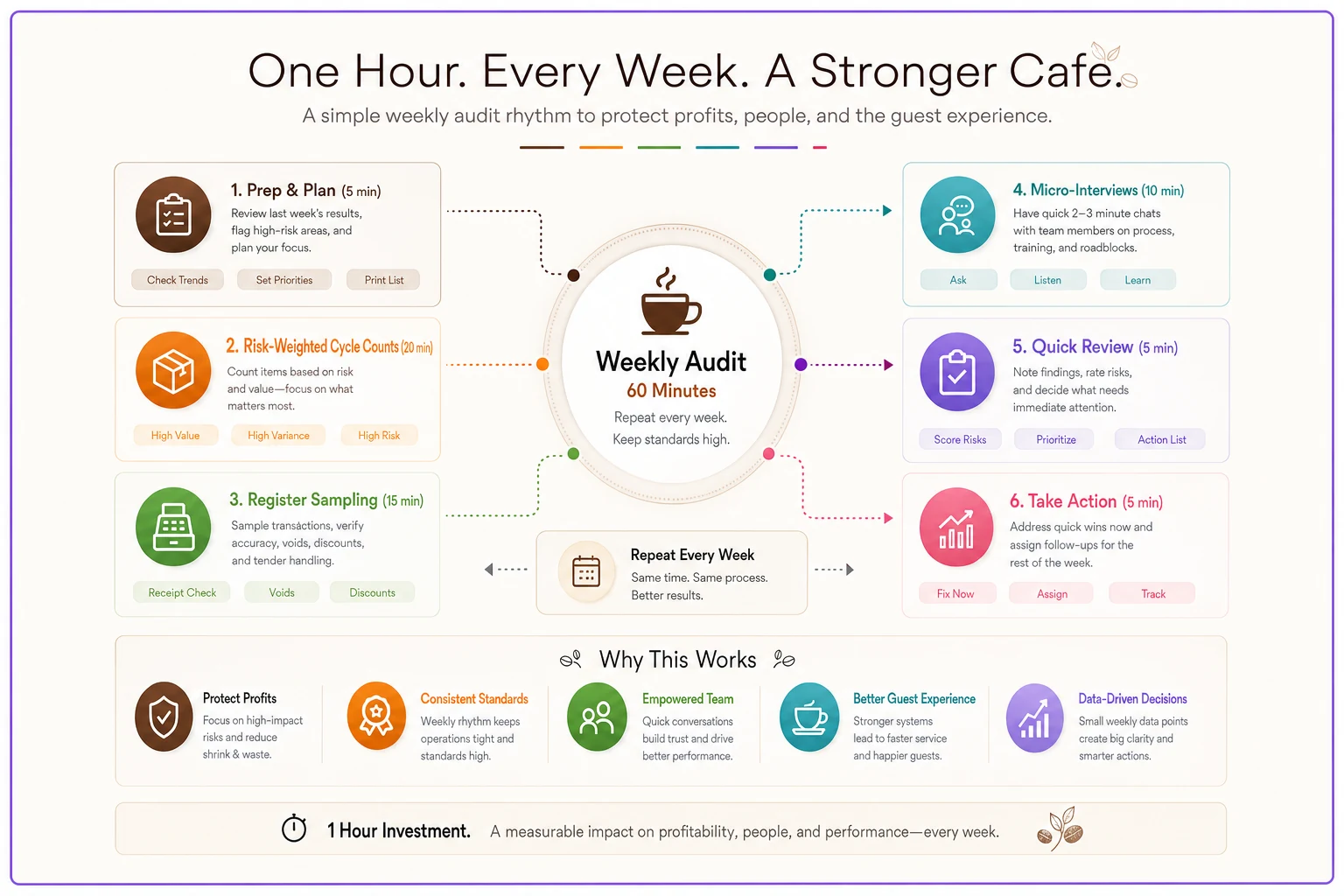
A quick visual of the weekly one-hour audit flow.
Risk-weighted cycle counts (about 20 minutes, twice a week)
Counting everything is a waste. Counting the right things frequently is where the value is. Sort your inventory by two axes: how much a unit costs, and how easy it is to walk out the door or get over-used without anyone noticing.
| Item type | Value / risk | Count frequency | Why |
|---|---|---|---|
| Whole beans, syrups (branded), retail bags | High value, easy to divert | 2x/week | Expensive per unit, resold or taken easily |
| Milk / alt-milk | Medium value, high variance | 2x/week | Over-pour and waste hide here constantly |
| Pastries / grab-and-go | Perishable, comp-prone | Daily quick count | Comps and "staff ate it" losses cluster here |
| Cups, lids, sleeves | Low value, high volume | 1x/week | Rarely stolen, but signals over-serving |
| Cleaning / back-of-house | Low value, low risk | Monthly | Not worth frequent attention |
You're not counting all of this every session. Top two rows twice a week, a fast pastry count daily (you're likely eyeing that anyway for your display rotation and markdown decisions), and rotating low-risk stuff through on a slow cadence.
-
Item, expected on-hand, actual on-hand, variance, variance %
-
Expected on-hand comes from your last count plus deliveries minus sales (theoretical usage). If you've already built solid usage math from your purchase-to-stock process, the "expected" column mostly fills itself.
The insight most people miss: variance percentage matters more than variance amount for detection. A 3-bag shortage on retail beans (say $45) is a much louder alarm than $60 of milk variance across a busy week, because retail beans have almost no legitimate reason to disappear. Weight your attention toward items with low legitimate-variance rates.
Variance escalation rules (so you don't overreact to noise)
The hardest part isn't finding variance — it's deciding when variance means investigate versus ignore. Without a rule, owners either panic at every wobble or normalize real theft as "just how it goes." Pre-set thresholds mean the decision gets made before emotions get involved.
-
Green (ignore) variance under 2% on milk/perishables, under 1 unit on high-value items. Normal. Log it, move on.
-
Yellow (watch) 2–5% on perishables, or a single-unit gap on beans/retail appearing twice in two weeks. Don't act yet — start noting which shifts and who closed. You're building a pattern, not a case.
-
Orange (investigate) over 5% perishable variance sustained across a week, or high-value shortages clustering on the same day of week or same closer. Now you run micro-interviews and possibly a shift-rotation test.
-
Red (act) clear high-value loss that maps to a specific window with no process explanation, or void/comp patterns far outside the norm. This is where you involve procedures, not just conversations.
One rule that saves a lot of trouble: never escalate to Red on a single data point. One bad count is almost always a counting error, a mis-keyed delivery, or a legitimate comp nobody logged. Real theft and real process failures leave repeated fingerprints. Requiring a pattern before you act protects you from torching trust over what turns out to be a math mistake.
Non-accusatory sampling audits for the register
Product shrink is half the story. The other half lives in the POS — voids, comps, refunds, and no-sale drawer opens. You don't need to audit every transaction. You sample.
-
Pull all voids and comps from the past week (most POS systems export this in a couple clicks).
-
Randomly pull 15–20 of them.
-
For each, ask
is there a logged reason? Does it match a known pattern (wrong order, quality remake)? Does the timing make sense?
You're looking for shape, not individual guilt. A few things that stand out in real data:
-
Voids clustered in the last 20 minutes of a shift (drawer being "cleaned up").
-
One person's comp rate running 3–4x the team average with no quality complaints to match.
-
No-sale drawer opens spiking during specific shifts.
None of that proves theft. Over-comping is often just a barista trying to keep customers happy, or someone who was never trained on the comp policy. That's exactly why the framing has to stay non-accusatory — because most of what you find is fixable process, and if you go in swinging, you'll never learn which is which.
Worth internalizing: the person whose numbers look worst is frequently your most conscientious, poorly-trained employee, not your thief. They're comping to solve problems they don't have authority to solve, and it shows up in your variance. Treat the audit as diagnosis, not prosecution.
Micro-interviews: manager scripts that get honest answers
This is the highest-leverage, most-skipped part. A three-minute structured conversation, run regularly and calmly, surfaces more real shrink causes than any camera. The trick is asking about the process, not the person.
-
On milk variance "We're running a bit heavy on oat milk this week and I'm trying to figure out the workflow, not point fingers. When you're slammed, are you steaming to order or batch-steaming ahead? Where does the extra usually end up?"
-
On pastry gaps "Pastry counts have been off by a couple each closing shift. Walk me through what happens to unsold or damaged ones at close — I just want the actual routine, not the official one."
-
On voids "I noticed we void a lot right before shift change. Is there something about the handoff or the drawer count that's making people clear the screen? Trying to fix the step, not blame anyone."
-
On comps "You comp a fair bit, which honestly might mean you're catching problems others aren't. Can you tell me the last three you did? I want to make sure the policy actually covers what you're running into."
When you ask "walk me through the actual routine, not the official one," people usually tell you the truth. Half of shrink tends to live in the gap between the SOP taped to the wall and what actually happens at 6pm on a Friday. You can't fix that gap until someone admits it exists — and they'll only admit it if they're not on trial.
Keep these to one or two per week. One barista, one focused question, three minutes, thank them, done.
Shift-rotation experiments: isolating whether it's a person or a slot
Sometimes your counts keep pointing at the same shift — say, every Tuesday and Thursday close runs 6% heavy on milk and short a pastry or two. The question is whether it's the shift (a rush pattern, a broken grinder, a layout problem) or the people on it.
-
Keep the shift the same, swap the closer. If variance follows the person, you've localized it. If it stays with the slot, it's a process or equipment issue.
-
Or keep the people, move them to a different day. Same logic.
A real-feeling example: a café kept seeing high-value syrup shortages on weekend mornings. The owner assumed it was the weekend crew. Two weeks of rotation showed the shortage stayed on Saturday and Sunday regardless of who worked — turned out the AM rush was driving batch-prepping of flavored lattes in a pitcher, and the over-prep got dumped when the afternoon menu switched in. Nobody stole anything. The fix was a smaller batch size and a par adjustment, not a firing.
That's the whole point of the experiment: it stops you from punishing a person for a system's flaw. Run these only at Orange escalation — they take coordination and you don't want to churn your schedule over normal noise.
When this makes sense — and when it doesn't
This system fits you if: you're a single site or a small group, you've got real variance you can't explain, and you want detection that doesn't cost a fortune in cameras or destroy team trust. The one-hour-a-week rhythm is designed for an owner-operator or a single manager who's already stretched.
When it's overkill: if your total food-and-cash shrink is comfortably under around 2–3% of relevant COGS and stable, you're probably fine with monthly counts and the occasional void check. Don't build a weekly audit habit to chase a leak that's smaller than the labor cost of chasing it.
Who should not lean on this alone: if you already have strong evidence of deliberate theft — clear, repeated, high-value, mapped to a person — sampling audits are the wrong tool. That's an HR and possibly legal situation, and it needs documented specifics, not curious micro-interviews. Sampling is for finding and diagnosing, not for building a termination case.
A quick real scenario
A neighborhood café doing roughly $40k–$45k a month kept losing about 6–7% on milk and syrups combined, plus a nagging register variance of $20–$40 most weeks. The owner had assumed theft and was quietly miserable about it.
Instead of a confrontation, they ran the weekly hour for about six weeks: twice-weekly counts on beans, milk, and syrups; a Friday void-and-comp sample; and one or two micro-interviews per week. The picture that emerged was almost entirely process. Batch-steaming during rush accounted for most of the milk loss. One newer barista was comping generously to handle a broken POS modifier that kept ringing up wrong drinks — a training-and-equipment problem, not dishonesty. The register variance traced to a sloppy shift-change count, not skimming.
After fixing the batch sizes, repairing the modifier, and tightening the handoff count, milk-and-syrup variance settled to around 3% and the weekly register gap mostly disappeared. On that volume, that's a few hundred dollars a month recovered — and maybe more valuable, an owner who stopped suspecting their whole team.
Most cafés never solve shrink not because they lack the tools, but because the detection work feels like a big scary project, so it never gets done consistently. Shrink only reveals itself to consistency. One dramatic count tells you almost nothing. Twenty small, boring, repeated ones tell you exactly which shift, which SKU, and which process step is leaking.
Keep it light. Keep it curious. Weight your attention toward the items that actually cost you money and the transactions people are most tempted to fudge. Require a repeated pattern before you act, and treat every gap as a process question first. Do that for an hour a week, and you'll find that most of your "theft" was never theft at all — it was a workflow nobody had permission to tell you was broken.
Ready to brew operational excellence?
Join hundreds of coffee shops using Coffehq to boost efficiency, reduce waste, and elevate customer satisfaction.