


Running a small-batch roasting operation inside your café sounds romantic until you're staring at 15 pounds of stale beans that didn't move fast enough. Or worse, you run out of your signature blend on Thursday morning because you underestimated weekend demand and your next roast isn't until Monday.
The math behind roasting schedules gets tricky at small volumes. Most roasting guides assume you're either a micro-roaster pushing 500+ pounds weekly or a café buying pre-roasted. When you're roasting 40-80 pounds across multiple origins, that standard advice just doesn't apply.
Why small-batch scheduling breaks differently than commercial operations
Commercial roasters can sit on inventory because they're moving thousands of pounds. You're working with maybe 12 pounds of Ethiopian and 8 pounds of Colombian, trying to keep everything fresh while minimizing waste. One bad forecast means either dumping product or disappointing regulars.
It compounds when you factor in green bean aging. Those Guatemalan beans that tasted incredible at 14 days post-roast might actually peak at 21. Your Ethiopian might hit its stride at 10 days but fall off a cliff by day 18. Standard roasting schedules assume consistent aging curves across all beans—which anyone who's cupped the same coffee at different rest periods knows isn't how it works.
Then there's yield variance. That 10-pound batch of green doesn't give you 10 pounds of roasted coffee. Between moisture loss (typically 12-20%) and chaff removal, you're looking at 8-8.5 pounds if you're lucky. Roast darker and you lose more. Hit first crack early and your yield calculations for the week are off.
The weekly cadence that actually works
Most cafés land on Monday/Thursday or Tuesday/Friday roasting schedules. Monday gives you fresh coffee for the Tuesday-Thursday office crowd, Thursday covers the weekend rush. But this assumes your demand curve matches standard patterns—and it probably doesn't.
Keep every order and shift perfectly aligned.
Coffehq helps you manage orders, inventory, and staff schedules seamlessly.
- Unified order processing
- Real-time inventory updates
- Staff shift coordination
No credit card required
Map your actual sales first. Pull transaction data for each blend by day of week, then work backwards. If you're selling 3 pounds of house blend on Tuesdays but 7 pounds on Saturdays, roasting equal amounts Monday and Thursday means stale coffee or stockouts.
Here's a working template based on 60 pounds weekly volume:
Monday roast (24 pounds green):
-
House blend
14 pounds
-
Single origin #1
6 pounds
-
Decaf
4 pounds
Thursday roast (36 pounds green):
-
House blend
20 pounds
-
Single origin #1
8 pounds
-
Single origin #2
8 pounds
This front-loads your weekend demand while keeping midweek coverage. Adjust the ratios based on your actual sales patterns, but the principle holds: roast closer to your consumption peaks, not on arbitrary schedules.
Green bean buffer calculations that prevent panic orders
Running out of green beans mid-week wrecks your entire schedule. Most cafés either overstock—tying up cash and risking stale greens—or scramble for emergency orders at premium prices.
Your buffer needs three components: base stock, safety margin, and aging allowance. Base stock covers typical weekly usage. Safety margin handles demand spikes. Aging allowance ensures beans have proper rest time before roasting.
-
Base stock
2 weeks (120 pounds)
-
Safety margin
30% (36 pounds)
-
Aging allowance
1 week (60 pounds)
-
Total green inventory
216 pounds
That seems like overkill until you factor in shipping delays. Most specialty suppliers need 3-5 days for delivery. Miss your order window and you're looking at a week without that origin. The buffer prevents those emergencies.
Rotate green beans FIFO by origin to prevent unexpected aging differences.
Track your supplier cadence and lead times separately for each vendor. Your local supplier might deliver next-day, but that Kenyan co-op direct trade might take three weeks. Build buffers accordingly.
QA checkpoints without overcomplicating
Professional cupping labs run elaborate protocols. You need something simpler that catches problems before customers do. Three checkpoints minimum: immediately post-roast, at intended rest period, and weekly production samples.
Post-roast tells you if something went wrong mechanically. Did the roaster flame out? Temperature probe acting up? You'll taste it immediately—grassiness, sourness, char. Don't wait for proper rest to catch equipment issues.
Rest period checking confirms your aging assumptions. Cup that Colombian at 3, 5, 7, 10, and 14 days. Document when flavors peak. You might find your "5-day rest" assumption is costing you quality. One café discovered their Honduran peaked at 8 days, not the 5 they'd been serving it at. Simple adjustment, noticeable improvement.
Weekly production samples catch drift. Roast profiles shift as equipment ages, ambient temperature changes, or green beans age in storage. Pull 100g from each batch and cup them together weekly. You'll spot gradual changes before customers start commenting on inconsistency.
Yield loss calculations and what they mean for ordering
That 15% moisture loss estimate everyone quotes? It's not accurate for your specific setup. Track actual yields for each origin at each roast level. The variance will surprise you.
| Origin | Green Weight | Roasted Weight | Loss % | Roast Level |
|---|---|---|---|---|
| Ethiopian | 10 lbs | 8.6 lbs | 14% | Light |
| Ethiopian | 10 lbs | 8.2 lbs | 18% | Medium |
| Colombian | 10 lbs | 8.4 lbs | 16% | Light |
| Colombian | 10 lbs | 8.0 lbs | 20% | Medium |
| Brazilian | 10 lbs | 8.5 lbs | 15% | Light |
| Brazilian | 10 lbs | 8.1 lbs | 19% | Medium |
Four percentage points might not seem significant until you're calculating weekly orders. If you need 50 pounds of roasted coffee and assume 15% loss, you order 59 pounds of green. But if actual loss is 19%, you need 62 pounds. That 3-pound shortage compounds every single week.
Build yield variance into your par level calculations. Don't use averages. Use worst-case numbers for safety stock and best-case for cash flow projections.
Demand forecasting without sophisticated software
Fancy demand forecasting feels excessive when you're roasting 60 pounds weekly. But basic tracking prevents most problems. Three numbers matter: baseline demand, day-of-week variance, and seasonal shifts.
Baseline demand is your typical weekly volume per SKU. Track it over 8 weeks minimum, ignoring clear outliers—that wedding that ordered 20 pounds doesn't count. This becomes your production floor.
Day-of-week variance shows actual consumption patterns. Tuesday might skew heavily toward house blend for office orders. Saturday might lean toward single origins for retail bags. Knowing this prevents roasting Ethiopian on Thursday when it mostly sells on Mondays.
Seasonal shifts are gradual but significant. Cold brew season might double your dark roast demand. Holiday gifting can spike retail bag sales considerably. Start tracking these patterns after your first full year. Until then, hold extra buffer November-December and June-August.
A simple spreadsheet handles this fine. Date, SKU, pounds sold, day of week. After 12 weeks, patterns start to emerge clearly.
The small-batch reality check
Some cafés just shouldn't roast in-house. If you're selling less than 30 pounds weekly, the labor and waste probably exceed any quality gains. If you can't maintain consistent roast profiles, you're hurting more than helping. If green storage requires climate control you can't provide, those savings disappear fast.
But when it works, the control is worth the complexity. You're cupping coffees at perfect rest, adjusting profiles for seasonal green changes, offering freshness that no wholesale relationship can match.
The operational overhead is real though. Someone needs to manage green inventory, track yields, schedule roasts around demand, maintain equipment, and handle quality control. That's roughly 10-15 hours weekly for a 60-pound operation—more if you're still dialing in profiles.
Pulling it together: sample weekly schedule
Here's what an actual week looks like for a café roasting 65 pounds across four offerings:
Sunday evening:
-
Pull sales data from previous week
-
Adjust Monday roast quantities if needed
-
Check green inventory levels
Monday morning (roast day 1):
-
Roast 28 pounds
house blend (16 lbs), Ethiopian (8 lbs), decaf (4 lbs)
-
Log actual yields
-
Cup previous Thursday's production
Tuesday:
-
Receive green coffee delivery if scheduled
-
Update inventory tracking
Wednesday:
-
Cup Monday's roast (2-day rest check)
-
Review weekend sales forecast
Thursday morning (roast day 2):
-
Roast 37 pounds
house blend (20 lbs), Ethiopian (6 lbs), Colombian (11 lbs)
-
Production cupping of week's offerings
Friday:
-
Green coffee ordering for next week
-
Equipment cleaning and maintenance
Saturday:
-
Monitor retail bag movement
-
Adjust next week's schedule based on sales
This rhythm maintains freshness while preventing the scrambles that kill quality. Skip the Wednesday cupping and you might miss a roast defect. Forget Friday ordering and you're short on greens the following week.
The sequence matters more than the specific days. Once you find a rhythm that maps to your demand curve, the rest is just discipline.
Visual workflow of the weekly roast cadence.
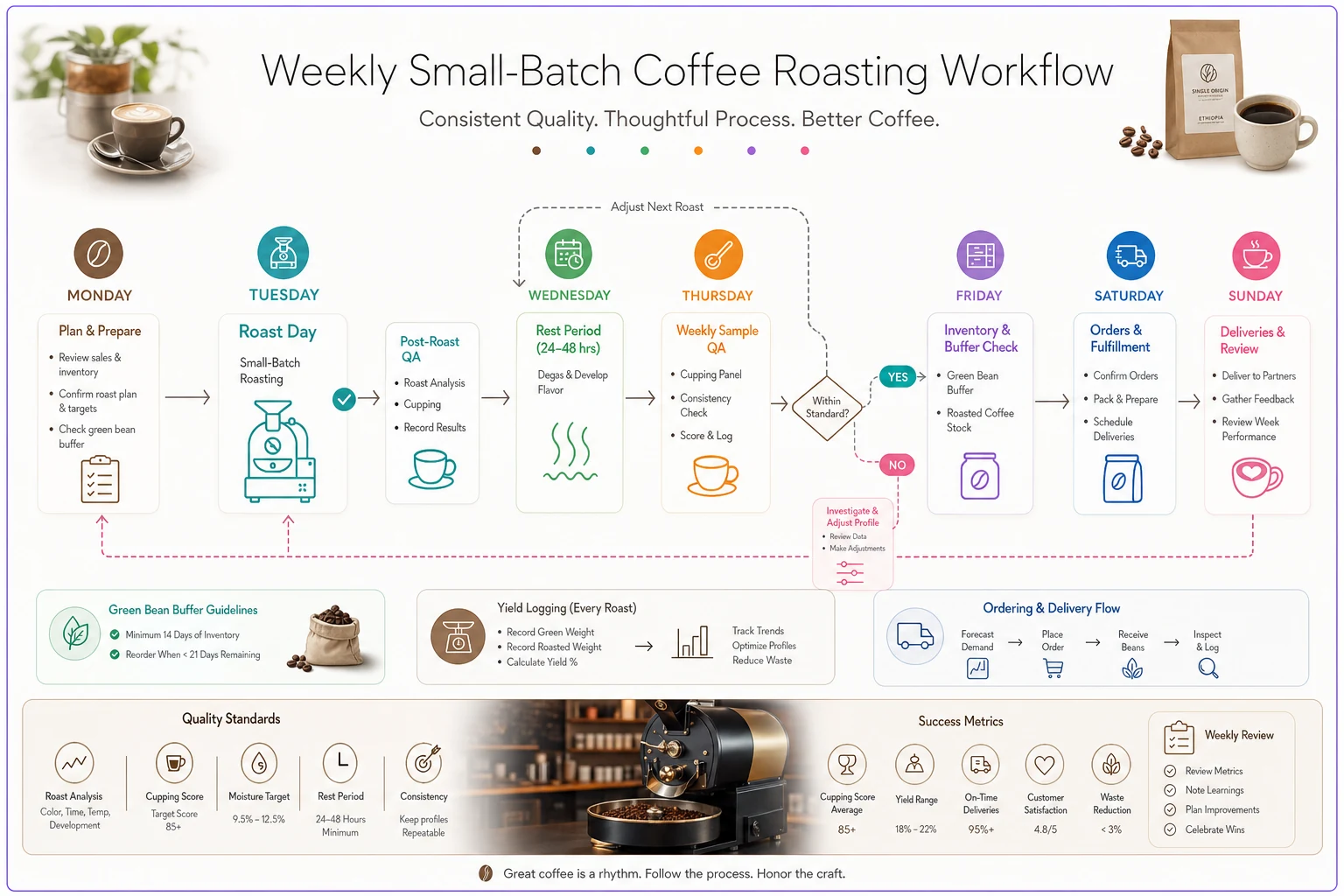
Use this to map tasks to team members and days.
When software starts making sense
Spreadsheets handle most of this fine early on. Green weight, roasted weight, yield percentage, sales by SKU. It's manual but manageable under 100 pounds weekly.
The breakdown happens around 80-100 pounds, or when you add a second roasting day, or when staff turnover means all that institutional knowledge walks out the door. That's when operational software starts earning its place—not because the work is too complex, but because you need consistency that doesn't depend on one person remembering everything.
AI-powered platforms can track yield patterns across dozens of batches, catching drift you'd miss in a spreadsheet. They'll flag when your Ethiopian yield drops below historical ranges, suggesting equipment calibration before it becomes a quality problem. They connect sales data to roast scheduling automatically, adjusting for day-of-week patterns without someone manually updating formulas each week.
More practically, the roasting schedule, yield assumptions, and quality checkpoints live in the system rather than someone's notebook. New staff can follow established protocols immediately instead of spending weeks piecing together institutional knowledge from scratch. The automation handles the repetitive tracking—logging batches, calculating running yields, monitoring green inventory against upcoming roasts—which frees up time for actual quality work: cupping, profile development, talking to customers about what they're tasting.
Common mistakes and their fixes
Roasting too far ahead: "Fresh roasted" loses meaning when beans sit for two weeks. Roast closer to consumption, even if it means smaller, more frequent batches.
Ignoring yield variance: That 15% average hides a 12-20% reality. Track actual yields by origin and roast level. Build buffers using worst-case numbers, not averages.
Skipping rest period testing: Assuming all coffees peak at 5 days costs you quality you'll never know you lost. Cup systematically, document peaks, adjust service timing accordingly.
Overcomplicating QA: Three simple checkpoints catch the vast majority of problems. Post-roast, proper rest, weekly production. That's enough for most small operations.
Fighting natural demand patterns: Thursday afternoon isn't the time to run out of house blend. Map actual sales patterns and roast accordingly, even if the schedule looks odd on paper.
Moving forward
Small-batch in-house roasting isn't just a freshness play—it's about control. Control over quality, timing, and what you're actually offering. But that control requires systems. Not complicated ones, just consistent ones.
Start with the weekly cadence. Track yields on every batch. Build appropriate buffers. Add QA checkpoints that catch problems early. Connect it all to actual demand patterns, not theoretical ones.
The math isn't complicated once you have real numbers. It's the discipline of tracking those numbers consistently that trips up most operations. Every batch logged. Every yield recorded. Every quality issue documented. The patterns that emerge over months guide better decisions than any roasting course or gut feeling ever will.
The cafés that make in-house roasting work treat it like any other operational system—clear procedures, tracked metrics, and adjustments made based on data rather than feel. Whether you manage all of this manually or eventually use software to carry the tracking load, that core approach doesn't change: roast to demand, buffer appropriately, check quality consistently, and let the numbers tell you what to fix.
Small-batch in-house roasting isn't just a freshness play—it's about control. Control over quality, timing, and what you're actually offering. But that control requires systems. Not complicated ones, just consistent ones.
Start with the weekly cadence. Track yields on every batch. Build appropriate buffers. Add QA checkpoints that catch problems early. Connect it all to actual demand patterns, not theoretical ones.
Ready to brew operational excellence?
Join hundreds of coffee shops using Coffehq to boost efficiency, reduce waste, and elevate customer satisfaction.