

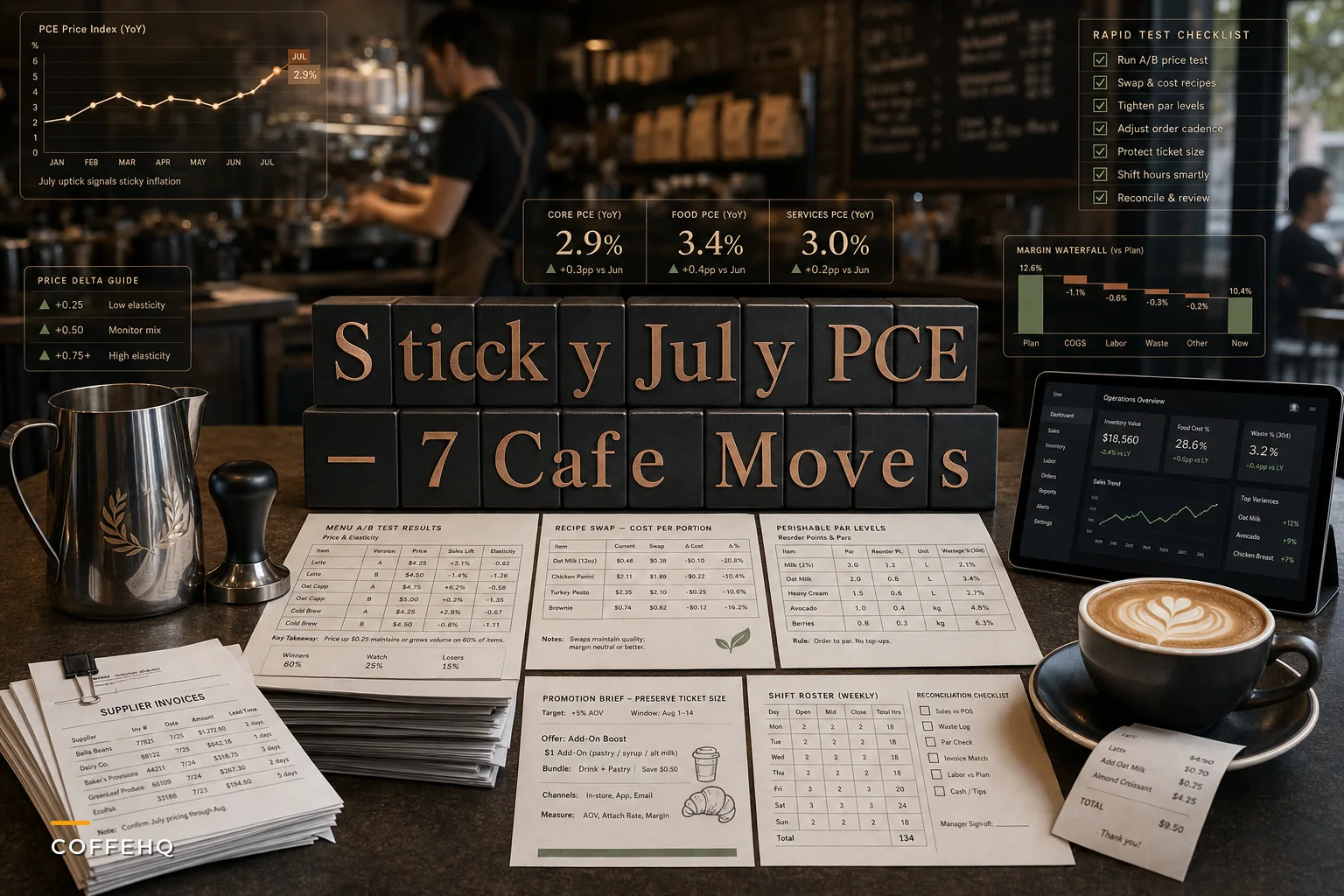

July's PCE numbers landed and they weren't the relief a lot of small operators were hoping for. Personal consumption expenditures rose 0.2% month-over-month, with annual PCE holding near 3.7%, according to a Reuters report on July inflation. Since PCE is the gauge the Fed watches most closely, "sticky" is doing a lot of work here — it signals that milk, syrups, cups, and your utility bill aren't drifting back down anytime soon.
For a café running on 8–14% net margins, that's not abstract macro news. It's the difference between a decent month and one where you're covering payroll out of your own pocket. The frustrating part is that most operators respond by doing nothing for six weeks, then panic-raising every price at once and confusing regulars.
There's a better play. Below are seven moves you can actually run this week — ordered roughly by how fast they protect margin versus how much effort they take. None of them require a full menu overhaul or a new POS.
Start With the Moves That Cost You Nothing but Attention
Before repricing anything, there are two levers that recover margin without touching a single customer-facing number. Most cafés skip these because they feel too small. They're not.
1. Kill the pour and portion drift first.
When costs are stable, over-pouring hides. When costs are climbing, it compounds. A barista free-pouring vanilla syrup at 1.5 pumps instead of 1 on a drink you sell 40 times a day is bleeding you on volume you can't see on any report.
Run a two-day portion audit this week. Weigh your espresso shots at open and mid-shift. Count pumps on your top three flavored drinks. The gap between spec and reality on syrups and milk tends to sit somewhere around 10–18% — and closing it is pure recovered margin, no price change required.
Weigh shots and count pumps over two days to identify pour drift quickly and act on the highest-volume gaps.
2. Re-check your waste log against your par sheet.
Sticky inflation makes over-ordering more expensive per unit and more expensive when it spoils. If you're throwing out pastries three days a week and topping off milk orders "to be safe," you're paying elevated prices for product that never rings up.
One pattern worth knowing: cafés that tighten pars during high-cost periods often over-correct and start running out of milk at 2pm, which costs more in lost sales than the waste ever did. Trim in small increments — one case, one crate — and watch two weeks before trimming again.
Reprice Deliberately, Not Reactively
Most operators hurt themselves here. They see costs rise and slap $0.50 on every drink overnight. Regulars notice a broad, blunt increase instantly. A targeted one, they barely register.
Keep every order and shift perfectly aligned.
Coffehq helps you manage orders, inventory, and staff schedules seamlessly.
- Unified order processing
- Real-time inventory updates
- Staff shift coordination
No credit card required
| Item type | Customer price awareness | Repricing move this week |
|---|---|---|
| Drip / house coffee | Very high (anchor item) | Hold the line — raise size gap instead |
| Signature lattes | Medium | +$0.25–$0.40, low risk |
| Seasonal / specialty drinks | Low | +$0.50 or reframe as premium |
| Pastries / grab-and-go | Low–medium | Round up, bundle instead |
| Add-ons (extra shot, alt milk) | Low | Best margin lever — adjust freely |
3. Raise the modifiers before the base.
Add-ons are where the quiet margin lives. An extra espresso shot, oat milk, an extra flavor pump — these are low-awareness charges customers rarely price-compare. Moving an alt-milk charge from $0.60 to $0.75 across a store doing 60 oat-milk drinks a day recovers real money without touching your headline coffee price.
4. Widen your size gaps instead of lifting your entry price.
Keep your small drip where it is. Nudge the medium and large. This protects your value perception at the door while letting most customers — who trade up anyway — carry more of the cost. Less visible and more effective than a flat across-the-board hike.
If you want the full framework for testing these changes without guessing, the menu-engineering and A/B pricing playbook walks through how to structure the experiments and read the results properly. During a sticky-cost stretch, one clean A/B test beats a dozen gut-feel changes.
Re-Engineer One Item Instead of Raising Five Prices
Repricing isn't your only tool. Sometimes the cleaner move is holding the price and adjusting what's behind it.
5. Swap the cost driver, not the experience.
Pick your single highest-volume specialty drink and look at its most expensive ingredient. Often it's a premium syrup, a specific milk, or an imported garnish that customers don't specifically notice.
A typical example: a café's bestselling seasonal latte used a branded caramel that cost noticeably more than a house-made alternative. Switching the base — while keeping the drink name, cup, and presentation identical — trimmed per-drink cost by roughly $0.30 without a single complaint. On 250 of those a week, that's real recovery, and nobody experienced a "downgrade."
The mistake is swapping something customers can taste — dropping to a cheaper espresso blend, for instance. That saves pennies and costs you regulars. Change the invisible inputs, protect the signature ones.
Tighten the Ordering Cadence So Elevated Prices Don't Compound
When unit costs are stable, ordering sloppiness is forgivable. When they're elevated, every extra case you order at the new higher price and every emergency top-off at retail markup stacks up fast.
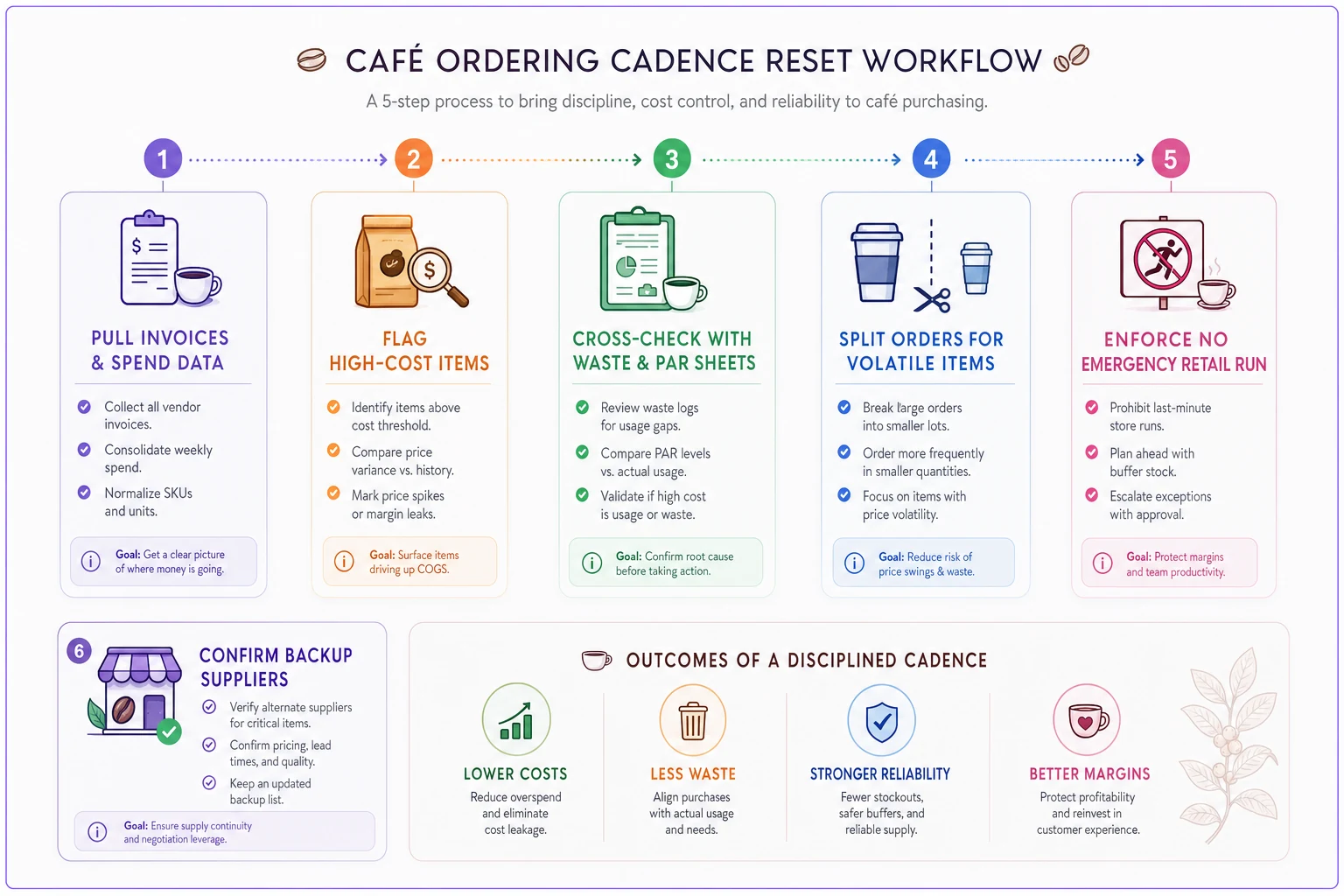
A five-step reset you can run in one manager shift:
-
Pull your last four weeks of invoices and flag the three items whose per-unit cost rose the most.
-
Cross-check those against waste and par sheets — are you over-ordering the exact items that got more expensive?
-
Split your order cadence on volatile items to smaller, more frequent drops so you're not sitting on high-cost inventory.
-
Lock a "no emergency retail run" rule — every mid-week grocery-store milk run at markup is a margin leak you can plan around.
-
Confirm one backup supplier for your top two cost-spiking items so you have leverage if your primary raises again.
Here's a quick visual of that five-step reset.
The operators who handle sticky periods well aren't the ones with the cheapest suppliers. They're the ones who stop letting small ordering mistakes compound at the new, higher price level.
Protect Throughput Without Adding Labor
6. Schedule to your revenue curve, not to habit.
Labor is your other big lever, and the instinct during margin pressure is to cut hours across the board. Usually a mistake — you cut into peak throughput and lose sales that mattered more than the wage you saved.
Look at where your coverage doesn't match your actual demand curve. A lot of cafés carry two extra bodies during a slow mid-afternoon and run thin during a 7:45am rush that's leaving drinks on the counter. Reshaping when people work, not how many, usually recovers more than a blanket cut — and it protects the speed that keeps your morning regulars coming back.
Watch for the Leaks That Only Show Up Under Cost Pressure
7. Reconcile weekly, not monthly, for the next stretch.
The biggest operational failure during inflationary periods isn't any one decision — it's the lag. A cost creep that would've been obvious in a weekly check hides for a full month, and by the time you catch it you've eaten four weeks of erosion.
Move your COGS-vs-sales check to weekly for now. You're watching for one thing: is your food-and-beverage cost percentage drifting up while your sales hold flat? If yes, a price or portion issue is live right now, and catching it at week one instead of week four is the whole game.
This is where centralized operational data earns its keep. When your POS sales, inventory counts, and supplier invoices live in separate places, spotting a 2% margin drift takes hours of manual cross-referencing that nobody actually does weekly. Platforms that pull those numbers together and flag the drift automatically turn a monthly panic into a five-minute Monday review. The value isn't the software — it's that you actually catch the leak while it's still small.
A Real Scenario: The 90-Day Squeeze
A single-location café doing roughly $34k–$38k a month watched their beverage COGS climb from about 26% to just over 31% across a rough quarter — dairy, syrups, and cups all creeping at once. Their instinct was a flat $0.40 hike across the whole menu.
Instead they ran the moves above over two weeks: a portion audit that fixed syrup over-pouring, a modifier bump on alt-milk and extra shots, one base-syrup swap on their bestselling latte, and a widened size gap on lattes while holding drip flat.
No single move was dramatic. Combined, they pulled COGS back toward 27–28% inside about six weeks — without the broad price hike that would've rattled regulars. The owner's takeaway was the useful part: the flat increase they almost ran would've recovered less margin and cost them foot traffic.
The Underlying Problem Sticky Inflation Exposes
Most cafés don't have a repricing system — they have a repricing reflex. Costs jump, prices jump, customers notice, momentum stalls. Then costs jump again and the cycle repeats.
The operators who protect margin through elevated-cost periods treat pricing, portioning, and ordering as connected levers they adjust in small, deliberate increments — with weekly visibility into whether it's working. Sticky inflation doesn't reward the boldest price move. It rewards the operator who catches the small drift early and adjusts before it becomes a monthly loss.
Run two or three of these this week. Don't try to do all seven at once — pick the portion audit and one repricing move, watch the numbers for a week, then layer the next. Steady beats dramatic when your costs won't sit still.
Ready to brew operational excellence?
Join hundreds of coffee shops using Coffehq to boost efficiency, reduce waste, and elevate customer satisfaction.