

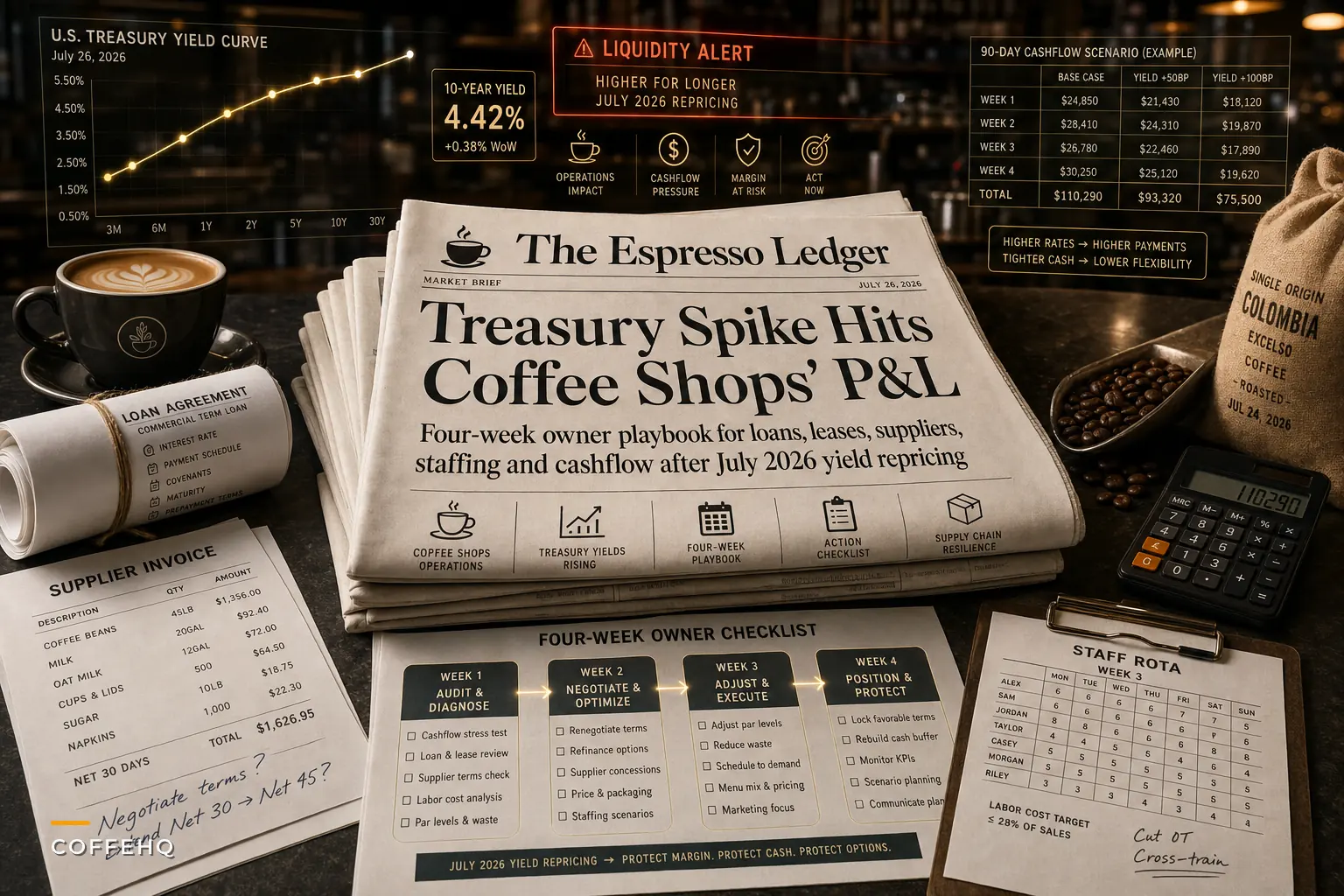

The 30-year Treasury yield just punched through levels we haven't seen since 2007. CNBC reported the surge after the Fed held rates steady, and suddenly every lender, landlord, and supplier is recalculating their risk. For coffee shop owners, this isn't abstract financial news — it's about to show up in your P&L through channels you probably aren't watching.
Most independent coffee shops don't track Treasury yields. Why would they? But when long-term borrowing costs spike, the ripple effects hit your operation from multiple directions at once. Your landlord's refinancing just got brutal. Your equipment financing terms are shifting. That supplier who's been extending 30-day terms is getting nervous about their own cost of capital. And your customers with adjustable-rate mortgages just watched their monthly payments jump.
The problem isn't just that costs are rising — it's that they're rising in ways that don't show up immediately on your daily cash report. By the time the damage appears in your monthly P&L, you're already three weeks behind on adjustments.
The landlord squeeze nobody talks about
Your rent might be fixed, but your landlord's costs aren't. When Treasury yields spike, commercial property refinancing gets expensive fast. A landlord who bought their building at 3.5% staring down 7.2% on a refinance is looking at an extra $18,000 per year on a modest $500k loan.
That money has to come from somewhere. Common area maintenance charges jump. The annual 2% escalation clause in your lease becomes non-negotiable. The broken HVAC unit that would've been replaced becomes your problem through a creative lease amendment. Small maintenance items quietly shift from landlord responsibility to tenant burden.
Three coffee shops in the same strip mall got hit with identical CAM increases recently — $340 extra per month, each. The landlord's property manager called it "deferred maintenance catch-up." The actual story? Their construction loan for parking lot repaving went from 5.8% to 8.1% between approval and closing. Coincidence? Not really.
Treating rent as a truly fixed cost is the mistake here. When rates spike, audit every lease-adjacent expense:
-
Utility allocations
-
Maintenance responsibilities
-
Insurance pass-throughs
-
Property tax adjustments
-
Security and cleaning charges
Document everything. When your landlord tries to pass through a cost that wasn't explicitly outlined in your lease, you need the paper trail.
Equipment financing just became a different game
That espresso machine upgrade you've been planning? The financing terms shifted underneath you. Equipment lenders price their rates off Treasury yields plus a risk premium, so when the 10-year Treasury moves from 4.2% to 4.8%, your equipment loan might jump from 7.5% to closer to 9%.
Keep every order and shift perfectly aligned.
Coffehq helps you manage orders, inventory, and staff schedules seamlessly.
- Unified order processing
- Real-time inventory updates
- Staff shift coordination
No credit card required
On a $25,000 machine financed over 5 years, that's nearly $1,900 in extra interest. But what actually kills operations is the down payment shift. Lenders suddenly want 20% down instead of 10%. Your monthly payment goes from manageable to margin-crushing.
"Just delay equipment purchases" isn't a real answer. That's how you end up with a dying grinder during Saturday morning rush, losing over $1,000 in sales while you wait for repairs. You need a cleaner framework:
Critical equipment (finance immediately if needed):
-
Primary espresso machine
-
Main grinder
-
POS system
-
Refrigeration
Efficiency equipment (finance only if terms allow):
-
Backup espresso machine
-
Batch brew system
-
Under-counter fridges
Nice-to-have equipment (delay or buy used):
-
Specialty grinders
-
Nitro setup
-
Advanced brewing equipment
The math genuinely changes when financing costs spike. That batch brew system saving you 15 minutes of labor per day needs to save closer to 22 minutes to justify borrowing at 9% instead of 6.5%.
Supplier credit is tightening right now
Coffee suppliers have been running on thin margins for years. When their cost of capital jumps, those net-30 terms start looking expensive. A roaster extending $8,000 in monthly credit across their customer base needs working capital. When their line of credit goes from 6% to 9%, that's real money coming out of somewhere.
First sign: stricter enforcement of payment terms. That invoice you've been paying on day 35 now triggers a call on day 31. Second sign: early payment discounts start appearing. "2% off if paid within 10 days" isn't generosity — it means they need cash flow badly.
Then comes the real squeeze. Credit limits drop. Instead of ordering your full monthly coffee needs on terms, you're capped at two weeks of inventory. Now you're placing twice as many orders, paying twice as many delivery fees, and dealing with twice the receiving labor.
A coffee shop ordering $6,000 monthly from three suppliers needs roughly $18,000 in trade credit to run smoothly. When credit limits drop to $3,000 per vendor, you suddenly need $9,000 in additional working capital. Most shops don't have it sitting around.
The customer psychology shift happens fast
Reuters analysis shows yield curve dynamics suggesting longer-term rate pressure ahead. Your customers feel this through mortgages, car loans, and credit cards before they consciously change habits. But when they do adjust, coffee shops feel it in predictable ways.
The $7 specialty latte becomes a $4 drip. The daily visit becomes every other day. The pastry add-on disappears. Group orders from nearby offices shrink as companies tighten expense policies.
What makes this tricky is that it doesn't happen uniformly. Your 7 AM regulars might not change at all — coffee is non-negotiable for them. But your 2 PM leisure crowd quietly evaporates. Weekend traffic holds while weekday afternoons die. The averaging effect hides the real damage until you dig into hourly sales data.
Track these leading indicators:
-
Average ticket by hour (not just daily totals)
-
Percentage of orders with food attached
-
Specialty drink mix versus standard coffee
-
Group order frequency
-
Gift card sales (they tank first)
When two of these shift negative for two consecutive weeks, you're in a demand pattern that needs immediate response.
Staffing decisions under rate pressure
Higher rates mean higher costs everywhere, but labor is where most shops have real flexibility. The mistake is cutting hours uniformly across the board. When demand softens unevenly, you need surgical adjustments.
Your morning rush might need the same coverage, but that 2-4 PM shift could run leaner. The problem is your best baristas work opens and mids — they need full-time hours. Cutting afternoon coverage means losing experienced closers or forcing openers into weird splits nobody wants.
A more useful approach:
-
Map hourly sales to hourly labor for the past 8 weeks
-
Find your break-even transaction count per labor hour
-
Flag every hour running below 85% of break-even
-
Build contingency schedules that cut those specific hours
The goal isn't slashing total labor cost right now — it's having the plan ready when specific dayparts become unprofitable.
Inventory financing through vendor management
When traditional financing gets expensive, vendor financing matters more. Most coffee shops don't realize how much room there is to negotiate payment terms with suppliers. Every vendor has different cash needs and cost structures.
Your roaster might be cash-rich and looking for volume commitments. Your dairy supplier might offer extended terms for exclusivity. Your paper goods vendor might do consignment inventory for guaranteed minimums.
Ask primary suppliers for 45-day terms in exchange for volume commitments to free up short-term cash without taking on expensive loans.
For your primary coffee supplier:
-
Request 45-day terms in exchange for
-
12-month volume commitment
-
Exclusive espresso blend agreement
-
Marketing co-op participation
For dairy suppliers:
-
Negotiate weekly billing instead of payment on delivery
-
Reduces transaction fees
-
Improves cash flow timing
-
Simplifies reconciliation
For dry goods and paper:
-
Push for quarterly volume discounts with monthly billing
-
Locks in pricing despite rate volatility
-
Reduces ordering frequency
-
Minimizes storage complexity
Yes, you're managing more payment cycles and vendor relationships. But when traditional financing costs 9%, vendor financing at 0% is a significant operational advantage.
The P&L blind spots that hurt most
Rate pressure creates expense growth in places most coffee shops don't watch closely. Insurance premiums adjust quarterly. Merchant processing fees have rate escalators buried in the fine print. Even your pest control service has financing costs baked into their pricing.
The compounding effect is what gets you. Each vendor raising prices 3-4% individually doesn't seem dramatic. But when sixteen vendors each bump 3.5%, your non-COGS expenses jump 6-8% without any single obvious culprit.
| Expense Category | Pre-Rate Increase | Post-Rate Reality | Monthly Impact |
|---|---|---|---|
| CAM Charges | $890 | $1,230 | +$340 |
| Insurance | $415 | $465 | +$50 |
| Equipment Leases | $1,200 | $1,380 | +$180 |
| Merchant Fees | $1,950 | $2,090 | +$140 |
| Misc Vendors | $2,100 | $2,280 | +$180 |
| Total Creep | $6,555 | $7,445 | +$890 |
That's $890 monthly — $10,680 annually — in expense growth with zero operational cause. On $65k monthly revenue, that's 1.4% of margin gone before you've made a single bad decision.
Creating your rate-pressure checklist
You can't control Treasury yields, but you can control response speed. Most shops take 60-90 days to fully adjust to rate pressure. The ones that move in two to three weeks protect their margins.
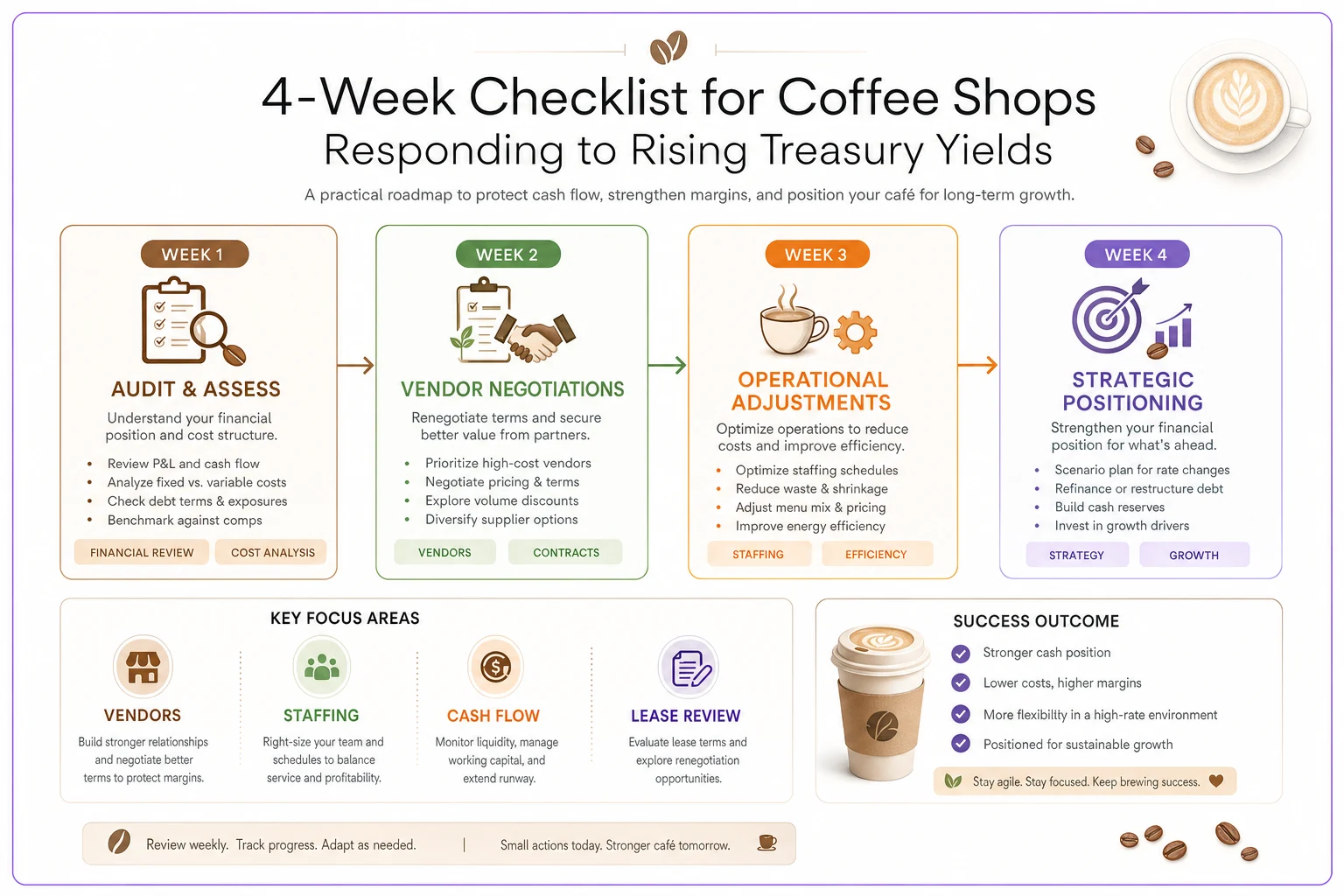
Week 1: Immediate audit
-
Pull all vendor contracts
-
List every payment term
-
Flag all adjustable rate provisions
-
Document lease escalation clauses
-
Review equipment financing dates
Week 2: Vendor negotiations
-
Request extended terms from top 5 suppliers
-
Negotiate volume commitments for better pricing
-
Lock in 6-month pricing where possible
-
Explore early payment discounts
-
Document all conversations
Week 3: Operational adjustments
-
Revise staffing model for demand shifts
-
Adjust par levels for tighter cash flow
-
Review menu mix and pricing power
-
Cut non-essential recurring expenses
-
Implement daily cash tracking
Week 4: Strategic positioning
-
Update cash flow projections
-
Build three-scenario models (base/worse/worst)
-
Identify credit line options before you need them
-
Create customer retention initiatives
-
Document all changes for team training
Here's a quick visual of the 4-week checklist workflow.
This isn't panic mode — it's moving faster than the pressure builds. Shops that waited to "see how things play out" are the ones scrambling for emergency loans at even worse rates.
Connecting rate pressure to operational systems
When every expense line is under simultaneous pressure, manual tracking starts breaking down. You can't spreadsheet your way through sixteen vendor price increases, shifting demand patterns, and changing payment terms all at once — not without things slipping through.
This connects directly to the spreadsheet-first financial model framework — but rate pressure is exactly what exposes where pure spreadsheet management hits its limits. Tracking daily cash, weekly vendor terms, hourly labor efficiency, and monthly lease escalations at the same time creates a reconciliation burden that's hard to sustain manually.
The shops handling rate pressure best have moved to AI-powered operational platforms that automatically surface variances. When your dairy invoice jumps 4%, the system flags it immediately. When afternoon transactions drop below threshold three days running, staffing adjustment recommendations surface without you having to dig for them. When vendor payment terms change, cash flow projections update automatically. Not replacing your judgment — just making sure the signals that need immediate decisions actually reach you in time.
Moving forward with rate reality
Treasury yields aren't returning to 2020 levels anytime soon. This isn't a temporary squeeze to weather passively — it's a new operational baseline that requires different management habits.
Vendor relationships need renegotiation. Every staffing hour needs justification. Every expense line needs scrutiny. That's a lot to hold in your head at once.
What separates the shops that come out stronger from the ones that disappear during these cycles isn't access to capital or better locations. It's how systematically they respond. Building vendor financing relationships beats emergency equipment leases. Targeted staffing adjustments beat across-the-board cuts. Proactive lease negotiations beat reactive rent fights.
Rising treasury yields coffee shop P&L pressure is real and already showing up in your numbers. The question isn't whether rates will impact your operation — they already are. The question is whether you respond with random cuts or something more deliberate.
Start the audits now, while you still have flexibility. By the time your landlord, lenders, and suppliers have locked in their new terms, your window for proactive negotiation has already closed.
Ready to brew operational excellence?
Join hundreds of coffee shops using Coffehq to boost efficiency, reduce waste, and elevate customer satisfaction.