
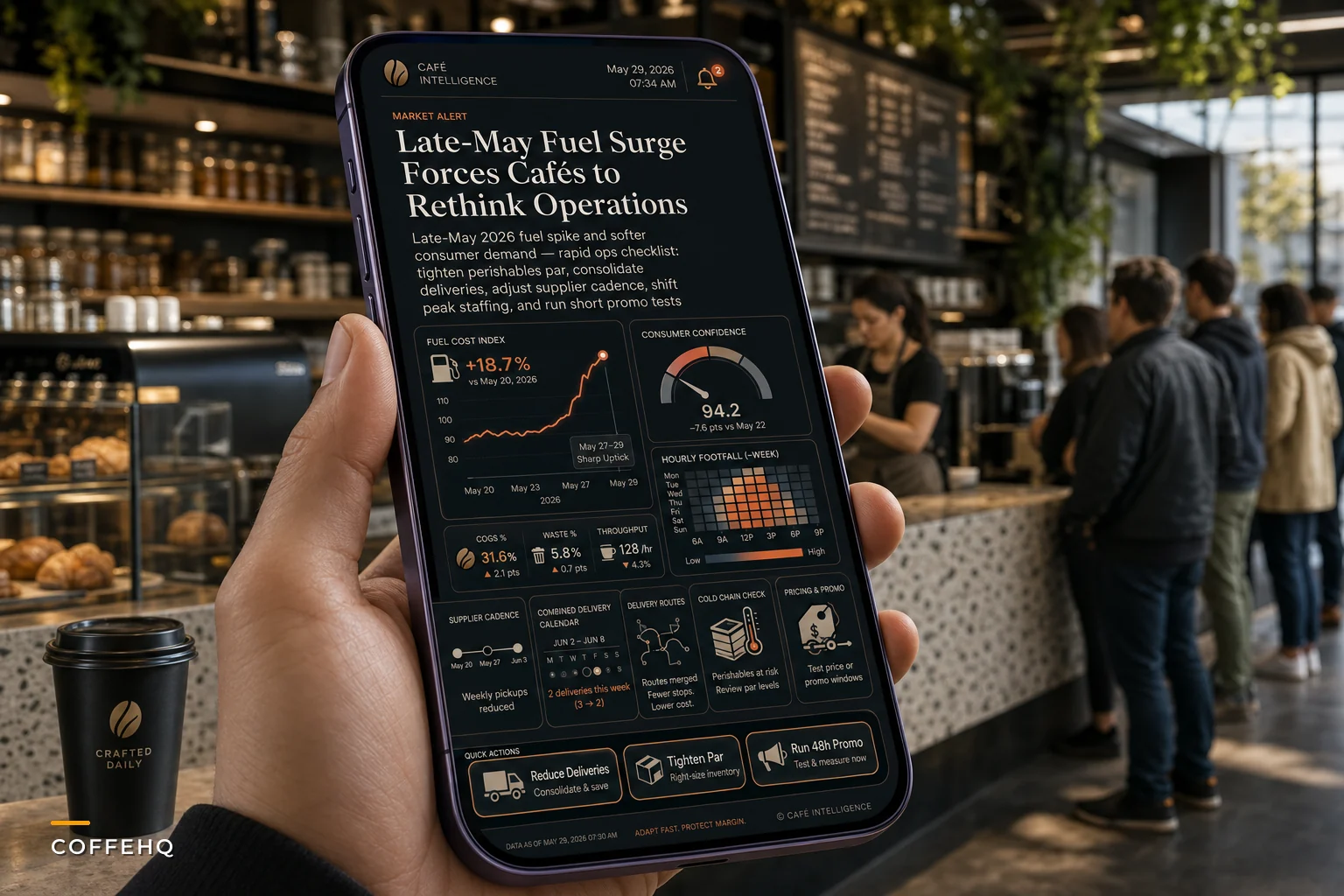

Consumer sentiment crashed to record lows last week as gas prices jumped and inflation worries mounted. For café owners, this creates an immediate operational problem that's different from anything we've dealt with before: suppliers passing through fuel surcharges while customers simultaneously cut their morning coffee runs.
Your coffee roaster adds a 4% fuel adjustment to their invoice. Your dairy supplier tacks on $15 per delivery. Meanwhile, foot traffic drops 12% as customers work from home more to save gas money. You're getting hit from both sides.
This isn't like the pandemic where everyone faced the same crisis together. Chains with locked-in fuel contracts and negotiated delivery rates barely feel it, while independents absorb the full impact week by week.
Why standard café playbooks fail during fuel-driven cost spikes
Most café operational guides assume stable input costs and predictable demand patterns. They tell you to negotiate annual contracts, standardize your menu, optimize for consistency. That framework completely breaks down when your costs change weekly and customer behavior shifts daily.
Raising prices to maintain margins—the traditional response—accelerates the death spiral. A customer already stressed about filling their gas tank sees your latte went from $5.50 to $6.25 and decides to make coffee at home. You lose the sale entirely instead of capturing it at a lower margin.
Rising fuel costs create cascading operational failures that compound quickly. Your supplier minimum orders stay the same but delivery fees increase, forcing larger, less frequent orders. This ties up more cash in inventory. Perishables spoil because you ordered based on last month's traffic patterns. Labor efficiency drops as you struggle to predict slower periods.
The speed makes this particularly brutal. During gradual inflation, you can test price changes, adjust portions, refine operations month by month. Fuel spikes hit immediately. Your Tuesday delivery costs 8% more than last Tuesday's. There's no adjustment period.
Delivery consolidation works better than you think
Chains figured this out years ago, but most independents miss it: delivery fees hurt way more than product costs when you're running multiple suppliers.
Keep every order and shift perfectly aligned.
Coffehq helps you manage orders, inventory, and staff schedules seamlessly.
- Unified order processing
- Real-time inventory updates
- Staff shift coordination
No credit card required
A typical independent café might have coffee roaster delivering twice weekly, dairy coming Monday/Wednesday/Friday, bakery dropping off daily, paper goods monthly, specialty items as needed. Each supplier adds their fuel surcharge. Some charge flat fees, others percentage-based. The administrative overhead of tracking these variable costs alone eats hours.
Map every delivery you receive over two weeks. Note minimums, lead times, and shelf life for each category. Then start combining.
Instead of twice-weekly coffee deliveries, can you store a week's worth? Instead of daily bakery runs, can you supplement fresh items with frozen parbaked goods? Can your main food distributor add dairy to their regular run?
Each eliminated delivery saves the fuel surcharge plus the hidden costs—checking in orders, rotating stock multiple times, managing more invoices. One café cut from 18 weekly deliveries to 11 and saved $340 monthly just in delivery fees, not counting the operational efficiency gains.
GRAPH PLACEHOLDER: Weekly Delivery Cost Comparison - Before vs After Consolidation
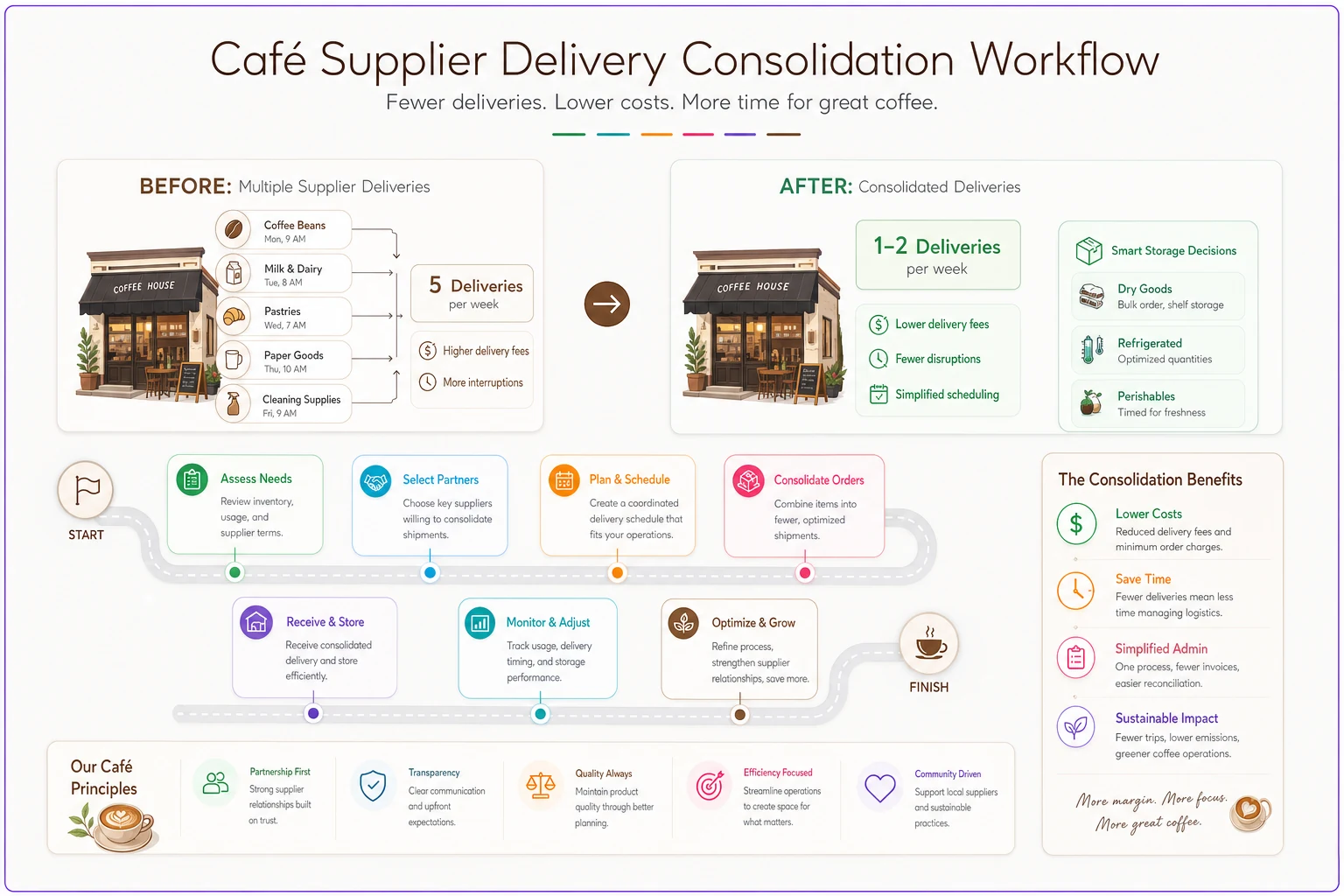
This compares weekly delivery costs before and after consolidation in a simple visual.
Building a fuel-adjusted pricing matrix that doesn't scare customers
Across-the-board price increases are almost always wrong. Different products have wildly different elasticity, and customers notice some prices way more than others.
Your pricing matrix needs three tiers:
-
Protected items - What customers use to judge your value. Usually drip coffee, basic espresso drinks. These prices stay flat even if you lose margin temporarily.
-
Flexible items - Specialty drinks, seasonal items, add-ons. These can absorb 5-10% increases without major pushback.
-
Premium items - Food, retail bags, merchandise. These can handle larger increases since they're already discretionary purchases.
Make increases invisible where possible. Don't raise the price of oat milk from $0.75 to $1.00. Instead, make dairy the upcharge and oat milk the default. Don't increase large drink prices—decrease the size slightly while maintaining price. Don't charge for extra shots—make doubles the standard and charge less for singles.
| Product Category | Price Adjustment Strategy | Customer Impact | Revenue Impact |
|---|---|---|---|
| Drip Coffee | Hold steady | Minimal | -2% margin |
| Specialty Lattes | 5-8% increase | Low resistance | +3% revenue |
| Food Items | 8-12% increase | Moderate resistance | +6% revenue |
| Retail Products | 10-15% increase | Minimal impact | +8% revenue |
Track the actual impact religiously. If a 50-cent increase on breakfast sandwiches causes a 30% drop in sales, you're worse off. But that same increase on afternoon pastries might see only a 5% volume decline.
Staffing adjustments that don't destroy service quality
Labor is usually 30-35% of revenue in a healthy café. When sales drop but you're trying to maintain service standards, this percentage balloons quickly.
Cutting hours across the board creates predictable failures. Your remaining staff burns out. Service slows. Customer experience degrades. Sales drop further.
Instead, restructure around demand reality. If morning rush is now 7:30-9:00 instead of 7:00-9:30, don't staff that extra half hour at full capacity. But don't just send someone home early. Shift that labor to prep, deep cleaning, maintenance—work that reduces future operational drag.
Create modular shift blocks that can expand or contract based on real-time demand. Instead of fixed 8-hour shifts, build 4-hour core blocks with 2-hour extensions that can be called off with notice. This requires clear communication and staff buy-in, but it preserves hours for your team while matching labor to actual needs.
Cross-training becomes critical. Every person needs at least two stations they can cover competently. When you're running lean, flexibility matters more than specialization. Staff who can handle register, espresso machine, and food prep can cover busy periods without backup.
Selective inventory expansion vs. aggressive reduction
Conventional wisdom says reduce inventory to free up cash. But with suppliers adding delivery charges and minimums, smaller orders often cost more per unit than larger ones.
Selective inventory expansion works better. Identify items with long shelf life and high fuel-cost exposure: coffee beans, tea, dry goods, paper products. Buy ahead on these when you can negotiate better rates or combine shipments.
Meanwhile, aggressively reduce perishable inventory. If you're seeing 15% less traffic, you need 15% less milk, produce, and bakery items. This seems obvious but requires constant adjustment. Your ordering playbook from three months ago assumed different demand patterns.
Build a simple tracking system: Monday's milk order should be based on the previous Monday, not weekly average. Most cafés still order on autopilot. When demand shifts suddenly, pattern-based ordering reduces waste immediately.
Manage variance without creating stockouts. Keep a skeleton safety stock of items that kill sales when absent—alternative milks, popular syrups, decaf. Let yourself run out of nice-to-haves: that third flavor of muffin, specialty retail items, seasonal drinks that aren't selling.
Customer retention tactics that actually work during inflation stress
Discounting is usually the worst response to falling demand, but targeted incentives can prevent customer defection without destroying margins.
Prepaid cards and subscriptions lock in revenue while providing customer value. Offer a $100 coffee card for $85, but only for the next week. The discount hurts less than losing the customer entirely, and you get immediate cash flow.
Loyalty programs need restructuring during these periods. Instead of "buy 10 get one free," shift to incremental rewards: "buy 3 this week, get $2 off your fourth." This creates urgency and frequency without massive giveaways.
Bundle strategically. A coffee and pastry combo priced $1 less than separate purchases moves inventory while maintaining decent margins. Afternoon "happy hour" pricing fills dead periods without training customers to wait for discounts.
Customers feeling inflation stress respond better to "we're in this together" messaging than premium positioning. Share (without whining) that you're absorbing some cost increases. Highlight local sourcing that reduces transportation costs. Make sustainability about saving money, not just the environment.
What the next 90 days really look like
The operational reality for the next quarter isn't pretty. Reuters reports that inflation expectations continue climbing, meaning both costs and customer caution will persist.
Your immediate focus needs to be cash flow preservation over margin optimization. This is a sprint disguised as a marathon.
Weeks 1-2: Audit all delivery schedules and consolidate where possible. Renegotiate payment terms with suppliers—even an extra 15 days helps. Implement the tiered pricing adjustments on flexible items only.
Weeks 3-4: Restructure staff schedules around new demand patterns. Start testing small menu simplifications—removing low-sellers that require unique ingredients. Launch prepaid card sales to generate immediate cash.
Weeks 5-8: Evaluate which changes actually improved operations versus just reducing costs. Some delivery consolidations might create more problems than they solve. Some price increases might be acceptable while others tank sales. Adjust based on actual data, not projections.
Weeks 9-12: Build the sustainable operating model. This isn't about returning to previous patterns—consumer behavior has shifted. The cafés that survive will run leaner operations permanently, not just during crisis periods.
Don't expect linear progress. Week 4 might feel worse than week 2 even if you're making good decisions. Customer behavior takes time to stabilize around new patterns.
Making operational tracking less painful
The biggest failure is cafés making all these adjustments blind, without tracking what actually works. Most owners barely have time to operate, let alone build complex tracking systems.
Start simple. Pick three numbers that matter: daily sales vs. last week same day, daily customer count, actual vs. theoretical food cost. That's it. Track these religiously. Everything else is nice-to-have.
If you're ready for more sophisticated tracking, AI-powered operational platforms can automate much of this data collection and analysis. Instead of manually calculating delivery cost impact or pricing elasticity, these systems track changes automatically and surface insights you'd miss otherwise.
The value isn't the technology itself—it's freeing up mental bandwidth to focus on customer experience and staff morale while the system handles the number-crunching. When every decision feels critical, having reliable operational data becomes the difference between guessing and knowing.
Pro-tip: Start with the three daily metrics mentioned and build consistency before adding complexity.
Simple spreadsheets work fine for basic tracking. A piece of paper taped to your register works too. The method matters less than consistency.
Playing the long game when everything feels urgent
Pure survival mode—cut everything, raise all prices, hope things improve—is tempting. But the cafés that emerge stronger will be those that use this pressure to build better operations, not just cheaper ones.
Every adjustment you make teaches you something about your business's real constraints. Maybe you discover you've been over-ordering dairy for years. Maybe that premium coffee offering barely sold anyway. Maybe your customers value speed over variety more than you realized.
Rising fuel costs expose operational waste that good times concealed. The forced efficiency creates capabilities you'll maintain even when costs stabilize. The customer relationships you preserve during their stress become loyalty when their situation improves.
Bloomberg notes that this isn't about optimism—it's about operational reality. The cafés still standing in six months won't be the ones that panicked or the ones that did nothing. They'll be the ones that adjusted intelligently, tracked religiously, and maintained the quality that made them worth visiting in the first place.
The fuel crisis will end. Consumer confidence will recover. But the operational discipline you build now becomes competitive advantage forever.
Ready to brew operational excellence?
Join hundreds of coffee shops using Coffehq to boost efficiency, reduce waste, and elevate customer satisfaction.