

Most speed training at cafes dies for one reason: it gets scheduled during the only windows when nobody actually has time to train. You tell yourself you'll work on dial-in consistency this week, then Tuesday rush hits, someone calls out, and the plan disappears until you forget you made it.
The fix isn't a weekend offsite or a $900 consultant. It's a tight, seven-day micro-training pack that runs in the dead zones you already have — the 2:00–3:30 lull, the 20 minutes after the morning rush breaks — with measurable before/after numbers so you actually know if it worked. Each day targets one skill, takes under 25 minutes, and has a rollback rule so you never ship a change that slows the line down.
This is the drill pack itself: what to measure, what to run each day, the cue cards your shift leads read from, and a simple dashboard that tells you whether speed improved without quality sliding.
Why quiet-window training is the only kind that survives
The reason cafe training fails isn't motivation. It's that the standard approach treats training as a block of time that competes directly with revenue hours. There's never a "good time," so it keeps getting pushed.
Quiet-window training flips the constraint. Instead of asking "when can we afford to stop making coffee and train," you ask "what 20-minute slot already has low ticket volume where a second person on bar is basically idle?" Almost every cafe has two or three of those a day. You're not creating new labor hours — you're using slack that already exists.
There's a second reason this works that most owners miss. Speed drills done at low volume let a barista fail safely. If someone botches a dial-in or fumbles a pour during the drill, the cost is one wasted shot and zero angry customers. Try to coach the same correction at 8:15am and you're either making the line wait or skipping the correction entirely. Low-stakes reps are where real muscle memory gets built — the same principle behind structured barista onboarding with 30/60/90 micro-certifications, where small repeatable checks replace one giant evaluation.
What to measure first (and why most cafes measure the wrong thing)
Before you run a single drill, you need a baseline. Skip this and the whole week becomes guesswork — you'll "feel like" people got faster without being able to prove it or spot the person who got faster by cutting corners.
Keep every order and shift perfectly aligned.
Coffehq helps you manage orders, inventory, and staff schedules seamlessly.
- Unified order processing
- Real-time inventory updates
- Staff shift coordination
No credit card required
-
Ticket time — seconds from order fired to drink on the handoff bar, measured per drink category, not blended. An espresso shot and a four-drink mobile order aren't the same thing.
-
Error rate — remakes plus corrections per 100 drinks. This is your guardrail. Speed that pushes error rate up isn't speed, it's debt.
A common mistake is tracking only average ticket time. Averages hide the problem. What kills morning throughput is the long tail — the drink that takes four minutes because someone forgot to start steaming milk while the shot pulled. Track your 90th-percentile ticket time, not just the mean. That's the number customers actually feel when they're standing there watching their latte not happen.
Here's a realistic baseline table from a two-bar cafe doing roughly 280–320 drinks on a weekday:
| Drink category | Avg ticket time | 90th percentile | Error rate (per 100) |
|---|---|---|---|
| Drip / batch | 22s | 40s | 1.1 |
| Single espresso drink | 68s | 110s | 3.4 |
| Milk-based (latte/cap) | 95s | 165s | 4.8 |
| Multi-drink order (3+) | 210s | 380s | 6.2 |
You don't need fancy tooling to capture this. A shift lead with a phone stopwatch sampling 15–20 drinks per category over two or three shifts gets you close enough to trust. The point isn't lab precision — it's having a real "before" so Day 7's "after" means something.
The 7-day drill pack
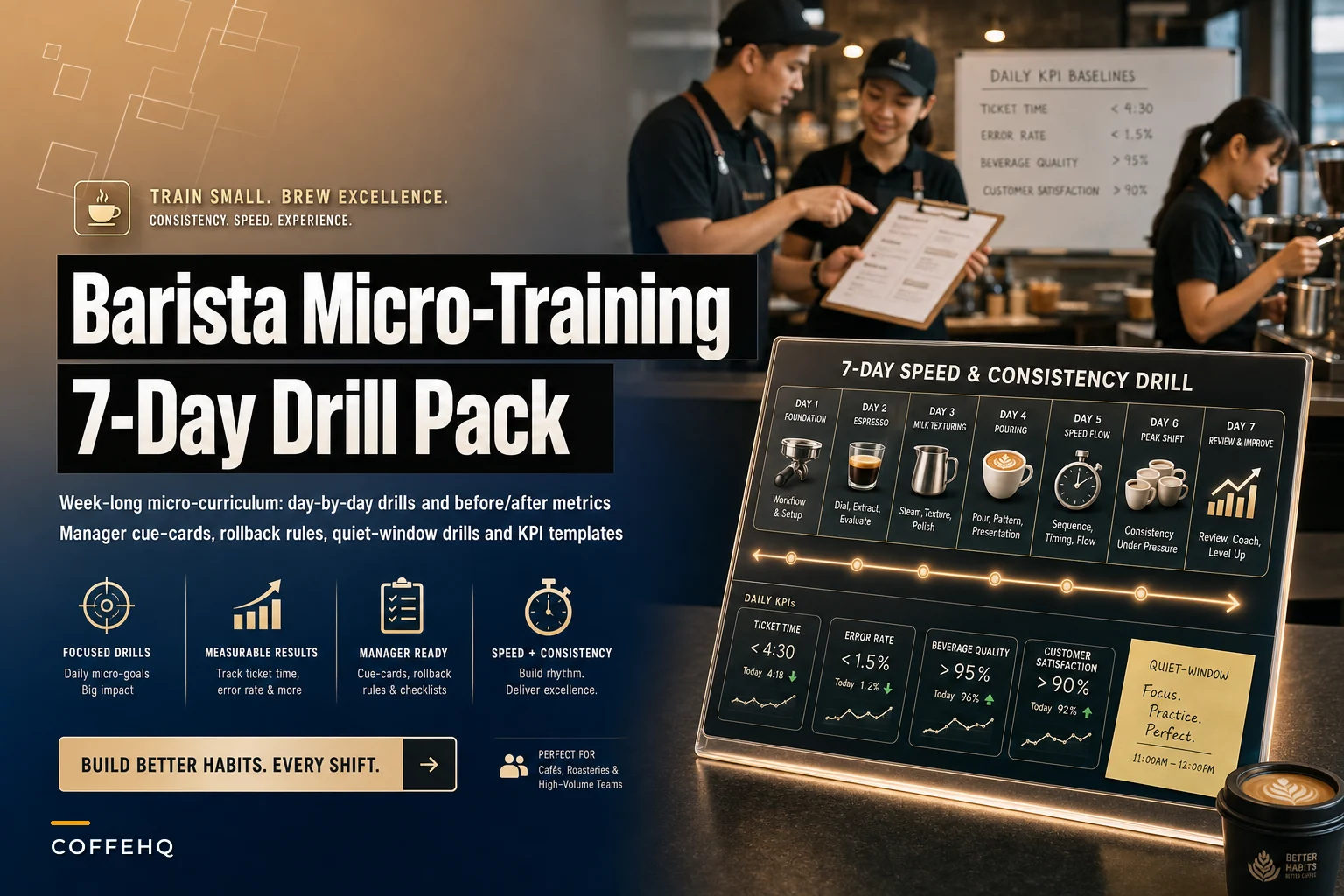
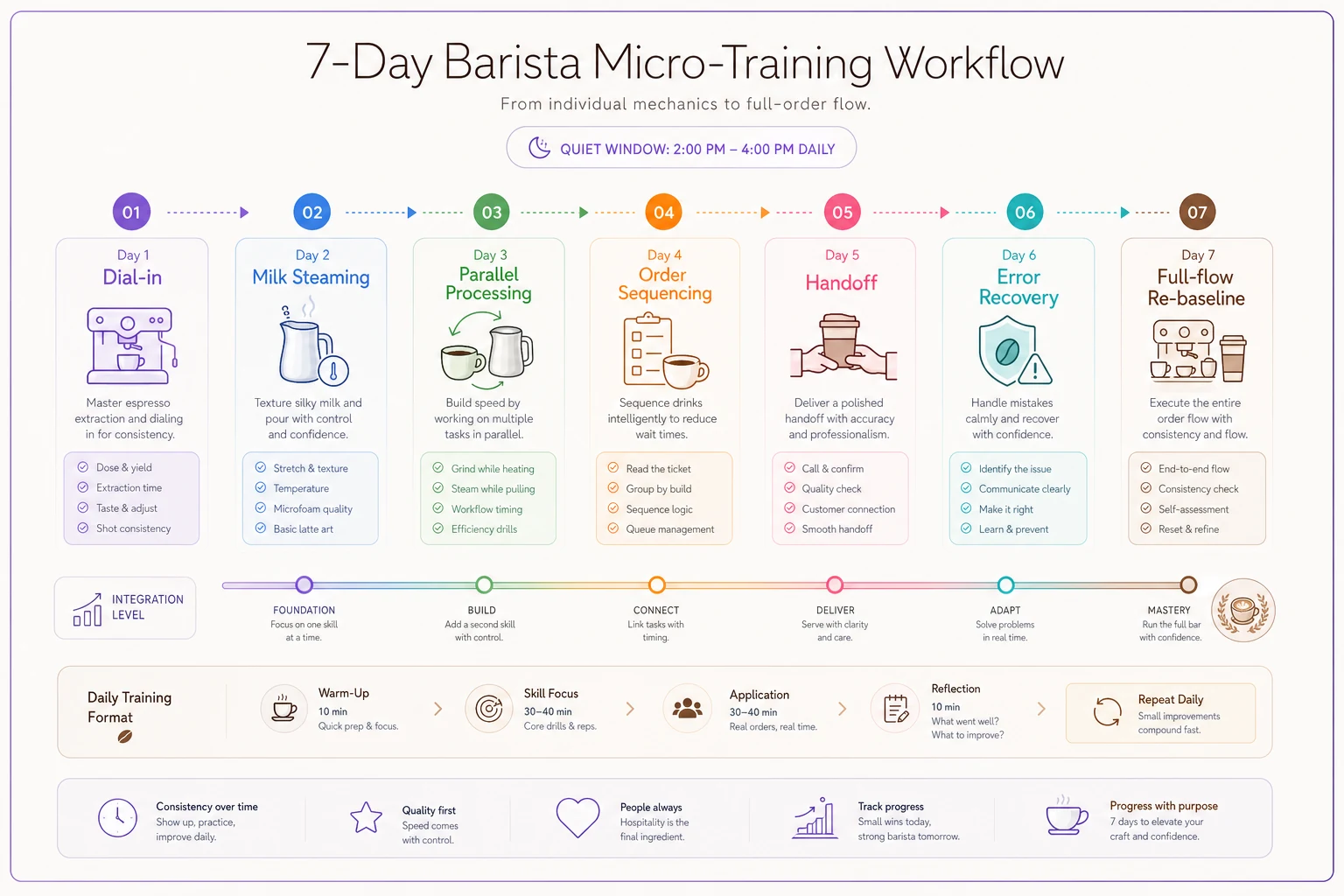
Each day is one focus, one drill, one measured outcome. Run it in a quiet window. Keep it under 25 minutes. The sequence matters — it builds from individual mechanics toward full-order flow, so don't shuffle the order.
Here's a simple visual to map the week's flow.
Day 1 — Dial-in speed and consistency
Focus: How fast can a barista get espresso in-spec from a cold start?
Drill: Barista pulls five shots back to back, calling out target yield and time before each. Shift lead logs actual vs. target. The goal isn't just hitting the window — it's hitting it without three throwaway shots first.
Measure: Shots-to-first-in-spec, and yield variance across the five.
Insight: The hidden speed killer here is grinder adjustment hesitation. Fast baristas make one confident adjustment; slow ones make three timid quarter-turns. Coach decisiveness, not just the number.
Day 2 — Milk steaming and pour discipline
Focus: Steaming the right volume to texture in one go.
Drill: Steam for three drink sizes in sequence. Measure time-to-texture and whether leftover milk got dumped — that's your waste signal. If you're fighting peak-hour milk waste, this drill doubles as a cost control, because overfilling the pitcher is both slow and expensive.
Measure: Steam time per size, milk waste per rep.
Day 3 — Parallel processing
Focus: Doing two things at once correctly — shot pulling while milk steams.
Drill: Build four milk-based drinks. Watch the sequencing: does the barista start the shot and steam simultaneously, or run them in series? Series is the single biggest source of slow latte times.
Measure: Ticket time on milk drinks vs. Day-0 baseline. This is usually where the biggest number moves.
Insight: Most cafes see a 15–25% ticket-time drop on milk drinks from this one day alone, because series-to-parallel is a mental model shift, not a skill ceiling. People just never got told to overlap the steps.
Day 4 — Order sequencing on multi-drink tickets
Focus: Building a 3–4 drink order in the fastest safe sequence.
Drill: Fire a mock four-drink ticket. Barista calls the build order out loud before starting — hot drinks last so they're fresh at handoff, batch items first, milk drinks grouped. Log whether anything went cold or had to be remade.
Measure: Multi-drink ticket time and remakes.
Sequencing is where station layout starts to matter as much as skill. If your tools and cups aren't placed to support the fast build order, no amount of drilling fixes it — that's covered in more detail in increasing barista throughput through station layout and tool placement.
Day 5 — Handoff and call-out accuracy
Focus: Clean verbal handoff so drinks don't sit or get grabbed wrong.
Drill: Run a mixed in-store and mobile queue of six drinks. Barista calls each drink clearly at handoff. Count drinks that sat more than 30 seconds and any mis-grabs.
Measure: Handoff dwell time, mis-grabs per order.
Insight: A surprising chunk of "slow service" complaints aren't about build speed at all — the drink was ready but sat silently on the bar for 45 seconds. Fixing call-outs can improve perceived speed without touching build time at all.
Day 6 — Recovery under a forced error
Focus: How fast someone recovers from a mistake without stacking more.
Drill: Shift lead intentionally injects one error into a mock rush — wrong milk, missed shot. Watch the recovery: does the barista fix it cleanly, or does the whole rhythm collapse for the next two or three drinks?
Measure: Time-to-recover, errors in the drinks immediately following the injected one.
Day 7 — Full-flow simulation and re-baseline
Focus: Put it all together and re-measure everything from Day 0.
Drill: Run a simulated 15-minute mini-rush at realistic volume. Capture the same metrics you took as your baseline.
Measure: All four categories, average and 90th percentile, plus error rate. This is your "after."
By the end of the week you'll have a clear picture of what actually moved and what didn't — which is at least as useful as the gains themselves.
Manager cue cards
The reason training doesn't stick is usually that the shift lead running it improvises differently every time. Cue cards fix that. Each card is roughly index-card-sized — a script the lead reads so every barista gets the same drill the same way.
A cue card has exactly four things:
-
Setup line — what to say to start the drill ("We're doing five shots, call your target before each one.")
-
What to watch — the one or two things the lead is actually scoring.
-
The correction cue — the single phrase to give when it goes wrong ("One confident adjustment, not three small ones.")
-
The log field — what number goes in the sheet.
Example, Day 3 cue card: > PARALLEL PROCESSING > Say: "Four lattes. Start your shot and milk at the same time — don't wait." > Watch: Series vs. parallel. Did they steam while the shot pulled? > Correct: "Lock the portafilter, hit the shot, go straight to milk." > Log: Milk-drink ticket time ×4
Keep the cards on a ring by the bar. The whole point is that any shift lead can grab them and run the day without re-reading a manual.
Rollback rules: the part everyone skips
A faster technique that raises your error rate is a loss, not a win — you just moved the cost from the customer's wait to the customer's wrong drink. You need a rule that catches that before it becomes habit.
The rollback rule is simple: if error rate on a category rises more than 1.5 points above its Day-0 baseline during or after a drill, you revert to the prior technique for that category and re-drill before shipping it to real shifts.
A typical example: a cafe pushed parallel processing hard, dropped latte ticket time from 95s to around 74s, and felt great — until error rate on milk drinks climbed from 4.8 to 7.1 per 100. Baristas were overlapping steps so aggressively they were under-texturing milk. The rollback rule caught it. They pulled back to a slightly slower overlap, latte time settled near 82s, error rate came back to roughly 5.0, and that's the version that shipped. Net result was still around a 14% speed gain — just a real one.
Without a rollback rule, that cafe ships the 74-second technique, remakes creep up quietly, and three weeks later the "faster" training has made the bar slower on net because every remake costs more time than it saved.
The KPI dashboard
You don't need software to run this, but you do need the numbers in one place where you can see the week's arc. A single sheet does it. Columns are the drink categories. Rows are the days. Each cell holds ticket time — average and 90th — plus error rate.
-
Did ticket time drop by Day 7 versus Day 0?
-
Did error rate stay inside the rollback threshold the whole way through?
-
Which category moved most — and which didn't move at all?
That last one matters. If multi-drink orders didn't improve, the problem is probably sequencing or layout, not individual skill, and no amount of re-running Day 1 fixes it.
Where tracking tools earn their place is when you're running this across more than one location or want ticket time pulled straight from POS timestamps instead of a stopwatch. Cafes managing several sites tend to standardize the drill pack and the dashboard so a new manager inherits the whole system instead of reinventing it. But for a single shop, a well-kept spreadsheet and a phone stopwatch will get you 90% of the value. Don't let "we need a system first" become the reason you never start.
When this drill pack makes sense — and when it doesn't
Run it when your bar is fundamentally sound but inconsistent — fast on some shifts, slow on others. Micro-training tightens the spread. It's also the right move after adding new hires and your averages have drifted.
Skip it when your bottleneck is structural, not skill-based. If lattes are slow because your espresso machine has two groups and you're running three baristas, drilling parallel processing just makes people good at waiting for the machine. Fix the equipment or layout constraint first. Running speed drills against a hardware ceiling frustrates good baristas and teaches them nothing.
Who should skip it entirely: a brand-new shop still figuring out its own recipes. You can't drill consistency toward a target that keeps changing. Lock your standards first, then come back to this.
A realistic before/after
A neighborhood cafe doing around 300 drinks a day, two baristas on bar, ran this pack over a slow mid-week stretch. Their pain point was milk drinks and multi-drink mobile orders bunching up at 8am.
Baseline: milk drinks averaging 95s (165s at the 90th percentile), multi-drink orders around 210s, milk-drink error rate 4.8.
After the week — including one rollback on Day 3 — milk drinks landed around 82s average with the 90th percentile pulled down to roughly 130s, which is the number customers actually felt. Multi-drink orders came in near 175s. Error rate held at about 5.0, basically flat.
Nothing dramatic on paper. But a 35-second cut on the 90th-percentile latte during a morning rush is the difference between a line that moves and a line that stalls. The staff said the mornings felt noticeably less frantic. That's the realistic outcome here — not a transformation, just a tightening. The slow shifts started looking more like the fast ones.
The one habit that keeps it from decaying
Training gains fade. The parallel-processing habit that was sharp in week one drifts by week six as people fall back into comfortable patterns. The cafes that hold their gains don't re-run the whole pack — they pick the single highest-impact day, usually Day 3 or Day 4, and run just that one drill once a week in a quiet window. Fifteen minutes. One category. One number checked against the dashboard.
That's the whole system. A week to build it, fifteen minutes a week to maintain it. The quiet windows were always there — you're just finally using them for something that compounds.
That's the whole system. A week to build it, fifteen minutes a week to maintain it. The quiet windows were always there — you're just finally using them for something that compounds.
Ready to brew operational excellence?
Join hundreds of coffee shops using Coffehq to boost efficiency, reduce waste, and elevate customer satisfaction.