

Your new barista started strong. Enthusiastic, punctual, eager to learn. But three weeks in, they're still asking basic questions during morning rush. Orders back up. Your experienced staff covers their mistakes while trying to manage their own stations. Customers notice the hesitation, the double-checking, the slower service.
The real cost hits harder than most managers expect. A poorly trained barista making 40 drinks per hour instead of 60 during peak means roughly 60 lost transactions daily. At $6 average ticket, that's $360 in missed revenue every single day they're underperforming. Multiply that across multiple new hires throughout the year and you're looking at tens of thousands in lost sales — not even counting remake costs, wasted product, and the overtime that piles up when experienced staff stay late to fix inventory mistakes.
Most cafes treat training like shadowing. New barista follows someone around for a few days, maybe gets a printed manual, then gets thrown on bar during a slow Tuesday afternoon. When they struggle, managers assume they're "not getting it" or "need more time." But the problem usually isn't the person — it's the complete absence of structured skill verification.
The competency roadmap that actually works
A proper barista onboarding program breaks skills into micro-certifications. Not broad categories like "knows espresso" — specific, observable competencies like "pulls shots within 23-27 second range consistently" or "steams milk to 145-155°F without looking at the thermometer."
Here's the framework:
Days 1-30: Foundation Station Competencies
The first month focuses exclusively on mastering individual stations without time pressure. Each skill gets its own micro-certification with specific pass/fail criteria.
Register & Customer Service:
-
Process 10 consecutive transactions without errors
-
Navigate all menu modifications without asking for help
-
Handle 3 different payment types (cash, card, mobile)
-
Complete a void and refund independently
-
Answer 5 common customer questions accurately
Espresso Station:
-
Dial in grinder within 2 attempts
-
Pull 10 shots within target time range
-
Identify channeling and adjust dose/tamp
-
Clean and backflush machine properly
-
Maintain shot timing log for full shift
Milk & Steam:
-
Steam to correct temperature 8/10 times
-
Create microfoam with proper texture consistency
-
Pour basic patterns (heart, tulip)
-
Batch steam for multiple drinks efficiently
-
Clean steam wand between every use
Cold Bar:
-
Build 5 different cold drinks to recipe
-
Measure syrups within 0.25oz accuracy
-
Blend frozen drinks to correct consistency
-
Maintain ice levels throughout shift
-
Complete station setup in under 10 minutes
Days 31-60: Integration & Speed Building
Month two connects individual skills into smooth workflows. The focus shifts from "can you do it" to "can you do it under pressure."
Multi-Station Flow:
-
Complete 20 drinks alternating between hot and cold
-
Maintain proper sequencing (start shots before steaming)
-
Handle 3+ drinks in queue without confusion
-
Communicate clearly with other stations
-
Recognize and prevent bottlenecks
Peak Performance Standards:
-
Achieve 40 drinks per hour during rush
-
Maintain quality standards at speed
-
Complete orders in correct sequence
-
Help teammates without abandoning station
-
Reset station between rushes properly
Days 61-90: Consistency & Coaching
The final month is about reliability. New baristas should be performing independently while starting to help orient newer staff.
Advanced Skills:
-
Handle special requests and customizations
-
Troubleshoot equipment problems
-
Coach newer baristas on basics
-
Manage inventory counts accurately
-
Open or close stations solo
Visual workflow for progressing from micro-certifications to integrated station flow.
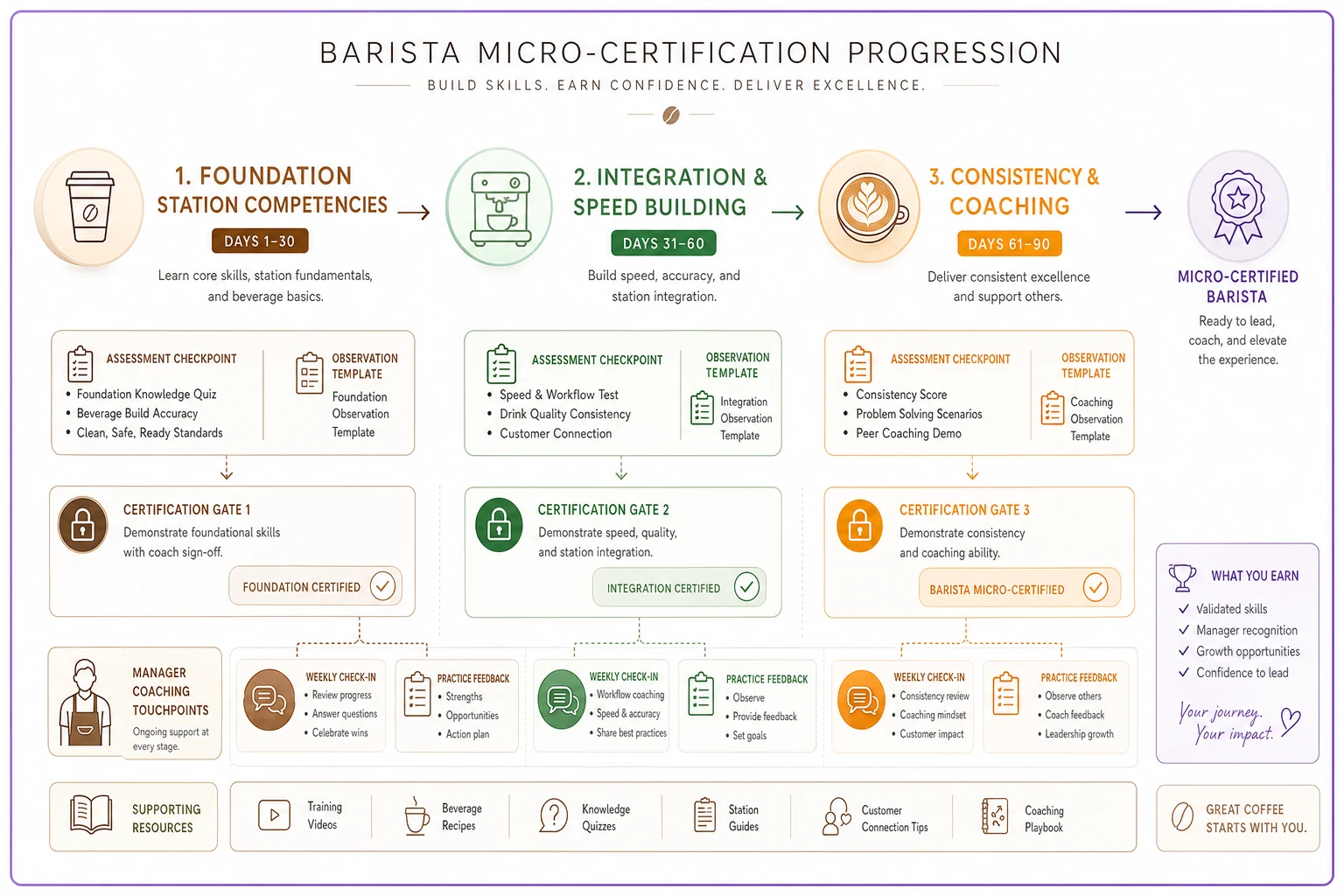
Use this flow as a reference when scheduling certifications and observations.
Daily observation templates that track real progress
Generic feedback like "doing better" or "needs improvement" tells you nothing useful. Structured observation templates capture specific behaviors and actual competency gaps.
Keep every order and shift perfectly aligned.
Coffehq helps you manage orders, inventory, and staff schedules seamlessly.
- Unified order processing
- Real-time inventory updates
- Staff shift coordination
No credit card required
Morning Rush Observation Sheet Station: Date: Observer: Drink Execution (check all observed): □ Follows recipe without checking □ Maintains proper shot timing □ Steams milk to correct temp □ Pours with consistent technique □ Remakes drinks when needed Workflow Management: □ Sequences drinks efficiently □ Communicates with team □ Maintains clean station □ Restocks during lulls □ Helps other stations when able Specific Issues Noted: _ _ Drinks completed this hour: Remakes required: Time to complete 5-drink sequence:
Weekly Competency Review
Track progression across all micro-certifications weekly. This isn't a performance review — it's a skill inventory.
| Competency | Not Started | In Progress | Certified | Date Certified |
|---|---|---|---|---|
| Register: 10 transactions | ||||
| Shots: timing consistency | ||||
| Milk: temperature accuracy | ||||
| Cold bar: recipe adherence | ||||
| Rush: 40 drinks/hour | ||||
| Communication: order calling |
This template shows exactly where each barista stands. No guessing whether someone is "ready" for morning shift — either they've hit the benchmarks or they haven't.
Manager coaching scripts that eliminate guesswork
Managers often fumble training feedback because they're improvising in the moment. Prepared coaching scripts make conversations consistent and actually useful.
Script: Addressing Shot Timing Issues "I noticed your shots are running long — around 32 seconds instead of our 25-second target. This usually means the grind is too fine. Let's adjust the grinder one notch coarser and pull a test shot. Watch how the flow changes... see how it's running faster now? We want that steady stream, not a slow drip. Pull three more shots and let's time them together."
Script: Correcting Workflow Sequencing "You're starting your milk before pulling shots, which means the espresso sits too long before you pour. Here's the sequence that works better: dose and tamp first, start your shots, then steam milk while shots pull. Everything finishes at the same time. Let me show you once, then you try it with the next three drinks."
Script: Building Confidence During Rush "Morning rush feels overwhelming at first — everyone goes through this. Focus on one drink at a time instead of the whole queue. Read the ticket, build the drink, move to the next. Speed comes from smooth movements, not rushing. I'll stay beside you for the next 30 minutes and help with sequencing."
Script: Celebrating Milestone Achievement "You just certified on milk steaming — consistently hitting temperature without the thermometer. Most baristas take around six weeks to develop this feel. You did it in four. Ready to start working on your pour technique?"
These scripts turn vague feedback into specific, actionable coaching. New baristas know exactly what to fix and how to fix it.
The 30-day checkpoint that predicts success
At day 30, you should have clear indicators of whether a new barista is going to succeed long-term. This isn't about being harsh — it's about catching issues before they become unfixable habits.
Green Flags at 30 Days:
-
Completed 8+ micro-certifications
-
Asks specific technique questions
-
Takes feedback without defensiveness
-
Shows measurable week-over-week improvement
-
Maintains cleanliness standards consistently
Red Flags at 30 Days:
-
Still checking recipe cards for core drinks
-
Makes the same mistakes repeatedly
-
Avoids difficult stations
-
Requires constant supervision
-
No speed improvement from week 1
A barista showing multiple red flags at 30 days rarely improves significantly by day 60. Better to have honest conversations early than drag it out.
Building station confidence through repetition tracking
Confidence comes from successful repetitions, not time served. Track specific repetition counts for each core skill.
Espresso Mastery Tracking:
New baristas need roughly 200 successful shots before achieving real consistency. Build a simple tally system:
Week 1: |||| |||| |||| |||| |||| (25 shots) Week 2: |||| |||| |||| |||| |||| |||| |||| |||| |||| |||| (50 shots) Week 3: |||| |||| |||| |||| |||| |||| |||| |||| |||| |||| (50 shots) Week 4: |||| |||| |||| |||| |||| |||| |||| |||| |||| |||| |||| |||| |||| |||| |||| (75 shots)
Once they hit 200 quality shots, muscle memory takes over. The movements become automatic. Suddenly they're not thinking about dose, distribution, and tamp as three separate steps — it flows as one motion.
Same principle applies to milk steaming (around 150 successful steams), register operations (roughly 300 transactions), and cold bar builds (100 drinks per recipe category).
Why traditional training creates six-month baristas
The typical cafe "training" looks like this: shadow for three days, work slow shifts for two weeks, get thrown into morning rush when someone calls out. Sink or swim from there.
This approach creates baristas who take six months to reach actual competency. They develop bad habits in the gaps between feedback. They lose confidence after making mistakes during rush. They plateau at "good enough" because nobody is tracking their progression toward anything better.
The micro-certification approach compresses that timeline to 90 days — not by rushing, but through structure. Clear benchmarks, daily observation, and prepared coaching eliminate the guesswork.
Think about your current training. Can you definitively say what skills a 30-day barista should have? Can your shift leads deliver consistent coaching? Do you know which competencies actually predict long-term success?
Most cafes can't answer those questions, which explains why training feels like rolling dice with every new hire.
Micro-certifications for specialty positions
Beyond basic barista skills, specialty positions need their own competency tracks.
Shift Lead Certifications:
-
Complete opening checklist in 45 minutes
-
Handle cash reconciliation within $2
-
Resolve 3 different customer complaints
-
Execute emergency equipment fixes
-
Train new barista through 5 certifications
Roasting Assistant Certifications:
-
Identify 5 roast defects by sight
-
Track roast curves accurately
-
Complete sample roasting independently
-
Maintain roasting log properly
-
Execute production roast unsupervised
Wholesale Account Support:
-
Calibrate commercial grinder properly
-
Train client staff on basics
-
Troubleshoot common equipment issues
-
Complete quality audit checklist
-
Handle ordering system changes
These specialized tracks prevent a common problem: promoting your best barista to shift lead means losing your best barista and gaining an undertrained shift lead.
The economics of proper onboarding
Real numbers. The typical cafe spends somewhere around $2,800 training each new barista:
-
80 hours training wages
$1,200
-
Trainer's time (half productivity)
$600
-
Product waste during practice
$300
-
Mistakes and remakes
$400
-
Lost sales from slow service
$300
That's when things go reasonably well. When training fails and the barista quits after two months, you're out the full investment plus another full cycle of hiring and training costs.
The structured micro-certification approach costs roughly the same in direct expenses but meaningfully improves retention. Baristas who complete structured training tend to stay significantly longer and reach full productivity in 90 days instead of closer to six months. They make fewer mistakes that require manager intervention.
A cafe with 10 baristas turning over twice yearly can realistically save upward of $25,000–$30,000 annually through structured onboarding. That's pure bottom-line improvement from fixing one operational problem.
Daily coaching rhythms that stick
The best coaching happens in 2-minute bursts throughout the shift, not lengthy training sessions nobody has time for.
Pre-Rush Check-In (2 minutes): "Today you're working on milk temperature consistency. I'll spot-check three drinks during rush. Remember — stop steaming when the pitcher feels too hot to hold comfortably."
Mid-Rush Adjustment (30 seconds): "Great sequencing on those last three drinks. Your shots are pulling a bit fast — tighten the grind one click when you get a break."
Post-Rush Review (2 minutes): "You handled that rush well. Completed 38 drinks with only one remake. Tomorrow let's work on calling drinks louder so hand-off goes smoother."
Post a single short checklist near the bar so shift leads can quickly reference coaching goals during rush.
These micro-coaching moments add up fast. Five brief interactions daily equals 25 coaching touches weekly. New baristas get constant calibration instead of waiting for weekly one-on-ones that often get cancelled anyway.
The observation data that matters
Tracking the right metrics shows whether your barista onboarding program is actually working.
Individual Progress Metrics:
-
Days to first solo shift
-
Certifications completed per week
-
Drinks per hour progression
-
Remake percentage by week
-
Time to menu memorization
Program Success Metrics:
-
90-day retention rate
-
Average time to full productivity
-
Training cost per retained barista
-
Customer complaint correlation
-
Revenue per labor hour improvement
Most cafes track none of this, then wonder why training feels expensive and hit-or-miss. Start with just 90-day retention — if fewer than 70% of trained baristas stick around for three months, the program needs a real overhaul.
Preventing the confidence collapse
Around week 3, a lot of new baristas hit a wall. They know enough to recognize their own mistakes but not enough to consistently prevent them. This is when most quit.
The micro-certification framework gives them something to hold onto during that period. Instead of feeling overwhelmed by everything they still don't know, they can see concrete progress. They've certified on register. They've got milk steaming down. There are real wins to reference when doubt creeps in.
Your role during this stretch: acknowledge the struggle while pointing to actual progress. "Three weeks ago you couldn't steam milk at all. Now you're hitting temperature 8 times out of 10. Everyone feels overwhelmed around now — it usually means you're becoming aware of how much the full job actually involves. Focus on one skill at a time. By week 6, these movements will feel automatic."
When AI-powered tracking multiplies training effectiveness
The micro-certification framework generates a lot of observational data over time. Who certified on what skill, when? Which competencies show up consistently before someone succeeds long-term? Where do most baristas actually get stuck?
Manual tracking in spreadsheets works at first but gets messy quickly — especially once you're managing multiple hires at once. This is where operational software can transform training from guesswork to something more systematic.
Modern platforms can track individual certifications, flag when someone needs follow-up coaching, and surface patterns across your whole team. Managers stop relying on memory and start working from actual data.
AI-assisted analysis can also identify which micro-certifications actually correlate with long-term retention. Maybe baristas who master milk steaming early stay longer. Maybe register confidence predicts leadership potential. These patterns only become visible when you're tracking consistently across time.
The software also helps standardize coaching delivery — managers receive prompted scripts based on observed performance gaps rather than improvising. Training stays consistent across shifts and locations, not dependent on who happens to be managing that day.
Building your cafe's certification blueprint
Start simple. List every discrete skill required for barista success. Break complex processes into observable steps. Set specific pass/fail criteria for each one.
Then build your observation templates. Keep them short enough that shift leads actually use them. Focus on behaviors, not subjective impressions.
Write coaching scripts for common situations. Test them during actual training and refine based on what lands.
Track everything for the first 90 days. Note which certifications happen naturally versus which consistently require extra coaching. Adjust your schedule based on what the data shows, not what you assume.
The micro-certification model works regardless of cafe size or style. A high-volume shop will emphasize speed certifications. A specialty cafe will focus more on brewing parameters. The framework adapts to what you actually need.
Your new baristas deserve better than "shadow and hope" training. They deserve clear expectations, consistent feedback, and a real path to getting good at the job. The micro-certification approach delivers all of that while protecting your investment in the people making your drinks.
Start with just five micro-certifications next week. Track them properly. You'll be surprised how quickly new baristas improve when they know exactly what success looks like.
Ready to brew operational excellence?
Join hundreds of coffee shops using Coffehq to boost efficiency, reduce waste, and elevate customer satisfaction.