

Your espresso machine groans during the morning rush. The grinder starts making that clicking noise again. Steam pressure drops just when mobile orders pile up. Equipment failures in cafes follow predictable patterns—the machines that work hardest break most often, usually at the worst possible moment.
The difference between a $400 repair and a $4,000 replacement often comes down to maintenance habits. Not the complicated stuff. Basic tracking, simple checks, and knowing exactly what to do when something breaks.
Why equipment fails in cafes (and why nobody notices until it's too late)
Equipment failure in cafes happens gradually, then suddenly. The espresso machine that breaks during Friday morning rush actually started failing weeks earlier—uneven extraction times, slightly lower boiler pressure, longer recovery between drinks. But when you're pulling 200 shots a day, those warning signs disappear into the noise.
The real problem isn't that equipment breaks. It's that most cafes run their machines blind. No usage tracking. No performance baselines. No early warning system. You find out your grinder bearings are shot when they seize up completely, not when they first started wobbling three weeks ago.
Commercial coffee equipment operates under brutal conditions. An espresso machine in a busy cafe pulls more shots in one month than most home machines pull in ten years. Steam wands cycle hundreds of times daily. Grinders process 20-30 pounds of beans per day. The mechanical stress adds up fast.
What makes this worse is the replacement timeline. When your espresso machine dies, you're looking at 2-4 weeks for parts if you're lucky. Full replacements can take 6-8 weeks. Meanwhile, you're either closed or limping along with rental equipment that your baristas hate and customers notice immediately.
Building a coffee shop equipment maintenance checklist that actually gets used
Most maintenance checklists fail because they're too ambitious. Twenty-item daily checks that take 45 minutes. Weekly deep cleans requiring partial disassembly. Monthly inspections nobody remembers to do. The checklist sits in a drawer while equipment slowly deteriorates.
Keep every order and shift perfectly aligned.
Coffehq helps you manage orders, inventory, and staff schedules seamlessly.
- Unified order processing
- Real-time inventory updates
- Staff shift coordination
No credit card required
A functional maintenance system needs to match your actual operations. Start with tracking usage, not time. Your espresso machine doesn't care if it's been running for 30 days—it cares about pulling 6,000 shots. Your grinder doesn't track calendar months—it tracks pounds of coffee ground.
Here's what usage-based tracking looks like in practice:
Daily 2-minute checks (opening shift):
-
Shot counter reading from espresso machine display
-
Grinder runtime counter (if equipped) or estimated pounds
-
Steam wand cycles (rough count from POS drink data)
-
Water filter pressure reading
-
Any unusual sounds logged in shift notes
Weekly 10-minute inspection (slow period):
-
Gasket condition check (visible wear or coffee buildup)
-
Portafilter wear inspection (basket fit, handle play)
-
Grinder burr spacing test (grind sample consistency)
-
Steam wand tip inspection (mineral buildup, worn holes)
-
Drip tray drainage flow rate
Monthly 30-minute service (after close):
-
Backflush count verification against manufacturer spec
-
Grinder calibration check with test shots
-
Water softener salt levels and regeneration cycle
-
Refrigeration temperature logs and condenser cleaning
-
Scale calibration with test weights
The magic happens when you tie these checks to actual usage metrics. Instead of "clean group heads weekly," you clean after every 1,500 shots. Instead of "replace gaskets monthly," you replace after 6,000 shots or when compression testing shows 20% degradation.
Reading equipment distress signals before catastrophic failure
Equipment sends warning signals long before it fails completely. The problem is recognizing those signals during busy service when everything already feels slightly broken.
Temperature instability comes first. Your espresso machine maintains brewing temperature within 1-2 degrees normally. When heating elements start failing, you'll see 5-10 degree swings. Shots taste different. Extraction times vary wildly. But during rush, baristas compensate by adjusting grind constantly, masking the root problem.
Mechanical wear shows up as timing changes. A healthy grinder produces 18 grams of espresso grounds in roughly 3.5 seconds. When bearings wear, that same dose takes 4-plus seconds. When burrs dull, you're grinding finer to maintain extraction, stressing the motor more. The efficiency patterns you've established start breaking down, but gradually enough that nobody catches it in the moment.
Pressure problems show up as drink quality issues first, equipment failures second. Steam wands lose power slowly as scale builds in the boiler. What used to take 20 seconds to steam now takes 35. Baristas adapt by steaming smaller pitchers, doing more batches, working harder to maintain speed. Meanwhile the boiler works overtime trying to hold pressure, accelerating wear on heating elements and pressure switches.
Warning sign timeline for espresso machines:
| Week 1-2 | Week 3-4 | Week 5-6 | Failure Point |
|---|---|---|---|
| Temperature swings ±3°F | Extraction varies ±5 seconds | Group head dripping | Heating element failure |
| Steam slightly slower | Wand sputtering occasionally | Pressure gauge fluctuating | Boiler pressure switch failure |
| Occasional portafilter slip | Gaskets compressing unevenly | Coffee spraying during extraction | Gasket blowout |
| Minor grinder slowdown | Grind consistency varying | Motor running hot | Burr seizure |
The key is documenting baseline performance when equipment is healthy. How long does it take to pull a standard double shot? What's the recovery time between drinks? How many seconds to steam a 12oz pitcher? When these numbers drift more than 20%, something's breaking.
Cost mathematics of prevention versus emergency repair
The financial case for preventive maintenance becomes obvious when you run actual numbers. Not manufacturer projections, but real operational costs including downtime, emergency service rates, and lost sales.
Take a typical espresso machine gasket failure. Preventive replacement costs about $60 in parts plus 30 minutes of labor—maybe $110 total if you do it after hours. Wait until it fails during service, and you're looking at emergency callout fees ($200 minimum), expedited parts shipping ($75), plus lost sales while you're down (easily $500-1,500 depending on timing).
The real costs hide in the cascade failures. When gaskets fail, they usually damage the group head ($400 part). Damaged group heads cause uneven water distribution, stressing the pump ($600 part). Pump problems spike pressure throughout the system, potentially damaging the flow meter ($300) and pressure relief valve ($200).
Actual repair cost comparison from operational data:
| Component | Preventive Cost | Emergency Cost | Cascade Risk |
|---|---|---|---|
| Gaskets/seals | $110 every 2 months | $750-1200 | Group head damage |
| Burrs | $180 every 6 months | $800-1400 | Motor burnout |
| Water filters | $45 monthly | $2000-4000 | Scale damage to boiler |
| Steam tips | $30 quarterly | $400-600 | Wand assembly damage |
The math gets worse when you factor in rental equipment. Emergency espresso machine rentals run $100-200 per day, plus delivery. Rental grinders cost $50-75 daily. A five-day emergency repair means $750-1,375 just in rental fees, not counting the actual repair.
Scale buildup is the clearest example. A $45 monthly water filter replacement prevents scale. Skip it for six months to save $270, and you risk a $3,500 boiler replacement. The mineral deposits don't just clog—they create hot spots that crack the boiler vessel itself. Once that happens, you're often better off buying a new machine.
Building your equipment failure contingency plan
When equipment fails, the difference between closing for three days and staying operational comes down to preparation. Not hoping nothing breaks, but knowing exactly what you'll do when it does.
Start with identifying single points of failure. Which equipment would shut you down completely? Usually it's the espresso machine, primary grinder, and POS system. Everything else you can work around, but those three stop operations cold.
For each critical piece, you need three things: a backup option, a simplified menu, and clear communication templates. The backup doesn't need to be identical—it needs to be functional. A $500 used home espresso machine can keep you running while your commercial unit gets repaired. It won't match your normal quality or speed, but it beats closing.
Emergency equipment matrix:
| Primary Equipment | Backup Option | Cost | Setup Time | Capacity Reduction |
|---|---|---|---|---|
| 2-group espresso | Used single group | $500-1000 | 2 hours | 60% speed |
| Commercial grinder | Prosumer grinder | $400-700 | 30 minutes | 70% speed |
| Batch brewer | French press + airpots | $150 | Immediate | Manual process |
| Ice machine | Bagged ice delivery | $30/day | Same day | No reduction |
| Refrigeration | Backup reach-in | $2000 | 4 hours | 80% capacity |
The simplified menu matters more than the backup equipment. When running on reduced capacity, trying to maintain your full menu creates chaos. Pre-plan a limited menu that works with degraded equipment—no flavored lattes if you're short on hands, no iced drinks if the ice machine goes down, batch brew only if the espresso machine is out. Customers understand equipment problems. What they don't understand is waiting 15 minutes for a drink with no explanation.
Communication templates save you during the crisis. Pre-write your social media posts explaining the situation. Create signage you can print immediately. Draft a quick email for your regulars. When equipment fails at 7am, you don't have time to craft thoughtful messages—you need to inform customers fast and get back to operations.
Turning maintenance into automated workflows
The gap between having a maintenance checklist and actually following it usually comes down to workflow integration. Standalone checklists get ignored. Maintenance built into daily operations gets done.
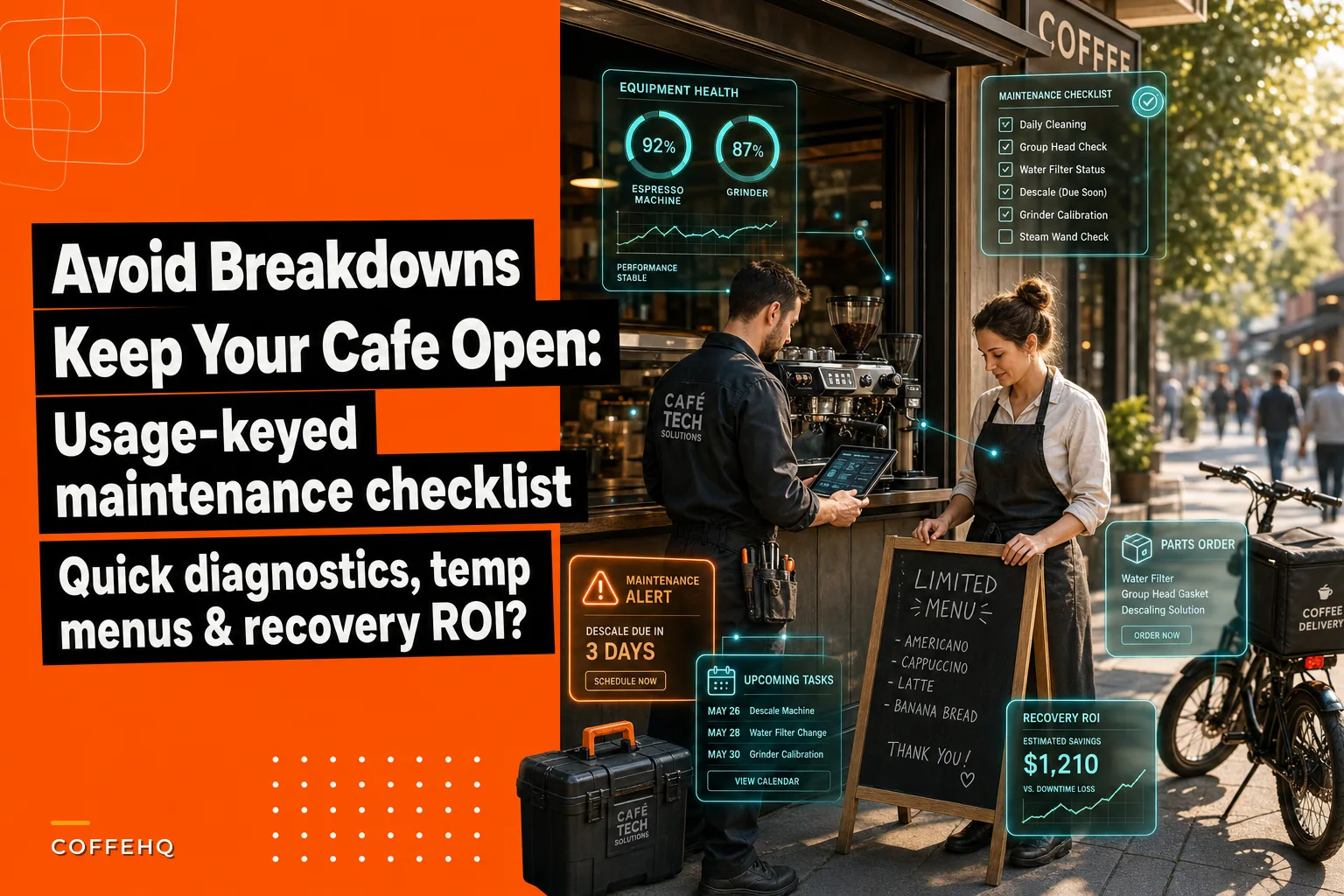
This is where AI-powered operational software genuinely changes things. Instead of remembering to check shot counts, the system pulls data from your POS and flags when you hit service intervals. Instead of manually tracking grinder runtime, it estimates based on drink sales and alerts before predicted failure points.
A visual workflow of how POS and equipment data trigger maintenance tasks.
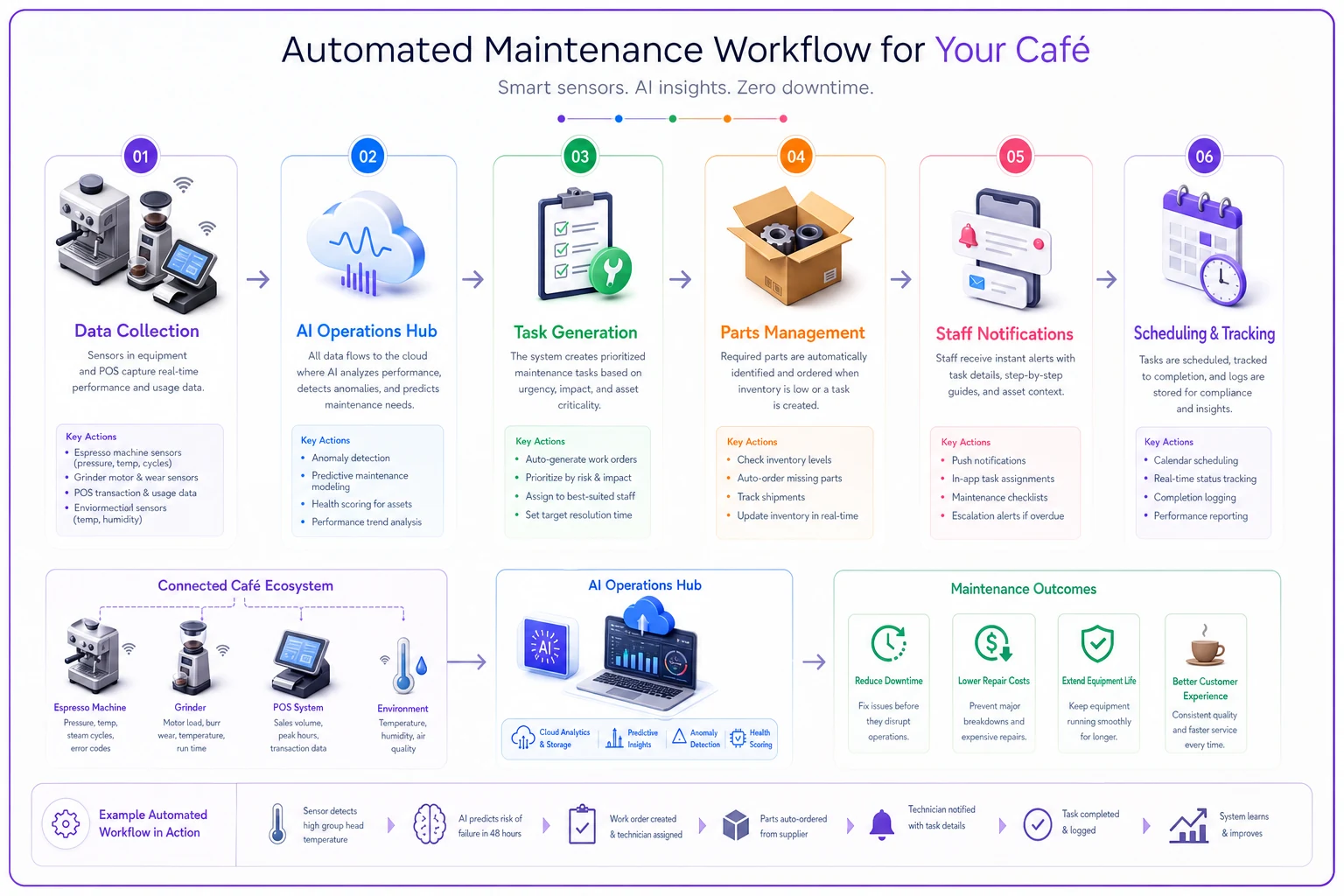
Modern operational platforms can transform your purchasing and inventory workflows to include automatic parts ordering when service intervals approach. The same system tracking your coffee bean usage can track water filter replacements, gasket schedules, and cleaning supplies. When you hit 5,500 shots, it adds gaskets to next week's supply order automatically.
The real value comes from pattern recognition across your operational data. When extraction times start drifting (tracked through drink prep timestamps), steam times increase (logged in service patterns), and customer complaints about temperature creep up (noted in POS modifications), the system connects those dots and flags a likely heating element failure—usually 2-3 weeks before actual breakdown.
AI automation also handles the documentation burden that makes preventive maintenance fall apart in practice. Every check gets logged automatically. Service history builds without manual entry. When you need warranty support or are selling equipment, you have complete maintenance records without anyone filling out forms.
The coordination piece matters too. The system assigns maintenance tasks based on who's working, their training level, and current workload. The Tuesday afternoon barista who always has downtime gets grinder calibration alerts. The experienced opener handles gasket inspections. Everyone knows their role without a manager having to remind them.
Financial impact of systematic maintenance
Running the numbers on systematic maintenance versus reactive repair makes the case pretty clearly. The math isn't complicated—it's just rarely calculated until after an expensive failure.
A typical 250-drink-per-day cafe running without preventive maintenance faces roughly $8,000-12,000 in annual equipment repairs. This includes one major failure (espresso machine or grinder), several minor breakdowns, and regular emergency callouts. Add lost sales during downtime and you're looking at $15,000-20,000 in total equipment-related losses annually.
The same cafe running usage-based preventive maintenance spends about $3,000-4,000 per year. This covers scheduled part replacements, regular service visits, and cleaning supplies. Major failures become rare—maybe once every few years instead of annually. Emergency calls drop to near zero.
The hidden savings show up in equipment lifespan. Commercial espresso machines typically last 7-10 years with reactive maintenance. With preventive care, they run 12-15 years. That $12,000 machine lasting five extra years saves roughly $2,400 annually in depreciation alone.
Labor efficiency compounds these savings. When equipment runs properly, drinks get made faster. Baristas spend less time fighting machinery and more time serving customers. A 10% efficiency improvement can mean one less labor hour per day—roughly $5,000-6,000 annually depending on your market.
Making maintenance stick in real operations
The challenge isn't knowing what maintenance to do—it's making it happen consistently when your team is already stretched thin.
Successful implementation starts with one critical task and builds from there. Usually that means daily shot counts and weekly backflushing for espresso machines. Get that routine solid for a month before adding anything else. Once the habit forms, layer in grinder cleaning. Then gasket inspections. Building gradually creates lasting systems. Trying to implement everything at once almost always fails.
Start with daily shot counts and weekly backflushing and make those routines non-negotiable for the first month.
The accountability structure matters more than the checklist itself. One person owns equipment health—not "whoever's working." This doesn't mean they do all maintenance, but they verify it happens. They check the logs. They order parts. They schedule service. Without single-point accountability, maintenance becomes everyone's job, which means it's nobody's job.
Visual management helps more than people expect. A simple whiteboard showing "Shots since service: 4,230 / 6,000" creates awareness. Color-coded equipment tags showing last service date make status obvious at a glance. Monthly calendars with maintenance tasks pre-printed remove the planning burden. The easier you make it to see what needs doing, the more likely it actually gets done.
Training needs to go beyond "how" to include "why." When baristas understand that backflushing prevents $400 screen replacements, they care more. When they see that gasket replacement prevents group head damage, they start noticing wear earlier. Connect every maintenance task to its financial and operational impact.
Preventive maintenance as operational insurance
Equipment will fail. That's not pessimism—it's physics. Metal wears. Seals degrade. Electronics burn out. The question isn't whether your espresso machine will break, but whether you'll see it coming and minimize the damage.
A coffee shop equipment maintenance checklist isn't about perfection. It's about shifting from reactive crisis management to proactive operations. Track usage, not just time. Watch for warning signs instead of waiting for complete failure. Keep backup plans ready before you need them.
The financial case is straightforward: spend $3,000-4,000 annually on prevention or $15,000-plus on emergencies and downtime. The operational case is even clearer—consistent quality and reliable service versus constantly fighting equipment problems.
This isn't about complex maintenance programs requiring technical expertise. It's about simple, repeatable checks tied to actual usage. Count shots. Listen for changes. Document what's normal. React to warnings before they become failures.
Your equipment is the core of your operation. Without functioning machines, you're not a coffee shop—you're just an expensive room with nice chairs. The cafes that survive long-term aren't the ones with the best equipment. They're the ones that keep their equipment running, day after day, year after year, through maintenance discipline and basic operational preparation. When everyone else is scrambling for emergency repairs, they're pulling consistent shots and building their business.
Ready to brew operational excellence?
Join hundreds of coffee shops using Coffehq to boost efficiency, reduce waste, and elevate customer satisfaction.