

The problem with cafe complaints isn't that they happen. It's that the response depends entirely on who's standing at the register when it happens. A new hire panics and comps a $22 order for a slightly-too-cool latte. A confident closer digs in and argues over a $4 refund until the customer films it. Neither of those is really a training problem — it's a missing rulebook problem.
If your complaint handling lives inside people's heads, you're paying for it in two directions: margin bleed from over-refunding and reputation damage from under-refunding. A written triage SOP — with actual dollar thresholds, actual words to say, and actual accounting steps — fixes both. Here's one you can adapt this week.
Why complaint handling drifts without a threshold
Watch a register over a busy weekend and you'll see the same pattern. When a customer complains, the barista makes a fast risk calculation: How angry is this person, and how much trouble will this be for me? That calculation has almost nothing to do with the actual cost of the drink or the fairness of the situation — it's about the barista's stress in that moment.
That's why comps cluster around personality, not policy. Your most conflict-averse staff give away the most. Your most stubborn staff generate the most one-star reviews. And because comps rarely get logged with a reason, you never see the pattern until you're staring at a shrinkage number you can't explain at month-end.
The fix isn't "train them to judge better." Judgment under pressure is exactly what you want to remove. You want a decision tree so simple that the barista isn't really deciding anything — they're reading the situation and following a branch.
The three-tier threshold model
Almost every cafe complaint sorts into one of three buckets by dollar value and cause. Set your thresholds once and the front-of-house stops improvising.
Keep every order and shift perfectly aligned.
Coffehq helps you manage orders, inventory, and staff schedules seamlessly.
- Unified order processing
- Real-time inventory updates
- Staff shift coordination
No credit card required
| Tier | Dollar range | Who decides | Typical cause | Default resolution |
|---|---|---|---|---|
| Tier 1 | Up to ~$8 | Any barista, no approval | Wrong milk, drink too cold, minor made-wrong | Remake OR refund on the spot |
| Tier 2 | ~$8–$25 | Shift lead | Whole order wrong, long wait, repeated error | Remake + small comp (drink or pastry) OR full refund |
| Tier 3 | Above ~$25, or any safety/allergen/health claim | Manager (call if off-site) | Allergen exposure, foreign object, large catering error, public escalation | Full refund + documented follow-up, manager contact |
The exact numbers should match your average ticket. A cafe with a $6 average drink might set Tier 1 at $8; a place doing $14 brunch plates might push it to $16. What matters is that the boundaries exist and everyone knows them cold.
Two rules that keep this from getting abused:
-
Remake-first on Tier 1. A remake costs you the COGS of one drink — often under a dollar in milk and beans. A refund costs you the full retail price. Default to the remake unless the customer clearly wants to leave. That single habit is worth more than most people expect over a year.
-
One resolution per customer per visit. No stacking a remake, a comp pastry, and a refund because a barista felt bad. The tier defines the ceiling.
The tier defines the ceiling.
Front-line scripts (so nobody freezes)
Scripts feel corporate until you watch a 19-year-old barista try to defuse an angry customer with no words prepared. Then they feel like a life raft. Keep them short and let staff say them in their own voice — the point is the structure, not the exact wording.
Tier 1 — minor drink issue:
> "I'm sorry about that — let me remake it right now, it'll just take a minute. Or if you're in a hurry, I can refund it, whichever's easier for you."
Notice it offers the remake first, but doesn't fight if they want the refund.
Tier 2 — order wrong or long wait:
> "That's on us, I'm really sorry. Let me fix your order and grab you a [pastry/drink] on the house for the wait. That work for you?"
The comp is named specifically so the barista doesn't over-offer.
Tier 3 — allergen, safety, or heated situation:
> "I'm so sorry — I want to make this right and I'm going to get my manager involved so we handle it properly. Can I get your name and the best way to reach you?"
The goal of the Tier 3 script is not to resolve it at the counter. It's to stop the barista from making promises they can't keep and to move the conversation to someone with authority and actual information.
One thing worth coaching explicitly: staff should never diagnose blame out loud. "Our machine was acting up" or "the morning crew mislabeled it" turns a $4 problem into a review about your broken operation. "Let me make this right" carries no admission and no story.
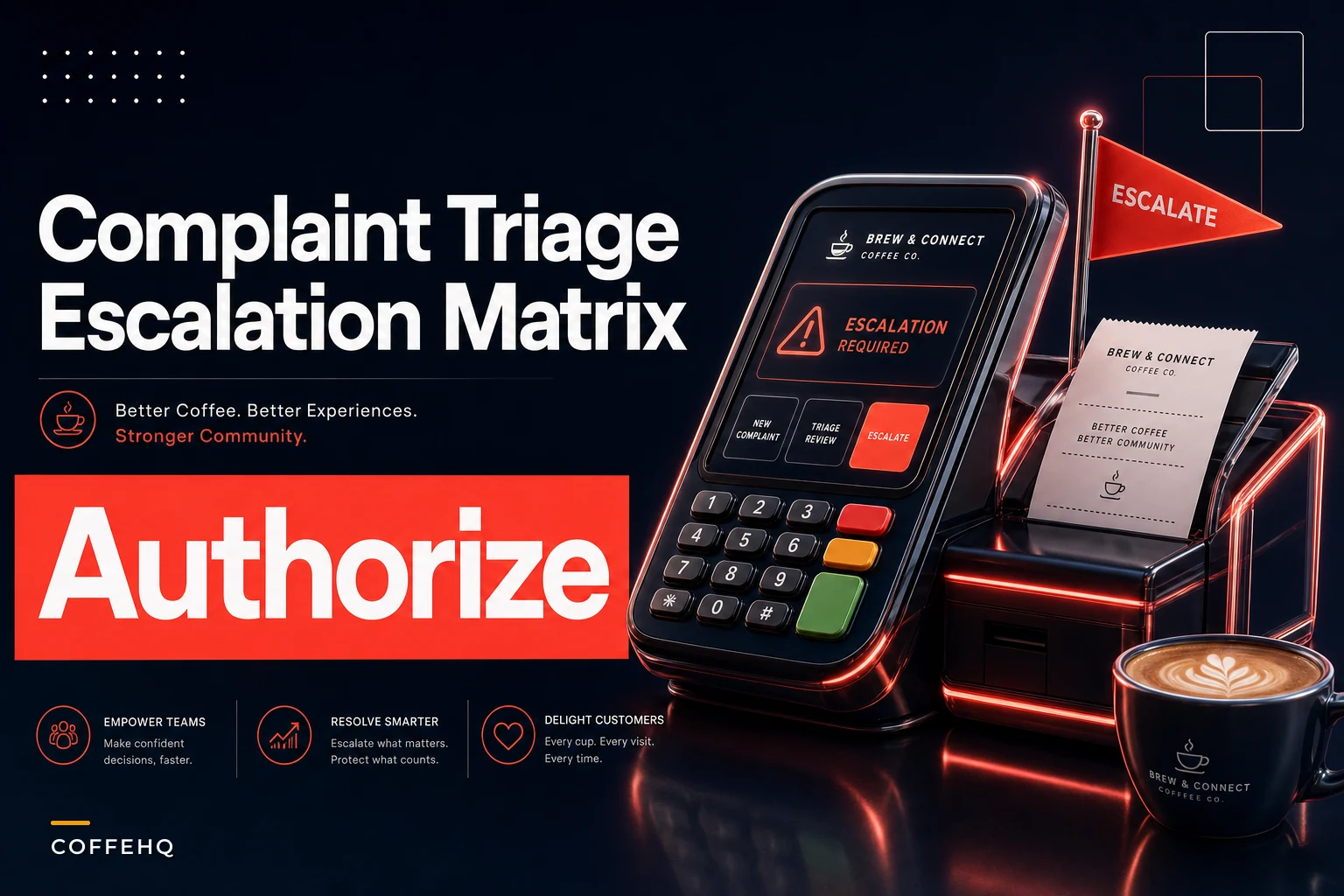
The escalation matrix
The threshold table tells staff what they can do. The escalation matrix tells them who to pull in and when — which is where most SOPs fall apart, because the manager is usually not on the floor.
Sample escalation matrix:
-
Barista handles all Tier 1 solo. Logs it, moves on.
-
Shift lead owns Tier 2. If no shift lead is scheduled, the most senior barista on shift holds that authority — name that person at the start of every shift so it's never ambiguous.
-
Manager owns Tier 3 and any situation where
- The customer explicitly asks for a manager - There's an allergen or illness claim - The dollar value exceeds the Tier 2 ceiling - The customer is recording or threatening a public review
-
Owner gets looped in only for potential legal/health-department exposure, catering disputes above a set figure (say ~$150), or anything a manager flags as reputationally serious.
For off-site coverage, the rule that actually works is a hard callback window: if a Tier 3 lands and the manager isn't in the building, the shift lead takes the customer's contact info and the manager calls back within a defined window — 30 minutes during hours, same day otherwise. Write the window down. "We'll call you" with no commitment is how complaints turn into reviews.
The part everyone skips: immediate accounting entries
The refund gets given, the customer leaves happy, and then nothing gets recorded properly. No reason code, no inventory adjustment, no ledger note. At month-end you've got a shrinkage gap and a comp total that makes no sense.
Every resolution needs a matching entry at the moment it happens, not reconstructed at the end of the week. Tie each tier to a specific POS action:
-
Remake (Tier 1) log as a waste/remake event, not a sale and not a refund. This pulls the ingredients out of inventory correctly so your COGS stays honest. Skip this and your inventory says you have milk you actually poured down the drain.
-
Refund (any tier) use a dedicated complaint refund code, separate from a normal void or a mis-ring refund. You want to be able to filter "refunds because something went wrong" from "refunds because the barista fat-fingered the order."
-
Comp (Tier 2) ring it as a $0 promo/comp line, which keeps the item flowing through inventory while recording zero revenue. A comped pastry still needs to leave your stock count.
If you've already built out refund codes and inventory adjustments, this ties directly into the same discipline covered in Fast refund accounting for perishables: POS refund codes, inventory adjustments and weekly ledger rules — same principle, applied to service complaints instead of spoilage.
A comp, a remake, and a refund all feel the same at the counter ("we lost a drink") but they hit your books in completely different places. Mixing them up is what makes reconciliation a guessing game.
Day-end reconciliation steps
The whole system only works if someone closes the loop each night. This should take a shift lead about five minutes, not thirty.
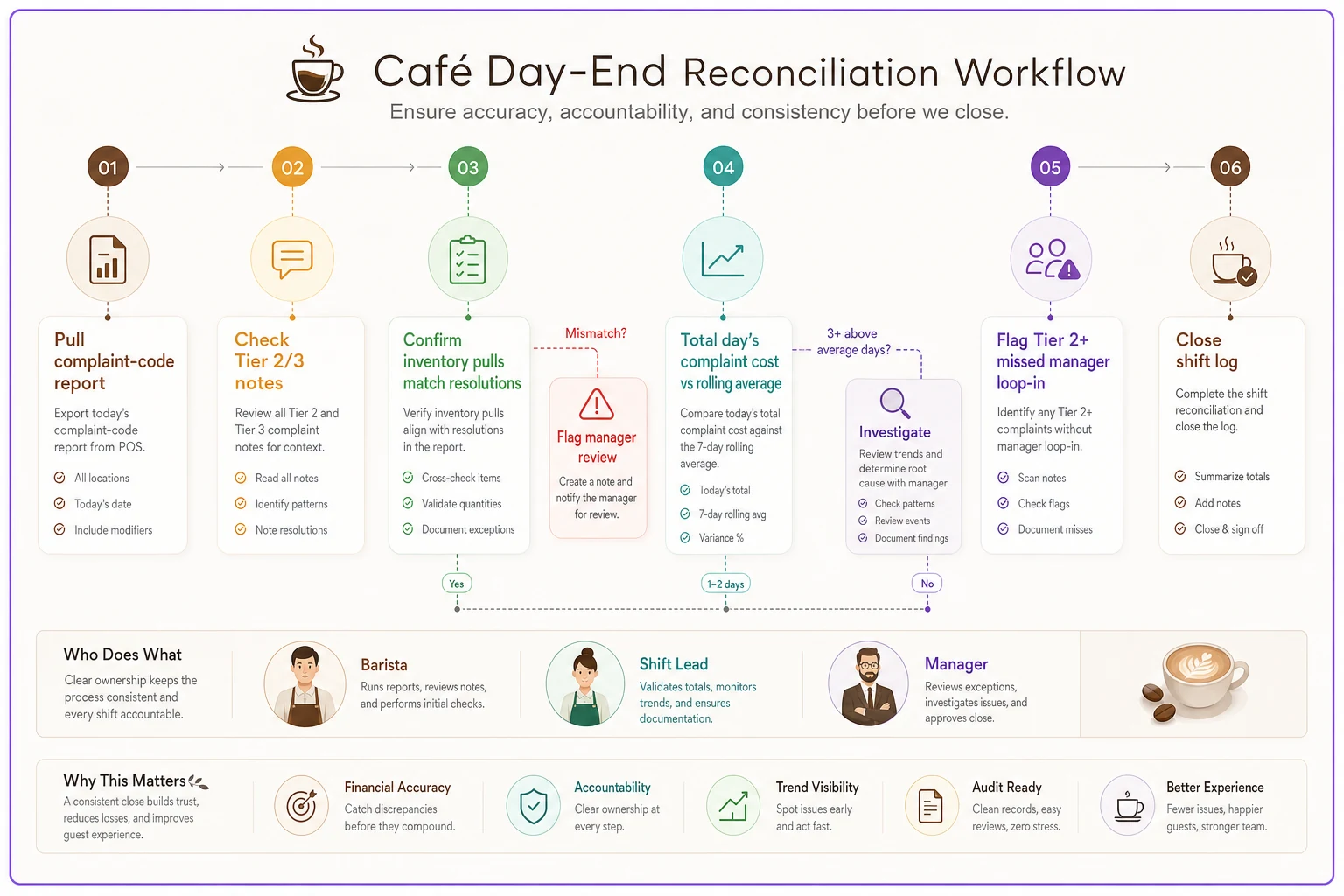
START: Pull complaint-code report for the day │ ▼ Check each Tier 2 and Tier 3 entry has a note (who, what, resolution) │ ▼ Confirm inventory pulls match resolutions (remake/comp = inventory deduction) │ ├── Mismatch found? → Flag for manager review │ ▼ Total the day's complaint cost vs. rolling average │ ├── 3+ above-average days in a row? → Investigate staff, machine, or menu item │ ▼ Flag any Tier 2+ that skipped manager loop-in │ ▼ DONE: Close shift log
Visualize this nightly close as a simple flow.
-
Pull the complaint-code report for the day — all refunds, comps, and logged remakes filtered by the codes above.
-
Check each Tier 2 and Tier 3 entry has a note. Who, what, resolution. A remake needs a word; a $20 refund needs a sentence.
-
Confirm inventory pulls match resolutions. Every remake and comp should show a corresponding inventory deduction. Mismatches usually mean someone gave away a drink without logging it.
-
Total the day's complaint cost and compare it to your rolling average. One bad day is noise. Three above-average days in a row is a signal — usually a specific staff member, a specific machine, or a specific menu item.
-
Flag anything above the Tier 2 ceiling that didn't loop in a manager. That's your control breaking down, and it's better to catch it the same night.
This nightly close is the difference between "we comp too much, I think?" and knowing that Tuesday afternoons cost you an extra $40 in remakes because the second grinder is out of calibration. When your complaint data actually lines up with your inventory and your sales, you catch these things fast — which is the same reconciliation logic laid out in the broader cafe data-sync and reconciliation playbook.
A quick real scenario
A two-location cafe doing roughly $40k–$45k a month in combined sales had a comp problem nobody could pin down. The owner knew comps were high but couldn't tell you why — everything got rung as a generic "refund" or just voided.
They put in the three-tier thresholds, split their refund codes into complaint-refund / mis-ring-refund / remake, and started a five-minute nightly close. Within about six weeks, two things showed up in the data that had been invisible before: one location's morning shift was refunding almost twice as often as the other (turned out to be a single barista defaulting to refunds instead of remakes), and one espresso machine was generating a steady stream of "too cold" complaints that traced back to a temperature issue.
Fixing those two things pulled their monthly complaint cost down somewhere in the $250–$350 range — not dramatic, but it was pure margin. More importantly, the variability dropped. Staff also just felt calmer, because they finally knew exactly what they were allowed to do without checking.
When to keep it loose (and when not to)
A rigid threshold SOP makes sense once you have more than a couple of people on the floor who weren't there when you set the culture. If you're a solo owner-operator at the register most hours, formal tiers might be overkill — your judgment is the SOP.
But the moment you're not on every shift, or you've got part-timers, or you're opening a second location, the informal version stops scaling. That's where "everyone just knows how we handle it" quietly becomes "everyone handles it differently."
The other case where you tighten this fast: any recurring allergen or safety complaint. Those never belong on a barista's judgment call, ever, regardless of dollar value. That's why Tier 3 is defined by cause, not just cost.
The takeaway
Complaint triage isn't about being generous or being firm. It's about being consistent — the same complaint getting the same response no matter who's working. Thresholds remove the guesswork, scripts remove the panic, the escalation matrix removes the "I didn't know who to ask," and the accounting entries make sure you can actually see what's happening.
Build the table, write the three scripts, name your shift lead at the start of every shift, and run the five-minute close. It's a couple hours of setup for a control you'll rely on every single day.
Build the table, write the three scripts, name your shift lead at the start of every shift, and run the five-minute close. It's a couple hours of setup for a control you'll rely on every single day.
Ready to brew operational excellence?
Join hundreds of coffee shops using Coffehq to boost efficiency, reduce waste, and elevate customer satisfaction.