

A barista texts at 6:12 a.m. — "throwing up all night, can't come in." Your open is at 6:30. Now you're standing in the back with a phone in one hand, a milk jug in the other, scrolling your contacts and trying to do math on who owes you a favor.
Every café owner knows this moment. What separates the shops that handle it cleanly from the ones that limp through a brutal day is whether they decided in advance what happens. Not vibes, not panic-texting the group chat. An actual set of rules you can run in under five minutes while half-asleep.
This is the part of a cafe emergency staffing SOP that most people skip. They build a nice schedule, pat themselves on the back, and then treat every no-show as a one-off emergency instead of a predictable category of event. No-shows aren't rare. Over a year you'll get dozens. The question is whether each one costs you a scramble or a shrug.
Why your current "backup plan" quietly fails
Most café backup plans are one line in someone's head: "call people until someone picks up." That sounds fine until you watch it play out in real time.
The calling order is random. You start with whoever you remember, not whoever's cheapest or closest or least likely to be hungover. Half your texts go out at 6 a.m. when nobody's awake. The person who does say yes often shows up 45 minutes late, which means you've already run a two-person rush with one person. And because there's no pay rule attached, you end up either guilting someone into coming or promising vague "I'll make it up to you" favors that erode trust over time.
The deeper issue: there's no decision point for not covering. Every missing person triggers a full replacement hunt, even when the smarter move might be to trim the menu for two hours and run lean. You treat "find a body" as the only option because you never defined the alternative.
What you see across a lot of small shops is that the staffing panic isn't really a staffing problem — it's a decision problem. Nobody decided ahead of time what's worth covering, what it pays, and when to just absorb the gap.
The four pieces of a compact on-call framework
You don't need a complicated system. You need four things written down and agreed to before you ever use them.
Keep every order and shift perfectly aligned.
Coffehq helps you manage orders, inventory, and staff schedules seamlessly.
- Unified order processing
- Real-time inventory updates
- Staff shift coordination
No credit card required
-
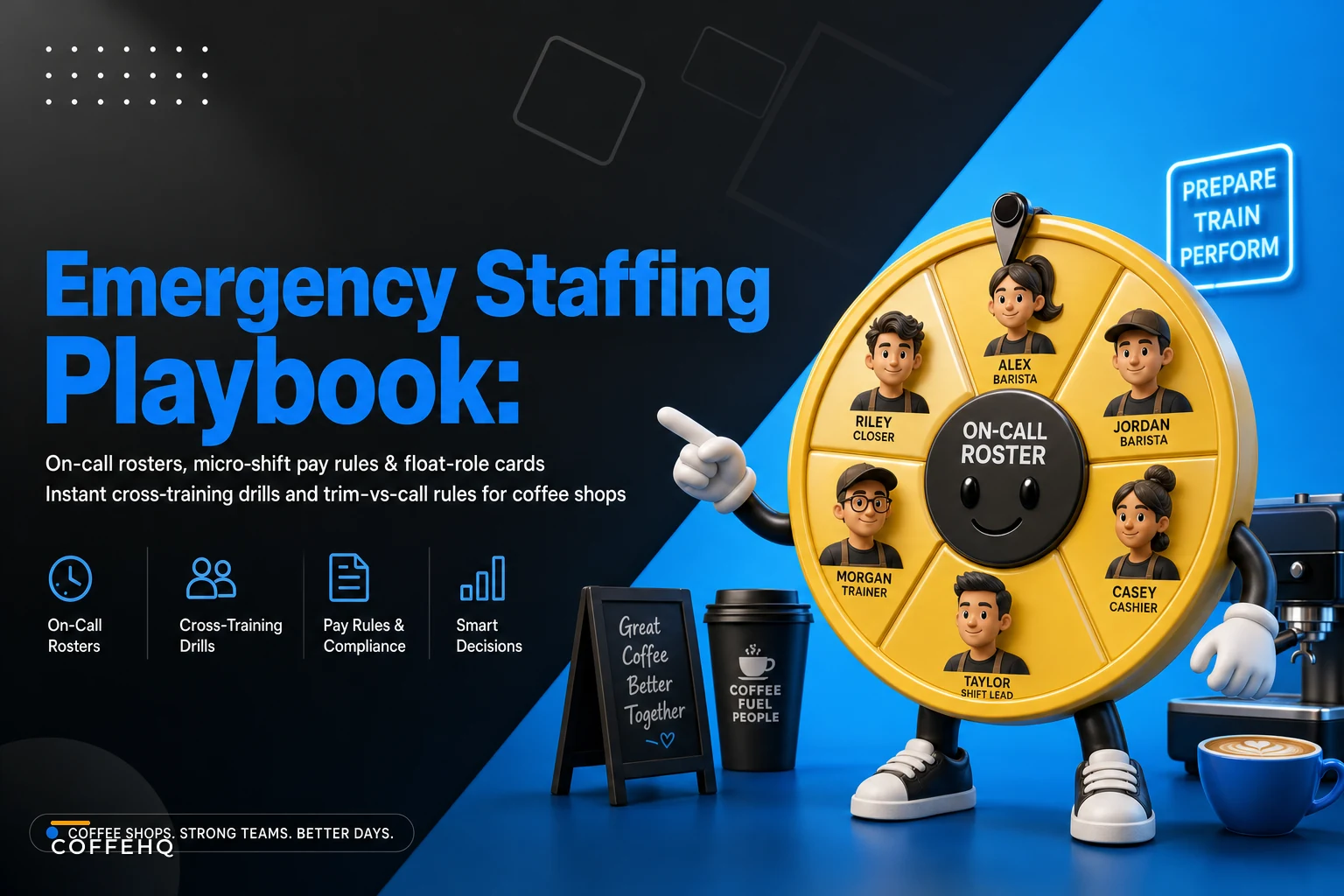
An on-call roster — a named, rotating person who has agreed to be reachable during a defined window, with a pay rule attached.
-
Micro-shift pay rules — clear money for short-notice coverage so you're not negotiating in the moment.
-
Float-role definitions — a stripped-down version of each station someone can step into with minimal ramp-up.
-
A trim-vs-call decision rule — the threshold that tells you whether to replace the person or shrink the operation.
Everything below is just filling those four in with real numbers and language your team can actually use.
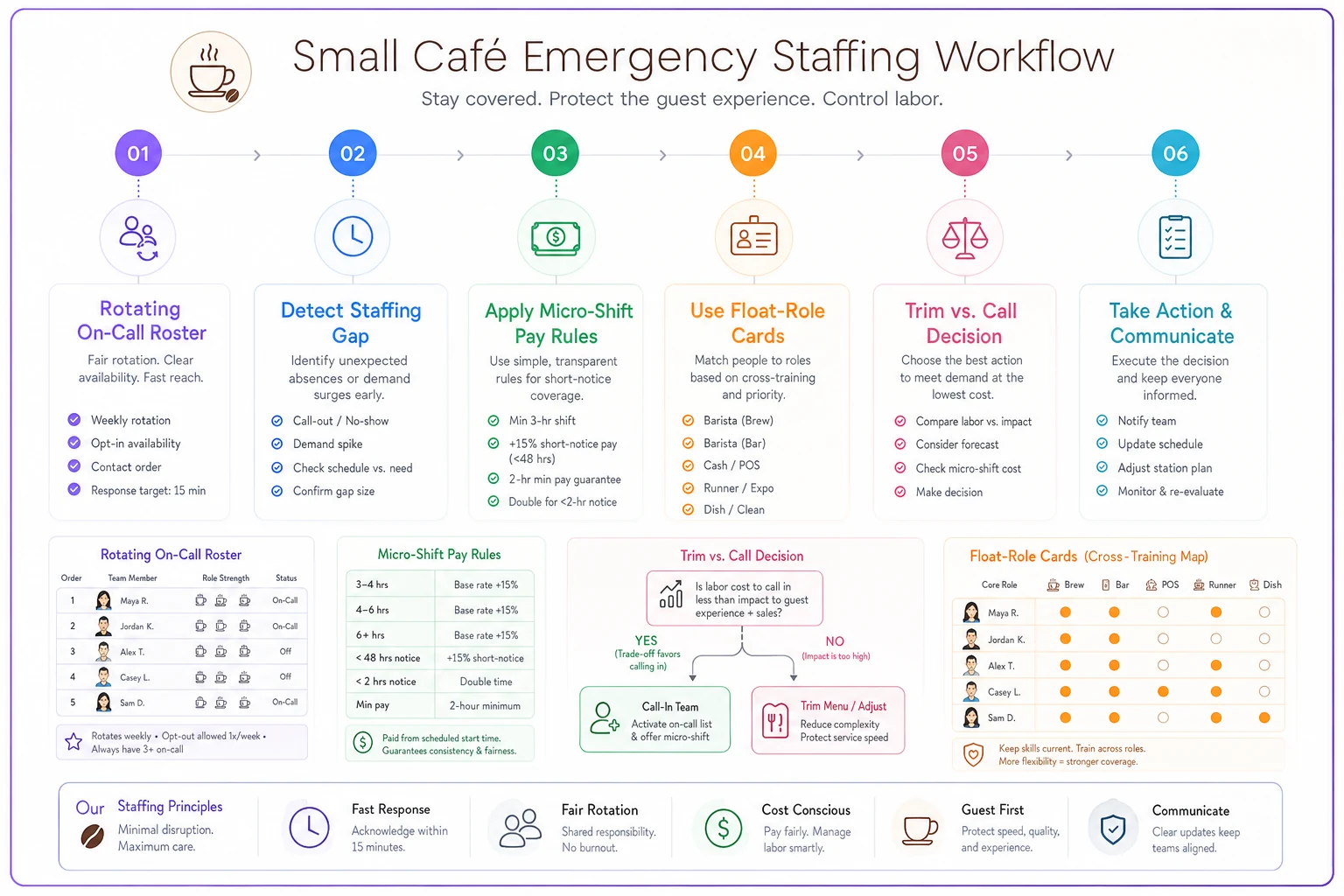
Here's a quick visual of how the four pieces flow together.
Building the on-call roster
The on-call roster is one person per shift block who has agreed to be reachable and ready. Not "on the schedule" — on standby. They can sleep in, run errands, stay home. They just need their phone on and the ability to be at the shop within a set window.
Keep the window honest. A realistic standby commitment for a small team is usually around 45 minutes from call to apron-on. If someone lives 40 minutes away, they're your late-morning standby, not your 6 a.m. open standby. Match geography to shift block.
Rotate it so no single person carries the burden. A six-person team can usually run a weekly rotation where each person is on call one or two days. The person on call knows it — it shows on the schedule as a distinct marker, not a shift, just a standby flag.
| Shift block | Standby window | Realistic arrival | Who fits |
|---|---|---|---|
| Open (6:00–11:00) | 5:30–6:00 call | ~30 min | Baristas who live close, early risers |
| Mid (11:00–3:00) | 10:00–10:30 call | ~45 min | Most of the team |
| Close (3:00–8:00) | 2:00–2:30 call | ~45 min | Students, part-timers with flexible afternoons |
The mistake most owners make is letting on-call feel like unpaid obligation. If someone's giving up the freedom to make plans, that has value even if they never get called. Which brings us to money.
Micro-shift pay rules that end the negotiation
The reason morning calls turn into guilt-trips is that there's no agreed price for the inconvenience. Set that once and the awkwardness mostly disappears.
Two separate pay concepts matter here, and people often mix them up:
-
Standby pay — a small flat amount for being on call, whether or not you get called. Think of it as renting someone's availability. Even $12–$20 for a standby block makes the commitment feel real and fair.
-
Call-in premium — extra on top of normal wage when someone actually gets pulled in on short notice. Usually a flat bump (say $15–$25 per call-in) or a slightly elevated hourly rate for that shift.
The micro-shift angle is the underused move. You don't always need someone for a full eight hours. A no-show at open often just means you need a second person from 7:00 to 10:30 to survive the rush, then you're fine running solo. Paying a three-hour micro-shift with a call-in premium is far cheaper than dragging someone in for a full day they'll mostly spend bored.
A realistic micro-shift structure looks like:
-
Minimum call-in length
3 hours (so it's worth their drive)
-
Call-in premium
flat $20 on top of hourly
-
Standby pay
$15 per standby block, paid regardless
Run the math on a typical month. If you average around six short-notice call-ins at a $20 premium, plus $15 standby across roughly 20 standby blocks, you're somewhere around $420 monthly for a system that keeps you from eating a half-staffed open. Compare that to the cost of a rough Saturday rush with a line out the door and a one-star review, and it's not close.
The exact figures aren't the point. What matters is that you set them once, written down, so nobody's doing emotional negotiation at 6 a.m. The answer to "can you come in" already has a dollar amount attached.
Float-role definitions: what someone can actually do cold
The hidden failure in emergency coverage is that the person who says yes isn't trained on the station that's short. You pull your closer in to cover a morning bar they haven't touched in months, and now you've technically got two people but you're moving like 1.3 people.
The fix is to define a float role — a deliberately simplified version of each station that a cross-trained person can run without being an expert.
-
Pull a drinkable shot to a set recipe
-
Steam milk to temp without burning it
-
Run the three or four highest-volume drinks accurately
-
Handle the register during the rush
Notice what's missing: the fancy stuff, the seasonal drinks, the custom orders. During an emergency, you want the menu narrower anyway. The float role and the trimmed menu are designed to work together.
Write the float role down as a one-page card per station. "Float Bar" lists only the core drinks and their recipes. "Float Register" covers the POS basics and the common edge cases. The goal is that someone cross-trained can glance at the card and run acceptably within a few minutes — not flawlessly, just well enough.
This connects directly to how you onboard. If your barista onboarding already uses staged micro-certifications, adding a "float-ready" checkpoint makes sense — a specific, verifiable bar where someone is cleared to cover a station in a pinch even if they're not the primary.
Instant cross-training drills
You can't just declare people cross-trained. You have to drill it, briefly and often, during normal shifts when nothing's on fire.
The trick is keeping the drills tiny. Nobody has time for a two-hour training block. What actually works is a five-minute swap built into slow periods:
-
During a lull, the person on register and the person on bar switch for ten minutes.
-
The one now on bar runs only the core float drinks.
-
The regular bar person watches and corrects silently unless something's genuinely going wrong.
-
After, a 30-second debrief
one thing that went fine, one thing to fix.
Do five-minute swaps during predictable slow periods so they actually happen.
Do this a few times a week per person and within a month your whole team can cover each other's core roles under pressure. The drills also surface who's genuinely float-ready and who still freezes — which tells you who belongs on the on-call roster and who doesn't yet.
Worth noting: shops that drill cross-training casually tend to have way calmer emergencies than shops that trained formally once and never revisited it. Skill decays. A station someone learned in July is rusty by October. Small recurring drills beat big one-time sessions every time.
The decision that saves you: trim the menu or call for help
This is the part almost nobody formalizes. When you're short, you have two real options, and defaulting to "always call someone" is a mistake.
Sometimes the right move is to shrink what you're offering for a few hours. Pull the complicated drinks off the board, post a quick "limited menu this morning, thanks for your patience" sign, and run lean with the people you have. Customers forgive a trimmed menu far more than they forgive a 15-minute wait.
| Situation | Action |
|---|---|
| Down one person, outside peak hours | Trim menu, run lean, no call-in |
| Down one person, during peak | Call in micro-shift (3 hrs) |
| Down two people, any time | Call in + trim menu both |
| Equipment also down (one grinder, etc.) | Trim menu hard, call-in only if line forms |
| Standby unavailable, down one, peak | Trim to float menu, owner/manager steps to bar |
Build your own version with your actual peak hours and your actual staffing floor. The point is that "do we call someone" becomes a quick lookup instead of a stressful judgment call.
One thing that changes how owners think about this: a trimmed menu during a staffing gap often protects margin. You're selling your highest-volume, highest-margin core drinks and temporarily cutting the labor-intensive low-margin ones. The emergency accidentally does some menu engineering for you. That doesn't mean running short-staffed on purpose is smart — but a two-hour trim isn't the catastrophe it feels like in the moment.
A real scenario
A two-location independent café, roughly eight staff per site, was averaging two to three no-shows a month per location. Their old system was pure group-chat panic. On a bad open they'd run one barista through the whole morning rush, drinks took 12-plus minutes, and they'd lose walk-outs — plus the lone barista would be fried and short with customers by 9 a.m.
They put in four things: a rotating on-call roster with a $15 standby block, a flat $20 call-in premium with a 3-hour minimum, a one-page float-bar card per site, and the trim-vs-call table posted by the office.
The cost wasn't dramatic — somewhere in the $350–$450 range per location per month in standby and premiums. But the no-show mornings stopped being disasters. Most gaps now resolve in one of two clean ways: a trimmed menu for the slower-hour gaps, or a quick micro-shift call-in for peak gaps where the answer and the pay are already settled. Walk-outs on rough mornings dropped noticeably, and the manager stopped starting shifts in a cold sweat. The baristas, somewhat surprisingly, actually liked the standby pay — being on call stopped feeling like a favor and started feeling like part of the job.
Where this ties into your broader scheduling
Emergency staffing isn't separate from your regular schedule — it's the failure buffer sitting on top of it. If your base roster is already tight on coverage, every no-show hurts more because there's no slack built in. It's worth making sure your foundation is solid first; a lot of the panic comes from coverage gaps baked into the original schedule rather than from the no-show itself.
If you're tracking standby rotations, call-ins, and who's actually float-ready across more than one location, this gets hard to hold in your head or in a group chat. That's usually the point where a shared scheduling and operations tool earns its keep — not for anything fancy, just so the on-call flag, the pay rules, and the float-ready status all live in one place everyone can see, and so you're not reconstructing who covered what at the end of the pay period. The system matters more than the software, though. Get the rules right first.
When this framework isn't worth it
A one-person-at-a-time café with a tiny team and an owner who works most shifts probably doesn't need formal standby pay — you are the backup. In that case, just build the float-menu card and the trim decision rule, and skip the roster.
And if your no-shows are coming from the same one or two people repeatedly, no on-call system fixes that. That's a performance and hiring problem, not a staffing-logistics one. Patch the real leak before you build infrastructure around absorbing it.
For everyone in the middle — a small team, a handful of no-shows a month, rushes you can't afford to limp through — deciding these four things in advance turns the 6:12 a.m. sick text from a crisis into a two-minute routine. Not perfect coverage. Just no more standing in the back doing frantic math with a milk jug in your hand.
Ready to brew operational excellence?
Join hundreds of coffee shops using Coffehq to boost efficiency, reduce waste, and elevate customer satisfaction.