

A customer orders an oat milk latte, mentions a severe dairy allergy, then your barista grabs the regular steam pitcher out of habit. Twenty minutes later you're dealing with an ambulance, a traumatized customer, and potential legal liability that could shut down your cafe. Most cafes handle allergen requests wrong. They rely on verbal communication between cashier and barista, use the same equipment for everything, and hope their staff remembers who ordered what during a morning rush when you're pushing 80 drinks per hour. Allergen management fails at three specific points: order entry, preparation handoff, and final verification. Each one needs its own system, not just good intentions and crossed fingers.
Why allergen protocols break down during peak hours
Your cashier takes an allergen-modified order at 8:15am. By the time that drink reaches the bar two minutes later, three more orders have been called out, the barista is halfway through steaming milk for a different drink, and the original allergen note exists only in someone's memory.
The breakdown happens because cafes treat allergen modifications like regular customizations. They're not. A decaf mistake annoys someone. A dairy contamination sends them to the hospital.
Standard POS systems make this worse. They bury allergen notes in modifier fields, display them in tiny text, or require multiple screen taps to access. Your barista, moving at peak speed, sees "oat milk" but misses the "SEVERE DAIRY ALLERGY" note three lines below.
Then there's equipment contamination. That steam wand you just used for whole milk? It's coating your oat milk with dairy proteins. The blender from the regular frappe? A quick rinse doesn't make those residues disappear.
Building POS modifier conventions that actually work
Your POS modifier system needs a hierarchy. Not all modifications are equal, and your system should reflect that.
Keep every order and shift perfectly aligned.
Coffehq helps you manage orders, inventory, and staff schedules seamlessly.
- Unified order processing
- Real-time inventory updates
- Staff shift coordination
No credit card required
Level 1 modifiers are preference changes - extra shot, less ice, half pump vanilla. These affect taste but not safety.
Level 2 modifiers are dietary restrictions - sugar-free, decaf, non-dairy milk. These matter for health reasons but aren't immediately dangerous if mixed up.
Level 3 modifiers are medical allergens - severe nut allergy, celiac requiring dedicated equipment, anaphylactic dairy reaction. These require a complete workflow change.
The setup that actually works:
Create separate modifier buttons for allergen alerts versus preferences. Your "Oat Milk" button is different from your "DAIRY ALLERGY - Oat Milk" button. The allergen version should display in red, trigger an audible alert, and print differently on both the customer receipt and drink ticket.
Program forced acknowledgment for Level 3 modifiers. When someone rings up a severe allergen order, the POS should require the cashier to confirm they've verbally verified with the customer and communicated to the barista. Three extra seconds. Prevents the majority of downstream errors.
Set up automatic drink routing. Orders with Level 3 allergen modifiers should print to a separate printer or display on a dedicated allergen screen if you're using digital order displays. Physical separation creates mental separation.
Modifier naming matters too. Instead of "DF" for dairy-free, use "DAIRY ALLERGY" in all caps. Instead of subtle highlighting, use stark visual contrast - black text on yellow background, red borders, whatever makes it impossible to miss mid-rush.
Prep surface choreography that prevents cross-contamination
Most cafes have one prep counter, one set of tools, and no real segregation system. That's why contamination happens even when staff knows about the allergy.
The fix is spatial choreography, not just awareness. Dedicated zones, even in tight spaces.
Start with the red zone/green zone concept. Your red zone handles all major allergens - dedicated allergen-free equipment clearly marked with colored tape or labels. Green zone is standard prep. The zones don't need to be large, but they need to be absolute.
In a typical 8-foot bar setup, your red zone might be the last 18 inches on the right side. That's where you keep:
-
Dedicated allergen-free milk pitchers (marked with red tape)
-
Separate tampers for gluten-free options
-
Allergen-only blender pitcher
-
Dedicated cleaning towels (never used in the green zone)
Always wash dedicated allergen equipment separately and store it apart from regular gear.
The choreography part is teaching movement patterns. When an allergen order comes through, the barista physically moves to the red zone for all preparation. The movement itself acts as a mental trigger - you're not just making a drink differently, you're in a different space with different tools.
Equipment dedication needs to be absolute. That red-taped milk pitcher never touches dairy, even during cleaning. Wash it separately, store it separately, and treat it like medical equipment - because for someone with a severe allergy, that's essentially what it is.
Nut allergies require even stricter handling. Airborne particles from grinding can contaminate an entire prep area. If you offer almond milk or nut syrups, store them below counter level, pour them away from other drinks, and use separate utensils that never touch other ingredients.
Quick verification steps that take 15 seconds
Verification can't be complicated or it won't happen when you're slammed. But it also can't be optional when someone's health is at stake.
The three-touch system works because it's fast and creates multiple safeguards:
A visual of the three-touch system:
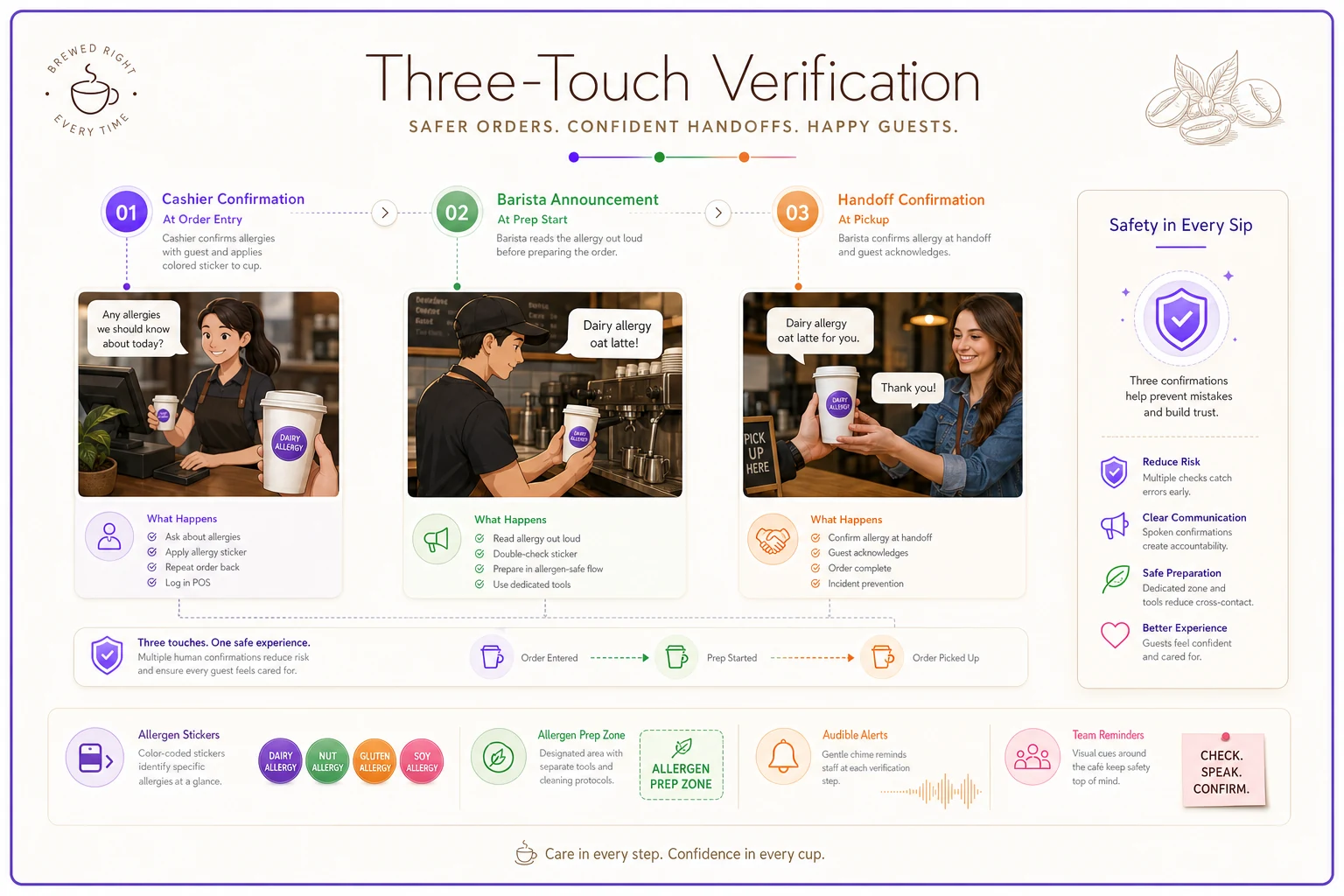
Touch 1 happens at order entry. Cashier verbally confirms the allergen with the customer and marks the order. "I have you down for a severe dairy allergy with oat milk, is that correct?"
Touch 2 happens at prep start. Barista announces the allergen order out loud before beginning. "Starting dairy allergy latte with oat milk." It's a mental checkpoint for the barista and alerts nearby staff to watch for contamination.
Touch 3 happens at handoff. The person passing the drink confirms with the customer. "Oat milk latte for Sarah, prepared dairy-free for your allergy."
None of these are time-consuming. Each touch point takes about five seconds. But together they catch mistakes before they become medical emergencies.
Make verification audible and visible. Silent checking doesn't work because nobody else can catch your mistake. When you announce each step, anyone within earshot becomes a potential safety net.
Some cafes add visual verification - allergen drinks get a different colored sleeve, lid, or sticker. Helpful, but don't rely on it alone. Tired staff miss visual cues more easily than verbal ones.
The incident log that protects your business
When allergen protocols fail, documentation matters for both immediate response and legal protection. Most cafes have no systematic way to record incidents.
Your incident log doesn't need to be complex, but it needs to capture specific information right away. Waiting until end of shift means details get forgotten or softened.
Here's the template that covers what actually matters:
| Field |
|---|
| Date/Time: |
| Customer Name: |
| Order Details: |
| Allergen Specified: |
| What Happened: |
| Immediate Response: |
| Customer Condition: |
| Follow-up Actions: |
| Staff Involved: |
| Process Failure Point: |
The "Process Failure Point" field is the most important one. It identifies whether the breakdown happened at ordering, preparation, or handoff. Over time, these logs reveal patterns. Maybe Tuesday mornings have more incidents because a newer barista works that shift. Maybe oat milk orders specifically get mixed up because the containers look similar.
Keep physical copies in a binder and digital backups. When health inspectors or lawyers come calling, you need to show systematic tracking, not scrambled memories.
The log also becomes a training tool. During team meetings, review recent near-misses without blame. Focus on process improvements, not individual mistakes. When staff sees you treat incidents as system failures rather than personal failures, they're more likely to report problems honestly.
Customer communication scripts that prevent confusion
Vague communication causes most allergen accidents. Customers say "no dairy" when they mean lactose intolerant versus actual allergy. Staff assume "gluten-free" is a preference when it's celiac disease. These miscommunications happen because neither party has a clear script.
Train your cashiers to ask specific questions:
Instead of "Any allergies?" ask "Do you have any food allergies we should know about?"
When someone mentions an allergy, follow with "Is this a severe allergy or a sensitivity?" The distinction matters operationally.
For any Level 3 allergen, state your protocol clearly: "We'll use dedicated equipment and separate prep areas for your drink. It'll take about 30 seconds longer to make sure it's safe."
That last part matters. Customers with severe allergies often feel like they're inconveniencing staff. When you proactively explain your safety process, they relax and are more likely to give you complete information.
For handoff, be specific about what you did, not just what they ordered: Bad: "Oat milk latte for John" Good: "Oat milk latte prepared with allergen-free equipment for John"
This lets customers know you took their allergy seriously and actually followed protocol.
Staff scripts for allergen situations
Your team needs exact phrases for common situations. Improvised communication under pressure leads to confusion.
When taking an allergen order: "I want to make sure we handle your allergy safely. We'll use separate equipment and prep areas. This might add about a minute to your wait time."
When unsure about ingredients: "Let me check that ingredient list for you right now. I'd rather take a moment to be certain than guess."
When a mistake happens: "I apologize, but I need to remake your drink. I want to make sure it's completely safe for your allergy."
When dealing with impatient customers during allergen prep: "The drink ahead of you requires special allergen protocols. Your order will be up in just a moment."
These scripts acknowledge the situation without creating drama. Matter-of-fact, professional, safety first.
Adapting your coffee shop allergen SOP for real operations
The perfect allergen system on paper falls apart when you're understaffed on a Sunday morning with a line out the door. Build in degradation modes - simplified versions that maintain safety even when you can't follow the full protocol.
During extreme rush periods, consider temporary menu limitations. Post a sign: "Due to high volume, we're temporarily unable to accommodate severe nut allergies safely." Better to disappoint someone than hospitalize them.
For single-barista situations, the verification system changes. The barista is both maker and verifier, so you need a different safety net. This might mean having customers with severe allergies wait at the bar for direct handoff, eliminating the possibility of drink mix-ups entirely.
Your shift playbook should specify which allergen protocols apply at different staffing levels. A three-person morning crew can handle full segregation. A solo evening barista might need to limit allergen accommodations to pre-packaged options only.
The technology layer that reduces human error
Manual allergen tracking breaks down because it relies entirely on human memory during high-stress periods. AI-powered operational software can flag allergen orders automatically, track preparation steps, and alert staff to potential contamination risks without adding friction to the workflow.
Modern platforms can integrate with your POS to highlight allergen orders visually and audibly, maintain digital logs of every allergen order and outcome, and identify process improvements based on incident patterns. When your system notices that dairy contamination incidents tend to cluster around shift changes, it can flag specific handoff protocols for those transition periods.
The automation doesn't replace human judgment - it catches the small mistakes that happen when someone's made their 50th drink of the morning or you're running with backup staff because your best barista called in sick.
These operational tools also connect to your HACCP compliance system, creating a more complete food safety framework. When temperature logs, allergen protocols, and incident records all live in one place, patterns become visible that you'd never catch with paper tracking alone.
Building an allergen culture, not just an allergen process
The best coffee shop allergen SOP in the world fails if your team treats it like bureaucracy. This isn't about following rules - it's about preventing someone's worst day.
Make allergen safety visible in training, in team meetings, and in daily operations. Share anonymized stories of close calls and what you learned. Celebrate when someone catches a potential contamination before it happens. Make it clear that pausing to verify an allergen is never wrong, even if it slows service by a minute.
Track your allergen success rate the same way you track sales or customer counts. Zero incidents should be celebrated. Near misses should be learning opportunities, not swept under the rug.
Allergen management will occasionally cost you speed. A drink might take an extra minute. You might need to refuse certain orders during peak times. You might lose a customer who doesn't want to wait. These are acceptable tradeoffs when the alternative is sending someone to the emergency room.
Your coffee shop allergen SOP isn't really about allergies. It's about running a place where customers can actually trust you. When you build that reputation, word spreads fast - parents of allergic kids become regulars, people with dietary restrictions seek you out specifically. You become the safe choice in your neighborhood.
That's worth more than any efficiency gain. And it starts with taking those POS modifiers seriously, being intentional about your prep surface layout, and building verification into your muscle memory until it's as automatic as pulling a shot.
Ready to brew operational excellence?
Join hundreds of coffee shops using Coffehq to boost efficiency, reduce waste, and elevate customer satisfaction.