

Most cafe owners treat sustainability and profit like they're on opposite teams. You buy the compostable cups, dial the thermostat back a few degrees, feel slightly better about the world, and your margins don't move. Or worse, the "green" choice costs you 8 cents more per cup and nobody ever runs the math.
Energy management, procurement hedging, menu pricing, and labor scheduling aren't four separate problems — they're four levers on the same machine. Pull one in isolation and the others shift in ways you won't notice until the P&L comes back ugly. The cafes that actually turn sustainability into money stop running these as side projects and start treating them as one connected system with shared ROI math.
This is that framework — decision matrix, ROI logic, prioritization rules, and a 30/90/180 roadmap you can copy. No eco-guilt, no vague "do better" advice. Just the operational wiring.
Why the four levers are actually one system
Walk into a typical independent cafe and you'll find the owner has made decisions on all four fronts — just never in the same conversation.
The espresso machine stays on from 5am to close because turning it off "takes too long to reheat." Milk gets ordered on a fixed weekly standing order regardless of what next week's weather or foot traffic looks like. The latte is priced at $4.75 because that's what it was last year plus a quarter. And the opening shift has two baristas scheduled even on a slow Tuesday where one could handle it until 8am.
-
Leaving the machine on all day is an energy cost, but it's also a labor cost disguised as convenience — you're paying for warmup time you could schedule around.
-
The fixed milk order is a procurement decision that directly creates waste, which shows up as COGS, which pressures your menu pricing.
-
Underpricing the latte means every bit of milk waste or energy cost eats a bigger share of a margin that was already thin.
This is where money quietly leaks in real operations: nobody owns the connection between the levers. The person ordering milk isn't thinking about the person pricing the menu, and neither of them is looking at the utility bill. Four reasonable decisions combining into one bad outcome.
The reframe is simple. Every sustainability move either reduces an input cost, reduces waste, or reduces labor friction — all three flow to the same place. If a change doesn't move one of those three, it's branding, not profit. Fund it like branding, not like an operations investment.
The one-page decision matrix
Before you spend a dollar or change a single SOP, score the move. This filter keeps you from doing the expensive, feel-good stuff first.
Keep every order and shift perfectly aligned.
Coffehq helps you manage orders, inventory, and staff schedules seamlessly.
- Unified order processing
- Real-time inventory updates
- Staff shift coordination
No credit card required
| Lever | Typical move | Primary payback source | Rough payback window | Disruption to staff | Priority signal |
|---|---|---|---|---|---|
| Energy | Scheduled equipment on/off, LED swap, fridge gasket repair | Lower utility bill | 1–6 months | Very low | Do first — cheap, invisible to customers |
| Procurement | Flexible milk/bean ordering tied to forecast, bulk hedge on staples | Lower COGS + less waste | Immediate to 2 months | Low | Do first — fast and reversible |
| Menu pricing | Reprice low-margin drinks, reformat to push high-margin items | Higher contribution margin | Immediate | Medium (requires consistency) | Do second — needs clean cost data first |
| Labor | Shift shape changes, cross-training, warmup-aware scheduling | Lower labor % of sales | 1–3 months | High | Do last — highest friction, do once data is clean |
The pattern this matrix encodes: start with the levers that are invisible to customers and reversible. Energy and procurement changes rarely upset anyone and can be undone in a week if they don't work. Pricing and labor touch the customer and the team directly, so you want clean numbers before pulling them.
One mistake owners make constantly: starting with the visible, emotional stuff — compostable packaging, the "locally sourced" signage — because it feels like sustainability. Those are often the worst first moves on ROI. Do the boring fridge gaskets first.
The ROI math, kept simple enough to actually use
You don't need a finance degree. Every lever reduces to the same three-line calculation:
-
Annual cost today (what you're spending or wasting right now)
-
Annual cost after the change (realistic, not best-case)
-
One-time cost to implement (equipment, labor hours, training)
Then: (Line 1 − Line 2) ÷ Line 3 = months to payback.
Here's what that looks like filled in for a couple of common moves.
Energy example — scheduled equipment shutdown and a fridge gasket fix: A mid-volume cafe running roughly $900–$1,100 a month in electricity finds that around 18% of it comes from equipment idling overnight and a walk-in working too hard against bad seals. A smart plug schedule plus two gasket replacements costs maybe $220 all in. If it trims the bill by around $120–$150 a month, you're fully paid back inside two months and keeping that saving every month after.
Procurement example — flexible milk ordering: Say you're throwing out roughly 6–9 liters of milk a week during slow stretches because the standing order doesn't flex. At wholesale, that's somewhere around $18–$30 of pure waste weekly — call it $1,000–$1,500 a year straight off COGS. The implementation cost here is almost zero. It's a process change, not a purchase. That's the kind of move that should jump the queue every time.
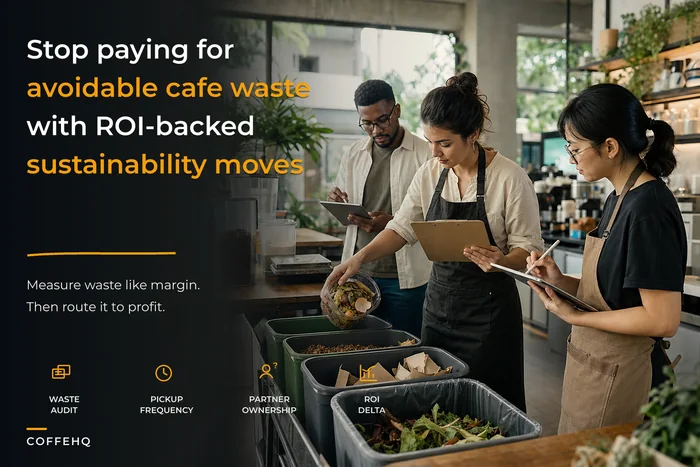
The waste side of this deserves its own deep dive, and the partner models and low-effort interventions are laid out in detail in the sustainable-ops playbook for cafés. The point for this framework: waste reduction is usually your highest-ROI sustainability lever because the implementation cost is near zero.
The number that trips people up is Line 2 — the realistic "after." Owners assume a change eliminates 100% of a cost. It almost never does. If flexible ordering cuts waste by 60%, model 60%, not 100%. Underpromise in the spreadsheet so reality beats it.
Prioritization playbook: what order, and why
Once you've scored moves on the matrix and run rough ROI, you still need a sequencing rule. Doing everything at once is how cafes burn out their team and lose the ability to tell what actually worked.
-
Fastest reversible wins first. Anything that pays back in under three months, costs little, and can be undone easily. Energy schedules, waste-driven procurement changes.
-
Data-cleaning moves second. Before you reprice anything, your per-item cost data has to be accurate. If you don't know your real milk, cup, and labor cost per drink, every pricing decision is a guess. Tightening cost tracking isn't glamorous but it unlocks the two highest-dollar levers.
-
Margin levers third. Repricing and menu reformatting, now that costs are clean.
-
Structural labor changes last. Shift reshaping, cross-training, warmup-aware scheduling. Highest friction, biggest team impact, and you want to know your cost and demand data cold before you touch people's hours.
Start with reversible, invisible changes to bank quick wins that fund cleaner data and build trust before touching pricing or schedules.
The connective tissue here is your P&L. If you can't see how each lever lands on contribution margin and labor percentage, you're flying blind. Building that link — mapping each operational decision to a line on the P&L — is foundational, and if you haven't set it up yet, the spreadsheet-first financial model walkthrough is the right place to start before touching this roadmap.
P&L sensitivity: pressure-test before you commit
This is where owners either save themselves or set themselves up for a bad quarter. Before rolling anything out, run a quick sensitivity check: what happens to the bottom line if your assumptions are off by around 20%?
-
If milk cost spikes 15%, how much does my flexible-ordering saving get eaten? Often it actually gets more valuable, because waste on a pricier input hurts more.
-
If foot traffic drops 10%, does my new two-shift labor shape still make sense, or do I need the warmup-aware single-barista opening?
-
If I reprice the latte up 25 cents and lose 5% of latte volume, am I still ahead? Usually yes — a small price increase almost always beats the volume it costs you, but you want to see the number, not assume it.
Sensitivity analysis isn't about predicting the future. It's about finding which of your changes are fragile — the ones that only work if everything goes right. A good sustainability-to-profit move should still be positive even when one assumption breaks. If it only pencils out in the best case, deprioritize it.
The 30/90/180 implementation roadmap
This is the copyable part. Adjust the specifics to your cafe, but keep the sequence.
The roadmap graphic below shows the phases and key actions.
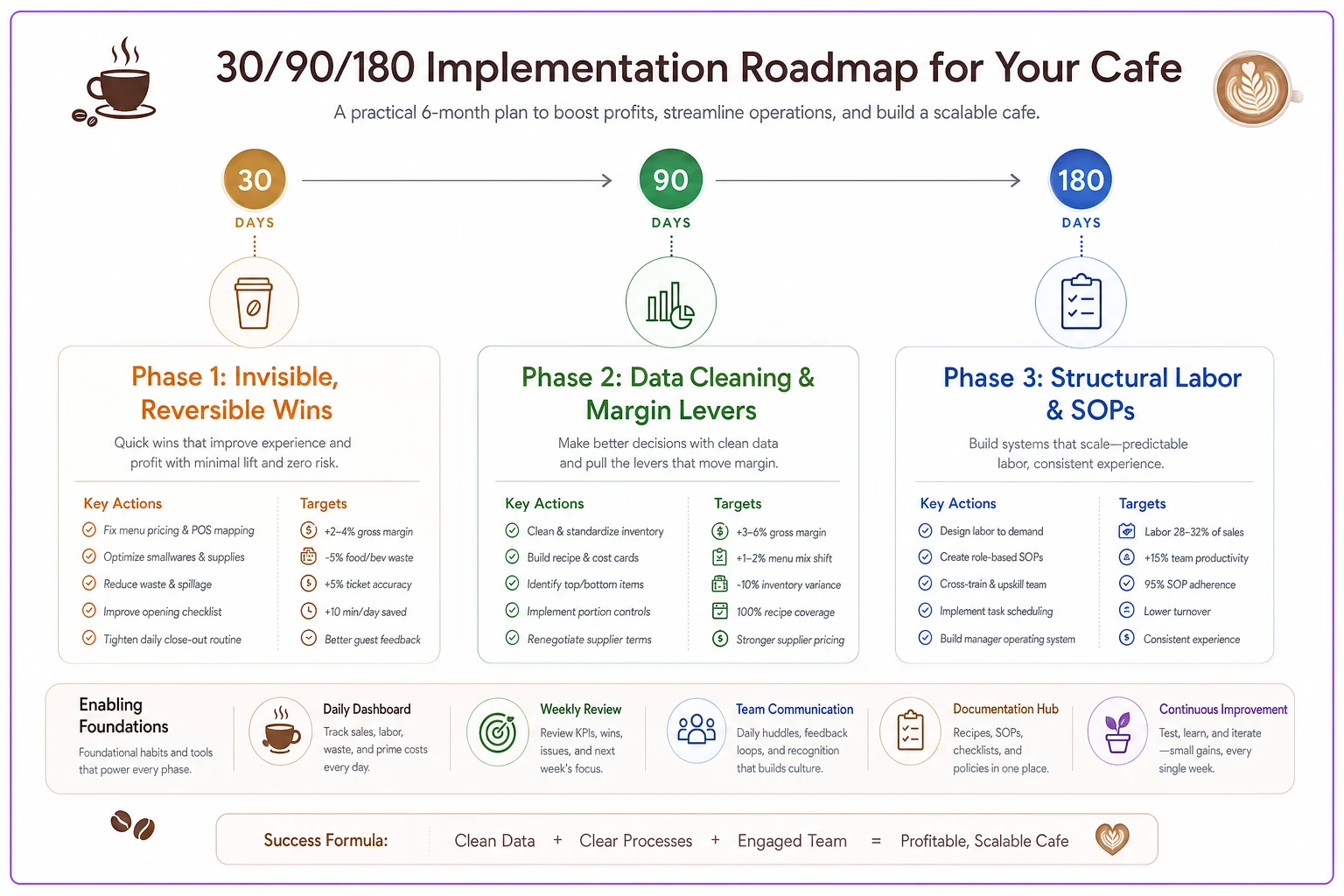
First 30 days — invisible, reversible, cash-positive
-
Audit your utility bill and identify idle/overnight equipment draw. Put the espresso machine, water heater, and any non-essential equipment on a schedule.
-
Fix the boring energy leaks
fridge and walk-in gaskets, door seals, lighting swaps.
-
Switch your two or three most-wasted perishables (usually milk and pastries) from fixed standing orders to a forecast-adjusted order.
-
Start tracking actual per-drink cost on your top five sellers. You can't reprice without this.
Target by day 30: a measurable utility dip and a visible drop in weekly waste. No customer or staff disruption.
Days 31–90 — clean the data, pull the margin levers
-
Finish accurate per-item costing across the full menu, including labor time per drink.
-
Reprice or reformat your lowest-margin, highest-volume items. Small moves, tracked carefully.
-
Run the P&L sensitivity check on everything you've changed so far. Kill anything fragile.
-
Begin cross-training so you have scheduling flexibility heading into the labor phase.
Target by day 90: contribution margin up a point or two, with clean before/after numbers you trust.
Days 91–180 — structural labor and locking it in
-
Reshape shifts using what you now know about demand and warmup timing. Warmup-aware openings, leaner slow periods.
-
Set the new ordering, energy, and pricing changes as standing SOPs so they don't quietly revert when you're off the floor.
-
Build a monthly review where all four levers get looked at together, on one P&L view, not in four separate conversations.
Target by day 180: the four levers are running as one system, reviewed together, with the savings baked into standard operating procedure.
When this framework makes sense — and when it doesn't
It makes sense when you're a single site or a few sites with a stable enough menu to actually measure changes, and when you have — or can build — basic cost-per-item data. The whole thing runs on knowing your real numbers.
It's a bad idea when your data is a mess and you try to skip straight to repricing or labor cuts. Pulling the high-friction levers on bad data is how you lose good staff and annoy regulars for savings that turn out to be imaginary. Fix the data first, pull the invisible levers first.
Who should hold off: a brand-new cafe still finding its volume. You need a few months of real demand and cost history before sensitivity analysis means anything. Spend your first season just getting clean numbers.
A real scenario
A two-barista neighborhood cafe doing roughly $420k a year was convinced its problem was pricing — everyone told them to just raise prices. Instead they ran the levers in order.
Energy first: scheduling the machine and heater and fixing two walk-in gaskets knocked about $140 a month off utilities. Procurement next: moving milk and pastry orders off the fixed weekly standing order cut waste by a bit over half, worth somewhere around $1,200 a year. Only then, with real per-drink costs finally visible, did they reprice — and the repricing was far smaller than the panic suggested, because the energy and waste work had already widened the margin.
Net effect over about six months: a few points back on margin, a labor shape that matched real demand instead of habit, and — almost by accident — a genuinely more sustainable operation. They never bought a single compostable cup to get there.
The takeaway
The reason most cafe sustainability efforts don't turn into profit isn't that the ideas are bad. It's that they're run as isolated, emotional, one-off projects instead of four connected levers on the same P&L.
Score every move on the matrix, run the three-line ROI, pull the invisible reversible levers first, clean your cost data before you touch pricing or people, and pressure-test for fragility before you commit. Do it in that order and the "green" choices and the profitable choices stop fighting each other — because, run correctly, they were almost always the same choices.
The reason most cafe sustainability efforts don't turn into profit isn't that the ideas are bad. It's that they're run as isolated, emotional, one-off projects instead of four connected levers on the same P&L.
Score every move on the matrix, run the three-line ROI, pull the invisible reversible levers first, clean your cost data before you touch pricing or people, and pressure-test for fragility before you commit. Do it in that order and the "green" choices and the profitable choices stop fighting each other — because, run correctly, they were almost always the same choices.
Ready to brew operational excellence?
Join hundreds of coffee shops using Coffehq to boost efficiency, reduce waste, and elevate customer satisfaction.