

Most cafe owners think about sustainability the way they think about flossing. They know they should, they feel a little guilty when they don't, and every attempt starts with good intentions that fizzle out by the third busy Saturday.
The problem isn't willpower. It's that sustainability usually gets framed as a values project instead of an operations project. You buy compostable cups, feel good about it, and then never look at whether that decision cost you $40 a month or saved you $200. Nobody closes the loop. So it stays a cost center forever, and the whole thing feels like a tax you pay to look good on Instagram.
Waste is just margin sitting in the wrong bin. Spoiled milk, over-ordered pastries, the coffee grounds you pay someone to haul away — that's money you already spent and never recovered. A well-built cafe sustainability program treats every waste stream as a line item you can shrink, redirect, or resell. This post is about wiring that thinking into your daily operations so it actually holds.
Why sustainability stays a cost center in most cafes
There's a pattern that plays out in almost every independent shop. Someone reads an article or a supplier pitches them, and the cafe makes a single swap — usually the most visible one, like cups or straws. It's the change customers can see. It's also almost always the most expensive per-unit and the least impactful on total waste volume.
Meanwhile the biggest waste streams are invisible. Milk poured down the drain during rushes. Pastries that hit the trash at close. Coffee grounds — pounds of them daily — going into general waste, which you often pay for by weight or by pickup frequency. None of these show up on a P&L as "waste." They're buried inside COGS and disposal fees, so they never get isolated and attacked.
The second reason it stays a cost center: nobody assigns ownership. Sustainability becomes "everybody's job," which means it's nobody's job. The compost bin gets contaminated with plastic within a week because there's no one checking, no one training new hires on it, and no consequence when it drifts. Contaminated compost gets rejected by haulers, and now you're paying for compost pickup and landfill. You've made things worse with good intentions.
At small scale you can white-knuckle it. One engaged owner keeps things tidy. But the moment you add staff, add hours, or open a second location, the informal system collapses. What worked when you personally emptied every bin stops working when you're managing from an office two days a week.
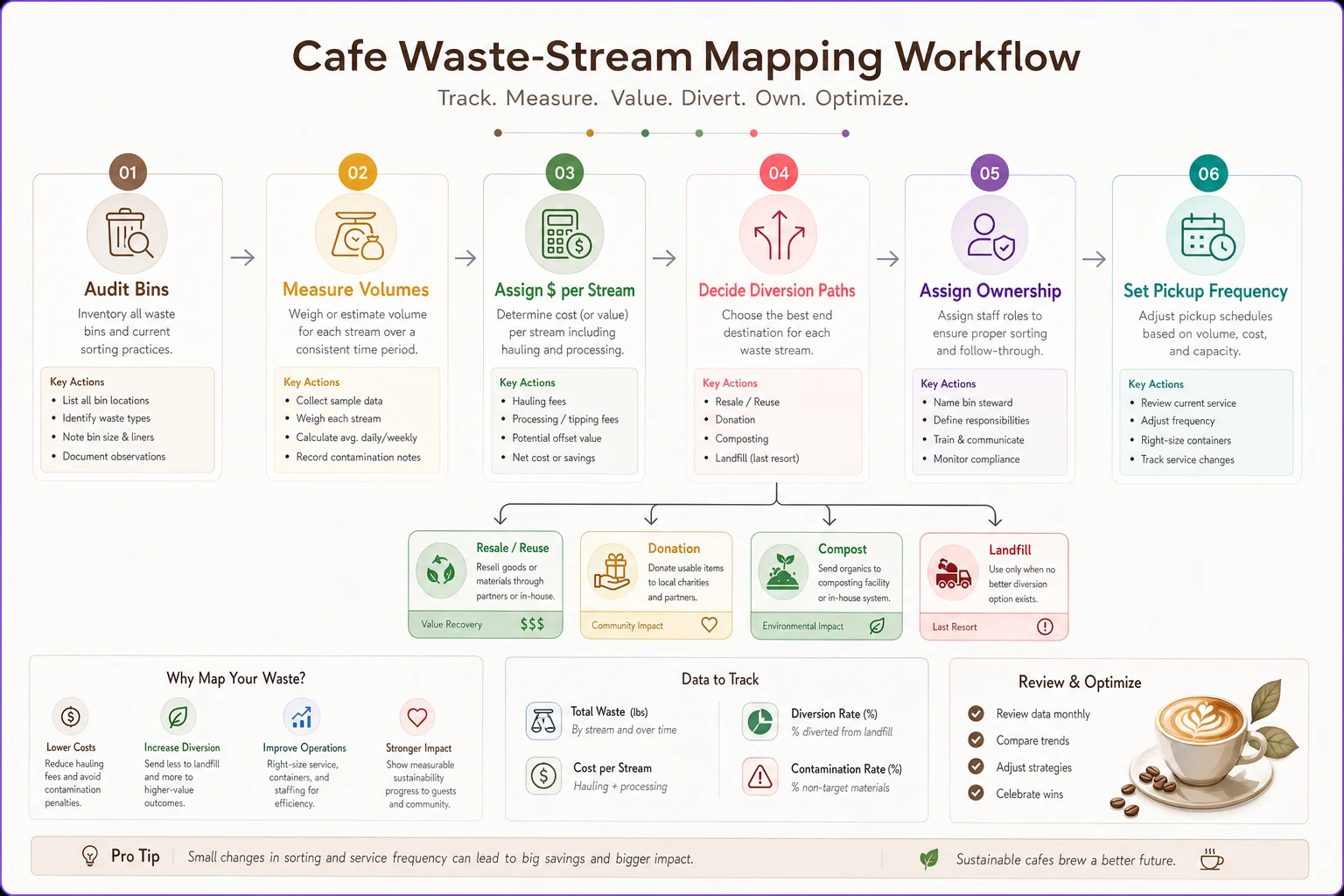
Start by mapping your waste streams, not your intentions
Before spending a dollar, you need to know what you're actually throwing away and what each stream costs you. This is boring, unglamorous work, and it's the single highest-leverage thing you can do.
Keep every order and shift perfectly aligned.
Coffehq helps you manage orders, inventory, and staff schedules seamlessly.
- Unified order processing
- Real-time inventory updates
- Staff shift coordination
No credit card required
Spend one normal week tracking waste by category. You don't need lab precision — rough weight or volume with a dollar figure attached is enough. Here's a simplified version of what that audit usually surfaces in a shop doing roughly $30k–$45k a month:
| Waste stream | Rough monthly volume | What it's costing you | Recoverable? |
|---|---|---|---|
| Spoiled/over-poured milk | 15–25 gallons | $75–$150 in product | Mostly — via prep discipline |
| Unsold pastries | 40–90 units | $120–$300 in COGS | Partially — markdown, donation, staff |
| Spent coffee grounds | 120–200 lbs | Disposal fees + hauls | Yes — compost/resale partners |
| Single-use packaging | Varies | $200–$500 in purchasing | Partly — right-sizing, not just swapping |
| General landfill volume | The catch-all | Pickup frequency charges | Yes — diversion cuts pickups |
The insight most owners miss: your disposal cost is often driven by pickup frequency and bin size, not just what's in the bin. Divert enough volume out of general waste and you can drop from three pickups a week to two, or downsize your dumpster. That's a hard-dollar saving that has nothing to do with the product itself. Some shops cut a recurring $60–$90 monthly line just by renegotiating pickup after diverting grounds and compostables.
Run the audit during a typical busy week so you capture peak waste patterns rather than an unusually slow period.
Your existing inventory discipline feeds directly into this. If your ordering is loose, your waste is high by definition. Tightening your purchase-to-stock process does double duty — it lowers COGS and shrinks the waste stream before you ever touch a compost bin.
The ROI math that makes or breaks each intervention
Every sustainability decision should pass a simple test: net monthly impact after all costs. Not the feel-good version — the actual number. Here's the frame for any single change:
-
Baseline cost — what you spend today on this stream (product + disposal).
-
Intervention cost — new materials, labor, equipment, partner fees.
-
Recovered value — savings, resale income, avoided disposal, or diverted product.
-
Net monthly impact — recovered value minus intervention cost.
-
Effort load — how many extra minutes per day, and who owns it.
That last one matters more than people admit. A change that nets $80 a month but adds twenty minutes of labor per shift isn't a win — you've spent $200+ in wages to save $80. That math kills more sustainability programs than cost ever does.
A real example of the trap: a shop switches to compostable clamshells for grab-and-go at roughly $0.22 each versus $0.09 for the old ones. At about 600 units a month, that's an extra $78 monthly. Fine as a marketing choice — but it does nothing for waste volume if those clamshells still end up in landfill because there's no compost stream to receive them. You've paid a premium for a symbol. That's probably the most common sustainability mistake in cafes: buying compostable products with no compost pathway.
Compare that to redirecting spent grounds. Grounds are heavy, they're free (you already have them), and multiple partners want them. The intervention cost is basically a labeled bin and a five-minute routine. Net impact is positive from day one.
Partner models: resale, compost, and donation
This is where sustainability stops being a cost and starts functioning more like a supply chain. You're no longer just throwing things away — you're routing outputs to people who value them.
Compost partners. Local composters or municipal programs take food scraps and grounds. Some charge a small pickup fee, but that fee is often less than the landfill volume it replaces. The key operational risk is contamination. One coffee-grounds bin with a plastic lid tossed in and the whole load can get rejected. Ownership and simple signage solve most of this.
Grounds resale and giveaway. Coffee grounds are useful for gardeners, community gardens, and some skincare or soap makers. Most shops just set out a "free grounds" bin by the door. It's not big money, but it empties your waste stream at zero cost and generates genuine goodwill. A few shops formalize it with a small local buyer who takes bulk grounds weekly.
Food donation. Day-old pastries and unsold prepared food can go to shelters or food-recovery nonprofits. In many regions you're protected by good-samaritan food donation laws, and the donation may carry a tax deduction. This pairs naturally with a tightened display and markdown routine — the same thinking behind a proper pastry rotation and markdown SOP. Mark down first to recover cash, then donate what doesn't sell, then compost the rest. Three tiers, in order of value recovery.
Staff take-home. Underrated. Letting staff take unsold pastries at close costs you nothing, reduces waste, and quietly improves retention. Just formalize it so it doesn't quietly become a reason to over-produce.
The pattern across all of these is the same: you're building a waterfall. Sell it → mark it down → donate it → resell or compost the output → landfill as the last resort. Every step you push volume down that waterfall recovers more value.
Low-effort interventions, ranked
Not everything is worth doing. Here's the honest priority order — high impact and low daily effort goes first.
-
Right-size your ordering. The cheapest waste to eliminate is the product you never buy. Pure margin, no new process required.
-
Tighten milk handling during peaks. Over-pouring and spoilage is one of the fattest hidden streams. Batching and prep-timing rules pay for themselves fast — the mechanics are covered in detail in this breakdown on cutting milk waste during peak hours.
-
Divert coffee grounds. Free input, willing takers, five-minute routine. Almost always net-positive immediately.
-
Set up a pastry recovery waterfall. Markdown → donate → staff → compost. Recovers cash and cuts trash volume.
-
Renegotiate disposal after diversion. Once volume drops, cut a pickup or downsize the bin.
-
Then, and only then, look at packaging swaps. Do this last, and only where a real compost or recycle pathway actually exists.
Notice packaging is at the bottom. It's the thing everyone starts with and it's usually the worst ROI. Flip the order.
When a formal sustainability program makes sense — and when it doesn't
When it makes sense: You're doing consistent volume, you have at least a few staff, and your waste streams are big enough to have real dollars in them. Multi-site is where this becomes genuinely essential, because informal habits don't survive across locations — you need documented routines a new hire can follow in any store.
When it's a bad idea: You're pre-revenue, running lean solo, or fighting a cash crunch this month. Sustainability compounds over time, but it's not an emergency fix. If your fundamentals are shaky, tighten ordering and labor first. A recycling audit won't save a shop that's overstaffed on slow mornings.
Who should not do this yet: Anyone whose inventory and prep processes are still chaotic. Sustainability sits on top of good operations. If you don't know your par levels or your daily demand pattern, you'll end up composting the symptoms of an ordering problem instead of fixing the cause.
Accounting treatment for small teams
This trips people up more than it should. The goal is for your books to actually reflect sustainability as the margin lever it is — otherwise it stays invisible and stays a "nice to have."
A few practical moves:
-
Break out disposal as its own expense line. If it's buried in utilities or misc, you'll never see the wins. Isolate it so a dropped pickup actually shows up.
-
Track recovered value as a contra-cost or small income line. Resale of grounds or avoided disposal should be visible, even if the numbers are modest. What you can't see, you won't defend when things get tight.
-
Log donations for the deduction. Keep a simple record of donated food value and the receiving nonprofit. Check your regional rules — the tax treatment varies, but the paperwork is usually light.
-
Treat packaging premiums honestly. If compostable packaging costs more, it's a marketing or brand expense, not a waste saving. Don't let yourself believe it's paying for itself when it isn't.
The goal is that at month-end you can point to a specific number and say "the program moved this." That's what keeps it alive past the honeymoon phase.
A real scenario
A neighborhood cafe doing around $38k a month had never separated its waste at all. Three landfill pickups a week, no compost, day-old pastries straight into the trash, and grounds — a lot of them — going out with everything else.
They ran a one-week audit and found roughly 150 lbs of grounds weekly, around 60 unsold pastries a week, and enough spoiled milk during weekend rushes to notice. Nothing exotic. They did four things: assigned the compost bin to whoever opened, set up a free-grounds bin at the door plus a small weekly pickup from a local gardener's collective, added a markdown-then-donate routine for pastries, and tightened weekend milk batching.
After about two months the picture looked like this: general waste dropped enough to cut one weekly pickup, saving close to $70 monthly. Pastry waste fell — some through faster markdown sell-through, some through donation, which also gave them a modest year-end deduction. Milk waste on weekends came down noticeably. Nothing dramatic, no viral moment. Roughly $250–$350 a month in combined savings and recovered value, on changes that added maybe ten minutes to the open and close routine.
The part that mattered most wasn't the number. It was that the routines held, because each one had an owner and a simple check. That's the difference between a program and a phase.
The system view
The reason sustainability usually fails in cafes is the same reason most operational initiatives fail — it gets treated as a one-time decision instead of a repeating routine with an owner, a check, and a number attached. Compostable cups don't fix anything. A waterfall that routes every output to its highest-value destination, run consistently by trained staff, does.
Wire it into what you already track. Your ordering discipline shrinks the stream. Your prep routines cut spoilage. Your display and markdown SOPs recover cash before anything gets thrown away. Sustainability isn't a separate project bolted onto the side of your cafe — it's what good operations look like when you stop letting margin walk out the back door in a trash bag.
Start with the audit, attack the invisible streams first, and make sure every change shows up somewhere you'll actually see it.
Ready to brew operational excellence?
Join hundreds of coffee shops using Coffehq to boost efficiency, reduce waste, and elevate customer satisfaction.