


Most cafe owners don't realize they have a data problem until two people run the same discount test across two locations and the numbers stop making sense. One manager tests a $1 pastry markdown at 4pm, another at 6pm, nobody wrote down which stores, which dates, or what "success" even meant — and three weeks later you're staring at POS reports arguing about whether the promo worked. Nobody was careless. The system just had no memory.
That's what cafe data governance actually solves. Not compliance binders. Not enterprise data lakes. Just a shared, boring agreement about what your numbers mean, who owns them, and how you run and record changes so that a decision made in March still makes sense in September.
This post gives you the whole spec: a canonical field list so everyone names things the same way, a one-page experiment registry you can copy into Sheets, minimal acceptance tests so you know your data is trustworthy, and a RACI so ownership doesn't quietly become "whoever noticed the problem last." It's built for a solo operator running one till and for someone juggling three or four sites.
Why data quietly falls apart in cafes specifically
Cafes generate a surprising amount of data for how small they are — POS transactions, modifiers, refunds, loyalty redemptions, waste logs, labor hours, vendor invoices. The problem isn't volume. It's that each system uses its own vocabulary and nobody reconciles them.
A typical example: your POS calls a drink "Large Oat Latte." Your inventory sheet calls it "16oz Oat." Your recipe card says "Oat Latte - LG." Your accountant sees a category called "Specialty Coffee." All the same thing, but no system knows that — so any time you try to answer "did oat milk drinks grow after we raised the price," you're stitching four naming conventions together by hand.
Now add people. A solo owner keeps most of this in their head, which works until they take a week off. At two sites, the tribal knowledge splits — each location develops its own shorthand. By three or four sites, you've got competing definitions of "sales," because one manager reports gross and another reports net-of-refunds. Neither is wrong. They just never agreed.
We covered why raw dashboards mislead operators in why cafe metrics fail, and this is the layer underneath that. Metrics fail partly because the underlying fields were never defined consistently in the first place. Governance is the plumbing; metrics are the faucet.
The canonical field list (your shared dictionary)
The single highest-leverage thing you can do is agree on names. A canonical field list is one sheet that says: this is the official name of this thing, this is what it means, this is the format, and this is where it lives. Everything else references it.
Keep every order and shift perfectly aligned.
Coffehq helps you manage orders, inventory, and staff schedules seamlessly.
- Unified order processing
- Real-time inventory updates
- Staff shift coordination
No credit card required
| Canonical field | Definition | Format / values | Source of truth |
|---|---|---|---|
site_id | Unique code per location | MAIN, WEST, KIOSK1 | Owner-assigned |
business_date | Operating day, not calendar timestamp | YYYY-MM-DD | POS close-of-day |
net_sales | Gross sales minus refunds and discounts | Currency, 2 decimals | POS report |
gross_sales | Sales before refunds/discounts | Currency, 2 decimals | POS report |
item_canonical | Official product name | Controlled list | Menu master sheet |
category | Grouping for reporting | Fixed set (e.g. Espresso, Brewed, Food) | Menu master sheet |
refund_reason | Why money went back | Fixed codes | POS refund codes |
waste_qty | Units logged as waste | Integer + unit | Waste log |
labor_hours | Scheduled + actual hours | Decimal | Scheduling system |
experiment_id | Links a change to its test | EXP-### | Experiment registry |
Two rules make this hold together. First, one source of truth per field — if net_sales comes from the POS, nobody redefines it in a side spreadsheet. Second, controlled values for anything you'll group by — categories, refund reasons, and site codes should come from a short fixed list, not free text. Free text is where "Espresso," "espresso," and "Esp." become three separate categories.
You don't need 80 fields. You need the 12–15 you actually report on and argue about.
Once fields are canonical, your integrations stop fighting each other. If you've been through the pain of syncing systems, small-cafe data architecture for resilient POS integrations walks through the technical side — the field list is the human agreement that makes those integrations meaningful instead of just connected.
The one-page experiment registry
Cafes run experiments constantly — they just don't call them that. A new latte size, a price bump, a rearranged pastry case, a happy-hour discount. Each one is a test. The difference between a shop that compounds knowledge and one that repeats mistakes is whether those tests get written down before they start.
The registry is one row per experiment. Copy this straight into a spreadsheet:
| Column | What goes in it |
|---|---|
experiment_id | EXP-014 |
title | Short plain description |
hypothesis | "If we do X, then Y will change because Z" |
site(s) | Which locations, using site_id |
startdate / enddate | Bounded window |
primary_metric | The one canonical field you're judging by |
guardrail_metric | What must NOT get worse (e.g. waste, complaints) |
owner | Single accountable person |
expected_effect | Rough direction + size |
result | Filled at close |
decision | Keep / kill / iterate |
The two columns most people skip are hypothesis and guardrail_metric, and those are the ones that actually save you. A hypothesis forces you to say what you expect before the data can bias you. A guardrail stops the classic own-goal — you raise a price, revenue on that item looks fine, but you never noticed transaction count dropped 8% because customers quietly switched somewhere else.
A realistic entry: EXP-014, "Move oat latte to $6.25 at WEST only," hypothesis "margin per drink improves without losing more than 5% of oat volume," primary metric netsales on oat drinks, guardrail unitcount on oat drinks, two-week window, owner is the WEST manager. When someone asks in two months whether it worked, the answer is one row, not a fight.
This pairs directly with structured pricing work. If you want the mechanics of running the price side well, the menu-engineering and A/B pricing playbook is the how-to; the registry is where you record what you learned so you don't rerun the same test next year.
Minimal acceptance tests (so you can trust the numbers)
Governance without verification is wishful naming. Acceptance tests are small, repeatable checks that confirm your data is clean enough to actually make decisions on. You don't need a data engineer — you need a handful of checks a manager can eyeball weekly.
Keep them minimal. Here's the full set worth running for a small cafe:
-
Reconciliation check POS
net_salesfor the week matches what hit the bank/deposit within a small tolerance. If it drifts, something's wrong upstream before any experiment matters. -
Category completeness every item sold maps to exactly one canonical category. Zero "uncategorized" rows.
-
Refund coding 100% of refunds have a valid
refund_reasoncode, not blank. -
Site tagging every transaction has a
site_id. Untagged rows silently break multi-site comparisons. -
Experiment linkage any active experiment has real data flowing to its
primarymetricandguardrailmetric— confirm within 48 hours of launch, not at the end. -
Date integrity
business_datematches your close-of-day, especially around midnight orders and late kiosk sales.
A test either passes or it doesn't. If category completeness fails — say 40 sales landed in "uncategorized" because someone rang a new muffin as a misc button — you fix the mapping before those 40 sales quietly poison your food-category report. The point isn't perfection; it's catching the failure while it's still small.
Run acceptance tests on a fixed cadence, not "when something looks off." By the time a number looks off, the bad data is already three weeks deep and mixed into decisions.
Ownership: a RACI that survives your day off
Every governance system dies the same way — everyone assumes someone else owns it. A lightweight RACI (Responsible, Accountable, Consulted, Informed) fixes this by naming exactly one accountable person per area. Not a committee. One name.
| Area | Solo operator | Small multi-site |
|---|---|---|
| Canonical field list | Owner (A/R) | Owner accountable, one lead manager responsible |
| Menu master / categories | Owner (A/R) | Head barista or ops lead responsible |
| Experiment registry | Owner (A/R) | Site managers responsible per experiment, owner accountable overall |
| Acceptance tests | Owner runs weekly | One manager runs, owner reviews monthly |
| Refund/waste coding | Owner + staff | Shift leads responsible, site manager accountable |
The distinction that matters: accountable means the buck stops there — one person, always. Responsible means does the work — can be several people. When a solo owner adds a second site, the temptation is to hand off accountability along with the work. Don't. Hand off responsibility, keep accountability visible until the new manager has genuinely internalized the field definitions.
When lightweight governance is enough — and when it isn't
Single site, this whole spec lives in two spreadsheet tabs and takes maybe an hour a week to maintain. That's the right amount. Anything heavier and you'll abandon it.
Where it starts to strain is around three-plus sites or when you add channels — catering, wholesale, a subscription box. At that point free-text categories and a shared Google Sheet get brittle, because more hands mean more drift, and manual acceptance tests start eating real management hours. That's the honest signal to move the registry and checks into whatever operational platform already holds your POS and inventory data, so the field definitions and tests run against live records instead of copy-pasted exports. The tooling should follow the operation's size — not lead it.
Who should not bother building this yet
Pre-open, or running a pop-up with 20 SKUs and one person — skip most of this. Keep a canonical menu list and a simple experiment log, nothing more. Governance overhead only pays off once you have enough decisions and enough people that memory alone stops working. Building it too early is just procrastination dressed up as diligence.
A real scenario
A two-site cafe — roughly 300–350 transactions a day combined — kept relaunching the same seasonal drinks and couldn't say which ones actually earned their shelf space. Each manager tracked promos in their own notebook. When they compared, the numbers never lined up because one reported gross and one reported net, and neither tagged which site.
They spent one afternoon setting up the canonical field list and the experiment registry, and started running the six acceptance tests every Monday. Nothing fancy. Within a couple of months they'd logged 11 experiments properly, killed two seasonal drinks that looked popular but ran a guardrail-busting waste rate, and settled the gross-vs-net argument permanently because net_sales now had one definition. No revenue miracle — just decisions that stopped getting relitigated, and a manager handoff that didn't lose three months of context.
How to stand it up this week
Follow these steps to get a minimal system running this week:
-
Build the canonical field list — pick your 12–15 real fields, assign one source of truth to each.
-
Lock down controlled values for categories, site codes, and refund reasons. Kill free text where you group.
-
Copy the experiment registry into a spreadsheet tab. Backfill any test you're currently running as your first rows.
-
Write your six acceptance tests as a checklist and schedule them weekly on a real day, with a real name attached.
-
Fill in the RACI — one accountable name per area, no blanks, no committees.
That's the entire system. It's boring on purpose. Data governance for a cafe isn't about sophistication; it's about making sure the number you trust today means the same thing next quarter, and that anyone can pick up the sheet and understand what you tested and why.
A simple workflow to follow:
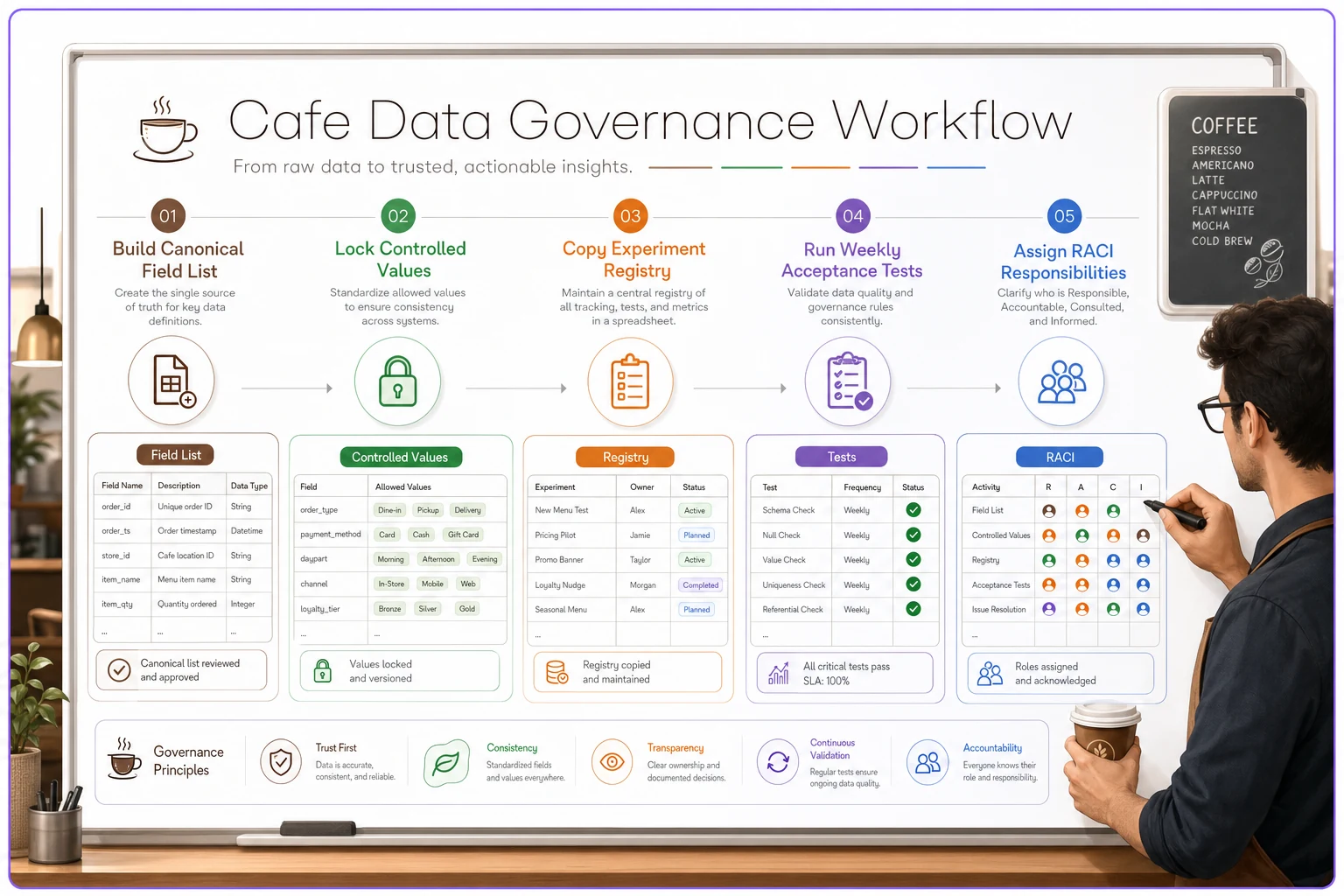
Get the names, the registry, the tests, and the ownership right, and most of your "the reports disagree" headaches simply stop happening.
Get the names, the registry, the tests, and the ownership right, and most of your "the reports disagree" headaches simply stop happening.
Ready to brew operational excellence?
Join hundreds of coffee shops using Coffehq to boost efficiency, reduce waste, and elevate customer satisfaction.