


Most cafe owners don't have an accounting problem. They have a timing and ownership problem that only looks like an accounting problem when the books don't close on time.
Here's the pattern. A café runs fine day-to-day. Sales ring up, milk gets ordered, staff get paid. Then the 15th rolls around, the owner sits down to reconcile the previous month, and nothing lines up. Gift-card balances don't match the POS. Refunds are floating somewhere between the register and the ledger. Perishable spoilage was never booked. Two hours turns into a Saturday. And the number that finally comes out — the "profit" — is a guess wearing a suit.
A cafe financial control system fixes this not by adding software or hiring a bookkeeper, but by deciding who does what, when, and in what order — and then putting that in a spreadsheet anyone on the team can follow. This post is the control pack itself: the close checklist, journal-entry templates for the messy stuff (perishables, refunds, gift cards), and a timing/ownership matrix so tasks stop falling through the cracks.
Why the books drift, and why it gets worse with a second location
The reason month-close breaks in cafés isn't complexity. A single-site coffee shop has maybe 40 transactions worth thinking about at close. It breaks because the work is invisible until it's late.
Daily operations produce financial events constantly — a barista comps a drink, a customer returns a stale pastry, someone reloads a gift card, the walk-in loses power and $180 of dairy hits the bin. None of these events announce themselves as accounting tasks. They just happen, get half-remembered, and then have to be reconstructed at month-end from receipts and vague memory.
At one location, a sharp owner can hold most of this in their head. The system is the owner. That works right up until it doesn't.
The moment you add a second site, three things break at once:
-
Nobody owns the shared tasks. Who books spoilage for Site B? The owner assumed the Site B manager would. The Site B manager assumed the owner did it centrally. Nobody did.
-
Timing desyncs. Site A closes its register Sunday night. Site B does it Monday afternoon. Now your consolidated numbers are comparing two different cut-off points, and you can't tell if a variance is real or just a timing artifact.
-
The same event gets coded three different ways. A refund at Site A gets logged as a sales reduction. The same refund at Site B gets logged as an expense. Your gross margin now lies to you.
The failure is almost never arithmetic. It's coordination. The math is easy. Knowing whose job it was and when it was due is the hard part — and that's exactly what a control pack encodes.
The core idea: a control pack, not an accounting overhaul
You don't need NetSuite. You need three artifacts living in one shared spreadsheet:
Keep every order and shift perfectly aligned.
Coffehq helps you manage orders, inventory, and staff schedules seamlessly.
- Unified order processing
- Real-time inventory updates
- Staff shift coordination
No credit card required
-
A month-close checklist — the ordered list of everything that has to happen, in sequence, before you trust the number.
-
A small library of journal-entry templates for the recurring ugly transactions, so nobody reinvents the coding each month.
-
A timing & ownership matrix (a lightweight RACI) so every task has exactly one name next to it and one deadline.
The whole point is that this survives you being on vacation. If your close only works when you personally run it, you don't have a system — you have a hostage situation.
This pairs naturally with a broader operating model. If you've already built out a spreadsheet-first financial model that links operational levers to your P&L, this control pack is the closing discipline that keeps that model fed with real, reconciled numbers instead of estimates.
The month-close checklist (copyable)
Sequence matters more than most people expect. You reconcile cash and sales first, because everything downstream depends on knowing revenue is real. Adjustments come last, because you can't adjust numbers you haven't confirmed yet.
Here's the ordered checklist. Treat it as your master template and strip out what doesn't apply.
Here's a simple workflow visualization of the phase sequence and responsibilities.
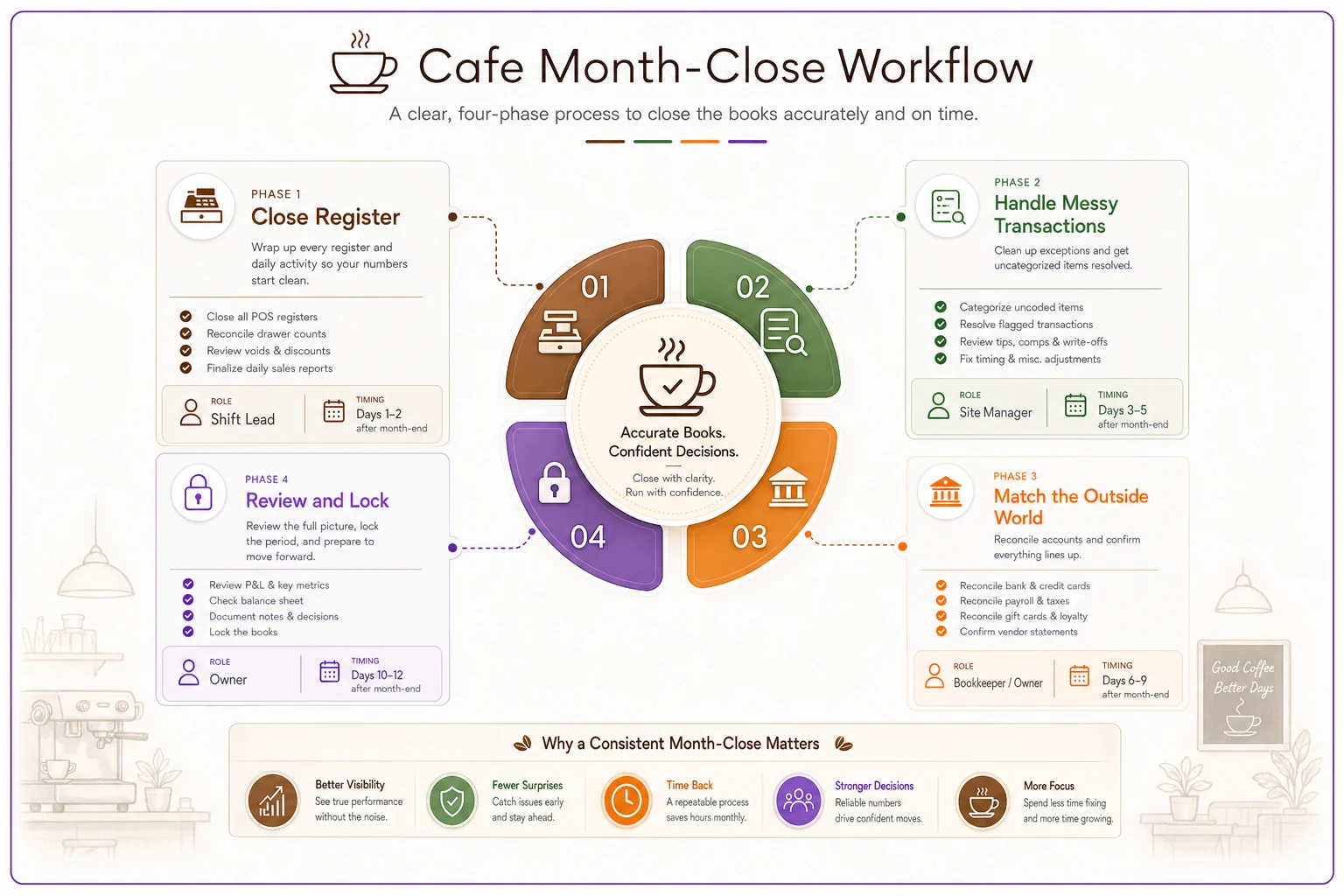
Phase 1 — Close the register (Days 1–2 after month-end)
-
[ ] Confirm final day's Z-report matches deposited cash
-
[ ] Reconcile card settlement totals to processor payout (watch for the 1–2 day lag)
-
[ ] Pull POS sales summary by category (drinks / food / retail / gift card)
-
[ ] Flag any day with a >5% variance between POS sales and expected deposits
Phase 2 — Handle the messy transactions (Days 2–3)
-
[ ] Total all refunds for the month; confirm each has a POS refund code
-
[ ] Book perishable spoilage/waste from the waste log
-
[ ] Reconcile gift-card sold vs redeemed vs outstanding liability
-
[ ] Post comps and staff discounts as contra-revenue (not as expense)
Phase 3 — Match the outside world (Days 3–5)
-
[ ] Reconcile bank statement to book cash balance
-
[ ] Match supplier invoices to received inventory (three-way check where possible)
-
[ ] Accrue any received-but-unbilled deliveries
-
[ ] Reconcile payroll to hours worked and to the bank draw
Phase 4 — Review and lock (Day 5–7)
-
[ ] Compare gross margin to prior month; investigate any swing over ~2 points
-
[ ] Owner reviews and signs off
-
[ ] Lock the period — no more edits without a written note
The single most-skipped item on that list is gift-card liability. It feels harmless because the cash already came in. But it's a liability you owe in product, and if you never track outstanding balances, your revenue is overstated and your eventual breakage math is fiction. If gift cards and loyalty are a meaningful part of your volume, the operational side of keeping redemptions clean matters — this pairs well with running loyalty and gift-card redemptions without back-office trips, so the POS data feeding your close is trustworthy in the first place.
Journal-entry templates for the three that always go wrong
These three categories cause the majority of café bookkeeping errors because they're reversals and non-cash events — the exact things a busy operator forgets to record. Copy these, adjust the account names to your chart of accounts, and stop improvising them at 11pm.
1. Perishable spoilage / waste
When dairy dies or pastries go stale, that inventory is gone but no sale happened. You have to move it out of inventory and recognize it as a cost — otherwise your COGS looks artificially low and your inventory on paper is fantasy.
Waste log shows $186 of spoiled dairy + $54 of unsold pastry Dr Spoilage Expense (or COGS-Waste) 240 Cr Inventory - Perishables 240
Book this weekly, not monthly. If you wait until close, you're reconstructing a month of waste from memory and it always comes out too round — nobody's real spoilage is exactly $200. A weekly entry from an actual waste log is more accurate and considerably less painful.
Book spoilage weekly from an actual waste log rather than reconstructing it at month-end.
2. Refunds on perishable/food items
Refunds are where cafés silently distort margin. A refund isn't an expense — it's a reversal of revenue, and if the item is unsellable (a returned stale sandwich), the inventory doesn't come back either.
Customer refunded $9.50 for a bad pastry; item discarded Dr Sales Returns (contra-revenue) 9.50 Cr Cash / Card Clearing 9.50 (No inventory entry — item was consumed/discarded, not restocked)
Compare that to a refund where product is returned in sellable condition — then you also restock inventory. Getting this distinction right is exactly the kind of thing that drifts across sites. The mechanics of refund codes and inventory adjustments deserve their own discipline; the deeper version lives in fast refund accounting for perishables, and it's worth aligning your journal templates to those same codes so the ledger matches the POS.
3. Gift cards (sold vs redeemed)
This is a two-stage life cycle and cafés almost always book only the first stage. When a card is sold, no revenue happened yet — you took cash and owe product. Revenue happens on redemption.
Gift card sold for $50 Dr Cash 50 Cr Gift Card Liability 50 Later, customer redeems $18 of it Dr Gift Card Liability 18 Cr Sales Revenue 18
The number that tells you whether you're doing this right: your Gift Card Liability balance at month-end should equal total sold minus total redeemed, ever. If your POS says $1,240 in outstanding balances but your ledger liability says $600, you've been booking sales when you shouldn't have. That gap is the fastest way to overstate profit in a café.
The timing & ownership matrix (RACI, café-sized)
A full corporate RACI is overkill. You need a stripped version with two rules: every task has exactly one "R" (the person who does it) and every task has a due day. Ambiguity is the enemy.
| Task | Responsible | Accountable | Due (after month-end) | Cadence |
|---|---|---|---|---|
| Daily register close | Shift lead | Site manager | Same night | Daily |
| Card settlement match | Site manager | Owner | Day 2 | Monthly |
| Waste/spoilage entry | Site manager | Owner | Weekly | Weekly |
| Refund review & coding | Site manager | Owner | Day 3 | Monthly |
| Gift-card liability recon | Bookkeeper/owner | Owner | Day 3 | Monthly |
| Supplier invoice match | Site manager | Owner | Day 4 | Monthly |
| Bank reconciliation | Bookkeeper/owner | Owner | Day 5 | Monthly |
| Payroll reconciliation | Owner | Owner | Day 5 | Monthly |
| Margin review & sign-off | Owner | Owner | Day 7 | Monthly |
| Lock period | Owner | Owner | Day 7 | Monthly |
Responsible ≠ Accountable. The site manager can be responsible for booking waste every week, but the owner stays accountable for it happening. When it doesn't happen, you know exactly whose door to knock on — not three doors hoping someone did it.
For multi-site operators, duplicate the Responsible column per location but keep a single Accountable owner for consolidation. That's what prevents the "I thought you did it centrally" gap that kills a whole close cycle.
A realistic before/after
A two-site café — roughly $780k combined annual revenue — used to close its books somewhere between the 18th and 25th of the following month. The owner handled most of it personally, reconstructing refunds and spoilage from receipts. Gift-card liability was never tracked; sales were booked at the point of card sale, which quietly overstated revenue by a few thousand a year.
Two real problems fell out of this: they couldn't trust monthly margin (it swung 4–6 points month to month for no operational reason), and any decision that needed clean numbers — a price change, a staffing cut — had to wait until the books settled.
After putting in the control pack — weekly spoilage entries, a fixed close checklist, and the ownership matrix with the Site B manager owning register and waste for their location — close moved to landing around Day 6–7, consistently. The margin swings shrank to about a point, which turned out to be real seasonal variation, not bookkeeping noise. The gift-card correction alone re-stated roughly $3k–$4k of revenue that had been sitting in the wrong place — not new money, but honest money the owner could finally plan around. The owner's own time on close dropped from most of a weekend to a couple of focused evenings, mostly because the site manager was handling Phase 1 and 2 before it ever reached them.
When a control pack like this makes sense — and when it doesn't
When it's worth it:
-
You have any gift-card or loyalty volume that creates a liability you're not tracking.
-
You run more than one location, or plan to within a year.
-
Your close takes longer than a week, or you don't trust the margin number it produces.
-
You want to hand off closing tasks without handing off control.
When it's overkill:
-
You're a single tiny kiosk with almost no refunds, no gift cards, and you personally see every transaction. A weekly cash reconciliation may genuinely be enough.
-
You're in month one or two of operating and don't yet have stable patterns to codify. Codify after you've seen the mess, not before.
Who should not just copy this blindly: Anyone whose chart of accounts differs meaningfully — the sequence and ownership logic transfer everywhere, but the specific account names in the journal templates need to match your setup. Copying account names verbatim into a mismatched chart of accounts creates a new mess instead of fixing the old one.
Where software quietly earns its keep
None of this requires a platform. A shared spreadsheet with the checklist, the templates, and the RACI will carry a single site and even two sites for a long time. Start there.
Tooling starts to matter around coordination across sites and cadence enforcement — making sure the weekly spoilage entry actually gets done, that Site B closes on the same cut-off as Site A, and that outstanding gift-card liability pulls straight from the POS instead of being hand-tallied.
When those tasks live inside an operational platform that already holds your POS, inventory, and scheduling data, the close stops being a reconstruction job and becomes a review job. You're confirming numbers the system already assembled, not hunting for them. AI-powered operational software adds another layer here — flagging when a site's waste entry hasn't been submitted, surfacing gift-card liability discrepancies before they compound, and keeping close timelines consistent across locations without the owner having to chase anyone down.
That's the natural upgrade path — but only after the discipline exists on paper. Software enforces a system. It doesn't invent one.
The bottom line worth keeping
Café books drift not because the accounting is hard, but because financial events hide inside operational moments and only surface, late, at close.
A control pack drags those hidden tasks into the open: an ordered checklist so nothing gets skipped, templates so the ugly entries stop getting improvised, and an ownership matrix so every task has one name and one deadline. Build the three artifacts in a spreadsheet first. Run one close with them. You'll find out fast which tasks nobody actually owned — and that discovery, more than any journal entry, is what a real cafe financial control system is for.
Café books drift not because the accounting is hard, but because financial events hide inside operational moments and only surface, late, at close.
A control pack drags those hidden tasks into the open: an ordered checklist so nothing gets skipped, templates so the ugly entries stop getting improvised, and an ownership matrix so every task has one name and one deadline. Build the three artifacts in a spreadsheet first. Run one close with them. You'll find out fast which tasks nobody actually owned — and that discovery, more than any journal entry, is what a real cafe financial control system is for.
Ready to brew operational excellence?
Join hundreds of coffee shops using Coffehq to boost efficiency, reduce waste, and elevate customer satisfaction.