

Your loyalty program should boost revenue, not destroy register efficiency. Yet most coffee shop loyalty operations create bottlenecks that cost more in lost throughput than they generate in retention. The real damage happens when baristas need to check balances, apply points, or process gift cards during morning rush—turning a 45-second transaction into a two-minute ordeal.
The math gets ugly fast. A single redemption delay during peak can back up your entire line. Six customers waiting means eighteen drinks not being made. Your average ticket drops while labor percentage spikes. Meanwhile, the loyalty member causing the holdup gets frustrated waiting for their "reward."
Why redemption timing destroys throughput
Loyalty redemptions fail operationally because they require information that lives outside the immediate transaction flow. Your barista needs to verify point balances, check redemption rules, apply the right discount, then update the customer's account—all while maintaining eye contact and explaining why their free drink doesn't include oat milk.
Standard POS systems handle this terribly. They treat loyalty lookups as separate processes that interrupt order flow. The barista enters the order, backs out to check points, re-enters with the discount, processes payment, then manually adjusts the loyalty balance. Each step adds friction.
Gift cards multiply the problem. Physical cards require manual entry. Digital cards need email lookups. Partial redemptions need math. Split payments need manager overrides. Your register becomes a data entry terminal instead of a revenue generator.
It compounds during promotions too. Double-point Tuesday brings twice the redemptions. Holiday gift card season means balance checks every third customer. Your carefully planned queue management system collapses under redemption complexity.
Inventory holds that prevent overselling reward items
Redemption inventory is its own headache: customers expect their free items immediately, but your par levels assume paid purchases. A typical Saturday morning might see 15 loyalty redemptions for specialty drinks that require ingredients you've portioned for regular sales.
Keep every order and shift perfectly aligned.
Coffehq helps you manage orders, inventory, and staff schedules seamlessly.
- Unified order processing
- Real-time inventory updates
- Staff shift coordination
No credit card required
The conflict becomes obvious with limited items. Your weekend special—a brown butter latte—has ingredients for 40 drinks based on historical sales. But when 12 loyalty members redeem points for it, you're out by 2pm. Now you're explaining to paying customers why the advertised special isn't available.
Smart cafes build redemption buffers into their inventory planning. Instead of calculating pars purely from historical demand patterns, they add a redemption reserve based on active loyalty members and typical redemption rates.
-
Base inventory
40 special drinks
-
Active loyalty members within 2 visits of redemption
85
-
Typical Saturday redemption rate
18%
-
Redemption buffer needed
15 drinks
-
Adjusted inventory
55 drinks
This buffer prevents the awkward "we're out" conversation with loyalty members while ensuring paying customers still get what they came for.
POS routing rules that keep lines moving
Register workflow determines whether loyalty programs help or hurt operations. Most cafes make the mistake of treating all transactions equally, forcing simple cash purchases to wait behind complex redemptions.
Effective coffee shop loyalty operations require transaction routing. During peak periods—typically 7–10am and 2–4pm—dedicate one register to cash and simple card transactions. Route loyalty redemptions, gift cards, and modifications to a second register with your most experienced barista.
The routing rules:
Express Register (Register 1):
-
Cash payments under $20
-
Single card transactions
-
No modifications
-
No redemptions
-
Target
30-second average
Full Service Register (Register 2):
-
Loyalty redemptions
-
Gift card payments
-
Order modifications
-
Group orders
-
Target
75-second average
This separation keeps flow moving for regular customers while giving loyalty members the attention they need. Overall throughput increases even though one register handles fewer transactions.
Here's a quick diagram of the routing workflow.
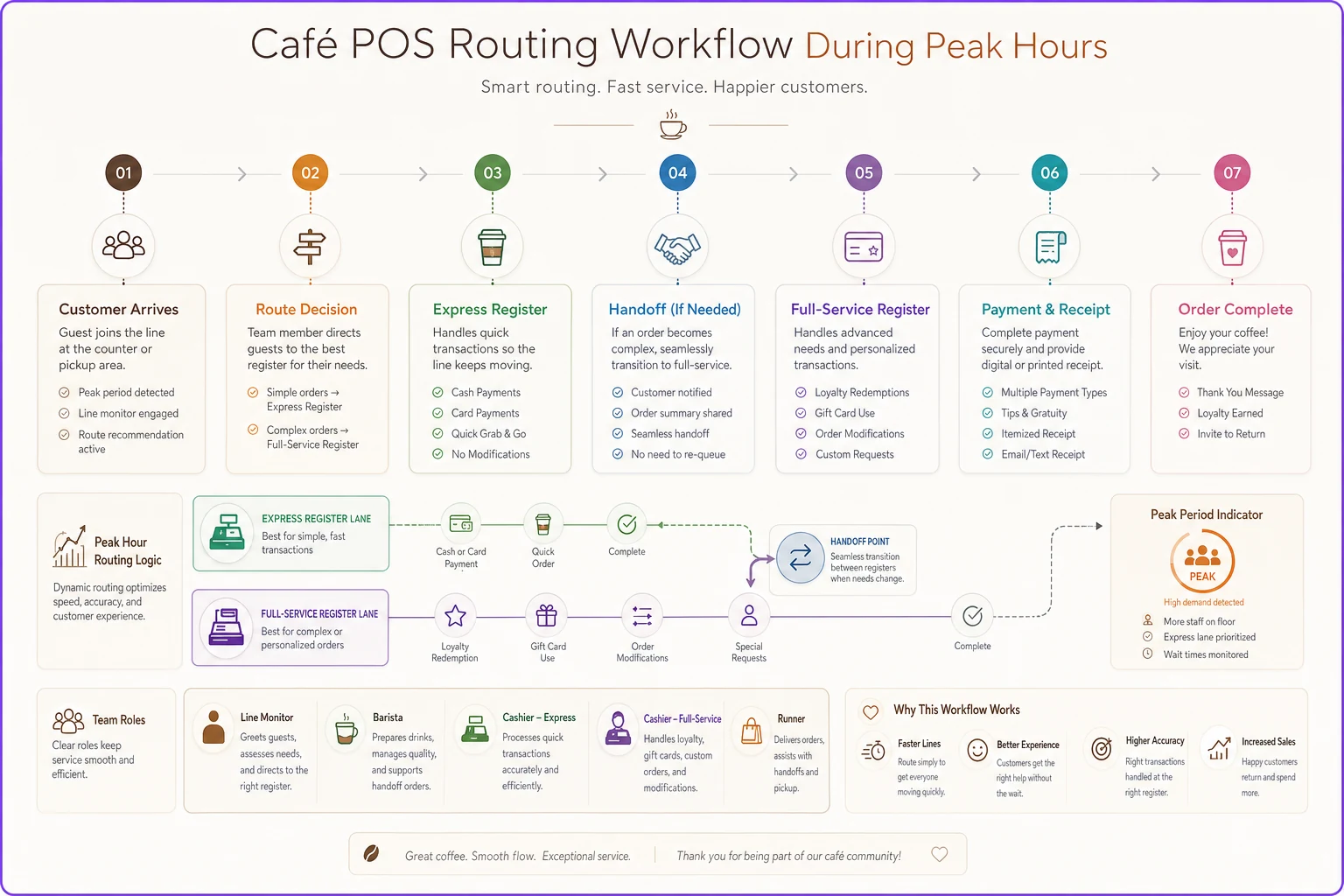
Training matters here. Baristas need clear handoff protocols. When someone approaches Register 1 with a loyalty card, the barista immediately redirects them with a positive frame: "Sarah at Register 2 will help you redeem those points—she's our loyalty expert."
Staffing buffers for promotional peaks
Loyalty promotions create predictable chaos. Triple-point weekends, birthday month perks, and "buy 5 get 1 free" campaigns all generate traffic surges that standard staffing can't absorb. The surge isn't just more customers—it's more complex transactions.
A normal Tuesday might need three baristas: register, espresso bar, and float. But "Triple Point Tuesday" needs five: express register, loyalty register, espresso bar, cold bar, and expediter. The extra labor cost (roughly $120 for a 6-hour shift) gets offset by maintaining service speed and capturing incremental revenue you'd otherwise lose to abandoned lines.
| Promotion Type | Traffic Increase | Complexity Increase | Extra Staff Needed |
|---|---|---|---|
| Double Points | 15-20% | Low | +1 register |
| Free Birthday Drink | 5-8% | High | +1 float |
| Buy X Get 1 Free | 25-35% | Medium | +2 (register + bar) |
| New Member Special | 10-15% | Very High | +2 (register + expediter) |
Use a two-week lookback window when scheduling. Track redemption patterns from previous promotions to predict staffing needs. If last month's double-point day saw 340 transactions versus your normal 250, plan for similar volume this time around.
Buffer scheduling also means having backup plans. Schedule one additional person on call for promotional days. They're guaranteed two hours minimum if called in—that's $30–40 in labor—but it prevents hundred-dollar losses from abandoned lines.
Real-time measurement of loyalty ROI
Most cafes track loyalty program success through redemption rates and member growth. These metrics lie. High redemption might mean you're giving away too much. Member growth might include people who joined for one promotion and never came back.
Real coffee shop loyalty operations tracking focuses on incrementality—revenue that wouldn't exist without the program. This requires comparing member behavior to non-member baselines, not just tracking member purchases in isolation.
Start with cohort analysis. Track 100 new loyalty members from their join date. Compare their 90-day purchase patterns to 100 similar non-members—similar initial order size, time of day, location. The difference represents true program value.
-
New loyalty cohort
100 members, averaging $280 in 90-day spend
-
Control group
100 non-members, averaging $195 in 90-day spend
-
Incremental revenue per member
$85
-
Program cost per member
$31 (redemptions + admin)
-
Net contribution
$54 per member
Static analysis misses operational reality though. You need live metrics that flag problems before they compound. Track hourly redemption impact on service times. If redemptions are pushing average transaction time above 90 seconds, your throughput loss is outpacing loyalty gains.
Build a simple dashboard tracking:
-
Redemption transaction time vs. standard
-
Register utilization during redemption periods
-
Line abandonment when redemption queues form
-
Inventory variance from redemption spikes
When any metric exceeds thresholds, trigger operational adjustments: open the second register, shift to express/full service mode, or temporarily limit complex redemptions.
Operational guardrails that maintain profitability
Loyalty programs fail when emotion overrides operations. The owner wants happy customers, so they approve every exception. The barista wants good tips, so they give extra punches. The manager wants good reviews, so they honor expired rewards. These micro-decisions compound into real losses over time.
Clear operational boundaries keep programs profitable. Set redemption windows that align with capacity. Birthday drinks valid only Monday through Thursday prevent weekend rush complications. Points expire after 6 months to avoid balance buildup. Free drinks exclude premium additions to protect margins.
Those boundaries need to be enforced through POS configuration, not human judgment. Lock out redemptions during peak hours through your system. Automatically exclude upcharges from reward drinks. Require manager codes for exceptions. This removes awkward confrontations while keeping things consistent.
Document the edge cases that quietly kill profitability:
Never Allow:
-
Retroactive point additions
-
Combining multiple rewards
-
Transferring points between accounts
-
Redeeming for retail merchandise
-
Cash value exchanges
Manager Override Only:
-
Expired reward extensions (max 7 days)
-
System error adjustments
-
Bulk purchase point additions
-
Damaged card replacements
Automatic Approval:
-
Points for registered complaints
-
Birthday reward extensions (within month)
-
App malfunction redemptions
-
Missing point investigations under $20
These guardrails feel restrictive until you calculate the alternative. One barista giving "just one extra punch" per shift costs roughly $1,400 annually. Manager overrides for expired rewards add another $2,000 or more. Suddenly your loyalty program is operating at a loss despite looking fine on the surface.
Balancing member satisfaction with operational reality
The best loyalty programs feel generous while running efficiently. That requires designing around operational constraints, not fighting them. Your milk prep systems limit how many oat milk drinks you can realistically offer as rewards. Your register setup determines redemption speed. Your staff training defines how consistently exceptions get handled.
Build the program backwards from operational capacity. If your peak hour throughput maxes at 120 transactions, limit hourly redemptions to around 12. If your specialty drink prep takes 3 minutes, exclude those drinks from instant redemptions. If your inventory system can't track real-time balances, require advance notice for bulk redemption orders.
Members accept operational limits when you frame them well. "Redemptions available during off-peak hours" becomes "Skip the line with early bird rewards." "Points expire after 6 months" becomes "Fresh points for frequent visitors." "Limit one redemption per visit" becomes "Something special every time you come in."
The technology layer matters more than most cafe owners realize. Modern operational software can automate the complex routing and rule enforcement that makes loyalty programs actually work. AI-powered platforms can predict redemption patterns, adjust inventory buffers automatically, and route transactions based on real-time capacity—removing the manual calculation burden from your staff while keeping the experience smooth for customers.
Consider how that changes something like the birthday drink surge. Instead of manually tracking birthdays and hoping baristas remember the rules, the system flags birthday members at order entry, applies the reward automatically, and adjusts inventory forecasts based on historical redemption rates. The barista just gets to say happy birthday while the operational complexity happens in the background.
Building sustainable loyalty operations
Coffee shop loyalty operations succeed when they enhance rather than interrupt regular operations. Every redemption should feel smooth to the customer and manageable to staff. That requires systematic thinking about capacity, workflow, and measurement—not hoping goodwill overcomes friction.
The cafes that get this right share a few common traits. They treat loyalty as an operational system, not a marketing program. They measure real-time impact, not just monthly reports. They set clear boundaries that protect both customer experience and margins. And they recognize that a slightly restricted program that runs smoothly beats a generous program that creates chaos at the register.
Your loyalty program should make regular customers feel valued while making your operation more predictable. When redemptions flow naturally, when inventory buffers prevent disappointments, and when staff can handle promotional days without stress, the program pays for itself through retention and word-of-mouth instead of eating into margins.
The operational guardrails aren't limitations—they're what makes consistent delivery possible. Get these fundamentals right, and your loyalty program becomes a competitive advantage instead of an operational burden.
Ready to brew operational excellence?
Join hundreds of coffee shops using Coffehq to boost efficiency, reduce waste, and elevate customer satisfaction.