

Most independent café groups don't have real vendor governance. They have relationships. You know the milk rep by first name, the roaster texts you when a lot is running low, and the pastry supplier has been reliable enough that nobody's questioned them in two years. That works fine right up until it doesn't — a delivery gets skipped on your busiest Saturday, oat milk goes on allocation, or a price creep nobody tracked quietly eats three points off your margin.
The gap isn't the absence of contracts. It's the absence of a lightweight system to hold vendors accountable — one that a busy manager can actually run. Big chains solve this with procurement departments and enforceable SLAs. A three-site café can't and shouldn't copy that model. What you actually need is contract‑lite governance: enough structure to catch problems early and negotiate from a position of data, without turning ordering into a bureaucracy.
This is where cafe supplier governance usually falls apart at small scale — not because owners are careless, but because the informal system that worked at one location silently breaks when you're managing two or three.
Why the informal system breaks the moment you add a second site
At one location, vendor management lives in one person's head. The owner knows the espresso supplier runs slow on Mondays, that the bakery shorts croissants during holidays, and that the produce guy will quietly swap in a lower grade if nobody checks. That knowledge is real governance — it just isn't written down.
Add a second site and that knowledge doesn't travel with you. Site B's manager doesn't know the bakery shorts orders, so they don't count deliveries, so they run out — and then they blame their own par levels when the actual problem was a supplier behavior nobody documented. Multiply that across five or six vendors and two locations and you get a fog of small failures where nobody can tell if the problem is ordering, staff, or the vendor.
What tends to happen across small multi-site operators is that the same vendor performs differently at different sites — not because the vendor changed, but because each location tolerates different things. One manager pushes back on late deliveries; the other silently absorbs them. The vendor optimizes for the site that complains least. Without shared scorecards, you're essentially training your suppliers to underperform wherever the standards are lowest.
This connects directly to ordering discipline. If your purchase-to-stock process is solid but your vendors are unreliable, your COGS still swings — because a clean order means nothing if half of it arrives short or late.
The four pieces of contract‑lite governance
Contract-lite doesn't mean no accountability. It means the accountability lives in four simple, repeatable artifacts instead of legal language:
Keep every order and shift perfectly aligned.
Coffehq helps you manage orders, inventory, and staff schedules seamlessly.
- Unified order processing
- Real-time inventory updates
- Staff shift coordination
No credit card required
-
Supplier scorecards — a shared, factual record of how each vendor actually performs
-
Backup rules — pre-decided fallback vendors and thresholds so nobody's improvising during a shortage
-
Renegotiation cadence — a fixed calendar for reviewing price and terms so you're not reacting to surprise increases
-
A one-page risk matrix — a single view of which vendors could actually hurt you and how badly
None of these require a lawyer. All of them require someone to write things down consistently, which is the part that quietly fails.
Supplier scorecards that a manager will actually keep
The mistake most operators make with scorecards is building something too detailed to maintain. A 20-field spreadsheet gets abandoned in three weeks. The scorecard that survives is the one a shift lead can update in under a minute at the point of delivery.
Track four things and nothing more:
-
On-time delivery (arrived in the promised window
yes/no)
-
Order accuracy (full order delivered, correct items
yes/no, note what was short)
-
Quality issues (rejected product, wrong grade, temperature problems: count)
-
Price change (any change from last order
note it)
That's it. The magic isn't in the fields — it's in doing it at every site the same way so you can actually compare. When Site A logs the roaster at 92% on-time and Site B logs 71%, you have a conversation grounded in fact instead of one person's impression.
Worth watching: a vendor's trend matters more than any single miss. Everyone has a bad week. But a supplier drifting from 95% to 80% on-time over two months is telling you something — usually that they've taken on a bigger client and you've quietly dropped in priority. Catching that drift early is the whole point.
| Vendor type | Score every | Who logs it | Red-flag trend |
|---|---|---|---|
| Dairy / milk | Per delivery | Receiving staff | Any short delivery 2+ times in 2 weeks |
| Roaster / beans | Per delivery | Shift lead | On-time drops below 85% |
| Pastry / bakery | Per delivery | Opening manager | Accuracy issues on weekends |
| Produce | Per delivery | Receiving staff | Grade substitutions without notice |
| Packaging / disposables | Monthly | Manager | Price change >5% unannounced |
The table above shows the simplest practical logging cadence and who should own it at a site-level.
Backup rules: decide the fallback before you need it
Shortages don't kill small cafés. Improvised responses to shortages do. When oat milk doesn't show up and there's no rule, a stressed opener makes a $180 emergency grocery-store run at retail, or just runs out and turns away the third of your customers who order oat lattes.
Backup rules are pre-made decisions. For each critical input, you decide in advance:
-
Who is the secondary vendor?
-
At what point do we trigger the switch? (e.g., "primary confirms they can't deliver by open")
-
Who has authority to make the call without checking with the owner?
-
What's the acceptable emergency cost ceiling before we just run a temporary recipe swap instead?
The authority piece is where multi-site operations quietly bleed money. If every shortage requires a call to the owner, you've centralized a decision that has to happen fast at 6am. Push it down. A backup rule that a shift lead can execute alone is worth ten backup vendors that require sign-off.
There's overlap here with margin protection during input spikes. If your backup vendor costs more, the smarter move is sometimes a temporary recipe adjustment rather than paying up. The backup rule and the cost ceiling should live on the same card so nobody's making a judgment call mid-rush.
Renegotiation cadence: stop reacting to price letters
Vendors raise prices when they think you're not paying attention. The drip of small increases — a few cents on a gallon, a slightly higher case price — is where margin quietly disappears. Nobody renegotiates because there's no trigger to do it, so the review never happens and the creep compounds.
Fix this by putting renegotiation on the calendar instead of waiting for a price shock:
-
Quarterly quick review of your top three spend vendors. Pull the scorecard, look at price trend, ask for updated pricing.
-
Semi-annually full review of all vendors, including whether the relationship still fits your volume.
-
Trigger-based any single price increase over roughly 5%, or two consecutive scorecard misses, forces an out-of-cycle conversation.
The leverage you bring to these conversations is the scorecard. Walking in with "you've been 88% on-time this quarter and here's the log" is a completely different negotiation than "I feel like deliveries have been rough lately." Data beats feelings every time a rep is trying to justify a rate increase. The negotiation questions themselves — lead times, allocation priority, volume tiers — pair well with a disciplined ordering cadence, because predictable volume is what vendors will actually discount for.
One overlooked move: consolidating spend across sites before you renegotiate. Three locations each buying separately have no leverage. The same three combined into one order commitment do. Most small groups never do this because ordering stayed decentralized as they grew.
The one-page risk matrix
The risk matrix is what makes everything else prioritized instead of equal. Not every vendor deserves the same attention. Your napkin supplier failing is annoying; your only espresso roaster failing during a supply crunch can close a site.
Score each vendor on two axes:
Impact if they fail (low / medium / high) — how badly does a failure hurt service and revenue?
Likelihood of failure (low / medium / high) — based on their scorecard trend and how replaceable they are
Vendors that land in high impact + high likelihood are your governance priority. Those are the ones that need a solid backup rule, a tight scorecard, and an actual renegotiation relationship. Low-impact, low-likelihood vendors barely need watching.
A typical small café matrix looks like this:
| Vendor | Impact if fails | Likelihood | Priority |
|---|---|---|---|
| Espresso roaster (sole source) | High | Medium | Top |
| Dairy | High | Low | Watch |
| Pastry | Medium | Medium | Watch |
| Produce | Low | Medium | Low |
| Packaging | Low | Low | Ignore-ish |
The thing most operators miss: sole-source vendors are always high-priority regardless of how reliable they've been. A vendor with a perfect record but no backup is a single point of failure. Reliability today doesn't protect you from allocation next quarter. If a critical input has no second source, finding one is the governance task — before you need it.
A short real scenario
A two-site café group, somewhere around $60k–$70k in combined monthly revenue, kept blaming inconsistent milk inventory on staff. Both sites ran the same dairy vendor. When they finally started logging deliveries the same way at both locations, the pattern was obvious: Site B was short-delivered about once a week, Site A almost never. Same vendor, different tolerance — Site B's opener never flagged it.
They didn't fire the vendor. They brought the log to a renegotiation meeting, set up a backup dairy source with a clear switch trigger, and pushed the authority to make that call down to shift leads. Over the next quarter, short deliveries at Site B dropped to near zero. Milk-related stockouts — which had been costing a few hundred dollars a month in turned-away orders and emergency runs — basically stopped. The change wasn't a new vendor. It was writing down what was already happening.
When contract‑lite governance makes sense — and when it doesn't
This makes sense when you're running two to six sites, have a handful of vendors that genuinely matter, and you keep seeing supply problems you can't cleanly attribute to staff or ordering. It's the right weight for operators who are too big for pure relationship management but too small for procurement software and enforceable SLAs.
This is overkill when you're a single location with two suppliers you see in person every week. At that scale the governance really does live in your head, and formalizing it adds friction for little gain. Wait until you feel the coordination pain across sites.
Who should skip it: if you can't get consistent logging even for basic receiving, don't start with scorecards — start with the receiving habit itself. Governance built on inconsistent data is worse than no governance, because it gives you false confidence in numbers nobody actually recorded.
As you scale past a few sites, this kind of lightweight system needs to be baked in early — alongside the tiered standards and decision rights covered in the second-site scaling blueprint. Vendor governance is far easier to install when you open a new location than to retrofit onto three sites that each developed their own habits.
Keeping it running without it becoming a burden
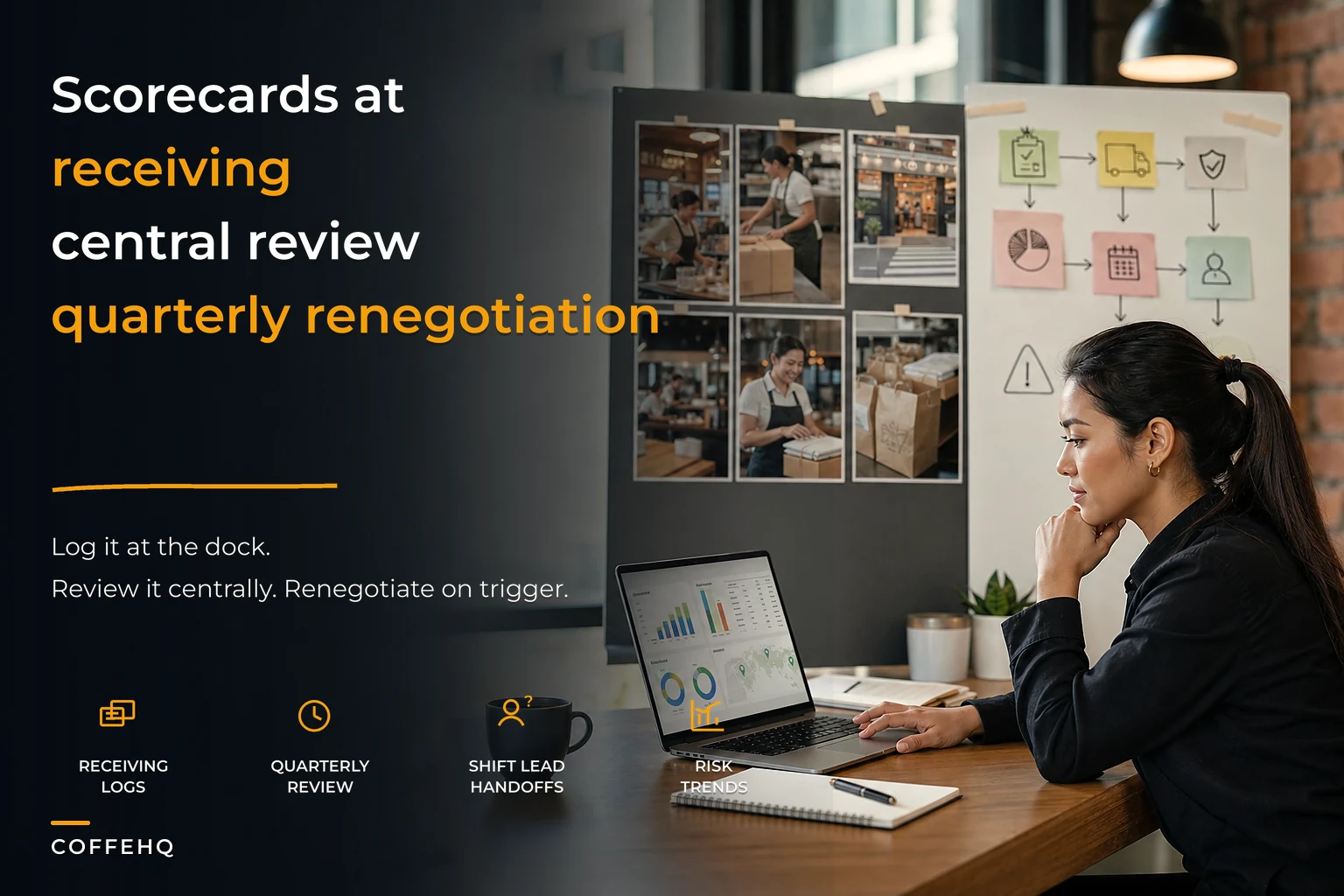
The real failure mode here isn't design — it's maintenance. Scorecards get abandoned, matrices go stale, renegotiation dates slip. The fix is to attach each artifact to something that already happens: scorecard logging to the receiving process, matrix review to your monthly numbers review, renegotiation to the calendar quarter. Governance that requires a separate ritual dies. Governance folded into existing routines survives.
This is also where centralizing the record across sites earns its keep. When both locations' delivery logs live in one place instead of two clipboards behind two counters, the trend that's invisible at each individual site becomes obvious across the group. That shared view — same fields, same cadence, one place to look — is what turns a pile of delivery notes into leverage you can actually use at the negotiating table.
Here's a simple workflow visualization.
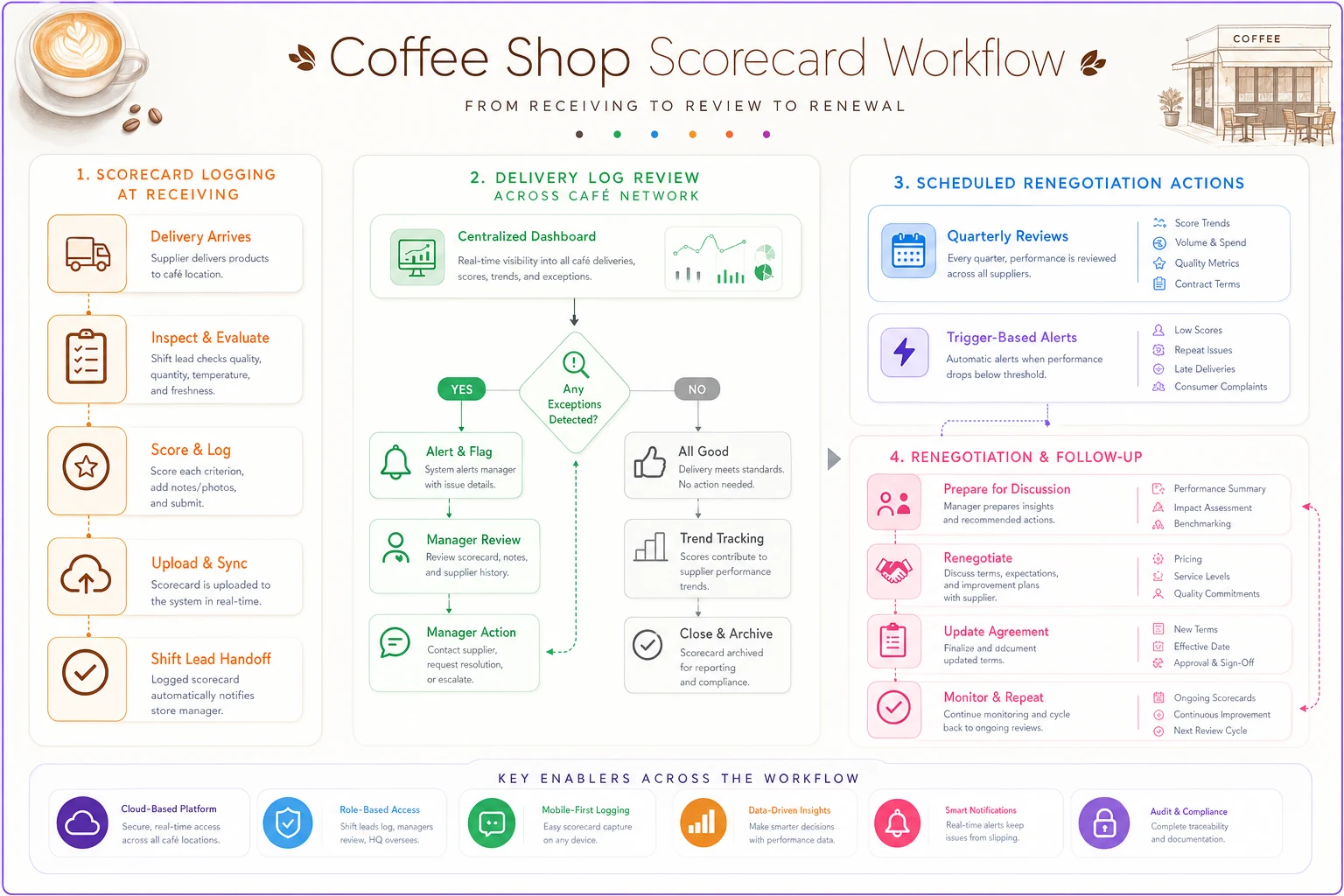
Attach scorecard logging to the receiving process so it becomes part of the normal handover rather than an extra task.
Contract-lite governance isn't about controlling your vendors. It's about knowing enough to catch drift early, respond to shortages without panic, and walk into every price conversation with facts instead of a hunch. For a small café group, that's usually the difference between suppliers who quietly test how much they can get away with and suppliers who know you're paying attention.
Contract-lite governance isn't about controlling your vendors. It's about knowing enough to catch drift early, respond to shortages without panic, and walk into every price conversation with facts instead of a hunch. For a small café group, that's usually the difference between suppliers who quietly test how much they can get away with and suppliers who know you're paying attention.
Ready to brew operational excellence?
Join hundreds of coffee shops using Coffehq to boost efficiency, reduce waste, and elevate customer satisfaction.