


Opening your second location feels like it should be straightforward. You've got one successful café running, customers love your coffee, and the numbers work. Then somewhere around week three, your original location's quality starts slipping because you're spending every waking hour at the new site, and neither location is running right.
The operational complexity doesn't scale linearly. Running two cafés isn't twice as hard as running one — it's closer to four times harder until you build the right systems. Most owners figure this out the hard way, bouncing between locations trying to fix problems that wouldn't exist if everyone had just been trained properly in the first place.
What tends to happen: your star barista at location one makes perfect lattes but can't replicate that at location two because the steam wand pressure is different. Your morning pastry delivery shows up at 5:30am at one site and 7:00am at the other, wrecking your entire prep schedule. One manager thinks 165°F is the right milk temp while the other swears by 155°F. Small variations compound into completely different customer experiences across sites.
Why standardization breaks down between 2–10 locations
The gap between single-site and true multi-site operations catches most café owners off guard. At one location, you personally fill the gaps. Institutional knowledge lives in people's heads, and your presence compensates for whatever isn't written down. That model falls apart the moment you can't be everywhere at once.
Between two and ten locations, you're stuck in a weird middle ground — too big for owner-does-everything management, too small for corporate-style systems. You need standardization, but rigid uniformity kills what makes each neighborhood café work. You need local decision-making, but too much autonomy creates chaos.
The expansions that go well figure out early what needs to be identical across locations versus what can flex. They build just enough structure to maintain quality without strangling local character.
The breakdown usually starts with purchasing. One location orders oat milk from supplier A because they deliver early. Another uses supplier B because they're cheaper. Suddenly you're managing different product codes, different invoice systems, different delivery schedules. The purchase-to-stock systems that worked perfectly for one site become a nightmare across multiple.
Building your tiered standardization framework
Not everything needs the same level of standardization. Some things must be identical everywhere. Others need flexibility. Most fall somewhere in between.
Keep every order and shift perfectly aligned.
Coffehq helps you manage orders, inventory, and staff schedules seamlessly.
- Unified order processing
- Real-time inventory updates
- Staff shift coordination
No credit card required
Tier 1: Non-negotiable standards (must be identical)
Your non-negotiables should be limited but absolute — things that directly impact safety, legality, or your core brand promise.
Coffee extraction parameters need to stay consistent. If your signature espresso pulls at 27 seconds with an 18g dose yielding 36g, that's the same everywhere. Customers ordering your house blend expect the same flavor whether they're at your downtown location or your suburban spot. Milk temps, grind settings for batch brew, water temperature for pour-overs — these create your flavor identity.
Food safety protocols can't vary. Temperature logs, handwashing procedures, allergen handling — identical across the board. When health inspectors show up, every location should pass using the same practices.
Financial controls and cash handling stay uniform too. How you count registers, when deposits happen, who can issue refunds, void transaction protocols — these protect your business. Every location runs the same end-of-day reconciliation.
Tier 2: Flexible within boundaries
This middle tier gives locations room to adapt while maintaining consistency. You set the guardrails; sites operate within them based on local needs.
Staffing patterns can flex based on traffic. Your downtown location might need three baristas during morning rush while your residential spot only needs two. But everyone follows the same position structure — one on register, one on espresso, one on handoff. The framework stays consistent even if headcount varies.
Local menu additions work within guidelines. Maybe you allow each location to add two or three locally-sourced pastries or one seasonal drink. But they have to meet your margin requirements, use approved suppliers, and go through review before launch.
Marketing and community engagement adapts to neighborhoods. One location might sponsor the local run club while another hosts art shows. Brand guidelines and approved messaging, though — that part doesn't move.
Tier 3: Completely localized decisions
Some choices should stay hyperlocal — things that don't meaningfully impact brand consistency or operational efficiency.
Store hours can match neighborhood patterns. Your office-district location might open at 6am for commuters while your college-area café doesn't see real traffic until 8am. Let managers adjust based on actual demand, not arbitrary schedules.
Background music, ambiance, furniture arrangement — these create the neighborhood feel customers actually want. The financial district location might play jazz while the arts district spot features local indie bands. That's fine.
Community partnerships and local sourcing for non-core items can be fully autonomous. If the manager wants to stock a local artist's mugs or partner with the neighborhood bakery for special events, that's their call as long as it doesn't conflict with existing contracts.
The 90-day stabilization cadence that actually works
Most café owners try to stabilize a new location in 30 days. That's not realistic. Real stabilization takes 90 days minimum, and you need a structured cadence to get there without destroying your existing operations.
-
Days 1–30
Foundation and crisis management
-
Days 31–60
Process refinement
-
Days 61–90
Performance optimization
Days 1–30: Foundation and crisis management
The first month is about survival and establishing basic operations. You're not trying to optimize anything — just getting the doors open consistently and serving decent coffee.
Week one focuses entirely on basic execution. Can everyone make drinks to standard? Does the POS system work? Are suppliers showing up? You're essentially running barista training certification in real-time while serving actual customers. Expect everything to take twice as long as it should.
By week two, you're identifying the critical gaps. Maybe the morning shift handoff isn't working. Perhaps the storage layout creates bottlenecks during rush. You discover that the espresso machine placement that looked great on paper means baristas are constantly running into each other.
Weeks three and four, basic rhythms start forming. Shifts feel somewhat predictable. Staff know where things are. Regular customers begin appearing. You're still fixing problems, but the chaos starts settling into manageable disorder.
Your presence needs to be heavy but strategic during this phase. Spend full shifts at the new location, but rotate through different dayparts — a few morning rushes, some afternoon lulls, weekend brunch service. See how operations actually flow.
Days 31–60: Process refinement
Month two shifts from crisis management to building repeatability. You're starting to reduce your constant presence.
This is when you implement real measurement. Track drinks per hour, waste percentages, labor efficiency — not to punish anyone, but to understand what normal looks like for this specific location. Your downtown store might average 180 drinks during morning rush while the new suburban site only hits 120. That's not failure, that's just the reality you need to plan around.
Training gaps become obvious now too. Maybe your experienced baristas never learned to properly explain the loyalty program because at the original location, you always handled it. Perhaps nobody knows how to process catering orders. You're filling knowledge holes while building documentation.
Supplier relationships often need adjustment during this phase. Those early morning deliveries might not fit the actual traffic pattern. The milk order that seemed right is either too much or nowhere near enough. You're dialing in par levels based on real consumption data.
Start introducing cross-location coverage. Have your strongest shift lead from location one cover a shift at location two. Send your new assistant manager to shadow at the original site. This cross-pollination surfaces operational inconsistencies you hadn't noticed before.
Days 61–90: Performance optimization
The third month is about fine-tuning and building sustainable operations without your constant oversight.
Labor scheduling gets dialed in based on actual patterns. You know Tuesday mornings need just two people until 8am, but Thursday requires full staffing by 6:30am. The schedule stops being guesswork.
Product mix optimization happens naturally during this stretch. You realize the new location sells significantly more cold brew than the original. Pastry preferences differ. The afternoon crowd wants different food options. You adjust ordering and prep accordingly.
Financial controls and reporting get integrated into your multi-site dashboard. Daily cash reconciliation, labor reports, product movement — everything flows into centralized tracking. You can spot problems without physically being there.
Manager autonomy increases gradually. By day 90, your site manager should be handling routine decisions without calling you. They know when to comp a drink, how to handle staff conflicts, when to adjust break schedules. You've moved from doing everything to overseeing operations.
Here's a visual of the 90-day cadence.
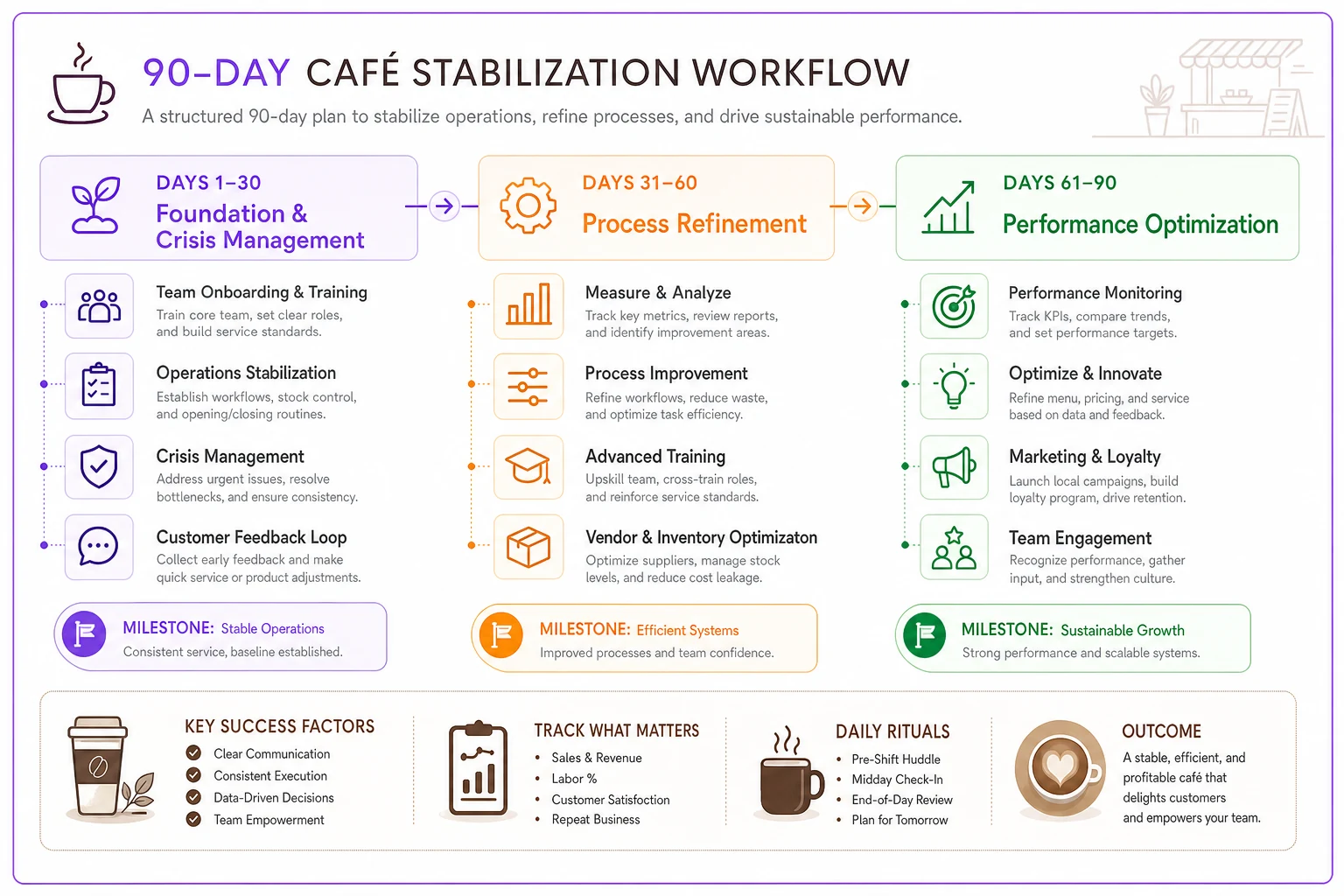
Visualizing the three-phase cadence makes it easier to communicate milestones to your team and schedule your presence purposefully.
Supplier bundling strategies that reduce complexity
Managing suppliers across multiple cafés gets exponentially messy without a clear approach. Every additional vendor relationship multiplies your administrative burden — different ordering systems, payment terms, delivery schedules, invoice formats. Smart bundling reduces this complexity while often securing better pricing.
Coffee and core beverages usually bundle well. You want consistent quality across locations, and volume purchasing gives you real leverage. Consolidating to one coffee roaster, one milk supplier, one tea vendor simplifies training and ensures taste consistency. When you're ordering 200 pounds of coffee weekly instead of 50, roasters become noticeably more flexible on pricing and delivery terms.
Paper goods and disposables are perfect bundling candidates. Cups, lids, napkins, stirrers — commodity items where volume discounts are real. One supplier delivering to all locations on a synchronized schedule beats managing multiple vendors with different minimums and delivery fees.
Food is more complicated. Pastries might need local sourcing for freshness, especially if your locations are spread across a region. But you can still standardize by category — maybe two bakeries total instead of each location finding their own.
What shouldn't you bundle? Anything hyperlocal or specialized. The local honey the neighborhood loves, the artisan chocolate supplier for your downtown location. These create character, and trying to standardize them often kills what makes each café work.
Negotiating multi-site agreements requires a different approach than single-location purchasing. Lead with growth potential, not just current volume. Vendors care more about landing all your future locations than squeezing margin from existing ones. Ask for standardized pricing across sites, consolidated billing, and flexible delivery schedules.
Payment terms matter more with multiple locations. Net 30 becomes powerful when you're floating inventory across several sites. Some suppliers offer better rates for ACH payments versus credit cards — the savings add up when you're processing dozens of invoices monthly.
Creating your one-page decision rights matrix
The biggest source of confusion in multi-site operations is unclear decision authority. Who can comp a customer's drink? Who approves schedule changes? Who decides when to 86 a menu item? Without clear guidelines, managers either paralyze operations by checking on everything or make decisions that create inconsistency and real financial risk.
A decision rights matrix doesn't need to be a long corporate document. One page, clearly formatted, posted in every manager's office and saved in everyone's phone.
Immediate decisions (no approval needed)
Shift supervisors need authority for real-time operational calls. Customer service recovery under $15, sending someone home sick, calling in additional coverage during an unexpected rush, adjusting break schedules, refusing service to disruptive customers. These can't wait.
Site managers handle daily operational choices. Adjusting par levels by 10–15%, scheduling emergency equipment service, approving time-off requests within coverage guidelines, local marketing under $200, hiring decisions for entry-level positions.
Same-day approval decisions
Some decisions need quick but not instant approval. Equipment replacement over $500, terminating employees, significant product outages, security incidents, any customer situation involving potential liability. Managers should be able to reach you or a designated backup within a few hours.
This tier prevents expensive mistakes while keeping operations moving. A broken grinder on Saturday morning can't wait until Monday's manager meeting.
Weekly review decisions
Larger operational changes need structured review but shouldn't drag out forever. Menu modifications, permanent schedule changes, new supplier relationships, price adjustments, marketing campaigns over $500. These get discussed in weekly manager calls with decisions made within seven days maximum.
Centralized only decisions
Reserve certain decisions for ownership or senior management only. New hires above shift supervisor, any contracts or leases, menu items affecting core products, changes to operating hours, anything affecting brand standards or multiple locations simultaneously.
Your matrix should also include escalation paths. If the manager can't reach you for a same-day decision, who's the backup? Clear escalation prevents paralysis while maintaining control.
| Decision Type | Shift Supervisor | Site Manager | Owner/HQ |
|---|---|---|---|
| Customer comp under $15 | ✅ Immediate | ✅ Immediate | — |
| Emergency equipment repair | — | ✅ Immediate | Notify same day |
| Equipment replacement over $500 | — | 📞 Same-day approval | Decides |
| Staff termination | — | 📞 Same-day approval | Decides |
| Menu modification | — | 📅 Weekly review | Approves |
| New supplier relationship | — | 📅 Weekly review | Approves |
| Lease or contract | — | — | ✅ Centralized only |
| Brand standard changes | — | — | ✅ Centralized only |
The matrix works because it removes the ambiguity. Managers stop second-guessing whether they're overstepping. Decisions happen at the right level, faster, with less back-and-forth.
Technology integration for multi-site coordination
The operational complexity of multiple cafés demands better coordination than phone calls and spreadsheets can realistically handle. AI-powered operational software changes how multi-site cafés share information, coordinate decisions, and maintain standards without drowning in administrative overhead.
The biggest challenge isn't tracking data — it's making that data actionable across locations. When your downtown café runs low on cold brew, the suburban location might have excess. Without centralized visibility, you never know. AI automation can monitor inventory levels across sites, flag imbalances, and surface transfer opportunities before stockouts actually happen.
Schedule coordination becomes critical with multiple sites. Employees might work across locations, managers need coverage for time off, and you need consistent labor efficiency everywhere. AI-assisted scheduling platforms can balance staff preferences with business needs across sites while maintaining labor targets. Instead of managers spending hours juggling availability, the system proposes optimized coverage they simply review and approve.
Financial reconciliation across multiple sites often becomes a nightmare of mismatched reports and delayed visibility. AI-powered platforms can automatically consolidate POS data, match it against inventory movement, and flag discrepancies in real-time. You know immediately if one location's cash doesn't match sales — not three days later when bookkeeping finally catches up.
The real value over time is pattern recognition across sites. Operational software can identify that your college-area location consistently needs extra staff on Thursday nights during semester, or that downtown requires reinforcement during monthly art walks. These patterns let you make proactive decisions instead of constantly reacting to problems that were predictable all along.
Common failure points during expansion
Even with solid frameworks, certain problems consistently derail multi-site café operations.
Culture dilution hits almost immediately. Your original location developed its personality organically over time — the regular who knows everyone's name, the barista who remembers every drink preference. Location two starts without any of that. Unless you deliberately transplant culture through staff rotation and intensive early training, the new site becomes generic.
Management pipeline gaps become obvious around location three. You promoted your best barista to manage location two, but now who manages location three? Suddenly you're hiring external managers who don't understand your operations, or promoting people who aren't ready. Bench-building needs to start before you actually need it.
Financial visibility degrades with each additional location. Single-site owners know their numbers intuitively — they feel when labor is high or sales are soft. Multi-site operations need structured reporting, but most owners don't build these systems until problems are already serious. By then, one location might be bleeding money while overall numbers look acceptable.
Supplier relationships get messy without clear protocols. Location one's manager has a great relationship with the produce vendor and gets special pricing. Location two doesn't know about the deal and pays more. Or both locations negotiate separately with the same supplier and undermine each other's leverage.
Customer experience variations are probably the most damaging failure point. Regular customers notice when their usual drink tastes different at your other location. They get frustrated when loyalty points work differently or promotional offers don't transfer. These seem like small issues until customers stop visiting the new location because it "isn't as good as the original."
Making the framework work in reality
These frameworks only work if you actually use them. Too many operators build elaborate plans and abandon them when daily chaos takes over.
Start with decision rights. This creates immediate clarity and reduces your daily interruption load. Managers stop texting you about every small issue. Decisions happen faster. You can focus on actual problems instead of operational minutiae.
Build tiered standardization gradually. Don't try to document everything at once. Pick your true non-negotiables first — probably coffee quality and safety protocols. Add flexible standards over the next few months. Let local decisions stay local until they cause real problems.
The 90-day stabilization cadence requires calendar discipline. Block time for new location oversight. Schedule your presence strategically. Set milestones for reducing your involvement. Without structure, you'll either abandon the new location too early or never successfully delegate.
Supplier bundling should happen before opening location two, not after location five when complexity is already overwhelming. Start those conversations early and use future growth as leverage even if expansion timing is still uncertain.
Technology integration works best when introduced during expansion rather than retrofitted later. If you're implementing new systems anyway, add AI-powered coordination from the start. Training happens once. Standards get built correctly rather than fixed later.
The path from two to ten locations
Two to three locations is about proving the model works. Four to six tests whether your systems actually hold up. Seven to ten determines if you've built a real business or just a collection of cafés that happen to share a name.
At two to three locations, you're still personally involved in most decisions — but you're building the frameworks for eventual delegation. Managers are learning to operate independently. Basic systems are getting stress-tested. This is also when you discover which standards actually matter versus which were just personal preferences you'd never properly articulated.
Four to six locations forces structural changes. You need an actual management layer, not just site managers. Someone needs to oversee operations while you handle strategy and growth. Financial controls have to be bulletproof. This transition determines whether you can scale further or not.
Seven to ten locations hits the limit of informal coordination. Group texts stop working. Weekly manager calls become insufficient. You need robust operational software, clear communication protocols, and possibly a regional management structure.
Throughout this growth, maintaining quality while building efficiency is the central challenge. Every additional location dilutes your attention. Systems and automation need to compensate for reduced personal oversight. The businesses that successfully scale figure out how to maintain soul while building structure — and they figure it out early, not after the wheels are already coming off.
Multi-site café operations require a different mindset than running a single great coffee shop. You're building a system, not just managing locations. Success comes from knowing what to standardize versus what to leave flexible, establishing clear decision rights, and creating frameworks that work without your constant presence.
The key is starting with structure from location two — not trying to retrofit systems after problems have already multiplied.
Ready to brew operational excellence?
Join hundreds of coffee shops using Coffehq to boost efficiency, reduce waste, and elevate customer satisfaction.