

Most cafés don't fail at adding revenue. They fail at adding it in the wrong order, at the wrong time, on top of an operation that wasn't ready for it.
A shop with steady in-store traffic launches a subscription. Six weeks later the baristas are pulling pre-paid drinks during the 8am window they can barely survive already, the roast schedule is off because subscription volume ate into retail bag stock, and the owner is quietly refunding people because fulfillment slipped. The revenue looked great on paper. The operation underneath it buckled.
That's the real problem with coffee shop lifecycle operations — the streams don't fail individually, they collide. Loyalty pulls margin. Subscriptions lock in demand you now have to honor. Catering spikes labor and inventory on unpredictable days. Wholesale changes your entire purchasing math. Each one is manageable alone. Stacked carelessly, they compete for the same beans, the same hours, and the same two people behind the bar.
This is a playbook for sequencing those streams deliberately — with allocation rules so streams don't steal from each other, forecast overlaps so you can see collisions before they happen, and a way to stage experiments so a new stream proves itself before it earns permanent capacity.
Why revenue streams collide instead of stacking
Every revenue stream a café adds is really a claim on three shared resources: inventory, labor hours, and equipment time. The espresso machine doesn't know if the shot it's pulling belongs to a walk-in, a loyalty redemption, or a catering order. It just pulls shots until it can't keep up.
The reason this stays invisible for so long is that most owners evaluate a new stream in isolation. "Will catering make money?" Yes, obviously — a $600 order has great margin. But that question ignores what the catering order displaces. If your prep person spends 90 minutes on catering during morning setup, your pastry case is thin, your grab-and-go is understocked, and your first retail rush runs slower. The catering profit is real. The retail loss it caused is invisible unless you're actively looking for it.
What you see across a lot of small food operations is that streams stack cleanly only when they draw from different capacity pools or different time windows. Loyalty and retail share everything, so loyalty has to be managed as a margin adjustment, not a separate stream. Catering, built off pre-orders and staged the night before, can run on slack capacity. Wholesale, done right, runs on a roast schedule that's already happening. The collisions come from streams that quietly overlap peak demand.
| Stream | Primary resource pull | Peak-hour conflict? | COGS behavior | Demand predictability |
|---|---|---|---|---|
| Loyalty / gift cards | Margin (discounts) + counter time | Yes — same customers, same rush | Reduces effective ticket margin | High (tracks existing traffic) |
| Subscriptions | Locked drink/bag obligation | Depends on redemption pattern | Fixed revenue, variable fulfillment cost | Medium — you control caps |
| Catering | Labor + prep + inventory spikes | Only if same-day, morning-of | Lumpy; high per-order COGS swings | Low without lead-time rules |
| Wholesale | Green bean stock + roast time | No (offset schedule) | Predictable if volume-committed | High once contracts exist |
The point of the table isn't the categories — it's the second and third columns. If two streams both say "yes" to peak-hour conflict, you cannot run them at full volume simultaneously without adding capacity. That's the collision you're trying to sequence around.
The sequencing logic: what to add, and in what order
There's a natural order most cafés should follow, and it isn't the order of excitement. It's the order of operational risk.
Keep every order and shift perfectly aligned.
Coffehq helps you manage orders, inventory, and staff schedules seamlessly.
- Unified order processing
- Real-time inventory updates
- Staff shift coordination
No credit card required
Loyalty first, because it's a modification of what you already do. You're not adding fulfillment — you're adjusting margin on existing transactions. The risk is entirely in the counter workflow and the discount math, not in new production. If you're still walking to the back to verify redemptions or manually adjusting balances, fix that before anything else. The mechanics of keeping this clean at the register are covered in the loyalty and gift-card redemption guardrails — get that tight before you pile more complexity on top.
Subscriptions second, but only after loyalty proves your redemption tracking works. A subscription is basically a loyalty program with a promise attached. If you can't reliably track a gift-card balance, you absolutely cannot track "12 drinks a month, capped at one per day." Subscriptions introduce a new failure mode: over-redemption. People buy the $45 monthly plan and treat it like it's free. Your caps and rules have to be enforced at the POS, not by a barista's memory.
Catering third, because it's the first stream that adds genuinely new production. This is where you're building output that didn't exist before — different volumes, different timing, sometimes different products. It doesn't have to hit peak hours if you build it around lead times and night-before prep, which is exactly why the catering intake-to-fulfillment checklist matters so much. Catering breaks operations when it's treated as walk-in-plus. It works when it's treated as a scheduled production run.
Wholesale last, because it changes your purchasing and roast math entirely. Committing to deliver 40 lbs of roasted beans a week to three restaurants means your green bean pars, roast cadence, and cash flow all shift. This is the highest-commitment stream and should sit on top of an operation that's already stable across the other three.
The mistake owners make is running this in reverse — chasing the wholesale contract or the big catering client first because the dollar figures are exciting, while the loyalty program is still a mess and the POS can't enforce a discount cleanly. You end up building the roof before the walls.
Allocation rules: keeping streams from stealing from each other
Once you're running more than one stream, you need explicit rules for who gets what when resources are tight. Without them, whoever shouts loudest at 8am wins — usually the walk-in line, which quietly starves your pre-committed obligations.
Allocation rules are just written answers to "when we can't do everything, what happens?" A few that hold up across most cafés:
-
Inventory reserve for committed demand. Subscriptions and wholesale get their beans and milk reserved before retail. If you've promised 40 wholesale bags this week, that green bean stock is untouchable for retail bagging even if retail runs hot. Reserve it in your par calculations, not in your head.
-
A catering inventory buffer that's separate from retail pars. When a catering order lands, it should draw from stock you ordered for catering, not from the pastry case that retail depends on. If catering and retail share the same stock, catering wins on order day and retail suffers for it.
-
A peak-hour redemption cap. During your busiest 90 minutes, cap subscription and loyalty-heavy transactions or route them to a dedicated flow. You're not blocking loyal customers — you're preventing pre-paid drinks from clogging the exact window where full-price throughput matters most.
-
A labor allocation ceiling for catering prep. Catering prep gets a fixed hours budget per week. If an order needs more than the ceiling, it either gets scheduled to a slower day or triggers an add-on shift. It does not silently borrow from the morning prep person.
-
Margin floors per stream. Each stream has a minimum acceptable margin after its true costs. Loyalty discounts stop when they'd push a category below the floor. Catering quotes below the floor get requoted or declined.
Reserve subscription and wholesale beans in your par calculations, not in your head.
The reason allocation rules matter more as you grow is that slack disappears. A single-location café with one busy stream has dead time to absorb a catering order. Add three streams and suddenly every hour is spoken for. Allocation rules are how you decide in advance which commitment wins.
Forecast overlaps: seeing collisions before they happen
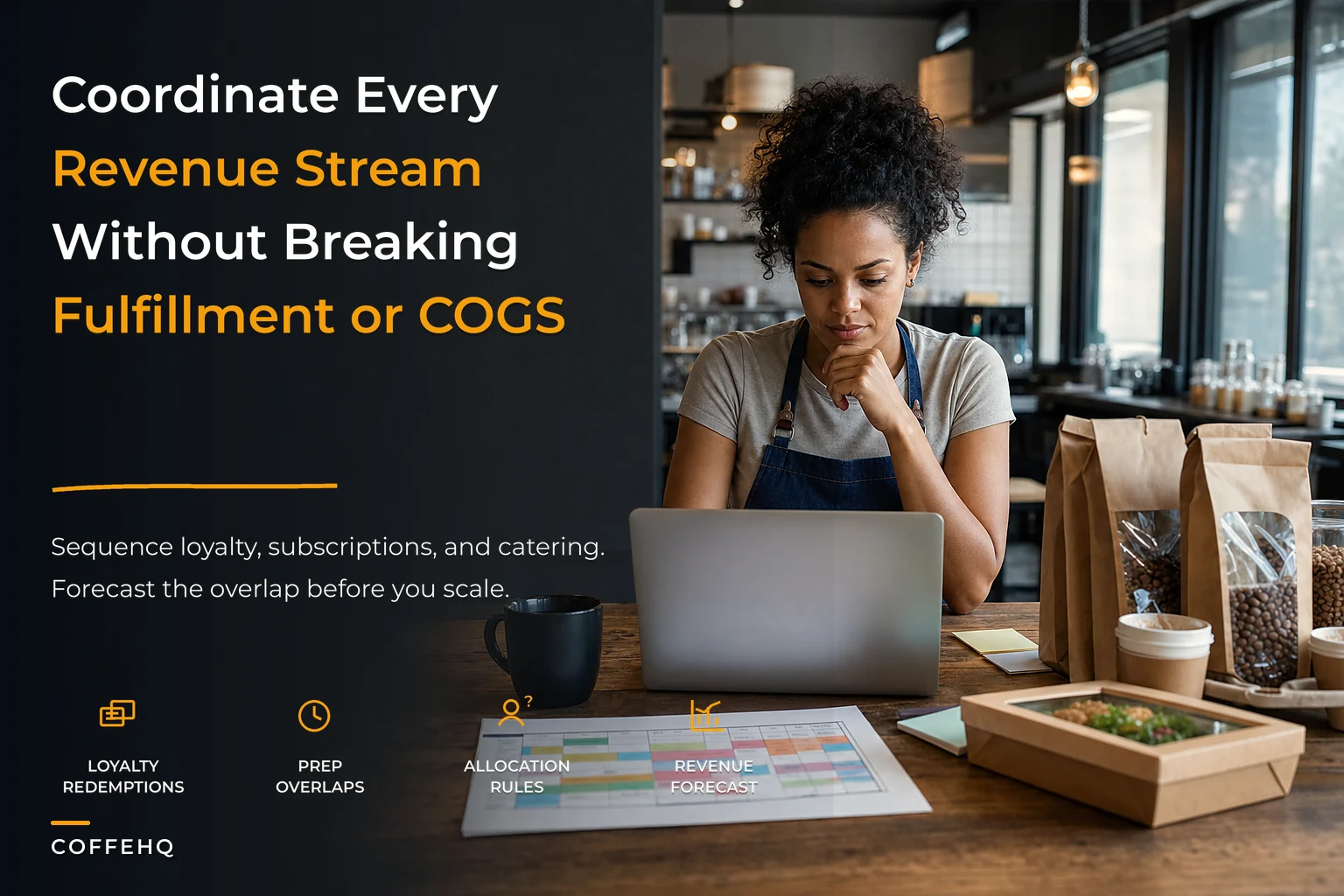
The single most useful forecasting habit for a multi-stream café isn't forecasting each stream — it's forecasting them on the same calendar so overlaps jump out.
-
Start with your baseline retail forecast — the daily and hourly demand you already track.
-
Overlay committed subscription redemptions as a floor — the drinks you know you owe, distributed across the days people actually redeem (which clusters on weekday mornings, not evenly).
-
Overlay confirmed catering orders on their fulfillment dates, with prep time landing the day before.
-
Overlay wholesale roast and bag obligations on your roast days.
-
Look for any day or hour where two or more streams peak at once. Those overlap cells are your risk days.
The insight most owners miss: the dangerous days aren't your busiest retail days. They're your average retail days that also carry a big catering order and a wholesale roast run. Retail alone looks manageable, so nobody staffs up — then all three streams hit and the operation drowns on a random Wednesday.
Here's a quick visual of that shared-calendar workflow.
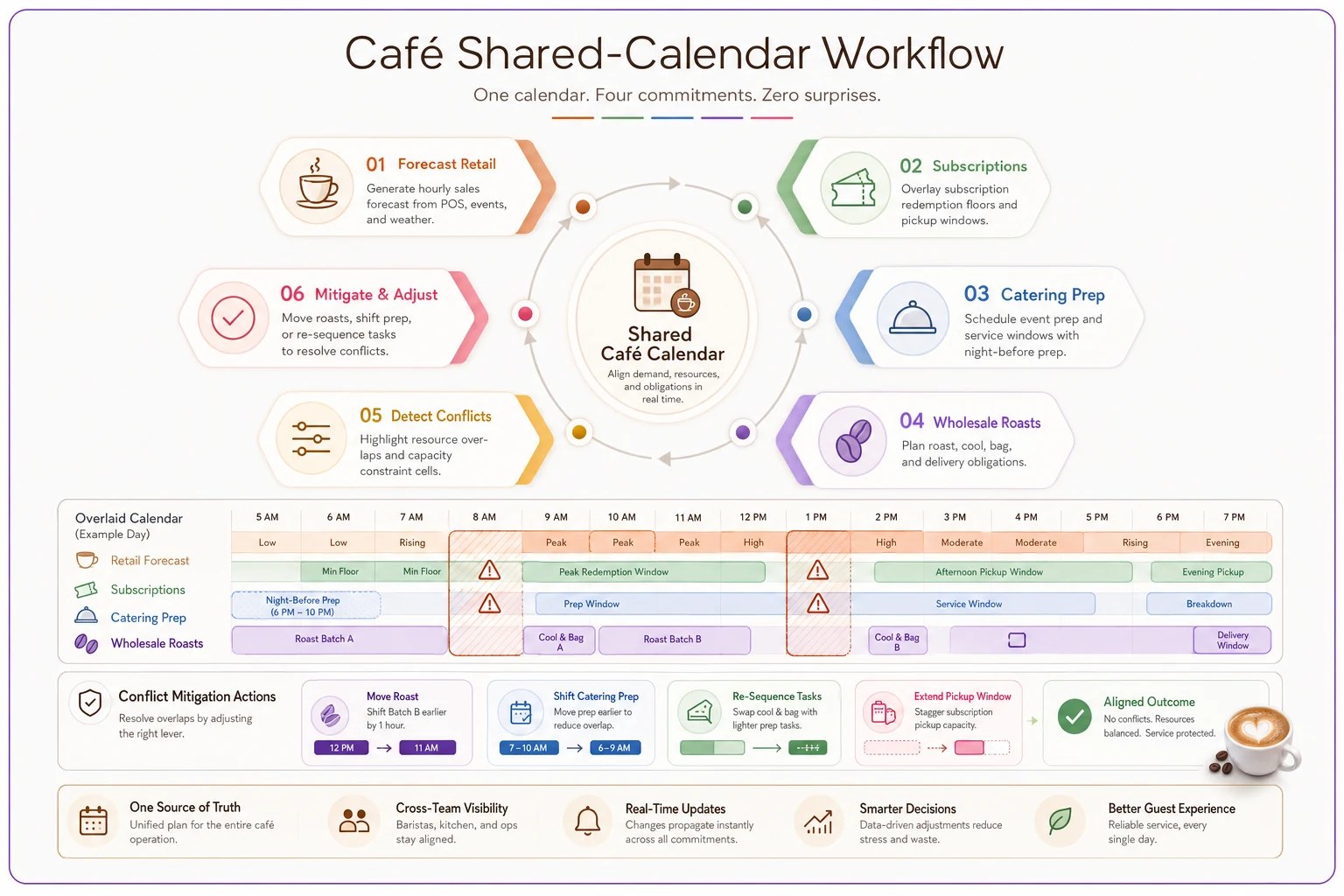
A typical overlap that bites cafés: a Friday with normal retail, a 200-item catering order for Saturday morning (so prep lands Friday afternoon), and a wholesale roast that has to go out Friday. Three separate commitments, all landing on one prep team. Each was reasonable when booked. Together they need capacity nobody planned for.
Once you can see overlaps on a shared calendar, the fixes are usually obvious — move the roast a day earlier, add a prep hour, or cap catering acceptance for dates already carrying load. The problem was never the math. It was that the streams were being forecast in separate documents that never touched.
Staging experiments: prove a stream before it earns permanent capacity
New streams should run as staged experiments, not permanent commitments, until they've earned their spot. Staging means a limited, reversible trial with clear metrics and a hard capacity cap — so a bad idea fails cheap instead of expensive.
A simple staging template that works for most new streams:
-
Cap the commitment. First subscription launch
cap enrollment at something like 40 members. First catering month: cap to two orders a week, weekdays only. Wholesale: one account before you sign three. Caps keep a failed experiment from becoming a fulfillment crisis.
-
Define the kill/scale metric before launch. Pick one or two numbers that decide continue-or-stop. For subscriptions: net margin per member after redemption and whether redemptions cluster at peak. For catering: prep-hour overrun rate and on-time fulfillment. Decide the threshold now, while you're calm.
-
Run for a fixed window. Four to six weeks. Long enough to see real redemption and demand patterns, short enough that you're not stuck with something that isn't working.
-
Isolate the stream's costs. Track inventory and labor for the new stream separately during the trial so you know its actual margin, not a blended guess. This is the step people skip, which is why they can't tell if the stream is profitable or just busy.
-
Have a rollback plan. Know exactly how you'd wind it down — pause enrollment, honor existing commitments, stop taking new orders. A stream you can't unwind isn't an experiment, it's a marriage.
The pattern worth noticing: experiments that fail usually fail on operational fit, not demand. People want the subscription. The catering orders come in. What breaks is fulfillment. So your staging metrics should weigh operational strain as heavily as revenue. A stream that's profitable but consistently blows your prep-hour ceiling isn't a win — it's a slow-building problem you're funding.
A real scenario: adding two streams without breaking the third
A single-location café doing roughly $34k–$38k a month in retail wanted to add both a subscription program and catering within the same quarter. Their instinct was to launch both at once for the marketing push.
Instead they staged it. Subscriptions went first, capped at 50 members, with a per-day redemption limit enforced at the POS. They tracked redemptions on the same hourly forecast used for retail and found the obvious: members were redeeming almost entirely between 7:30 and 9am — piling onto their worst window. Before scaling, they added a small perk for after-10am redemptions and shifted roughly a third of the volume off peak.
Catering came six weeks later, capped at two weekday orders a week with a 48-hour lead time and a dedicated inventory buffer separate from retail pars. The first month, one Friday hit the classic overlap — catering prep plus a normal retail day plus a small wholesale roast run. Because they were forecasting all three on one calendar, they'd caught it two days out and moved the roast to Thursday.
The result wasn't a dramatic revenue explosion. Subscriptions added a few thousand a month in largely predictable revenue, and catering added lumpier income on top. What actually mattered: retail throughput and margins held steady through both launches, because neither stream was allowed to quietly borrow from the operation already paying the bills. That stability — not the headline revenue — is the whole point of running lifecycle operations deliberately.
When this level of structure makes sense — and when it doesn't
This makes sense when you're already running one stream well and genuinely have demand for another, and your current operation has some slack to absorb an experiment. If retail is stable and predictable, layering is the natural next move.
This is a bad idea when your core operation is still shaky. If your morning rush already runs behind, your pars are guesses, and your loyalty tracking is manual, adding a subscription or catering stream just multiplies existing chaos. Fix the base first. New revenue on a broken operation doesn't scale profit — it scales the mess.
Who should probably not do this yet: brand-new cafés still finding their baseline demand, and any shop where the owner is the only person who knows how anything works. Multi-stream operations demand that rules live in systems and SOPs, not in one person's head — because the whole reason for allocation rules and shared forecasts is to make good decisions when the owner isn't standing there.
The through-line across all of it: a new revenue stream is never just revenue. It's a claim on inventory, hours, and equipment that something else was already using. Sequence the streams by operational risk, write down who wins when resources are tight, forecast them on one shared calendar so collisions surface early, and stage each one as a capped, reversible experiment. Do that, and loyalty, subscriptions, catering, and wholesale stop competing — and start compounding into revenue you can actually predict. And when you're ready to run a promotion on top of all this, the same discipline applies, which is why an inventory-aligned promo runbook belongs in the same toolkit.
Ready to brew operational excellence?
Join hundreds of coffee shops using Coffehq to boost efficiency, reduce waste, and elevate customer satisfaction.