
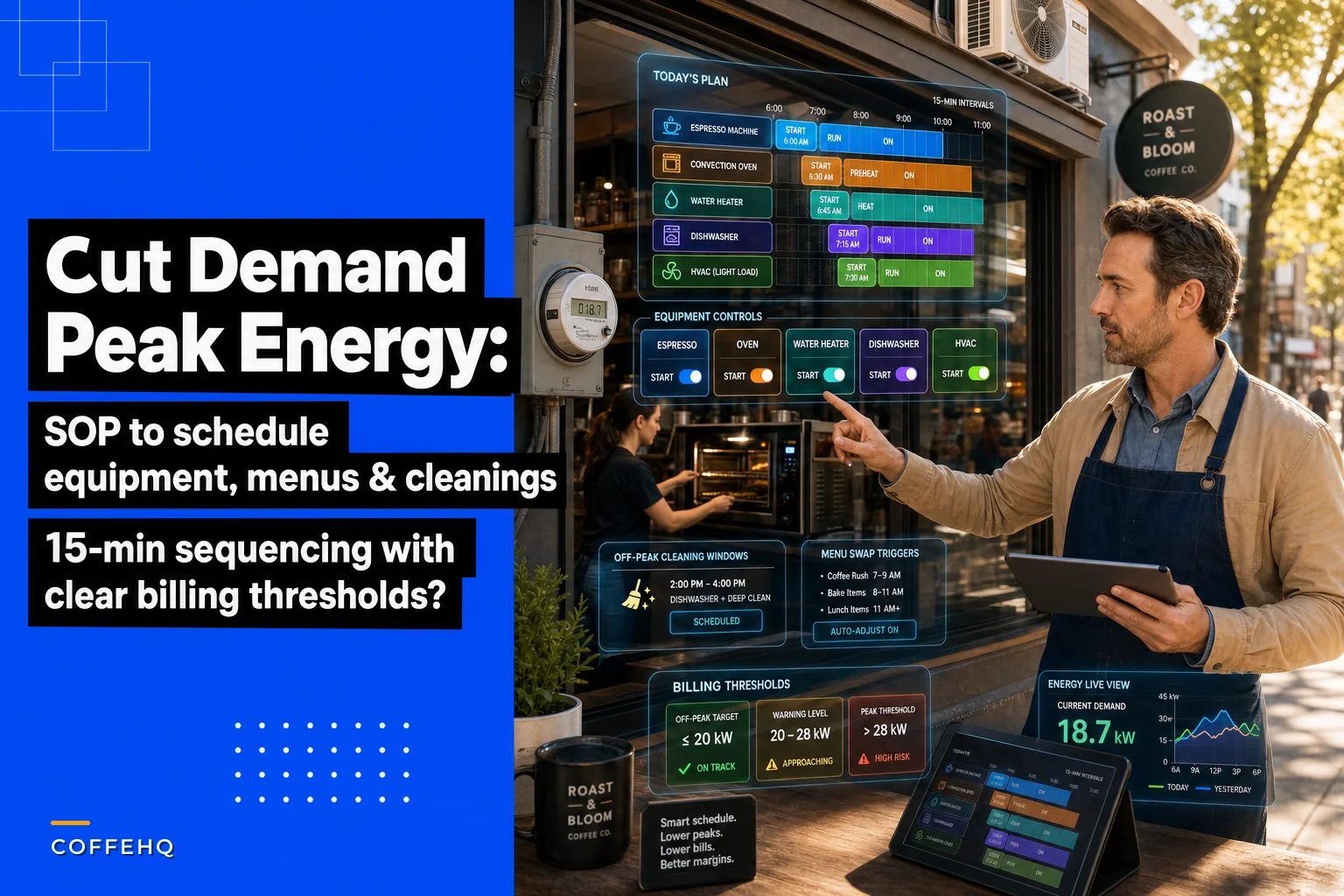

Most café owners stare at the kWh number on their utility bill and never notice the line quietly eating them alive: the demand charge. It's not about how much electricity you use over the month — it's about the single highest 15-minute spike you hit. One morning where your espresso machine, oven, dishwasher, and HVAC all ramp up together can set your rate for the entire billing cycle.
That's the frustrating part. You can cut total usage by 10% and still watch your bill stay flat, because demand charges are priced off peaks, not averages. On a lot of commercial rate plans, demand charges make up 30–50% of the total bill. For a café pulling roughly $900–$1,400 a month in electricity, that's $300–$600 tied directly to when your equipment fires up, not how long it runs.
So this isn't a "turn off the lights" article. This is about cafe peak energy management as a scheduling problem — the same way you'd schedule staff or roast batches. You control the timing of a handful of high-draw machines, and you flatten the spike that sets your rate.
First, understand what's actually creating your peak
Before you touch a schedule, you need to know which pieces of equipment stack on top of each other. Most café owners assume the espresso machine is the villain. It's usually not the single worst offender — it's the combination firing at the same minute.
Here's the rough draw profile for typical café equipment. Your exact numbers will vary, but the relationships hold:
| Equipment | Typical draw | Behavior | Peak risk |
|---|---|---|---|
| Espresso machine (dual boiler, 3-group) | 4–6 kW | Heavy at heat-up, cycles after | High at open |
| Convection/deck oven | 5–11 kW | Big pull when reaching temp | Very high |
| Dishwasher (high-temp sanitizing) | 6–8 kW | Spikes during heat cycle | High |
| HVAC / rooftop unit | 3–7 kW | Ramps hard on hot afternoons | High in summer |
| Refrigeration (combined) | 2–4 kW | Compressor cycles | Moderate, constant |
| Water heater | 4–5 kW | Recovery after heavy use | Moderate |
| Roaster (if on-site) | 8–15 kW | Sustained during batch | Very high |
Your demand peak is almost never one machine. It's the 7:45 a.m. window where the espresso machine is still recovering from pre-heat, the oven is bringing up the first pastry bake, and the dishwasher is clearing overnight dishes — all at once. That three-way overlap is what the meter remembers.
Why the overlap happens (and why nobody catches it)
In real operations, this usually happens because opening tasks are stacked by convenience, not by load. The opener walks in, flips everything on, and starts the oven and dishwasher because "might as well get it going." Nobody's thinking about electrical sequencing — they're thinking about getting ready before the first customer walks through the door.
Keep every order and shift perfectly aligned.
Coffehq helps you manage orders, inventory, and staff schedules seamlessly.
- Unified order processing
- Real-time inventory updates
- Staff shift coordination
No credit card required
The espresso machine is the sneaky one. A lot of shops leave it off overnight to "save energy," which feels responsible but actually hurts you. Cold-start heat-up pulls the machine's full load for 20–40 minutes, and if that window lands on top of oven heat-up, you've just built your monthly peak before you've sold a single cup.
On-site roasting makes everything worse. A roaster running an 8–15 kW sustained load during morning prep is basically a peak-setting machine. If you're roasting at the wrong time, nothing else you do matters much. The batch cadence side of this is worth understanding too — we covered it in small-batch roast scheduling for cafés, and the energy-timing layer sits right on top of it.
The core idea: stagger, don't shrink
You're not reducing what the equipment does. You're spacing out when it does it so the peaks never land on the same 15-minute interval the utility is measuring.
Think of it like a four-lane highway where everyone merges into one lane at the same moment. You don't need fewer cars — you need them arriving a few minutes apart.
Here's a concrete opening sequence that staggers load instead of stacking it:
-
5
30 a.m. — Espresso machine on first, alone.
Let it fully reach temp while nothing else is drawing heavy. Heat-up finishes before the oven starts. -
5
55 a.m. — Oven heat-up starts.
Espresso machine is now cycling at maintenance load, not full draw, so the oven's big pull isn't stacked on top of it. -
6
20 a.m. — First bake begins, oven settling into cycle.
Water heater recovery allowed here if needed. -
6
40 a.m. — Dishwasher first run.
By now the oven is holding temp, not ramping, so the dishwasher's heat spike lands in a gap. -
Hold the HVAC pre-cool for before 6 a.m. or after the morning rush, so it's not ramping hard during the 7:30–8:30 overlap window on hot days.
The whole trick is making sure no two "ramp-to-temp" events overlap. Steady-state draw is fine. It's the simultaneous ramps that build the spike.
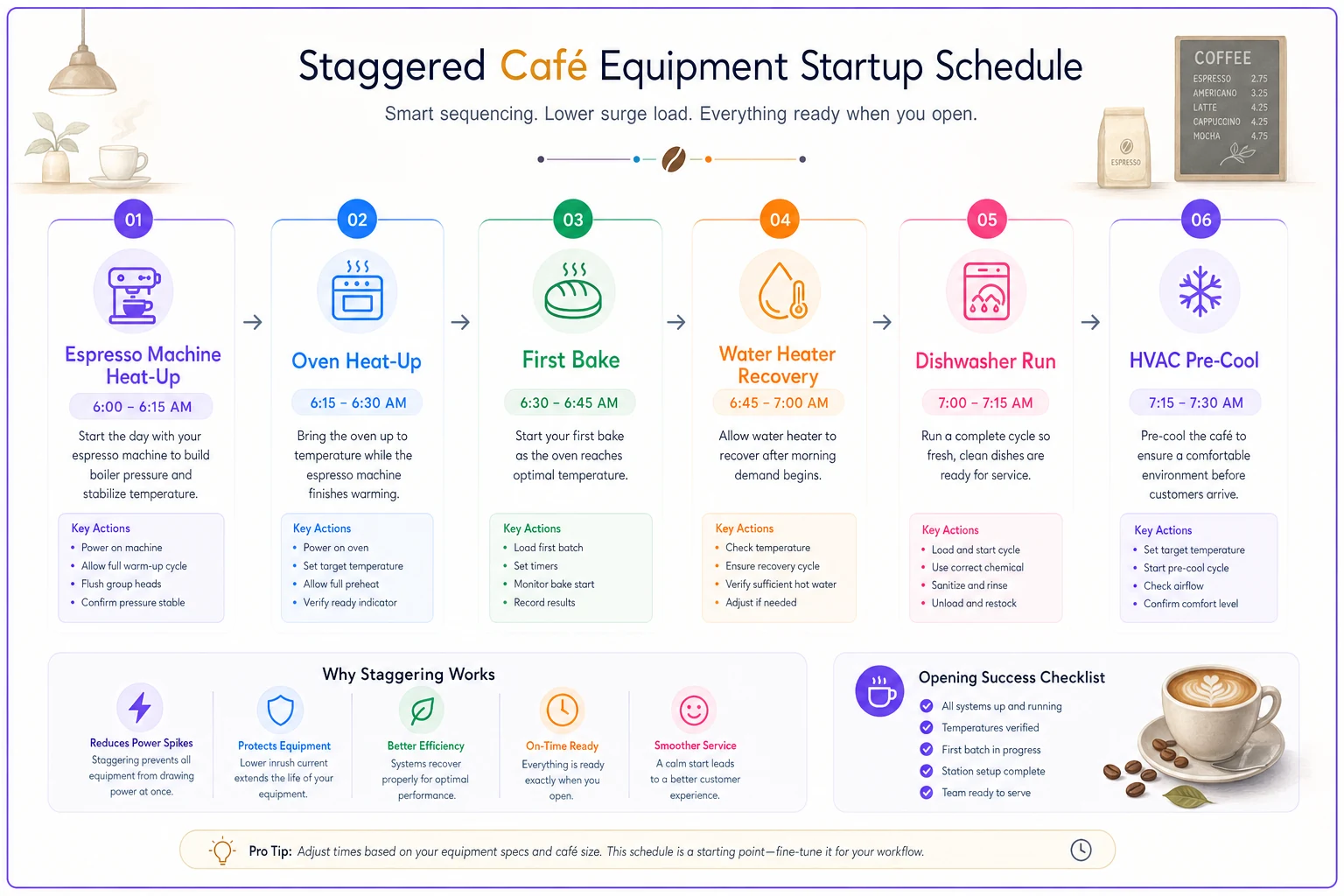
A simple timeline like this makes sequencing obvious to staff.
Off-peak windows for the energy-hungry tasks
Some tasks have no business running during peak rate hours at all. Roasting, deep-clean dishwasher cycles, batch cold brew, water heater recovery after cleaning — these are flexible. They don't need to happen at 2 p.m. just because that's when someone remembered them.
Most commercial time-of-use plans split the day into something like this (check your actual tariff — it varies by utility and season):
-
Off-peak before ~9 a.m. and after ~9 p.m., all weekend
-
Mid-peak roughly 9 a.m.–2 p.m. and 7–9 p.m.
-
On-peak roughly 2 p.m.–7 p.m. weekdays (summer especially)
A deep-clean and roast window checklist that respects off-peak hours:
-
Roast batches scheduled before 9 a.m. or on weekend mornings, never in the 2–7 p.m. block
-
Dishwasher deep-sanitize cycle run at close (after 9 p.m.) or early open, not mid-afternoon
-
Cold brew batching done during morning off-peak
-
Water heater recovery after heavy cleaning timed for post-close
-
Oven deep-clean (self-clean cycles pull serious load) scheduled for a closed day or late evening
-
Any equipment pre-heat for catering or events staggered 20+ minutes apart
That afternoon on-peak block is where you get hit twice: higher per-kWh rates and the demand charge window. So the rule becomes simple — move anything flexible out of the 2–7 p.m. window.
Where menu availability comes in
This is the part most energy guides miss. Your menu is an energy schedule. Every hot-food item that requires the oven, panini press, or steam is a demand-charge trigger disguised as a product.
If your hot breakfast sandwich menu drives heavy oven use right during the morning overlap window, you've got a menu problem feeding an energy problem. The fix isn't cutting the item — it's shifting how and when it's produced.
A typical example: a café batch-bakes its egg bites and warm items during the 5:55–6:40 oven window (when the oven is already up to temp for pastries), holds them, and serves from the hot well through the rush. Instead of firing the oven on demand throughout the 7:30–8:30 peak — which creates repeated ramp spikes — the oven does its heavy work once, early, in a staggered slot, and coasts through service.
The decision threshold worth using:
-
If a hot item requires the oven or press to re-ramp more than 3 times during your peak demand window, batch it during off-peak and hold instead.
-
If a menu item only sells a handful of units during peak hours but forces a high-draw machine to stay hot, consider making it a "morning only, baked ahead" item or dropping it from the peak-hour menu entirely.
This is where menu swaps become an energy lever. On a brutal summer afternoon when HVAC is already maxing your demand, that's exactly when you don't want build-your-own hot paninis driving the press. A menu that leans toward cold drinks, pre-made items, and no-cook options during the 2–7 p.m. on-peak block protects your demand charge on the worst-rate days.
Billing triggers: tie the schedule to the actual rate calendar
None of these SOPs matter if the opener doesn't know which day is which. Peak rate periods change by season — summer on-peak is usually harsher and longer than winter — and demand charges often reset monthly.
What works in practice is linking your prep and cleaning schedule to the billing calendar, not just the clock:
-
Summer season (typically June–Sept) tightest menu restrictions during 2–7 p.m., HVAC pre-cool before 6 a.m., absolutely no roasting or deep cleans in the afternoon.
-
Winter / shoulder season more flexibility, but keep the opening stagger because morning is still your demand peak.
-
The first week of a new billing cycle this is when a single careless peak sets your whole month. Be strictest here — one 8 a.m. everything-on mistake in week one costs you for 30 days.
That last point catches people off guard. There's no benefit to behaving well for 29 days if day 1 spiked the meter. The demand charge remembers your worst moment, not your average behavior.
A real scenario
A single-location café with on-site roasting was running roughly $1,250–$1,350 a month in electricity, with the demand charge portion sitting around $480. Their roaster was being run mid-afternoon — usually around 3 p.m., squarely in on-peak — because that's when the roaster had a lull between rushes.
Two changes: they moved roasting to a 6:30–8:30 a.m. off-peak slot before the café got busy, and they staggered the opening sequence so the espresso machine finished heat-up before the oven started. They also batch-baked their warm breakfast items in the early oven window instead of firing on demand.
Over the next two billing cycles, the demand charge dropped to around $310–$340. That's roughly $140–$160 a month, somewhere in the range of $1,700–$1,900 a year, without buying a single piece of new equipment or changing a recipe. The coffee tasted the same. The only thing that changed was when machines ran.
When this makes sense — and when it doesn't
This is worth doing if:
-
Your utility plan has a demand charge (look for "kW demand" or "max demand" on your bill — not kWh)
-
You run high-draw equipment, especially a roaster or high-temp dishwasher
-
Your opening routine currently flips everything on at once
-
You're on a time-of-use rate with a pricey afternoon block
This isn't worth much if:
-
You're on a flat per-kWh rate with no demand component (some small accounts are) — in that case, total usage reduction matters more than timing
-
Your space is tiny with minimal equipment and your bill is already under a few hundred dollars
-
Your lease includes electricity in a flat CAM charge and you don't see a metered bill at all
Who should hold off: if your equipment is aging and unpredictable, fix reliability first. Staggering start times assumes your machines reliably hold temp between ramps. If your oven can't maintain temperature or your espresso machine trips breakers, you've got a maintenance issue to handle before a scheduling one — that's a different playbook, covered in the preventive-maintenance and downtime recovery guide.
Making the schedule actually hold
The hardest part isn't designing the stagger — it's getting it to survive staff turnover and busy mornings. Openers forget. New hires don't know the sequence. On a slammed Saturday, someone flips everything on to save time and blows the whole month's demand charge in one go.
What keeps it stable is turning the sequence into a timed opening checklist tied to the clock, posted where the opener actually stands, with the reason attached so people understand it's not arbitrary. "Oven on at 5:55, not before — it keeps our power bill down" lands better than a naked instruction nobody respects.
Post the timed opening checklist at the station where openers stand and include the short reason line so it's read and followed.
Some café operators build this into their broader scheduling and task systems so the right prompts surface at the right time — equipment start reminders, seasonal menu switches when on-peak season kicks in, a flag when a flexible task is about to run during the pricey window. The tooling matters less than the fact that the decision gets made once, correctly, and then runs consistently instead of depending on whoever opened that morning remembering an energy rule at 5:30 a.m.
If you want to see where the energy line connects to everything else on the P&L, it fits naturally into a full operational model — we mapped how individual levers like this roll up to profit in linking every operational lever to P&L.
The takeaway
Demand charges reward timing, not restraint. You can keep every machine, every menu item, and every ounce of quality exactly as it is, and still cut a meaningful chunk off your bill just by refusing to let high-draw equipment ramp up at the same moment. Pull your bill, find the demand line, map which machines overlap in your morning window, and stagger them. Then protect your afternoon on-peak block with a cooler, bake-ahead menu on the hottest days. It's unglamorous scheduling work — but it's some of the cleanest money a café can find without raising a single price.
Ready to brew operational excellence?
Join hundreds of coffee shops using Coffehq to boost efficiency, reduce waste, and elevate customer satisfaction.