


Retention in a tiny cafe rarely dies from one dramatic event. It bleeds out quietly. A solid barista who's been with you 14 months starts picking up fewer shifts. Then they're "just filling in until they figure things out." Then they hand you two weeks' notice on a Tuesday, and you realize you never had a single conversation that would have caught it.
What owners get wrong is treating retention like a mood — something you fix by being nicer, buying pizza, or bumping wages when someone threatens to leave. That works for a while, then it stops. What actually holds a small team together is a coffee shop retention system: a set of small, repeatable loops that make people feel like they're getting somewhere, without needing a benefits department or performance-review software.
Tiny teams actually have an advantage here that most corporate HR departments would trade a lot for — you can see everything. You know who's fast on bar, who's carrying the morning rush, who's quietly training the new hire without being asked. The problem is you're not doing anything structured with that visibility. That's what this is about.
Why retention breaks in cafes specifically
Coffee shops have a brutal combination of factors working against them. The pay band is narrow, the work is physical, the customer interactions are relentless, and most of your staff are at a stage of life where they're actively deciding whether this is a job or a career. Add in the fact that a competing cafe two blocks away can offer fifty cents more an hour, and you've got a workforce that's always half-considering the exits.
The pattern that keeps showing up in small cafes: owners invest heavily in the first 90 days — training, coaching, attention — and then go silent. Onboarding is intense, and then nothing. Once someone can run a shift solo, they fall off the radar. No more milestones, no more growth, no more reason to feel like tomorrow is different from today.
That flatline is the killer. A barista who's been fully competent for six months and sees no path forward isn't unhappy exactly. They're just bored and available. When something shinier comes along, there's no friction holding them in place. The retention system's whole job is to manufacture that friction — good friction, the kind that comes from momentum and belonging rather than guilt.
The other structural issue is that small cafes conflate "senior" with "has been here a long time." Tenure isn't the same as competency, and when the only way to move up is to wait for someone to quit, your best people leave before a spot opens. You need a ladder that rewards skill and contribution, not just survival.
The three loops that actually hold a team together
Forget the corporate machinery. For a team of three to eight people, retention runs on three low-overhead loops that reinforce each other.
Keep every order and shift perfectly aligned.
Coffehq helps you manage orders, inventory, and staff schedules seamlessly.
- Unified order processing
- Real-time inventory updates
- Staff shift coordination
No credit card required
Loop one: the competency ladder. A visible map of skills that turns "getting better at coffee" from a vague feeling into concrete, achievable rungs. This gives people a sense of progress even when a title change or raise isn't available yet.
Loop two: micro-promotions. Small, real recognitions of increased responsibility that don't require creating a whole new management position. A "lead" designation for a specific area, a small pay bump, a title that means something on the floor.
Loop three: the manager 1:1. A short, regular conversation — 15 to 20 minutes, biweekly — that catches problems while they're still small and keeps you connected to how people actually feel. This is the loop that feeds the other two, because it's where you notice who's ready to climb and who's about to walk.
None of these individually is revolutionary. What makes them a system is how they connect. The 1:1 surfaces who's ready. The ladder gives them somewhere to go. The micro-promotion marks the milestone. Then the 1:1 resets and the cycle continues. Break any one loop and the whole thing sags.
The basic flow looks like this:
-
1. 1
1 check-in surfaces readiness
— you notice the barista has been dialing in espresso without being asked and mentions wanting more responsibility -
2. Ladder review confirms progress — you verify the observable competencies for the next rung are consistently there
-
3. Micro-promotion formalizes the step — you name the role, communicate it to the team, adjust pay or perks accordingly
-
4. Next 1
1 resets the cycle
— you acknowledge the milestone, ask what they want to work on next, and the loop starts again
Here's a quick way to picture the cycle in operation.
This diagram shows how the three loops feed each other and keep momentum on small teams.
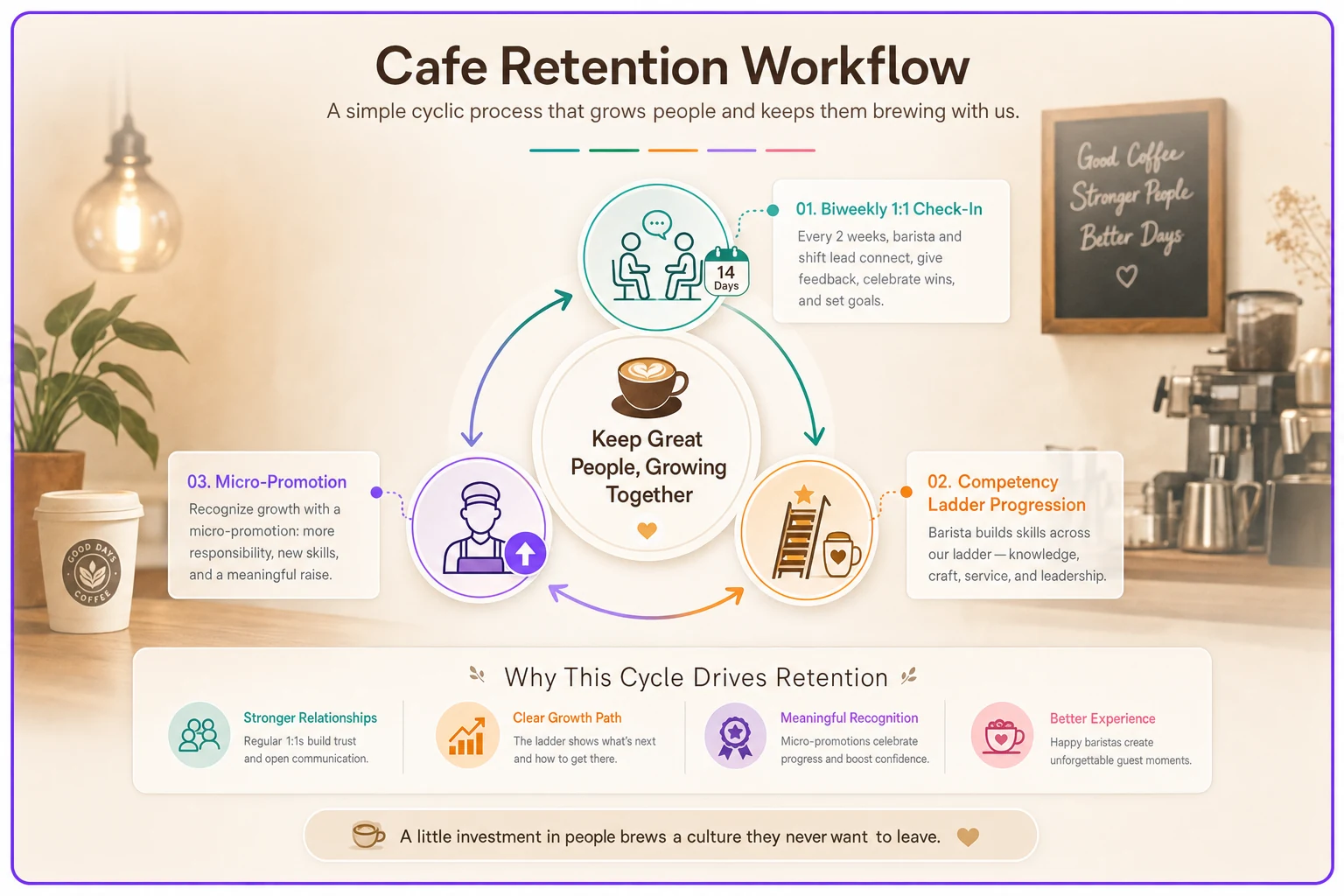
Break any one arrow in the cycle and the system loses momentum.
Building the competency ladder
The ladder is where most owners overthink it. You don't need twelve levels and a scoring rubric. You need three or four clear tiers, each with observable skills that anyone can verify by watching someone work a shift.
A workable structure for a small cafe looks like this:
| Tier | What it means | Example competencies | Rough pay signal |
|---|---|---|---|
| Barista I | Fully solo-capable on a standard shift | Dials in espresso, handles the register, follows open/close, calls out drinks cleanly | Starting rate |
| Barista II | Handles rush + quality ownership | Runs peak bar without falling behind, latte art consistency, spots dialing drift, trains during quiet periods | +$1.00–$1.50/hr |
| Shift Lead | Owns a shift end-to-end | Cash handling, opening/closing accountability, resolves customer issues, manages the flow of two other people | +$2.00–$3.00/hr |
| Trainer / Key | Develops other people, holds standards | Onboards new hires, maintains SOPs, covers manager gaps | +$3.00+ or salaried consideration |
The magic isn't in the exact tiers — it's in the fact that each competency is observable. "Runs peak bar without falling behind" isn't a feeling. Either the tickets stayed under control during the 8am rush or they didn't. This is what keeps the ladder from becoming a popularity contest.
The competency approach connects directly to how you onboard people in the first place. If you're already using something like 30/60/90 micro-certifications for new baristas, the ladder is just the natural continuation — the certifications don't stop at day 90, they roll into the next rung. A new hire should be able to see the whole staircase in their first week, not just the first step.
One mistake to avoid: don't gate every rung behind a pay raise. If Barista II requires a dollar bump and your margins are tight, you'll freeze the ladder to protect labor cost and the whole system stalls. Some rungs should be recognition and responsibility first, with the money following on a predictable schedule. A "certified trainer" badge, first pick of shifts, or being the go-to for a specific station carries real weight even before the raise lands.
Micro-promotions: recognition without a management bureaucracy
A micro-promotion is any small, real step up in status or responsibility that you can grant without restructuring the business. The point is frequency and visibility — you want people crossing meaningful lines several times a year, not waiting eighteen months for a big announcement.
Examples that work in a cafe:
-
Station ownership. "You're our espresso lead now — you own dialing in every morning and flagging when the grinder drifts." Costs nothing, means everything to the right person.
-
Named responsibility. Ordering for a single category (pastries, or milk), owning the weekend playlist, managing the tip-out math.
-
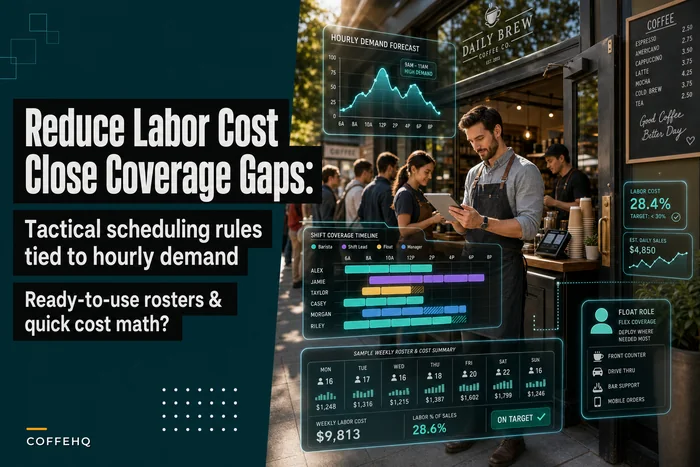
First-look scheduling. Higher-tier staff get to submit availability and preferences before the schedule opens up. This ties directly into how you build your rosters — if you're already running tactical scheduling rules to close coverage gaps, scheduling priority becomes a tangible perk you can actually hand out.
-
Training authority. The moment someone is trusted to onboard a new hire, they've crossed a line that changes how they see themselves at the job.
The operational insight most owners miss: micro-promotions only work if they're earned and visible. If you hand out "espresso lead" to everyone to make them feel good, it means nothing within a month. The value comes from the fact that not everyone has it, and that people watched someone earn it. Scarcity is what gives recognition weight.
There's also a timing pattern worth respecting. The best moment to grant a micro-promotion is right when you notice someone has already been doing the thing informally. The barista who's been quietly dialing in espresso every morning without being asked — formalizing that isn't giving them new work, it's naming work they've already claimed. That feels like being seen, which is probably the most retention-positive thing you can create on a small team.
The 1:1 template that makes the whole thing run
If you only implement one thing from this article, make it the biweekly 1:1. It's the cheapest early-warning system you'll ever install, and it's the loop that feeds everything else.
The mistake owners make is either skipping these entirely ("we talk all day, we don't need a meeting") or turning them into performance interrogations. Neither works. Talking all day isn't the same as a focused conversation, and interrogations make people defensive. The sweet spot is a short, predictable, low-pressure check-in with a consistent shape.
Here's a template that runs in about 15 minutes:
-
1. Wins since last time. "What went well the last two weeks?" — start positive, let them talk first.
-
2. Friction. "What's been annoying or getting in your way?" — this is where you catch the small stuff before it grows.
-
3. One skill. "What's one thing you want to get better at?" — connects them to the ladder without you forcing it.
-
4. Your input. One specific piece of positive feedback, one specific coaching point. No more than that.
-
5. Forward look. "Anything coming up — schedule, life stuff, goals — I should know about?" — this is where you hear about the second job interview before the resignation.
Keep notes. Not a formal file — just a running doc per person with the date, what they said they wanted to work on, and what you committed to.
Keep notes. Not a formal file — just a running doc per person with the date, what they said they wanted to work on, and what you committed to. Nothing kills trust faster than a manager who "listens" and then forgets everything. If someone said they wanted more latte art practice three weeks ago and you followed up with fifteen minutes of actual coaching, you've done more for retention than a pay raise would have.
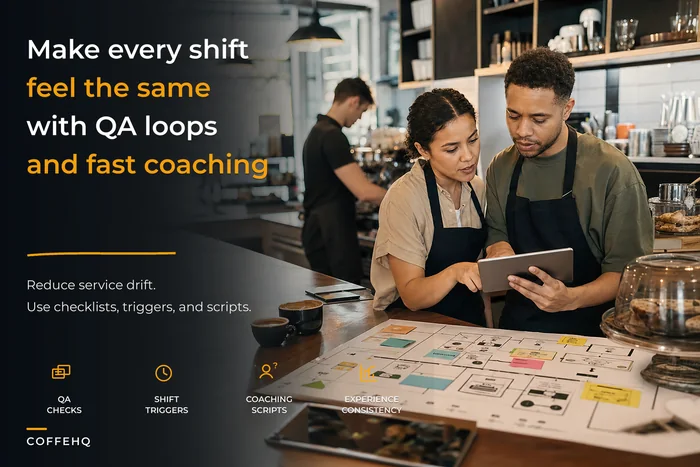
These conversations also feed directly into consistency on the floor. The QA and coaching habits from making every shift feel the same give you the observations that make 1:1s concrete — you're not saying "be better," you're saying "your morning tickets were tight all week, that's exactly Barista II territory."
A real scenario: turning a revolving door into a stable crew
Consider a two-location cafe with a combined staff of around nine. The owner was replacing roughly three to four baristas a year — not catastrophic, but each departure meant weeks of retraining, more owner hours on the floor, and a noticeable dip in drink consistency while the new person got up to speed. Rough cost per turnover, counting hiring time and the productivity dip, landed somewhere around $2,500–$3,500 each.
The fix wasn't fancy. They wrote a four-rung ladder on a single laminated page and posted it in the back. They started biweekly 15-minute 1:1s — the owner did the leads, the leads did the newer staff. And they created three micro-promotions: espresso lead, pastry ordering, and certified trainer.
Within about eight months, turnover dropped to one departure — and that person moved out of state. Two baristas who'd been quietly checked-out re-engaged once they had a visible path; one of them became the trainer at the second location. The owner's own floor hours dropped because shift leads were genuinely owning their shifts instead of deferring every decision upward.
The interesting part wasn't the money saved, though that was real — somewhere around $8k–$10k annually in avoided turnover costs. It was that the crew started acting like a crew. People covered for each other more, trained each other without being asked, and the constant low-grade anxiety of "who's about to quit" mostly went away.
Where the coordination usually breaks
As a team grows past five or six, the informal version of all this stops working. This is the transition point where owners get caught off guard.
When you're four people, you carry all of it in your head. You know who's ready for a micro-promotion because you were standing right there. You do "1:1s" by talking during the slow hour. The competency ladder lives in your gut.
Somewhere between six and ten people — especially across two locations — that mental model collapses. You're not on every shift anymore. The shift lead at the second location is noticing things you never see. Someone got promised a raise three months ago and it fell through a crack because you were juggling a broken espresso machine that week. The 1:1s slip because there's no system reminding you they're due, and within two months you're back to flying blind.
This is where a lightweight operational platform earns its place — not as HR software, but as the shared memory the team is outgrowing. Somewhere to log competency sign-offs so a shift lead can mark that a new hire cleared their peak-bar milestone, a simple recurring reminder so 1:1s don't quietly disappear, and a record of who's on which rung so promotion promises don't evaporate. The point isn't automation for its own sake — it's that the visibility you had naturally at four people has to become a system at nine, or the retention loops break at exactly the moment your business is most fragile.
When this system is worth it — and when it isn't
When it makes sense:
-
You have at least three or four staff you want to keep, and turnover is genuinely costing you money and quality.
-
You're on the floor less than you used to be, and things are starting to slip through cracks.
-
You have people who are competent but plateaued, and you can feel them drifting.
When it's overkill:
-
You're a solo operator or you-plus-one. Just talk to each other. Don't build a ladder for a team of two.
-
Your turnover is entirely seasonal students who were always leaving in September regardless of what you do. Optimize your onboarding speed instead of your retention loops.
Who should not do this yet: if your core problem is that the pay is genuinely below market for your area, no competency ladder will paper over that. Fix the wage floor first. Retention systems multiply the effect of fair pay — they don't substitute for it. A beautiful ladder attached to poverty wages just gives people a clearer view of how little they're being offered.
Making it stick
The reason most retention efforts fail isn't the design — it's the follow-through. You'll build the ladder, run 1:1s enthusiastically for three weeks, then a busy stretch hits and the whole thing evaporates. Six weeks later nobody remembers it existed, and you've actually damaged trust because you signaled you cared and then stopped.
Protect against that by making the loops small enough to survive a bad week. A 15-minute biweekly conversation survives busy season. A monthly two-hour review process does not. Whatever you build, build it at a size you can maintain on your worst month, not your best one.
Retention in a tiny team ultimately comes down to momentum — the steady sense that being here means growing, being noticed, moving somewhere. You don't manufacture that with grand gestures. You manufacture it with small loops that never stop turning: notice, name, reward, reset. Get those turning and keep them turning, and the good people you've spent months training will have a reason to stay that a fifty-cent raise down the street can't touch.
Ready to brew operational excellence?
Join hundreds of coffee shops using Coffehq to boost efficiency, reduce waste, and elevate customer satisfaction.