

The coffee shop customer experience map most owners think they have doesn't actually exist. There's a barista training manual, maybe some service standards posted in the back, and definitely strong opinions about how drinks should taste. But when your regulars start timing their visits around specific shifts because "the morning crew just gets it right," you're watching operational variability eat into your brand.
I spent three months documenting service variation across multiple cafes, tracking the same customers ordering the same drinks from different crews. The variance was rough. Not in drink quality — most cafes nail that part — but in everything around the actual coffee. How orders get acknowledged. Where customers wait. Whether anyone mentions the seasonal menu. How mobile orders flow through the counter. The tiny friction points that add up to someone deciding your cafe is their place versus just another caffeine stop.
The hidden cost of shift personality
Every shift manager develops their own system. Sarah runs a tight ship with clear zones and minimal chatter. Marcus prioritizes speed and keeps the line moving. Jennifer focuses on regulars and remembers everyone's modifications. None of these are wrong — they're adaptations to real pressure. But each creates a fundamentally different experience for whoever walks in.
Track any operational metric across shifts and you'll see it: average ticket varies by over a dollar, drink remakes cluster on certain days, loyalty sign-ups spike with specific crews, and Google reviews mysteriously mention "the afternoon team" by name. Your business isn't one cafe — it's four or five different cafes operating in the same location.
The problem compounds when you try to diagnose issues. A customer complains about slow service, but when was their visit? Which crew? Was it during a shift change? Without a consistent baseline, you're troubleshooting ghosts. Meanwhile, your best baristas burn out adapting to each manager's unofficial playbook while trying to maintain standards nobody's actually enforcing.
Why standard operating procedures fail in cafes
Traditional SOPs assume a manufacturing mindset: document the process, train the team, enforce compliance. This breaks down fast in a cafe environment where every hour brings different challenges. Your 7am rush needs different choreography than your 2pm lull. Weekend crowds behave differently than weekday regulars. A rigid SOP either slows you down during peak or leaves gaps during quiet periods.
Keep every order and shift perfectly aligned.
Coffehq helps you manage orders, inventory, and staff schedules seamlessly.
- Unified order processing
- Real-time inventory updates
- Staff shift coordination
No credit card required
Most owners respond by creating more documentation. Longer training manuals. More detailed station guides. Elaborate closing checklists. This just pushes the problem underground. Experienced baristas develop workarounds. New hires get overwhelmed and default to survival mode. Managers enforce what they personally care about while ignoring the rest.
Running a cafe requires constant micro-adjustments. The espresso machine starts pulling shots two seconds slower. The pastry delivery arrives during morning rush instead of before opening. A regular orders something weird that backs up the whole flow. These aren't exceptions — they're the business. Your system needs to work with this variability, not fight it.
Building a dynamic coffee shop customer experience map
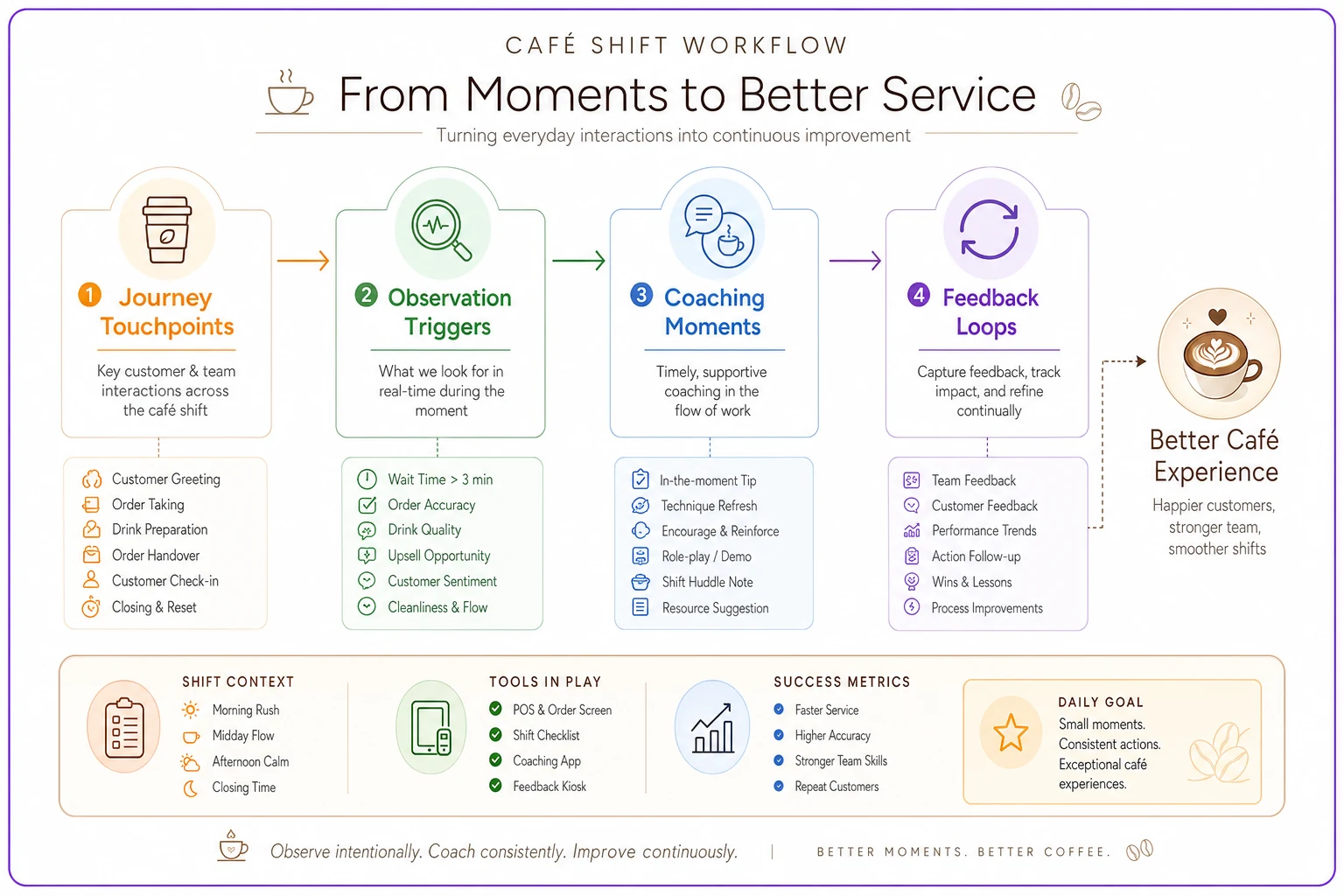
Instead of a static document, think of your customer experience map as a living framework with three core components: journey touchpoints, observation triggers, and coaching moments. Each element connects to create a self-correcting system that maintains consistency without rigidity.
Start with journey touchpoints — but make them shift-agnostic. Don't document what should happen at 8am versus 3pm. Document what should happen when a customer enters, when they're waiting to order, when they're at the register, when they're waiting for their drink, and when they leave. Each touchpoint gets one non-negotiable standard and multiple acceptable variations.
This diagram helps teams visualize how touchpoints, triggers, and coaching moments connect in a continuous feedback loop.
The "customer enters" touchpoint, for example, might have a standard of "acknowledged within 10 seconds" with acceptable variations including eye contact from the bar, a verbal greeting from register, or a hand signal from anywhere if you're slammed. The standard stays consistent, the execution adapts.
The 15-minute handoff that changes everything
Shift changes are where experience consistency goes to die. The morning crew leaves notes about a broken steam wand. The afternoon crew discovers it mid-rush. Information about difficult customers, special events, or menu changes evaporates between crews. Each shift essentially starts cold.
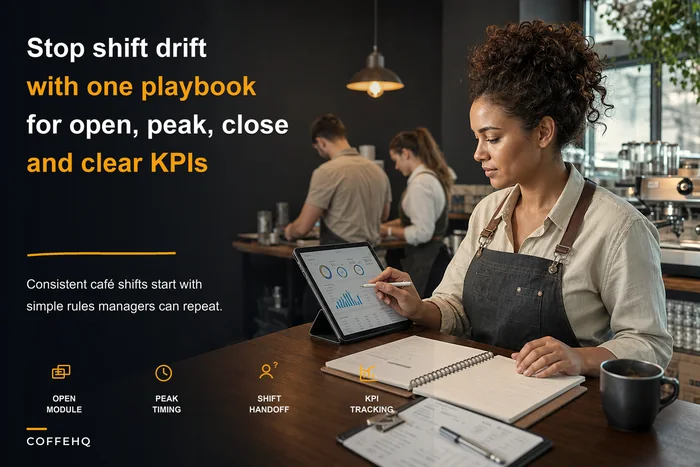
Replace your current handoff with a structured 15-minute transition built around three things: a visual walkthrough, a KPI snapshot, and a briefing on active issues. This isn't a meeting — it's an operational transfer that happens while service continues.
-
a visual walkthrough
-
a KPI snapshot
-
a briefing on active issues
The visual walkthrough takes five minutes. Outgoing shift lead walks incoming lead through each station, physically pointing out anything non-standard. Low oat milk. Wonky grinder. Slippery spot near the ice machine. This catches the stuff that never makes it into logs.
The KPI snapshot takes three minutes. Not a full report — just four numbers written on a handoff card: current hourly rate, drinks remade today, average ticket so far, and one wild card metric you're tracking this week (loyalty sign-ups, pastry attachment rate, time to first acknowledgment — whatever's relevant). These numbers create context for the incoming shift.
| current hourly rate | drinks remade today | average ticket so far | one wild card metric you're tracking this week |
|---|---|---|---|
| current hourly rate | drinks remade today | average ticket so far | examples: loyalty sign-ups, pastry attachment rate, time to first acknowledgment |
The remaining seven minutes cover what's happening right now. Not what went sideways six hours ago. The regular who's been waiting on a special order. The new hire struggling with milk steaming. The POS glitch that requires a specific workaround. Information that actually impacts the next four hours.
QA observation checklists that actually work
Traditional quality assurance in cafes means secret shoppers twice a year and managers occasionally watching the floor. This catches major failures but misses the slow drift that erodes customer experience over time.
Create station-specific observation cards that take 90 seconds to complete. Not comprehensive audits — targeted checks anyone can run mid-shift. The espresso bar card might cover: shots timing within range? Portafilters cleaned between uses? Steam wand purged and wiped? Workspace clear of unnecessary items? Each question is binary — yes or no — and tied to customer-visible quality.
The key is embedding these observations into natural workflow, not adding a separate task. Every time a manager grabs ice, they run the front counter card. Every bathroom check includes a customer seating area scan. Every break includes one station observation. That's 8-10 quality touches per shift without any dedicated QA time carved out.
Run a station observation whenever you perform a linked task (ice grab, bathroom check, break) to make QA part of normal flow.
But observation without action is theater. Each "no" on an observation card triggers an immediate coaching moment — not later, not at the end of the shift, but within the next 15 minutes. This could be a quick demonstration, a reminder, or a station adjustment. The lag between observation and correction is what determines whether standards stick or quietly degrade.
KPI triggers that drive immediate action
Numbers without context are just decoration. Your POS probably tracks dozens of metrics, but how many actually change what someone does during a shift? The most sophisticated cafe shift playbooks fail because they track everything but trigger nothing.
Pick three KPIs that directly reflect customer experience and can be influenced within a single shift. Average transaction time, remake percentage, and drinks per labor hour are solid starting points. But the magic isn't tracking them — it's setting specific trigger points that demand an immediate response.
When transaction time exceeds 4 minutes, the shift lead evaluates and adjusts stations within 10 minutes. That might mean pulling someone from cleaning to support, opening a second register, or simplifying the featured drink. The trigger forces real-time optimization instead of end-of-day analysis.
When remake percentage hits 3% in any hour, production pauses for a 30-second calibration. Everyone tastes their last drink. Grind settings get checked. Milk temps verified. A brief pause costs less than continuing to make bad drinks for another hour.
When drinks per labor hour drops below threshold (varies by daypart), the shift lead runs a quick flow check. Are handoffs clean? Is someone doing unnecessary tasks? Is the station layout creating bottlenecks? The metric becomes a prompt for inspection, not just a number to report later.
Five-minute coaching scripts managers can actually use
The gap between knowing standards and maintaining them isn't training — it's real-time correction. Most cafe managers aren't natural coaches. They're experienced baristas promoted for technical skill, not their ability to develop people. They need coaching that's brief, specific, and doesn't grind service to a halt.
Build a library of five-minute coaching interventions tied to specific observation failures. Not lectures or retraining — targeted adjustments that can happen during service. Each follows the same format: observe the specific issue, demonstrate the correct approach, have them practice once, confirm understanding.
For milk texture: "Let me show you something about steam wand position. Watch where I hold it — just below surface until 100°F, then deeper. Try it with this pitcher. Feel the difference? That's what we're looking for." Three minutes including the demo drink.
For acknowledgment delays: "I noticed customers waiting at the counter without eye contact. Even when you're pulling shots, a quick look up changes their entire wait experience. Try catching the next customer's eye while you're steaming — see how they relax? That's the standard." No drink required, just awareness.
For upselling gaps: "You're nailing the technical stuff, but we're missing easy add-ons. When someone orders a single pastry, mention we're doing two for a discount. When they get a small coffee, ask if they want room for cream — if yes, tell them the medium is only 30 cents more. Try it with the next three customers." Immediate practice with real transactions.
The shift huddle that takes seven minutes
Pre-shift meetings in cafes fall into two categories: non-existent or way too long. Neither works. You need information transfer fast enough to fit into setup but thorough enough to actually align the team.
Structure your huddle around three prompts that rotate daily. Monday: what broke over the weekend that needs attention? Wednesday: what's the one thing we're improving today? Friday: what customer feedback have we heard this week? Each prompt generates 2-3 minutes of focused discussion.
The real power of the huddle is its predictability. Same time (15 minutes after clock-in), same location (by the register, not in back), same duration (seven minutes max). This makes it automatic — not something managers need to remember to schedule.
Include one micro-training element each time. Not a full demonstration — a 30-second reminder. How to handle the new loyalty program question everyone's asking. The faster way to clean the steam wand between drinks. Why pastries are positioned differently this week. These compound into real skill development over time.
End with role confirmation for the shift. Not job titles — actual responsibilities. "Sarah's running bar and calling out mobile orders. Marcus is on register and maintaining the pastry case. I'm floating and handling remakes." This prevents assumption confusion that creates service gaps mid-shift.
Removing variation at the counter and beyond
The customer's experience starts before they order and extends past receiving their drink. Most experience maps focus on the transaction itself, missing the atmospheric elements that shape perception. Music volume varies wildly between shifts. Seating arrangements change based on who's cleaning. The retail display gets attention or gets ignored depending on who's managing.
Create environmental standards that are specific enough to maintain but flexible enough to work under pressure. "Background music audible but not dominant" beats "music at volume 6." "All tables cleared within 5 minutes of departure" beats "constant table maintenance." These shape experience without rigid rules that crack under a busy Saturday.
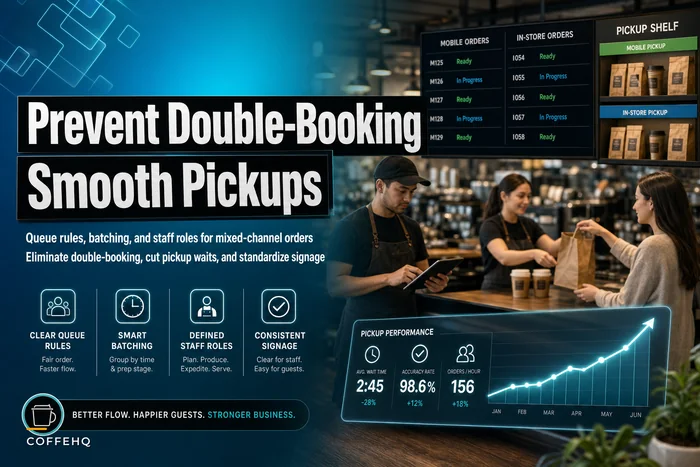
The mobile order pickup zone is where variation hurts most. Some shifts call out names loudly. Others silently place drinks on the counter. Some organize by time, others alphabetically, others not at all. Mobile customers already paid — inconsistency here is what drives the negative reviews.
-
where mobile orders stage (same spot, always)
-
how they're announced (name called once, clearly)
-
how long they sit before a remake evaluation (10 minutes is a reasonable ceiling)
Standardize three things: where mobile orders stage (same spot, always), how they're announced (name called once, clearly), and how long they sit before a remake evaluation (10 minutes is a reasonable ceiling). This creates predictability for customers who've already done their part and just want their coffee.
When experience maps need adjustment
Your coffee shop customer experience map isn't carved in stone. Seasonal changes, new equipment, staff turnover — all of it demands adaptation. But instead of wholesale rewrites, build in systematic evolution.
Every month, pick one journey touchpoint for deep evaluation. Pull all observation cards related to it. Review relevant complaints. Check the KPI trends. Then run one question with your shift leads: what would make this touchpoint 10% better for customers?
The constraint matters — 10% better, not transformed. This keeps suggestions practical. Maybe it's adding a mat to signal where the line forms. Maybe it's moving the sugar station two feet to improve flow. Maybe it's a small change to the script for suggesting food. Small adjustments that compound into noticeable improvement over months.
Track adjustments on a simple change log: date, touchpoint, old approach, new approach, result after two weeks. This becomes your operational history — proof of what actually works in your specific space. When something doesn't move the needle, roll it back. When it does, it becomes the new standard.
The compound effect of consistent operations
A customer who visits 3-4 times a week racks up roughly 150-180 interactions over a year. Each slightly different experience trains them to expect variability. They start hedging — avoiding certain times, requesting specific baristas, adding buffer time for potential delays. Your cafe becomes unpredictable, which is the opposite of what drives loyalty.
When every shift delivers the same core experience — acknowledgment timing, drink quality, service flow, atmosphere — something shifts. Customers stop thinking about their visit. They just come. The cognitive load of choosing your cafe drops to zero. That's when you stop being a coffee option and start being their coffee solution.
The operational discipline required isn't massive. Clear handoffs that transfer real information. Observation rhythms that catch drift early. Triggers that force immediate correction. Coaching that happens in the moment. None of these are complex individually. The power is in how they connect.
Small cafes often assume experience consistency is a luxury for chains with big training budgets. But chains struggle with the same variation, just at scale. Your advantage is proximity — managers see every shift, know every barista, and can adjust in real-time. The coffee shop customer experience map isn't about documentation. It's about systems that self-correct toward consistency.
AI-assisted operational platforms increasingly help cafes here — not by removing human judgment, but by supporting it. When managers can see what happened last shift, track problems developing in real-time, and get specific prompts for correction, variation naturally decreases. Better information flow produces better decisions, and better decisions produce more consistent experiences.
Your regulars shouldn't prefer the morning shift. They should just prefer your coffee. The seven-minute huddle, the 90-second observation card, the three-minute coaching script — these aren't administrative overhead. They're the infrastructure of a predictable customer experience. The cafes that win long-term aren't always the ones with the best coffee or the coolest aesthetic. They're the ones where Tuesday afternoon feels exactly like Thursday morning.
Ready to brew operational excellence?
Join hundreds of coffee shops using Coffehq to boost efficiency, reduce waste, and elevate customer satisfaction.