


Most cafe experiments don't fail because the idea was bad. They fail because nobody decided, in advance, what "working" actually meant — and then the thing got rolled out to three more locations on a gut feeling. By the time the numbers come in, your POS is cluttered with half-configured modifiers, two sites are still running the old recipe, and your best shift lead is quietly ignoring the whole thing because it slowed down the morning rush.
That gap — between a promising pilot and a repeatable win across sites — is where cafe experiment governance lives. Not governance in the boring compliance sense. Governance as in: the small set of rules, gates, and templates that let you move fast without scaling your mistakes.
This is the pack I'd hand to any operator who's past their first location and starting to run real tests: new loyalty mechanic, a different cup size, a prep-ahead batching change, a markdown rule, a new POS button. The deliverables are simple — a one-page charter, acceptance tests tied to actual POS and inventory fields, readiness gates for staffing and training, a rollout/rollback ladder, and a capacity planner for multi-site training. The hard part isn't the templates. It's connecting them so a win at Store 1 becomes a standard everywhere without a three-week cleanup afterward.
Why pilots look like wins and then quietly fall apart
Here's the pattern. A single store tries something new. The owner or GM is physically there, hovering, fixing things in real time. Of course it works — there's a human patch over every rough edge. The experiment "succeeds" because the environment was artificially supportive.
Then it scales. At Store 3, there's no owner standing behind the register. The barista never got the full context, just a one-line Slack message. The POS button exists but the modifier maps to the wrong inventory item, so your cost of goods quietly drifts. Nobody notices for two weeks because the reporting was never set up to catch it.
-
Measurement defined after the fact. The team argues about whether it worked because success was never written down in testable terms.
-
POS and inventory drift. Buttons get added without mapping to the right SKU, recipe, or tax rule. Margin erodes invisibly.
-
Training treated as an afterthought. The rollout date gets set before anyone checks whether the trainers and shift coverage exist to actually teach it.
-
No rollback plan. When a test underperforms, nobody knows who decides to kill it or how to cleanly remove it from the system.
What tends to happen across small multi-site operations is that the first thing to break is almost never the idea itself. It's the handoff. The pilot lived in one person's head. Scaling requires it to live in fields, SOPs, and gates that don't need a founder babysitting them.
Governance fixes these not by slowing you down, but by forcing five decisions up front that you'd otherwise make badly under pressure later.
The one-page experiment charter
Every experiment starts with one page. If it needs more than a page to define, it's actually two or three experiments pretending to be one.
Keep every order and shift perfectly aligned.
Coffehq helps you manage orders, inventory, and staff schedules seamlessly.
- Unified order processing
- Real-time inventory updates
- Staff shift coordination
No credit card required
The charter isn't paperwork. It's the contract between "the person who wants to try this" and "the people who have to run and measure it." Here's the structure:
-
Name & ID short name plus a registry ID (more on the registry later).
-
Hypothesis one sentence. "If we add a 12oz default to drip orders, average ticket drops but throughput rises and waste on large brews falls."
-
Primary metric the one number that decides this. Pick ONE. Multiple primary metrics is how teams rationalize failures into wins.
-
Guardrail metrics the things that must NOT get worse. Usually margin %, labor %, drink times, and complaint rate.
-
POS/inventory fields touched exactly which buttons, modifiers, SKUs, recipes, and reports change.
-
Test site(s) and duration where, how long, and the minimum volume needed before you read results.
-
Owner one named person accountable. Not a committee.
-
Decision date the day you commit to scale, iterate, or kill.
The discipline here is the single primary metric plus guardrails. Without it, you get the classic trap: a new loyalty promo "increased redemptions 20%" while quietly dragging gross margin down two points. Both are true. Only one got reported.
If you already run a structured experiment registry and data governance setup, the charter is the intake form that feeds it. If you don't, the charter is where you start building that habit.
Acceptance tests tied to real POS and inventory fields
This is the part most operators skip, and it's the one that saves you from scaling a configuration mess.
An acceptance test is a yes/no check you run before the experiment counts as "ready," and again before you scale it. The key is that it's tied to actual fields in your system — not vibes. "Did the new button work?" is not an acceptance test. "Does the 12oz drip button ring up at $3.25, map to SKU DRIP-12, deduct 12oz from the brewed-coffee recipe, and apply the correct tax code?" is.
-
[ ] New button/modifier exists at the test site and only the test site
-
[ ] Price rings correctly (incl. any size or modifier pricing)
-
[ ] Modifier maps to the correct inventory SKU/recipe
-
[ ] Inventory depletion fires correctly on a test transaction
-
[ ] Tax code is correct for the item/region
-
[ ] The item shows up in sales reporting under the expected category
-
[ ] Refund/void path works and reverses inventory correctly
-
[ ] Guardrail metrics are visible on a report before launch (not after)
-
[ ] A test transaction reconciles cleanly end-of-day with no orphan lines
That last point matters more than it looks. The silent killer in cafe experiments is the transaction that doesn't reconcile — a button that doesn't deplete inventory, a modifier that double-counts. It compounds across sites. A tight data-sync and reconciliation workflow is what turns these acceptance tests from a one-time check into an ongoing safety net, so drift gets caught at close instead of at the end of the quarter.
Run the acceptance tests twice: once at pilot setup, once at each new site during rollout. The second run is where you catch the "it worked at Store 1 but Store 3's menu structure is different" problems before customers do.
Readiness gates: staffing and training before rollout dates
A rollout date set without a readiness check is just a deadline for chaos. Before anything scales, three gates have to be green.
Gate 1 — Staffing coverage. Does the receiving site have enough trained people on the shifts where this experiment actually runs? A new peak-hour batching change is useless if your strongest baristas are all on afternoons.
Gate 2 — Trainer availability. Who teaches it, and do they have the hours? This is the gate everyone fakes. "We'll train during the shift" is not a plan — it's how experiments get taught badly to one person who then leaves.
Gate 3 — Material readiness. The SOP is written, the POS config is built and acceptance-tested, and the one-page "how to run this" exists. If a barista can't learn it from the materials alone, it's not ready to scale. It's still relying on someone's memory.
Track trainer-hours alongside your experiment registry so rollout dates reflect actual capacity.
The pattern worth internalizing: training capacity, not idea quality, is usually the real bottleneck to multi-site rollouts. You can have five solid experiments and only enough trainer-hours to properly roll out two per month. Pretending otherwise just means all five get taught badly.
The rollout and rollback decision ladder
Once the pilot reads out, you don't just "launch everywhere." You climb a ladder, and every rung has an off-ramp. This keeps a mediocre test from becoming a company-wide standard by momentum alone.
| Rung | Scope | What has to be true to climb | Rollback trigger |
|---|---|---|---|
| 0 | Single pilot site | Charter signed, acceptance tests pass | Primary metric clearly negative, or any guardrail breached |
| 1 | Pilot + 1 similar site | Pilot hit primary metric, guardrails held over full duration | Second site fails to replicate within tolerance |
| 2 | ~Half of sites | Both sites green, training materials validated by a non-author | Any site breaches a guardrail two weeks running |
| 3 | All sites / standard | Capacity planner confirms trainer-hours exist for remaining sites | Reverts to Rung 2 if rollout quality drops |
The rollback half of the ladder is what operators underbuild. Killing an experiment should be as defined as launching one. For a POS change that means: who flips the button off, how inventory mappings get cleaned up, how you communicate the reversal to staff so nobody keeps ringing a phantom item, and how the registry gets updated so the lesson isn't lost.
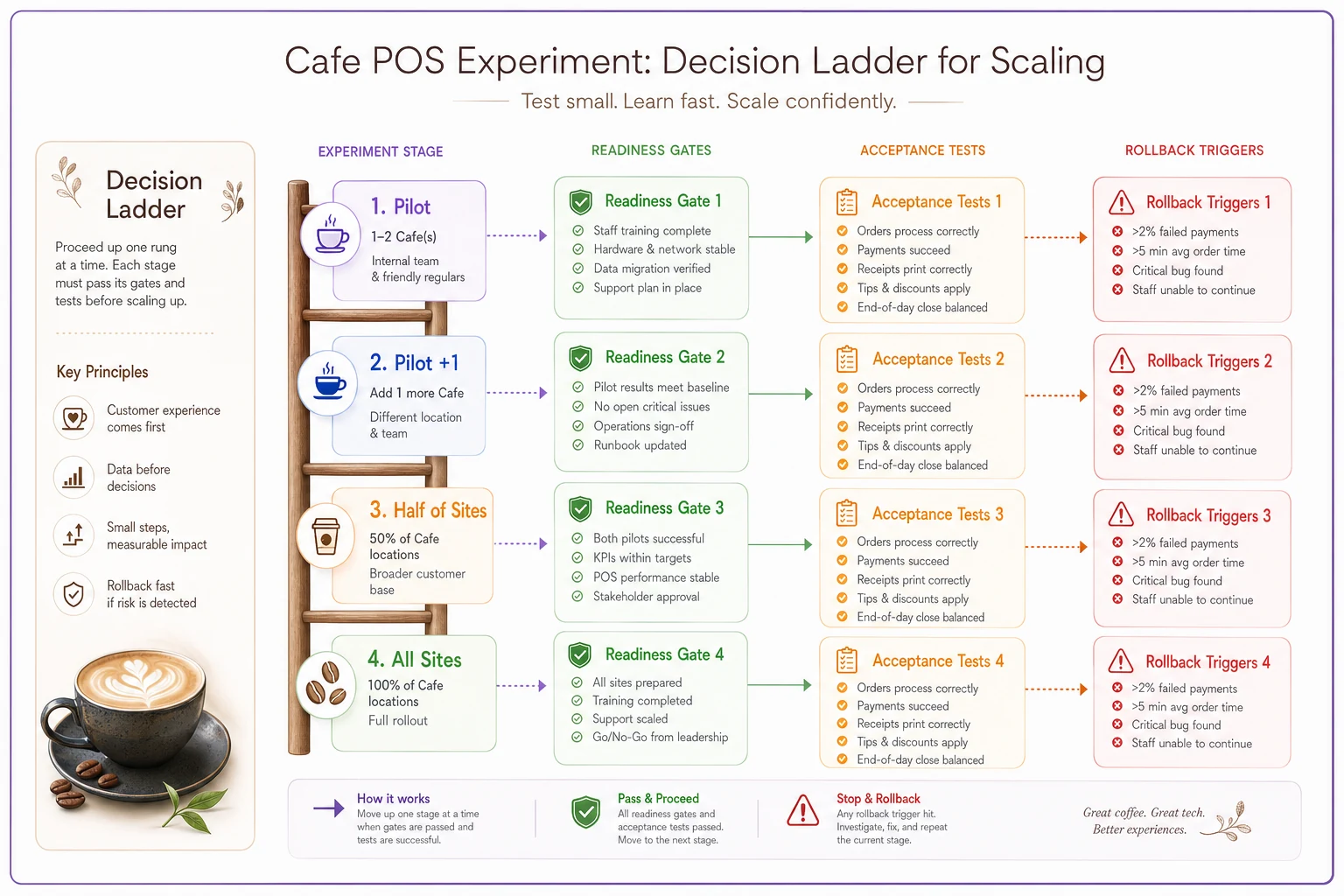
A rollback is not a failure. An undocumented rollback is — because six months later someone proposes the exact same test and you repeat the whole cycle.
Capacity planning and trainer templates for multi-site rollouts
Here's the math most operators never do before committing to a rollout date.
Say you're scaling a prep-batching change to six remaining sites. Each site needs about 2 hours of trainer time per person on the stations that touch it, and you've got roughly 4 affected staff per site. That's around 8 trainer-hours per site, 48 hours total. If your one qualified trainer has about 6 free hours a week after their normal duties, you're looking at eight weeks — not the "two-week rollout" someone already put on the calendar.
-
List sites remaining to roll out.
-
For each, count staff who need the training on the relevant shifts.
-
Estimate trainer-hours per person for this specific experiment.
-
Multiply to get total trainer-hours needed.
-
Sum your available trainer-hours per week across all qualified trainers.
-
Divide total needed by weekly available = realistic number of weeks.
-
Compare to your proposed rollout date. If reality is longer, either extend the date, add a trainer, or narrow the scope.
That gap between planned and real is where rollouts quietly collapse. The capacity planner forces it into the open.
A lightweight trainer template per experiment keeps quality consistent across sites:
-
One-line purpose ("why we're doing this")
-
The 3–5 steps that change at the station
-
The single thing most likely to go wrong, and how to spot it
-
A 2-minute "show me" check the trainer runs before signing someone off
-
Where to log that the person was trained (ties back to the registry)
The "show me" check is what separates real training from "I told them once." You don't mark someone trained until they demonstrate it clean.
A sample registry for scaling winners safely
Everything above feeds one living document: the experiment registry. This is your institutional memory — the reason you stop re-running the same tests and arguing about the same results.
A workable registry row includes:
-
ID & name
-
Status (pilot / scaling / standard / killed / parked)
-
Rung currently on
-
Primary metric result (actual vs. target)
-
Guardrail outcomes
-
POS/inventory fields touched (so you can audit config later)
-
Sites live
-
Owner
-
Decision date & what was decided
-
Rollback notes (if applicable)
The registry's real value shows up at month six and year two. A new manager proposes a pricing test? Pull the row from the last time and skip the mistake. Debugging a margin drift? Check which experiments touched that SKU's config. It becomes the connective tissue between your experiments, your POS setup, and your P&L.
This also pairs naturally with pricing and menu work — if you're running structured menu-engineering and A/B pricing tests, each of those becomes a registry entry with its own charter, acceptance tests, and ladder. That's when scattered experiments start behaving like an actual system.
A real scenario: the three-site loyalty button
A small operator with three cafes wanted to test a "buy 9, 10th free" punch mechanic built into the POS instead of paper cards. Classic experiment. Easy to screw up.
Before governance: The first version got switched on at all three sites the same week because it "seemed obviously good." Within about ten days, two problems surfaced. The free-drink redemption at one site wasn't depleting inventory — it rang as $0 and skipped the recipe deduction entirely — so brewed-coffee and milk usage looked artificially low. And baristas at the busiest location started hand-keying workarounds during rush because the button added a few seconds per order. Drink times crept up. Nobody had set a guardrail for that.
After governance: They re-ran it properly. One pilot site. Charter with a single primary metric (repeat-visit rate within 14 days) and guardrails on drink time, labor %, and margin. Acceptance tests caught the $0-redemption inventory bug before launch this time. Rollout followed the ladder — pilot, then one more site, then all three only after training capacity was confirmed.
The outcome wasn't a fireworks show. Repeat-visit rate improved a few points — a real, steady lift. But the bigger win was that cost of goods stayed accurate because redemptions depleted inventory correctly, and drink times held because the rollout waited until baristas were actually trained on the faster flow. The experiment that "obviously worked" the first time had quietly been costing them margin visibility. The governed version made roughly the same gain and didn't break the books.
When this level of governance makes sense — and when it's overkill
When it makes sense: You're running two or more sites, or you're about to open a second. You're testing things that touch POS config, inventory, pricing, or staffing — anything that can drift or compound. You've been burned by a rollout that worked in one place and fell apart somewhere else.
When it's overkill: You're a single location testing a new pastry on the display shelf. You don't need a charter and a ladder for "let's see if people buy scones." Governance scales with blast radius. Small, reversible, single-site tests just need a note and a date to check back.
Who should NOT bolt this on yet: If your core data isn't trustworthy — if your POS and inventory already don't reconcile at close — fix that first. Governing experiments on top of a broken ledger just gives you well-documented bad numbers. Get your day-to-day reconciliation solid, then layer experiment governance on top of a foundation you can actually trust.
Bringing it together
The whole point of cafe experiment governance isn't bureaucracy. It's that a win at one store should be able to become a standard everywhere without you personally standing behind every register to make it work.
The charter forces clear decisions. The acceptance tests protect your POS and inventory from silent drift. The readiness gates keep rollout dates honest about training reality. The ladder gives you a clean way up and a clean way back. The registry means you only learn each lesson once.
Start with one experiment you're already thinking about running. Write the one-page charter. Define the single primary metric and the guardrails. Build the acceptance tests against your actual POS fields. You'll either catch a problem before it scales, or you'll have your first clean, repeatable win — and the system to turn the next ten into standards the same way.
Ready to brew operational excellence?
Join hundreds of coffee shops using Coffehq to boost efficiency, reduce waste, and elevate customer satisfaction.