

The moment a food item leaves your counter in a sealed cup or clamshell, the rules quietly change. Inside your cafe, temperature and time are governed by your prep line and your display case. Once it's in a customer's tote bag heading to an office three blocks away, you're responsible for whatever happens next — and if a health inspector or a sick customer works backward, the label on that container is your entire defense.
Most cafes get grab-and-go labeling wrong in the same predictable way: they treat it like a retail sticker (name + price) instead of a food-safety record. That gap doesn't cause problems on a normal Tuesday. It causes problems the one day something goes sideways, and suddenly you're trying to remember whether the egg salad you sold at 11:40 was made at 7am or reworked from yesterday.
This is a single-shift system. You can build the templates, print them, and have your morning crew running it correctly before the lunch rush — no consultant, no software migration, no month-long rollout.
Why your current labels probably fail an audit
It's almost always one of three things.
The label has a price but no time. A "Turkey Pesto — $9.50" sticker tells the customer what to pay and tells an inspector nothing. If that sandwich contains a temperature-controlled-for-safety (TCS) filling — meat, dairy, cut leafy greens, cooked rice — the clock matters more than the price. Without a made-on or discard-by time, you can't prove the product left your hands inside a safe window.
The prep person and the packer are different people, and nobody wrote anything down. In real operations, this usually happens during the 10:30–11:30 build-up before lunch. One person batches egg salad, another assembles sandwiches, a third bags grab-and-go for the cold case. By the time a customer buys at 1pm, three people have touched that item and none of them own the timestamp.
Allergen info lives in someone's head. The barista who built the wrap knows it has walnuts in the pesto. The person who sold it at rush doesn't. Offsite consumption makes this worse — the customer isn't standing at your counter to ask a follow-up question.
None of these are exotic problems. They're just invisible until the day they're not.
The real cost when it goes wrong
A grab-and-go recall or a single allergen complaint isn't a rounding error for a small cafe.
Keep every order and shift perfectly aligned.
Coffehq helps you manage orders, inventory, and staff schedules seamlessly.
- Unified order processing
- Real-time inventory updates
- Staff shift coordination
No credit card required
Picture a cafe doing roughly 40–60 packaged items a day — cold brews, overnight oats, sandwiches, yogurt parfaits. One customer reports getting sick from a chicken wrap bought "sometime around noon." The health department asks for your logs. If you can't produce a made-on time, a prep source, and a hold-temperature record, the conversation stops being about one wrap and starts being about your whole cold program. Best case, you dump the entire grab-and-go case that day and lose somewhere around $150–$300 in product plus a few hours of staff time reconstructing records. Worse case, you get a follow-up inspection and a note on your public score.
Compare that to the labeling failure that never surfaces publicly but bleeds you slowly: parfaits with no discard time sitting in the case an extra day because nobody's sure when they were made, so the closer either tosses good product to be safe (waste) or leaves questionable product up (risk). Both cost you. The whole point of a real label is to remove the guessing.
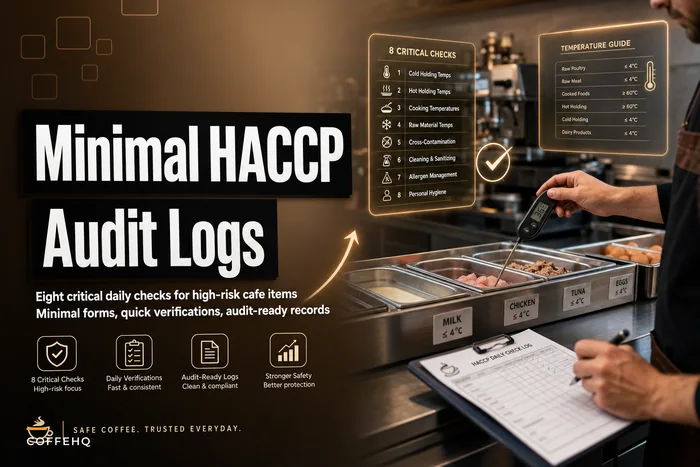
This connects directly to the discipline behind our minimalist HACCP for small cafes — the grab-and-go label is just where those critical checks become physical and portable.
What actually belongs on a grab-and-go label
Strip it down to what an inspector, a customer, and your closer each actually need. Every packaged perishable leaving the counter should carry these fields:
-
Item name (specific enough to trace — "Chicken Caesar Wrap," not "Wrap")
-
Made-on date + time (the honest build time, not open-time)
-
Discard-by / best-by (calculated, not guessed — see the windows below)
-
Prep initials (who built it — accountability, not blame)
-
Allergen flags (the big ones
milk, egg, wheat, soy, tree nuts, peanuts, fish, shellfish, sesame)
-
Keep refrigerated reminder for TCS items ("Keep cold. Eat within 4 hrs of purchase if left out.")
That last line does real work. Once the item is offsite, you've lost temperature control, so you shift responsibility to the customer with clear language. It's the difference between a defensible handoff and an open-ended liability.
Hold windows you can actually defend
The core of a HACCP-lite grab-and-go program is the discard clock. Below is a working reference for common cafe items. Adjust to your local code, but these are conservative and easy to teach.
| Item type | Storage after packing | Discard-by rule | Notes |
|---|---|---|---|
| TCS sandwiches / wraps (meat, egg, dairy) | Refrigerated ≤ 40°F | Made-on + 24 hrs, OR same-day if temp abuse | Never re-case if it's been out > 2 hrs |
| Cold brew / iced coffee (dairy added) | Refrigerated | Made-on + 24 hrs | Black cold brew can go longer; dairy shortens it |
| Overnight oats / parfaits (dairy) | Refrigerated ≤ 40°F | Made-on + 48 hrs | Fruit toppings soften — quality often fails before safety |
| Cut fruit cups | Refrigerated ≤ 40°F | Made-on + 24 hrs | High-risk; keep windows tight |
| Baked goods (no dairy filling) | Ambient | Made-on + 1–2 days | Not TCS — quality-driven, see markdown SOP |
| Hummus / dip cups | Refrigerated | Made-on + 3–5 days if commercially portioned | Shorter if house-made |
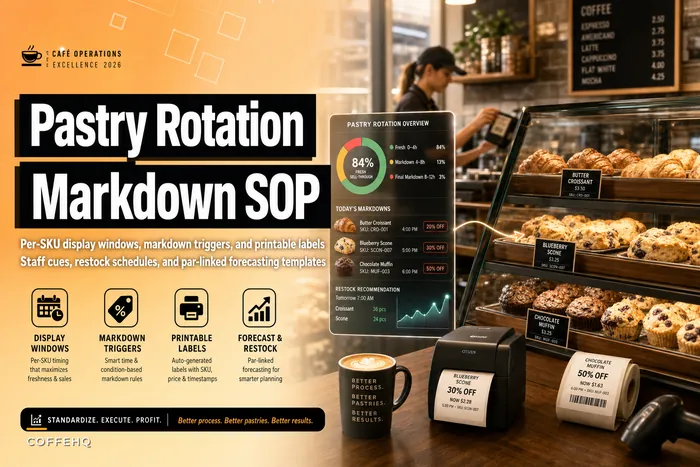
For ambient items where quality drives the pull decision rather than safety, your discard logic overlaps with the pastry display rotation and markdown SOP — same clock discipline, different reason for pulling it.
The one-shift build: setting this up before lunch
You don't need a phased rollout. A manager can run this in a single morning shift.
-
List your packaged SKUs. Pull every item you sell in a cup, clamshell, or bag for offsite consumption. Most cafes land on 8–15 SKUs. Write them in a column.
-
Assign each a hold window. Using the table above, put a discard rule next to each SKU. Do this once; it becomes your master reference taped inside the prep station.
-
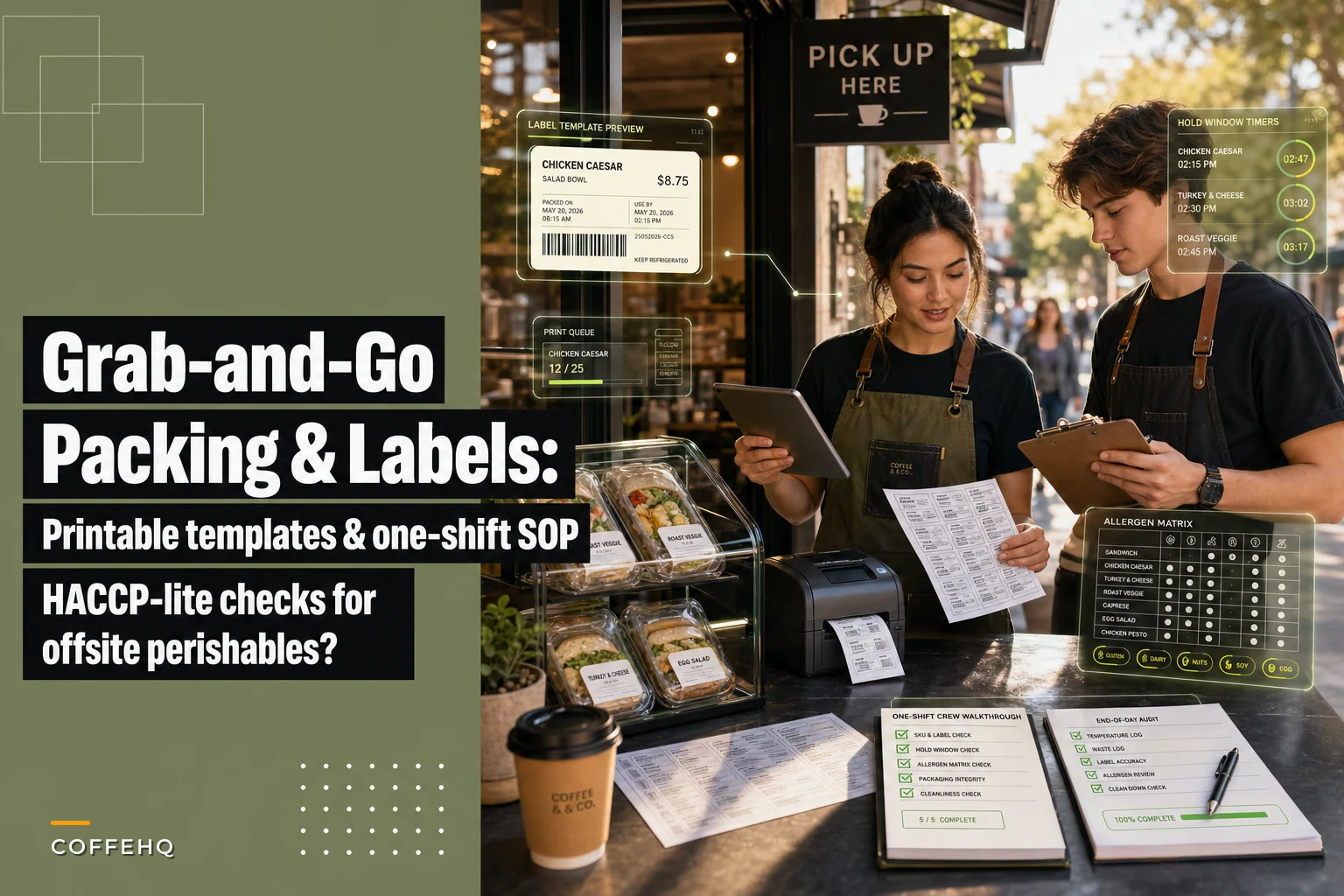
Build the label template. Whether you're printing on a thermal labeler or a sheet of Avery labels, the template has fixed fields (name, allergens, "keep cold" line) and blank fields the packer fills in (made-on time, discard-by, initials). Pre-print everything that doesn't change.
-
Print a master allergen matrix. One laminated page
every SKU across the top, the nine major allergens down the side, checkmarks in the grid. This is your source of truth so packers aren't guessing at rush.
-
Do a five-minute crew walkthrough. Show the template, the matrix, the discard rules. Have one person label a test item wrong on purpose so the crew learns to catch it.
-
Run it live and audit at close. At end of day, pull three random packaged items and check every field. If any field is blank or wrong, that's your coaching point for tomorrow's pre-shift.
Visualize the one-shift setup with a simple workflow image.
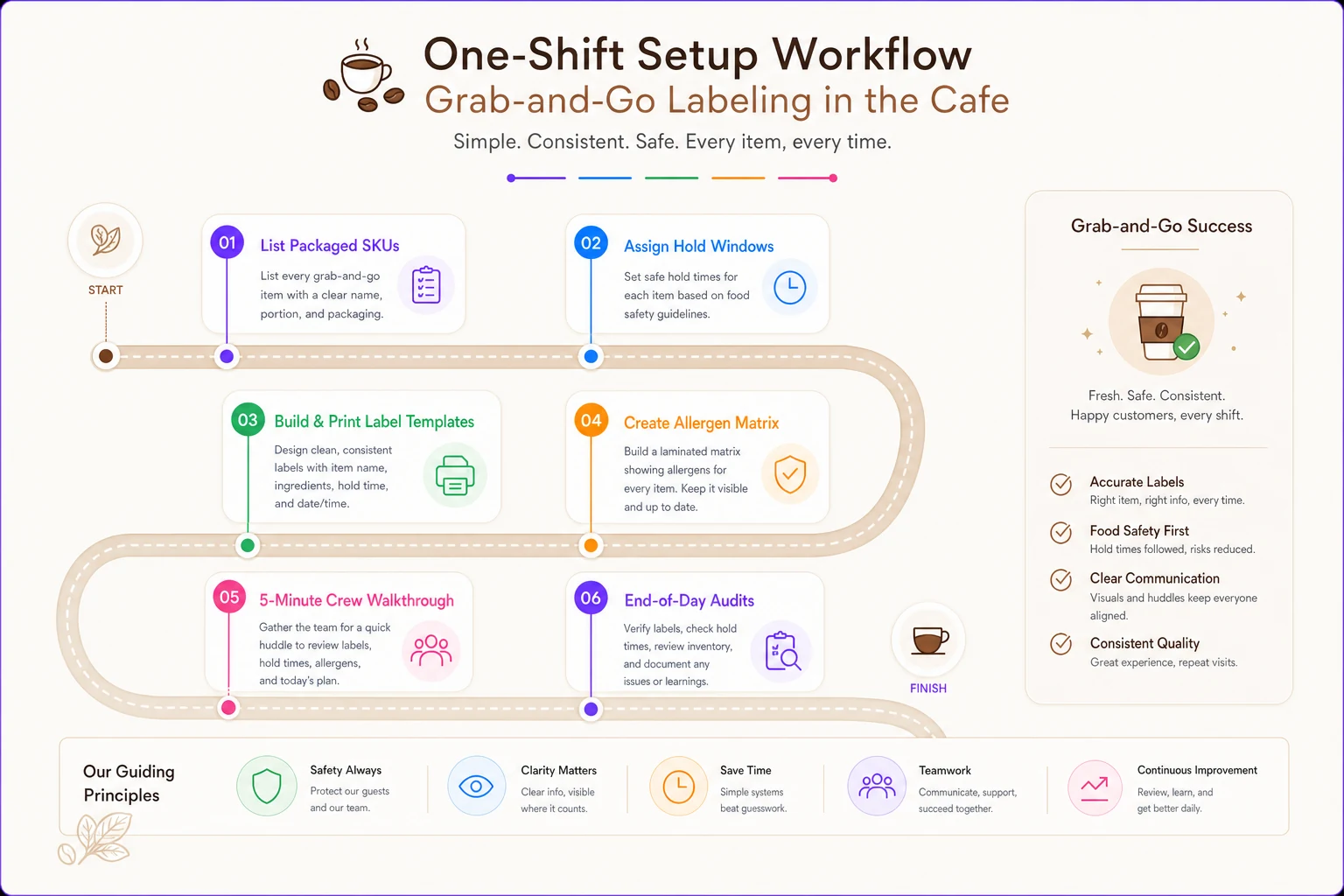
The whole thing fits in one shift because you're not inventing anything — you're moving food-safety knowledge that already exists in your crew's heads onto a physical, traceable label.
The closing-shift verification (the part everyone skips)
Labels only protect you if someone confirms they're actually being applied. Build a 90-second close check into the routine:
-
Pull 3 random grab-and-go items from the case
-
Confirm each has a legible made-on time and discard-by
-
Confirm the case temp log shows ≤ 40°F for the day
-
Confirm no item in the case is past its discard-by
-
Initial the daily log
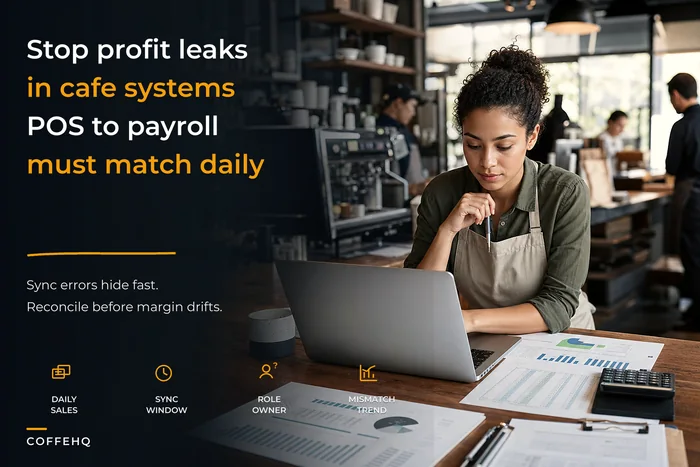
This is where labeling connects to your broader records. When your POS discard adjustments, inventory counts, and food-safety logs all agree, you close the loop that most cafes leave open — the same reconciliation discipline behind stopping profit leaks across POS, inventory and accounting. A labeled item pulled for being past-window should show up as a logged discard, not a mystery shrink.
A real scenario: the parfait problem
A neighborhood cafe selling roughly 30–40 packaged parfaits and overnight oats a week kept running into the same fight at close. The morning crew made a batch, but there was no consistent made-on time on the cups. The closer never knew which parfaits were day-one and which were day-two, so to be safe they were dumping about a third of the unsold case every night — maybe 4–6 cups, three or four nights a week. Over a month that's easily $120–$180 in tossed product that was probably still fine.
Once they built a label with a made-on stamp and a calculated discard-by time, the closer stopped guessing within about two weeks. Product past 48 hours got pulled and logged; product inside the window stayed and sold. Waste on that category dropped noticeably — not to zero, but the panic-dumping stopped.
The unexpected win came during a routine inspection. The parfait case had a made-on time on every cup and a temp log to match. The label paid for itself twice over — once in reduced waste, once in a clean inspection.
When this makes sense — and when it's overkill
Do this if you sell any TCS item for offsite consumption, especially anything with dairy, egg, meat, or cut produce. The moment a customer can walk out with something that needs refrigeration, you need a defensible clock on it.
You can keep it lighter if your entire grab-and-go program is shelf-stable — whole fruit, commercially sealed snacks, bagged coffee, dry pastries with no dairy filling. Those are quality-driven, and a simple made-on date is plenty. Don't over-engineer non-TCS items with HACCP-lite machinery they don't need.
Who should NOT bolt this on carelessly: a cafe with a chaotic prep line and no one clearly owning the build station. If three people touch every item and nobody owns the timestamp, the label just becomes a field everyone leaves blank. Fix ownership first — assign the packer role for the shift — then add the label. A label with no accountable owner is theater.
Keeping it running past week one
The failure mode after a good launch is drift. Week one, everyone stamps times perfectly. Week three, the labeler runs out of stock during rush and someone hand-writes "made this morning" — and now you've got an untimed item back in the case.
The fix is boring but it works: keep a backup roll of labels at the station, put the discard-window reference where the packer can see it without walking away, and use that 90-second close check as the enforcement mechanism. If the close check keeps catching blanks from the same shift, that's a training gap, not a paperwork gap — coach it in pre-shift the next day.
The labels aren't the point. The point is that when someone asks when was this made, who made it, and what's in it, you have an answer that doesn't depend on anyone's memory. Build the template once, teach it in five minutes, verify it at close — and the sandwich walking out your door stops being a liability you're quietly hoping nobody tests.
Ready to brew operational excellence?
Join hundreds of coffee shops using Coffehq to boost efficiency, reduce waste, and elevate customer satisfaction.