

Most cafes don't have an omnichannel problem on paper. They have a POS, a tablet for mobile orders, maybe a delivery app or two, and a counter. The problem shows up in the gap between those channels — specifically around 8:15am on a Tuesday when the in-store line is six deep, three mobile orders just pinged, a DoorDash driver is standing near the pastry case looking impatient, and your one espresso machine can physically produce drinks at only one speed.
That moment is the real omnichannel fulfillment question. Not "should we be on more platforms?" but "when everything hits at once, who gets served first, how fast did we promise, and does the order we just accepted actually make us money?"
Almost nobody answers those three questions on purpose. They get answered by whoever is loudest, whichever screen beeps, and muscle memory. This article is about replacing that chaos with a system — one you can actually run without an IT department.
The thing nobody tells you about adding channels
Every channel you add doesn't just add revenue. It adds a claim on the same bottleneck. Your espresso machine, your single steam wand, your one oven, your two people on bar.
A delivery app doesn't create new capacity. It creates new demand that competes with your walk-in regulars for capacity you already maxed out at peak. So the real cost of a new channel isn't the commission — it's what it does to your throughput ceiling during the 90 minutes a day that actually matter.
What you see across a lot of small food operations is that owners evaluate channels one at a time ("is UberEats worth 30%?") when they should be evaluating them as a portfolio competing for the same oven. The question isn't whether a channel is profitable in isolation. It's whether that channel's orders, arriving at the worst possible time, push out higher-margin orders or blow your service times for everyone.
This is why a cafe can add three channels, watch total revenue climb, and still feel poorer and more stressed. Margin per labor-minute fell even though the top line grew.
What actually breaks, in order
The failures are predictable and they stack. If you've felt all five, you're not disorganized — you just never built the decision layer.
Keep every order and shift perfectly aligned.
Coffehq helps you manage orders, inventory, and staff schedules seamlessly.
- Unified order processing
- Real-time inventory updates
- Staff shift coordination
No credit card required
-
Promise drift. Mobile says "ready in 7 min," delivery platform quotes the customer 25, walk-ins expect "now." Nobody agreed to these numbers; the apps set them. Your kitchen can't hit all three at peak, so one silently breaks.
-
Priority by volume. Whatever beeps loudest or whoever complains in person gets bumped up. Your most profitable order sits while you remake a $4 drip for a platform that takes 30%.
-
Blind acceptance. Orders auto-accept even when the line is already past your throughput ceiling. You've now promised production you physically can't deliver on time.
-
No capacity awareness in pricing. Same price, same availability at 8am peak as at 2pm dead time. You're selling scarce peak capacity at off-peak prices.
-
Disconnected outcomes. Nobody connects "we accepted 40 delivery orders at peak" to "we 86'd oat milk by 9am and lost 15 walk-in regulars." The routing decision and the inventory/margin result live in different universes.
Each of these is survivable alone. Together they create the familiar feeling: busy all day, exhausted, and the P&L doesn't reflect the hustle.
The four layers of an operator-first fulfillment system
Think of this as a stack. Each layer makes a decision the layer below it can't.
| Layer | Question it answers | What it controls | Who owns it |
|---|---|---|---|
| Priority ladder | When two orders compete, who wins? | Sequence of production | Bar lead / shift lead |
| Per-channel SLA | How fast did we actually promise? | Customer expectations + alerts | Manager (set), staff (hit) |
| Throttles / acceptance windows | Should we take this order right now? | Intake rate vs capacity | System rule + manager override |
| Capacity-aware pricing/quota | Is this order worth the capacity it eats? | Margin per constrained minute | Owner |
Most cafes have none of these written down. They have vibes. The goal is to turn vibes into a one-page document a 19-year-old can follow on their third shift.
Layer 1 — The priority decision ladder
A priority ladder is a ranked list that tells staff who to serve first when orders collide. The mistake is building it around channel loyalty ("regulars always first") instead of a blend of margin, promise-risk, and perishability.
-
Order already past 80% of its SLA (any channel) — you're about to break a promise, fix it now
-
In-store customer physically waiting, drink only — fastest to clear, highest perceived cost if ignored
-
High-margin / high-ticket order (catering slice, multi-item) — protects margin per minute
-
Mobile order with pickup window now — customer is en route or arriving
-
Delivery platform order — driver absorbs wait better than a standing human; platform sets longer customer expectation anyway
-
Mobile order with pickup window 10+ min out — intentionally deprioritized, it's not due yet
The non-obvious move is #6. Staff instinctively make every mobile order immediately because the ticket printed. But a mobile order due in 12 minutes made at minute one just sits getting cold and clogs the hand-off shelf. Make it when it's due, not when it arrives.
One thing to watch: a ladder is only useful if it has a tiebreaker. When two orders sit at the same rank, default to oldest ticket wins. Don't make bar staff do margin math mid-rush.
Layer 2 — Per-channel SLAs that match reality
An SLA here just means the promise you'll stand behind per channel — and critically, the numbers you choose, not the defaults the platform shoved at your customer.
| Channel | Target (off-peak) | Target (peak) | Alert trigger |
|---|---|---|---|
| In-store drink | 3–4 min | 6–7 min | Over 8 min |
| In-store food | 5 min | 9–10 min | Over 12 min |
| Mobile pickup | 6 min | 10 min | 80% of window elapsed |
| Delivery | 8–10 min to ready | 14–16 min | Driver waiting 4+ min |
Notice peak targets are looser on purpose. Pretending you can hold a 4-minute drink promise at 8:15 is how you break every promise instead of managing one. Honest peak SLAs that staff can actually hit beat ambitious ones they miss by default.
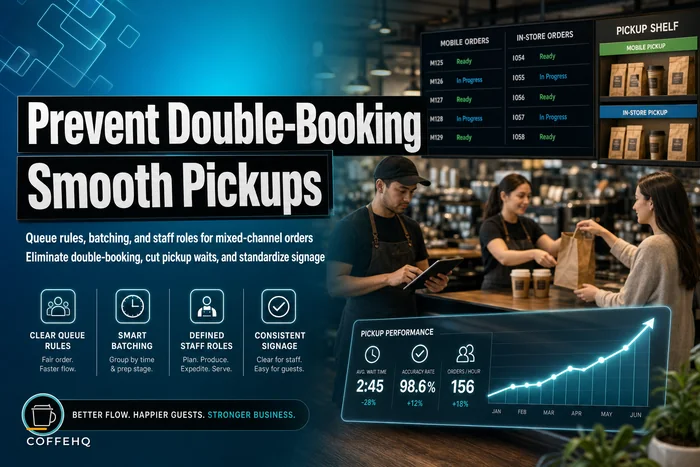
If you run mixed mobile and in-store flow, the hand-off mechanics matter as much as the timing — this pairs directly with the queue rules and staff-role approach in preventing double-booking and pickup delays.
Layer 3 — Throttles and acceptance windows
This is the layer almost no independent cafe uses, and it's the one that saves the most sanity.
-
Peak delivery cap accept no more than X delivery orders per 15-minute block during your defined rush (set X from your real throughput — more on that below). Beyond the cap, auto-pause the channel.
-
Mobile pre-order shaping push mobile pickup windows so orders spread into the quieter minutes on either side of peak rather than piling into the exact peak.
-
86 propagation when oat milk hits its reorder floor, the channel stops offering oat-milk drinks — not just the manual "tell the barista" method that fails at rush.
How do you find X? Run this once:
-
Pick your three busiest 15-minute blocks from last week's sales timestamps.
-
Count total items produced in each.
-
Divide by your number of production stations to get items-per-station per block.
-
Subtract roughly 15–20% as a safety buffer for remakes and friction.
-
That number is your true per-block ceiling. Allocate it across channels using your priority ladder.
Your throughput ceiling is a real, measurable number, and most cafes accept orders well past it every single peak. Throttling isn't turning away money — it's refusing to promise money you can't deliver, which is what actually costs you (refunds, bad reviews, lost regulars).
Layer 4 — Capacity-aware pricing and quota rules
Peak capacity is your scarcest asset. Selling it at the same price and availability as dead-time capacity is the quiet margin leak behind a lot of "we're busy but broke" cafes.
-
Channel quotas at peak reserve a fixed share of peak capacity for walk-ins (your highest-margin, no-commission customers). Delivery gets what's left, not first dibs.
-
Nudge low-margin channels off-peak small incentives (a loyalty bonus, a slightly better mobile deal) at 2–4pm move flexible demand out of your bottleneck.
-
Minimum ticket on delivery at peak if a platform takes 30%, a single $4 item during peak loses money and capacity. A peak minimum protects both.
The deeper framework for deciding which channels deserve capacity at all lives in the profit-first channel strategy work — this fulfillment layer is how you operationalize those channel decisions minute to minute.
Connecting routing to inventory, staffing, and margin
A routing rule that ignores the pantry is just a faster way to disappoint people. The whole point of an operator-first system is that the four layers talk to your three constraints.
Routing ↔ Inventory. Every accepted order draws down perishables. When a channel runs hot at peak, it can 86 an ingredient for all other channels — including walk-ins. Your throttle and your 86 propagation need to share the same low-stock trigger, or delivery eats your last oat milk and your 7:50am regular leaves annoyed.
Routing ↔ Staffing. Your throughput ceiling moves when staffing moves. A two-barista bar has a different X than one. If your acceptance caps don't flex with the roster, you either throttle too hard when fully staffed (leaving money on the table) or too loose when short (breaking every SLA). Tie the cap to who's actually on bar.
Routing ↔ Margin. This is where it all pays off. Track margin per constrained minute, not just margin per order. A $9 catering-adjacent order that ties up bar for 90 seconds beats a $4 delivery drink that takes the same 90 seconds and pays a 30% commission. Your priority ladder is really a margin-per-minute ladder wearing a simpler costume.
When these connect, routing stops being a stress response and becomes a lever on weekly P&L — which is the same spine as the operator-first revenue-operations system for predictable weekly P&L. Fulfillment is just that system living at the espresso machine.
A quick workflow walkthrough
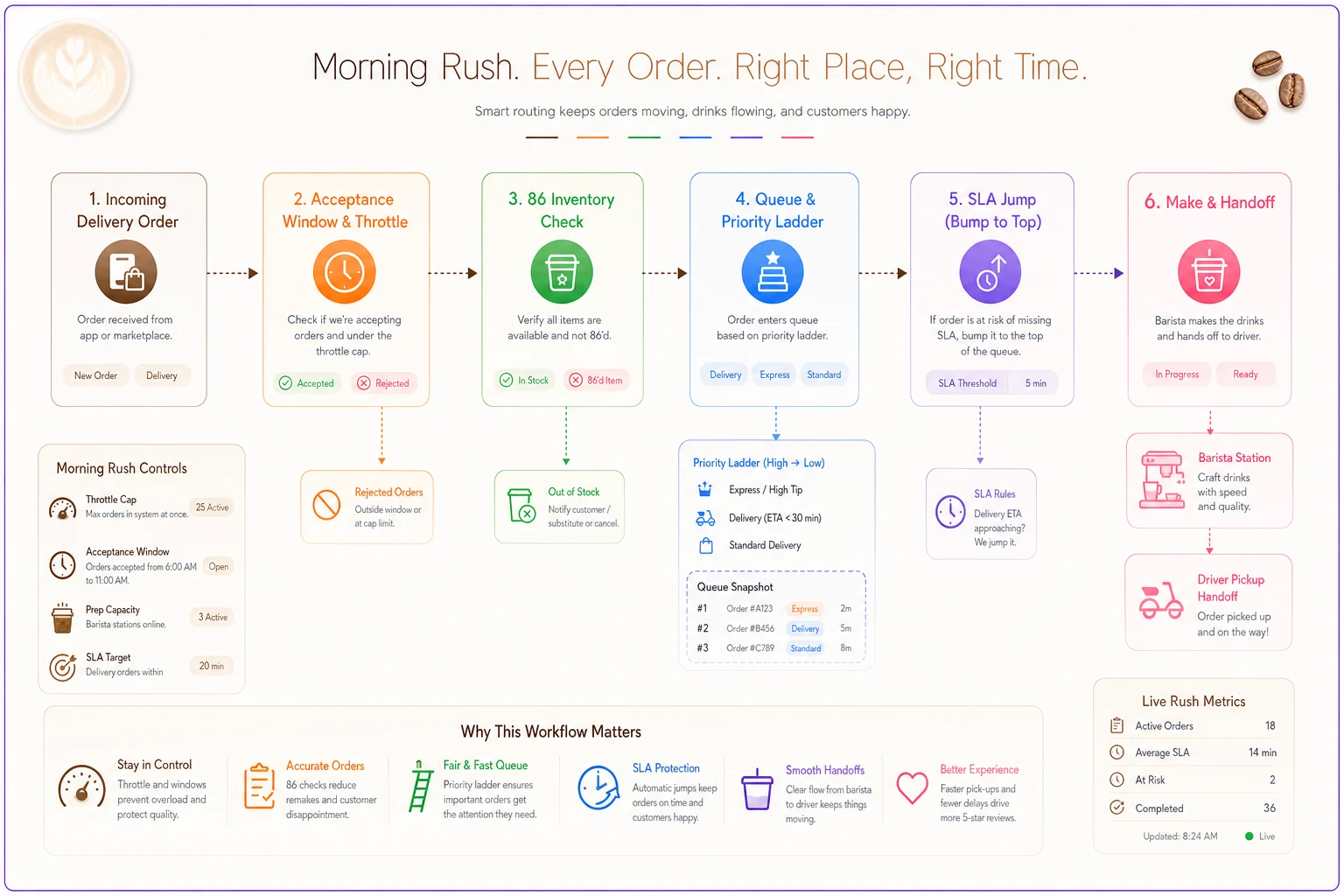
Picture a single order moving through the full stack during morning rush — no drama, just the system doing its job.
A delivery order arrives at 8:12am. The acceptance window checks: it's peak, and this 15-minute block is at 4 of its 5 delivery slots — accepted, but the fifth slot now locks. The 86 check confirms oat milk is above its floor — fine. The order joins the queue at priority rank 5 (delivery). A walk-in food order arrives 40 seconds later at rank 2 and slots ahead of it — correct, the human is standing there. The delivery order crosses 80% of its 14-minute SLA at 8:24; it jumps to rank 1 and gets made next. Driver arrives, no awkward wait, no cold food, walk-in regular never noticed a thing.
Below is a simple visual of that workflow.
No hero barista. No shouting. The decisions were made before the shift started.
When this makes sense — and when it doesn't
This makes sense when:
-
You run more than two channels and they collide at predictable peaks
-
You've had delivery orders 86 an item your in-store regulars wanted
-
"Busy but the numbers don't show it" describes a recent month
-
You have at least one genuine rush where production is the bottleneck
This is overkill when:
-
You're a single channel (counter only) with no mobile or delivery
-
Your "peak" never actually hits your throughput ceiling — if you're never the bottleneck, throttles solve a problem you don't have
-
You have fewer than around 30 orders on a busy morning; just use a priority ladder and skip the throttle math for now
Who should NOT start here: a cafe that hasn't nailed basic hand-off and queue roles yet. Routing logic sits on top of clean fulfillment mechanics. If orders still get lost on the pickup shelf, fix that first — the fancy ladder won't save a broken shelf.
A real-ish scenario, with numbers
A two-location independent cafe, roughly 320–360 morning transactions a day across both sites, added a second delivery platform and watched revenue tick up about 6–7% — while two things quietly got worse. Peak-hour item availability dropped (they were 86'ing milk alternatives before 9:30 most days), and Google reviews started mentioning long waits.
They ran the throughput count and found their real peak ceiling was about 20% below what they'd been accepting. They set a per-block delivery cap, reserved roughly 60% of peak capacity for walk-ins, set honest peak SLAs, and tied 86 triggers to a shared low-stock floor.
Over the next two months: total revenue stayed roughly flat (they turned away some peak delivery, gained back some walk-in regulars), but margin per labor-hour at peak improved noticeably, oat-milk 86 events at peak basically stopped, and the wait-time review complaints faded. Same revenue, more money kept, and a calmer bar. That's the whole point — fulfillment isn't a volume game, it's a yield game.
The 3-phase pilot you can run without IT
You don't roll all four layers out at once. You earn each one.
Phase 1 — Measure and ladder (Week 1–2).
-
Pull peak-block item counts from your POS; calculate your throughput ceiling.
-
Write the priority ladder on one laminated page at the bar.
-
Set honest per-channel SLAs, peak and off-peak.
Success check: staff can state "who gets made next and why" without thinking.
Phase 2 — Throttle and connect (Week 3–5).
-
Introduce one throttle
a peak delivery cap at your measured ceiling minus buffer.
-
Wire 86 propagation so a low-stock item pauses across channels, not just verbally.
-
Flex the cap with staffing (fully-staffed vs short numbers).
Success check: no peak item-outages that hit walk-ins; no SLA breaches you didn't choose.
Phase 3 — Price for capacity (Week 6–8).
-
Reserve a walk-in share of peak capacity.
-
Add a peak delivery minimum ticket.
-
Nudge flexible demand into off-peak with a small incentive.
Success check: margin per labor-hour at peak moves up while total revenue holds or grows.
Checklist to know you're done:
-
Throughput ceiling is a known number, per staffing level
-
Priority ladder is posted and followed
-
SLAs are your numbers, with alerts before breach
-
Peak delivery is capped and auto-pauses past the cap
-
86 events propagate across all channels automatically
-
Walk-in capacity is reserved at peak
-
You can see margin per labor-hour, not just daily revenue
Checklist to know you're done:
The real shift here
The cafes that win at multiple channels aren't the ones on the most platforms. They're the ones who decided — in advance, in writing — what their equipment and people can actually deliver, and who gets that capacity when everyone wants it at once.
Routing, SLAs, throttles, and capacity pricing aren't separate features to bolt on. They're one decision layer sitting between demand and your bottleneck. Build it once, keep it to a page, let it flex with staffing, and your worst 90 minutes a day stop being the part that quietly eats your margin — and start being the part you run on purpose.
Routing, SLAs, throttles, and capacity pricing aren't separate features to bolt on. They're one decision layer sitting between demand and your bottleneck. Build it once, keep it to a page, let it flex with staffing, and your worst 90 minutes a day stop being the part that quietly eats your margin — and start being the part you run on purpose.
Ready to brew operational excellence?
Join hundreds of coffee shops using Coffehq to boost efficiency, reduce waste, and elevate customer satisfaction.