

Most cafe owners obsess over the second location's lease, the espresso machine, the buildout. Those are the visible costs. The invisible one — the thing that quietly decides whether you make it to four sites or blow up at three — is your people system.
There's an uncomfortable pattern that shows up repeatedly: a single strong cafe usually runs on one exceptional person. Often that's the owner, sometimes a killer lead barista who just gets it. Everything works because that person is physically present, catching mistakes, retraining on the fly, absorbing chaos. Then you open site two, and suddenly that person can't be in two places. Quality splits. The new site feels like a photocopy of a photocopy. Cafe multi-site people systems exist to solve exactly this — to make competence portable instead of trapped inside one heroic employee. This isn't about HR paperwork. It's about designing how skill, decision-making, and accountability move across locations without you personally couriering them.
Why the "clone yourself" plan always fails
The default instinct when opening site two is to take your best person and station them there. It feels smart. It almost always backfires.
You've now weakened site one (which was running on that person) and set an impossible bar at site two — nobody else can match them. What you've actually done is create two under-supported locations instead of one great one. Growth built on individual talent doesn't scale; it just spreads your best person thinner until they burn out or quit.
The real fix is boring and it works: you stop moving people and start moving systems. Role clarity, defined skill levels, a repeatable way to teach those skills, and a schedule for rolling all of it out. That's the whole game. Let me break down how the pieces connect, because in isolation none of them do much.
Start with role archetypes, not job titles
Job titles at a single cafe are mushy on purpose. "Barista" means whatever that person happens to be good at. That flexibility is a feature at one site and a disaster at five, because there's no shared definition of what anyone actually does.
Keep every order and shift perfectly aligned.
Coffehq helps you manage orders, inventory, and staff schedules seamlessly.
- Unified order processing
- Real-time inventory updates
- Staff shift coordination
No credit card required
-
Bar / production — drink execution, speed, consistency
-
Counter / guest — ordering, payment, complaint handling, upsell
-
Prep / support — pastry, dish, restock, opening/closing setup
-
Shift lead — coordinates the floor, handles exceptions, owns the shift's numbers
-
Site manager — owns the P&L, scheduling, hiring, vendor relationships
-
Multi-site lead / owner — standards, rollout, cross-site coaching
The insight here: archetypes are about decisions, not tasks. A shift lead isn't "a barista who's been here longer." A shift lead is the person allowed to comp a drink, send someone home early when it's dead, or override a par during a rush. Define roles by what they're authorized to decide, and coordination across sites gets dramatically easier.
A common mistake is skipping the shift lead layer entirely. Owners jump from "barista" straight to "manager." But the shift lead is the load-bearing role in a multi-site operation — it's the person handling live problems when neither you nor the manager is there. Skip it and every small decision escalates to someone who's off-site, which is how you end up answering texts about oat milk at 7am on your day off.
Micro-certification ladders: making skill measurable
Once roles are clear, you need a way to know who can actually do each one — not who's been around longest, not who you like. This is where micro-certifications come in, and it builds directly on the idea of stackable competencies covered in barista onboarding that sticks.
The principle: break each role into small, verifiable skills that someone either can or can't demonstrate. Not "good at espresso" but "dials in a new bag to target yield within 3 shots, verified by a lead." Small, observable, pass/fail.
| Level | Certification | How it's verified | Unlocks |
|---|---|---|---|
| 1 | Core drinks to spec | Lead observes 10 drinks, all in spec | Solo bar during off-peak |
| 2 | Dial-in & calibration | Adjusts grind to hit yield/time targets | Opening bar setup |
| 3 | Peak-hour throughput | Holds quality at rush volume | Solo bar during peak |
| 4 | Trains & signs off others | Successfully certifies a level-1 | Path to shift lead |
The magic isn't the certificate. It's that certifications become the input for two other systems: scheduling and pay. Now you can schedule by capability instead of vibes — you know you need at least one level-3 bar person on a Saturday morning. And you can tie pay bumps to verified skill instead of tenure or negotiation, which kills a huge amount of resentment.
One pattern worth flagging: don't let certifications expire quietly. Skills drift. A person certified on peak throughput eight months ago who's mostly worked slow shifts since is not the same as freshly verified. Build a light re-verification cadence — quarterly for the high-stakes ones — or your capability map slowly turns into fiction.
Re-verify high-stakes certifications quarterly to prevent skill drift.
For the retention side of this — how micro-promotions and competency ladders keep small teams from walking — the people-ops retention system for tiny teams goes deeper than this post will.
Trainer-of-trainers: how skill actually travels between sites
Here's the coordination bottleneck almost everyone hits. You've got certifications defined. Great. But who certifies people at the new site when you're not there?
-
You (or your most senior operator) certify 2–3 people as trainers, using a shared rubric.
-
Those trainers certify shift leads and strong baristas at each site.
-
Those newly-certified people can now certify the next tier — but only up to one level below their own.
-
Every certification gets logged centrally, so you can see the skill coverage of each site at a glance.
The one-level-below rule matters. It prevents skill dilution — the photocopy-of-a-photocopy problem. A level-3 person can certify up to level 2, never level 3. Only the top tier mints new top-tier people, and that stays close to you as owner for as long as it needs to.
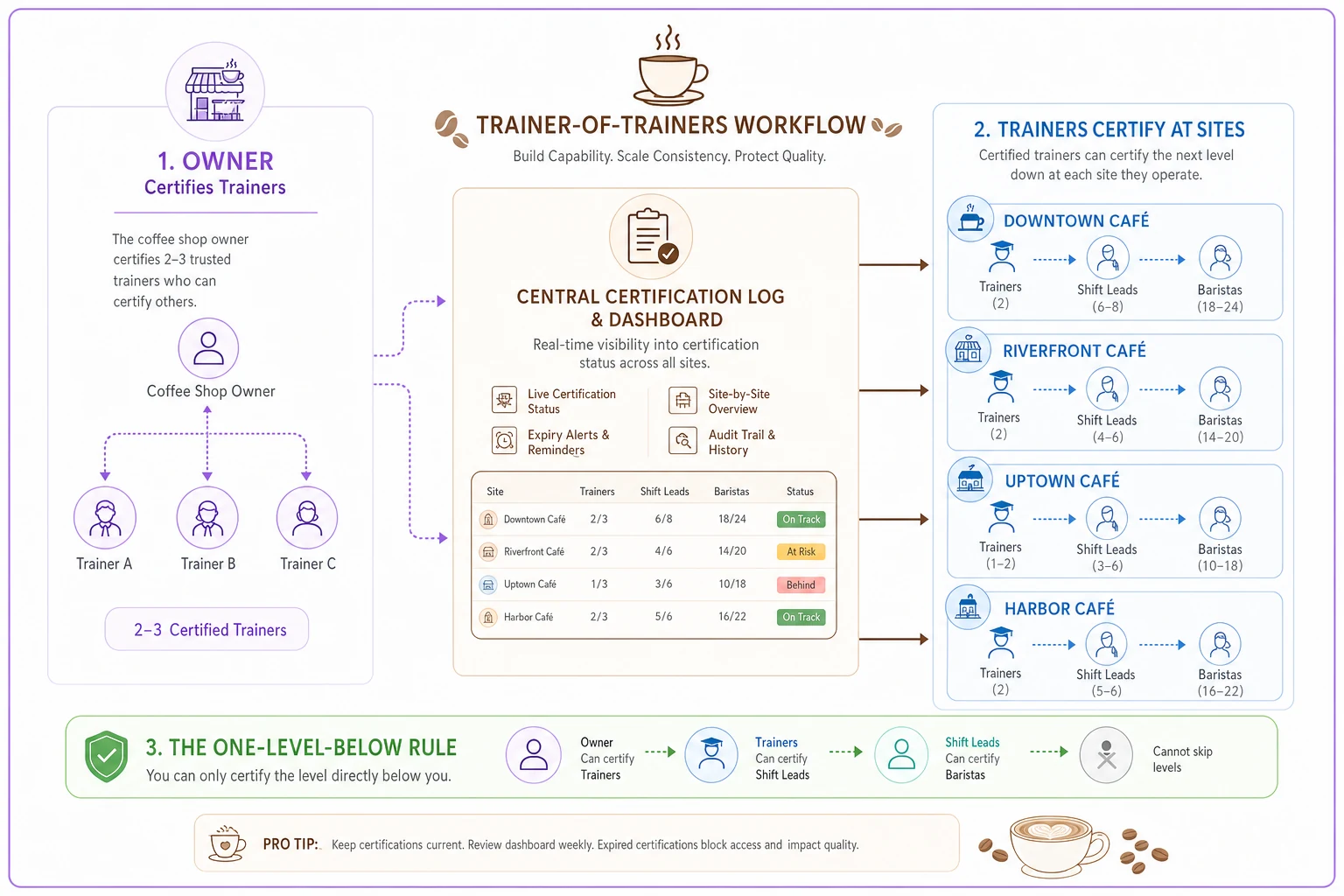
This sketch shows how certification authority and logging flow between owner, trainers, and site staff.
What breaks this system: inconsistent rubrics. If trainer A's "peak throughput pass" is easier than trainer B's, your certifications stop meaning the same thing across sites and you're back to quality drift with extra paperwork. The rubric has to be specific enough that two different trainers watching the same person reach the same verdict. That's the whole point of writing them down.
A month-by-month people roadmap
Systems fail from being deployed all at once. Roles, ladders, trainers, pay changes — dumping all of it on your team in week one guarantees confusion and pushback. A staged rollout works far better. Here's a realistic shape for a cafe going from 2 to 4 sites over roughly a year:
-
Month 1–2 Define role archetypes and decision rights. Write the first rubrics for the bar and counter roles. Don't tell the team it's a "new system" yet — just start using clearer language.
-
Month 3–4 Certify your first 2–3 trainers. Run the ladder quietly at your strongest site as a pilot. Fix the rubrics that turn out to be vague.
-
Month 5–6 Roll certifications out to the second site through your trainers. Start tying the first pay bump to a certification level. Watch how people respond — this is where you learn if your ladder feels fair.
-
Month 7–9 Site three opens (or gets folded in) already running the system. Now certifications feed your scheduling directly.
-
Month 10–12 Certification data feeds labor forecasting and your P&L. Site four is staffed from a known bench of certified people instead of panic-hiring.
The sequencing question — tiered standards, stabilization windows, and who gets to decide what as you add sites — connects tightly to the operations blueprint for opening your second site. The people roadmap and the operations roadmap should be running in parallel, not one after the other.
Where people systems meet the P&L
This is what separates a labor system from a training program. Certification data isn't just for HR — it's a forecasting input.
Once you know which sites have which certified capabilities, you can forecast labor against revenue with actual precision. Instead of "we probably need three people Saturday morning," you get "we need one level-3 bar, one certified counter, and one support — and site three is short a level-3, which caps its Saturday throughput and its revenue ceiling."
That's a genuinely different conversation. A capability gap becomes a visible constraint on the P&L, not a mystery about why one site's sales plateau while another's climb.
A concrete way this plays out: labor cost as a percentage of revenue tends to look fine on average and terrible in the details. One site runs 34% because it's overstaffed with under-certified people who are slow, so you throw bodies at rushes. Another runs 26% because a couple of highly certified people move volume efficiently. The certification data tells you why — and points you at exactly where to invest training to fix the expensive site.
Trying to hold all of this — role definitions, who's certified in what, re-verification dates, schedule-by-capability, pay tied to level — in spreadsheets and memory is where growing operators drown. That's the honest case for operational software that centralizes it: a shared record of who can do what, at which site, feeding both scheduling and labor forecasting, so a manager isn't rebuilding the capability map from scratch every week. The value isn't the tech; it's that the coordination stops living in your head.
Compliant pay and benefit handoffs
The least glamorous, most dangerous part. When you go multi-site, payroll complexity multiplies and mistakes get expensive fast — especially around overtime, tip pooling across locations, and benefit eligibility thresholds.
-
Treat cross-site hours as combined for overtime from day one. Decide your policy before it comes up, not after.
-
Write down your tip-pooling rules per site and make them identical unless there's a real reason not to. Inconsistency reads as favoritism.
-
Track benefit-eligibility hours across all locations, since part-timers stacking shifts can cross thresholds you didn't plan for.
-
Standardize the pay bump tied to each certification level so nobody's negotiating raises ad hoc. The ladder is the raise schedule.
When you certify someone up a level, the pay change should flow automatically from that event — not require a separate manual approval that a busy manager forgets for three pay cycles. Linking the certification to the pay adjustment is one of those small handoffs that, done sloppily, generates more resentment than almost anything else on this list.
A real scenario
A two-site cafe in a mid-size city — roughly 18 staff total — was stuck. Site one, the original, ran well because the owner was there most days. Site two, opened about ten months prior, had inconsistent drinks, higher waste, and turnover that felt relentless. Labor cost at site two was running around 33% against site one's 27%, and the owner couldn't explain the gap beyond "the new people just aren't as good."
They built role archetypes and a bar/counter certification ladder over a couple of months, certified two trainers (one at each site), and tied three pay steps to certification levels. Nothing exotic.
Over the following two quarters, the visible change was site two's drink consistency, but the operational change was bigger. Turnover at site two dropped noticeably once people had a clear path — they could see the next rung. Labor cost drifted down toward the high-20s, mostly because certified staff moved volume faster and the owner stopped over-staffing to compensate for slowness. And the owner got roughly a day a week of their life back, because a certified shift lead could handle what used to require a drive across town.
Not a miracle. Just competence made portable.
When this makes sense — and when it doesn't
This is worth building if: you're at two sites and seriously eyeing a third, quality is drifting between locations, or you're the single point of failure for training and problem-solving. The system pays off most when growth is the actual goal.
This is overkill if: you run one cafe and have no intent to expand. A full archetype-and-ladder system at a single site is more structure than you need — a lighter onboarding and coaching approach serves you better.
Who should NOT rush this: anyone whose current single site isn't actually stable. If your original location is chaotic, systematizing chaos just gives you organized chaos across more locations. Fix the mothership first, then make it portable.
The real point
Scaling a cafe isn't a real-estate problem or an equipment problem. It's a coordination problem wearing the costume of an expansion plan. The operators who make it past three sites aren't the ones with the best coffee at site one — they're the ones who figured out how to move competence, decision rights, and accountability across locations without personally carrying them there.
Role archetypes tell people what they own. Certification ladders make skill visible and fair. Trainers spread that skill without diluting it. The roadmap paces the rollout so nobody drowns. And when all of that feeds your scheduling and your P&L, labor stops being a mystery cost and starts being a lever you can actually pull. Build the system while you're small enough to build it carefully — because at five sites, you won't have the time.
Build the system while you're small enough to build it carefully — because at five sites, you won't have the time.
Ready to brew operational excellence?
Join hundreds of coffee shops using Coffehq to boost efficiency, reduce waste, and elevate customer satisfaction.