


Most café owners can tell you their coffee margins down to the cent. Ask them what the blueberry muffin actually contributed last month after waste, labor to display it, and markdowns — and the room goes quiet. That gap is where real money leaks. The pastry case, the bag-of-beans shelf, the branded mug stack by the register: these get managed by gut feel, "it looks full enough," and whatever the baker dropped off that morning.
The problem isn't that owners don't care about merchandising. It's that merchandising rarely gets treated as something you measure. It gets treated as an aesthetic — keep the case looking abundant, rotate the stuff that's going stale, mark down whatever's left at 3pm. None of that is tied to a number you can defend. And when you can't defend a number, you can't improve it.
A real cafe merchandising system connects four things that usually live in separate heads: what each item contributes per unit, how much you lose to shrink and waste, how long a product earns its spot in the display, and what your staff actually does about any of it. When those four things talk to each other, merchandising stops being decoration and starts being a P&L line you can actually steer.
Why this breaks in almost every small café
The core issue is that merchandising decisions happen at three different moments, made by three different people, with no shared scorecard.
The owner decides assortment — which SKUs to carry — usually based on vibes, a vendor pitch, or copying another café. The baker or supplier decides volume — how many croissants show up. And the closing barista decides disposition — what gets marked down, comped, eaten, or tossed. Each of those decisions is reasonable on its own. Together they produce a case that looks fine and loses money quietly.
The pattern that shows up repeatedly: a café carries 14 pastry SKUs. Four of them sell through consistently and carry a healthy margin. Three sell okay but get over-ordered, so they're the ones marked down nightly. The remaining seven are "we've always had them" items that move a couple units a day and sit there soaking up display space and daily waste. Nobody kills the seven, because nobody's looking at them as individual profit centers. They're just "the case."
What makes it worse is that waste and shrink get blended into one murky number at the end of the month. A muffin that didn't sell and a muffin that walked out with an employee both show up as "we made less than we thought." Without separating them, you can't fix either. The shrink-versus-waste confusion is almost universal in small operations — it's one of the biggest reasons merchandising margins look worse than they should and nobody knows why.
What falls apart as you grow
At one location with an owner who's always there, the system kind of works because the owner is the system. They notice the apple turnovers aren't moving. They remember to tell the closer to pull the retail beans that are near roast date. Their memory is the merchandising spreadsheet.
Keep every order and shift perfectly aligned.
Coffehq helps you manage orders, inventory, and staff schedules seamlessly.
- Unified order processing
- Real-time inventory updates
- Staff shift coordination
No credit card required
Add a second shift, a second register, or a second location, and that falls apart fast. The owner isn't there to notice. The new closer doesn't know the markdown rule for day-old scones is different from the rule for cookies. The retail shelf at the second location gets restocked by whoever has a free minute, with no reference for what should be there or what's gone missing.
-
Assortment drift. Each location slowly carries different SKUs because managers order what they personally like or what's easy.
-
Shrink becomes invisible. With more hands and more foot traffic, the gap between "what we displayed" and "what we sold or wasted" widens — and without a count discipline, nobody catches it.
-
Markdown chaos. Three closers use three different markdown times and three different discount depths. Your effective margin on marked-down items becomes a guess.
-
No contribution ranking. Nobody can say which five SKUs actually carry the case, so expansion decisions get made blind.
This is the same coordination failure that shows up in financial reconciliation generally — when the numbers live in separate systems and separate heads, the leaks hide in the gaps. If you've wrestled with that broader problem, the approach in this cafe data-sync and reconciliation playbook covers the parent issue that this merchandising system is one piece of.
The four parts of a merchandising system that actually holds
The fix isn't a fancy display or a better vendor. It's four connected documents that force merchandising decisions onto the same scorecard.
1. The per-SKU contribution sheet
This is the foundation, and most cafés have never built it. For each merchandised item — every pastry, every retail bag, every branded good — you track what it actually contributes per unit after the costs merchandising specifically creates.
| SKU | Unit sell price | Unit cost | Avg daily units | Daily waste units | Markdown % of units | Effective contribution/day |
|---|---|---|---|---|---|---|
| Butter croissant | $4.25 | $1.55 | 18 | 1 | 10% | ~$42 |
| Blueberry muffin | $3.75 | $1.10 | 12 | 2 | 25% | ~$22 |
| Apple turnover | $4.50 | $1.70 | 4 | 1 | 40% | ~$6 |
| Retail beans (12oz) | $18.00 | $9.50 | 2 | 0 | 0% | ~$17 |
The effective contribution column is the one that changes behavior. The apple turnover looks like a premium item at $4.50, but after 40% of units get marked down and one gets wasted most days, it's contributing around six bucks. That's your signal to cut it, reduce the order, or figure out why it isn't selling at full price.
The insight people miss: ranking SKUs by contribution per day of display space exposes items that are quietly subsidized by your good sellers. You're not looking for the highest-margin item. You're looking for the ones earning their real estate.
2. The weekly merch-count audit with shrink triggers
A contribution sheet tells you the theory. A weekly count tells you the truth. Once a week, someone counts what's physically present against what the POS says should be present, broken into two buckets: expected waste (logged nightly) and unexplained variance.
-
Variance under 2% of units normal, no action.
-
Variance 2–5% flag the SKU, check logging habits on recent shifts.
-
Variance over 5% two weeks running controlled-items review — recount at shift change, tighten who has access, watch void and comp patterns.
-
Retail goods variance over 1 unit investigated every time, because retail items are higher-value and the easiest to walk.
This weekly audit ties directly to the loss-prevention side of the operation. If you already run manager-hour shrink audits, the merch count feeds the same loop — it's just a narrower, product-level version of the same control discipline.
The weekly cadence also matters more than the precision. A rough count done every week beats a perfect count done once a quarter.
3. Display-window economics
Every item in your case has a window where it earns its spot, and a point where it starts costing more than it makes. The pastry case is the obvious one, but the same logic applies to retail: a bag of beans past its freshness window is a markdown waiting to happen.
The economics are simple to state and hard to enforce without a rule: an item should hold its prime display position only while its contribution-per-hour beats the next item you could put there. A croissant selling steadily all morning earns the eye-level center. A slow turnover dragging contribution down should not.
For the mechanics of display windows, markdown triggers, and the printable labels that make this run without a manager hovering, the pastry display rotation and markdown SOP covers the per-SKU timing in detail — this merchandising system just plugs those windows into the contribution math so decisions are tied to dollars, not just freshness.
4. Markdown cadence and staff choreography
Require closers to log markdowns at the time they apply them so the contribution sheet doesn't get filled with backfilled guesses.
This is the part that lives or dies on consistency. A markdown system where every closer improvises is worse than no system, because you can't measure what three people are doing three different ways.
A workable cadence: items hit their first markdown at a fixed clock time, not "when it looks slow." Depth is predetermined per SKU category — pastries that store poorly take a deeper cut than cookies that keep. The closer logs every markdown and every disposition (sold-marked-down, comped, staff, wasted) so it flows back into the contribution sheet. No freelancing, no mental math.
-
Open Barista stocks the case per the assortment plan and sets prime positions by yesterday's contribution ranking.
-
Midday Quick visual check — any item clearly not moving gets noted, not touched yet.
-
First markdown window (fixed time) Flagged items get labeled at the predetermined discount. Logged.
-
Close Full disposition count — units sold full price, marked down, comped, staffed, wasted. Logged against the day's starting count.
-
Weekly Manager runs the merch count, compares physical to POS, separates waste from shrink, applies trigger rules.
-
Monthly Rank SKUs by effective contribution per display slot. Cut or reduce the bottom performers. Adjust orders.
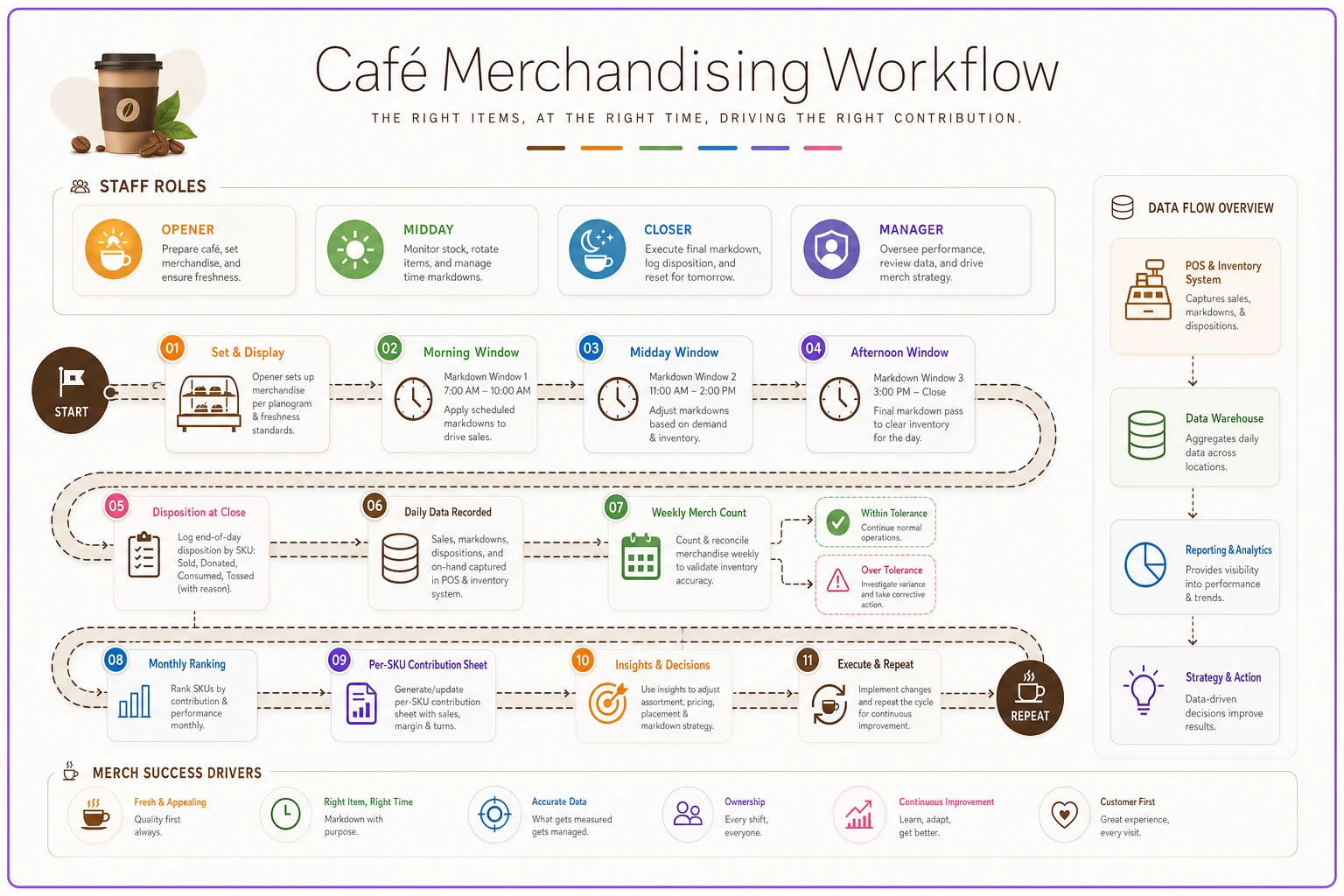
The connection that makes this whole thing work: the closer's disposition log and the manager's weekly count feed the same contribution sheet that drives next month's assortment decisions. It's one loop, not four disconnected chores.
A real scenario
A single-location café carrying 14 pastry SKUs and a small retail shelf ran purely on the owner's instinct. Monthly, merchandised items brought in roughly $9k–$10k in revenue, but the owner couldn't say what actually dropped to the bottom line after waste and markdowns — and had never separated shrink at all.
They built the contribution sheet first. Three things came up immediately: two pastry SKUs were contributing under $8/day each after markdowns, the retail shelf had a quiet shrink problem (around 3–4 bags a month unaccounted for), and the two "premium" croissants were carrying the whole case on their own.
The changes weren't dramatic. They cut the two dead pastry SKUs and reallocated those orders toward the croissants. They moved retail beans behind the counter and started a weekly count with a 1-unit trigger, which basically ended the mystery shrink. They standardized markdown time across all closers.
Two months in, merchandised contribution improved by roughly $600–$800 a month — not from selling more, but from killing subsidized SKUs, stopping retail walk-off, and marking down on a schedule instead of a whim. The owner's bigger win was less tangible: they could finally say, with a real number, which items deserved space.
When this makes sense — and when it doesn't
This system is worth the effort if you carry more than a handful of merchandised SKUs, run multiple shifts, or you're about to add a location. The moment merchandising decisions pass through more than one person, you need a shared scorecard or the margins drift.
It's probably overkill if you carry three pastries and sell out by 10am with no markdowns and no retail. At that volume, instinct genuinely is the system, and building four documents to manage twelve croissants is busywork. Be honest about which café you're running.
Who should not start here: an owner whose waste and ordering are already chaotic. If you don't have reliable daily counts, the merchandising contribution math will be built on garbage inputs. Get your ordering and waste logging stable first — the thinking in this waste-into-margin playbook is the right prerequisite. Then layer merchandising on top.
The deliverables, and where software earns its keep
Everything above runs on four artifacts you can build in a spreadsheet this weekend:
-
A per-SKU P&L sheet with effective contribution per item
-
A printable weekly merch count separating waste from unexplained variance
-
Shrink-trigger rules tied to variance thresholds
-
A staffing checklist for open, markdown windows, and close
The spreadsheet version works fine at one location. Where it strains is the hand-keying — closers forgetting to log dispositions, counts that never make it into the sheet, the weekly reconciliation eating an hour of manager time. That's the point where operational software that pulls POS sales directly, prompts the disposition log at close, and auto-flags SKUs crossing a shrink threshold stops being a luxury. The value isn't the dashboard — it's that the contribution sheet stays current without anyone remembering to update it, so your monthly assortment decisions are made on real numbers instead of last month's guesses.
Start with the spreadsheet. Prove the loop works. Automate it once the manual logging becomes the thing that's breaking, not before.
The system is the point; the tooling just keeps it honest when you're not standing there watching the case.
Ready to brew operational excellence?
Join hundreds of coffee shops using Coffehq to boost efficiency, reduce waste, and elevate customer satisfaction.