


Every cafe owner I talk to has a list. Sometimes it's in a notebook, sometimes it's 40 browser tabs, sometimes it's just a low-grade anxiety that lives in their chest during the morning rush. The list is always some version of: things I know I should fix but haven't. New POS. Better scheduling. Fix the waste problem. Get the loyalty program working. Train the closers properly. Set up real inventory counts.
The problem isn't the list. It's how owners decide what to work on next. Almost nobody picks based on return. They pick based on whichever problem screamed loudest that week — a bad Yelp review, a surprise invoice, a staff blowup. So the roadmap becomes reactive, and the highest-leverage projects (the boring ones that quietly compound) never get touched because they never scream.
That's what a cafe ops prioritization framework is actually for. Not to make you feel organized. To force a consistent comparison between very different projects so the next thing you build is the thing that pays back fastest with the least risk. Below is the scoring rubric, the sequencing logic behind it, and three sample roadmaps for different cafe sizes you can copy today.
Why cafe project lists rot
Here's the pattern in almost every independent cafe. The owner has maybe 15–25 "improvement" ideas floating around. Three or four are genuinely transformative. The rest range from mildly useful to total time sinks. Without a scoring system, all 25 feel roughly equal, so the decision defaults to emotion or urgency.
-
The shiny-object trap. A new tool gets demoed, looks great, and jumps the queue past three cheaper fixes that would've returned more.
-
The firefighting loop. Whatever broke yesterday becomes today's project. You spend all your project time patching instead of building.
-
The abandoned-halfway project. Something gets started, turns out to need way more time than expected, and dies. Now it's dead weight — a half-migrated inventory system nobody trusts.
What people miss is that difficulty and value are completely separate axes, and they almost never line up. The highest-value project might be a 2-hour fix. The sexiest project might take three weeks and break every time a staff member touches it. If you're not scoring both dimensions, you can't see that.
The four-factor scorecard
The whole framework runs on four numbers per project. Score each from 1 to 5, then combine them. Four factors, because once you go past that, owners stop filling the sheet out — and a rubric nobody uses is worthless.
Keep every order and shift perfectly aligned.
Coffehq helps you manage orders, inventory, and staff schedules seamlessly.
- Unified order processing
- Real-time inventory updates
- Staff shift coordination
No credit card required
| Factor | What it measures | 1 = | 5 = |
|---|---|---|---|
| ROI | Dollar or time return once it's running | Marginal / unclear | Large, recurring, obvious |
| Hours-to-implement | Total setup effort (inverted) | Weeks of work | A few hours |
| Failure-risk | Odds it breaks or gets rejected by staff (inverted) | High chance it flops | Very likely to stick |
| Maintenance burden | Ongoing effort to keep it alive (inverted) | Constant babysitting | Set and forget |
Three of the four factors are inverted — a high score is good across the board. A 5 on hours-to-implement means it's fast. A 5 on failure-risk means it's low-risk. This matters because it lets you add the numbers cleanly without flipping signs in your head.
Scoring the hard one: ROI
-
Hard-dollar ROI "This recovers about $600/month in milk waste." → high score.
-
Labor ROI "This saves the opener 25 minutes a day." That's roughly 12–15 hours a month of someone's time. → high score.
-
Risk-reduction ROI "This stops the cash variance problem that cost us ~$1,400 last quarter." → medium-high.
-
Vague ROI "Customers will probably like it." → that's a 2 at best until you can name the number.
If you genuinely can't articulate the return, that's your answer. Score it low and move on.
The weighted formula
Priority Score = (ROI × 3) + (Failure-risk × 2) + (Hours-to-implement × 1.5) + (Maintenance × 1.5)
Max possible is 40. Anything scoring 30+ is a "do it now." 22–29 is "schedule it." Below 22, either rework it into something smaller or park it.
The copyable scorecard spreadsheet
Build this as a flat sheet. Columns:
-
Project name
-
ROI (1–5)
-
Hours-to-implement (1–5, inverted)
-
Failure-risk (1–5, inverted)
-
Maintenance burden (1–5, inverted)
-
Priority Score — formula
=(B23)+(D22)+(C21.5)+(E21.5) -
Bucket — 30/90/180 (filled in during sequencing)
-
Owner — who's accountable
-
Notes — the specific ROI number you used
Sort descending by column 6. That sorted list is your roadmap draft. The only discipline required is honesty in columns B through E, which is harder than it sounds — people inflate the ROI of projects they already emotionally want to do. The notes column is your defense against that. If you can't write a concrete number there, knock the ROI score down.
A quick worked example. Say you're comparing two projects:
-
Fix nightly cash variance — ROI 4 (stops ~$1,400/qtr leakage), hours 4 (one afternoon to set the checklist), failure-risk 4 (simple, hard to mess up), maintenance 5 (runs itself). Score = 12 + 8 + 6 + 7.5 = 33.5.
-
New customer-facing mobile app — ROI 3 (maybe more orders, unproven), hours 1 (weeks of setup), failure-risk 2 (adoption is a coin flip), maintenance 2 (constant updates). Score = 9 + 4 + 1.5 + 3 = 17.5.
The cash fix wins by a mile, even though the app feels more exciting. That gap — 33.5 versus 17.5 — is exactly what stays invisible without a rubric.
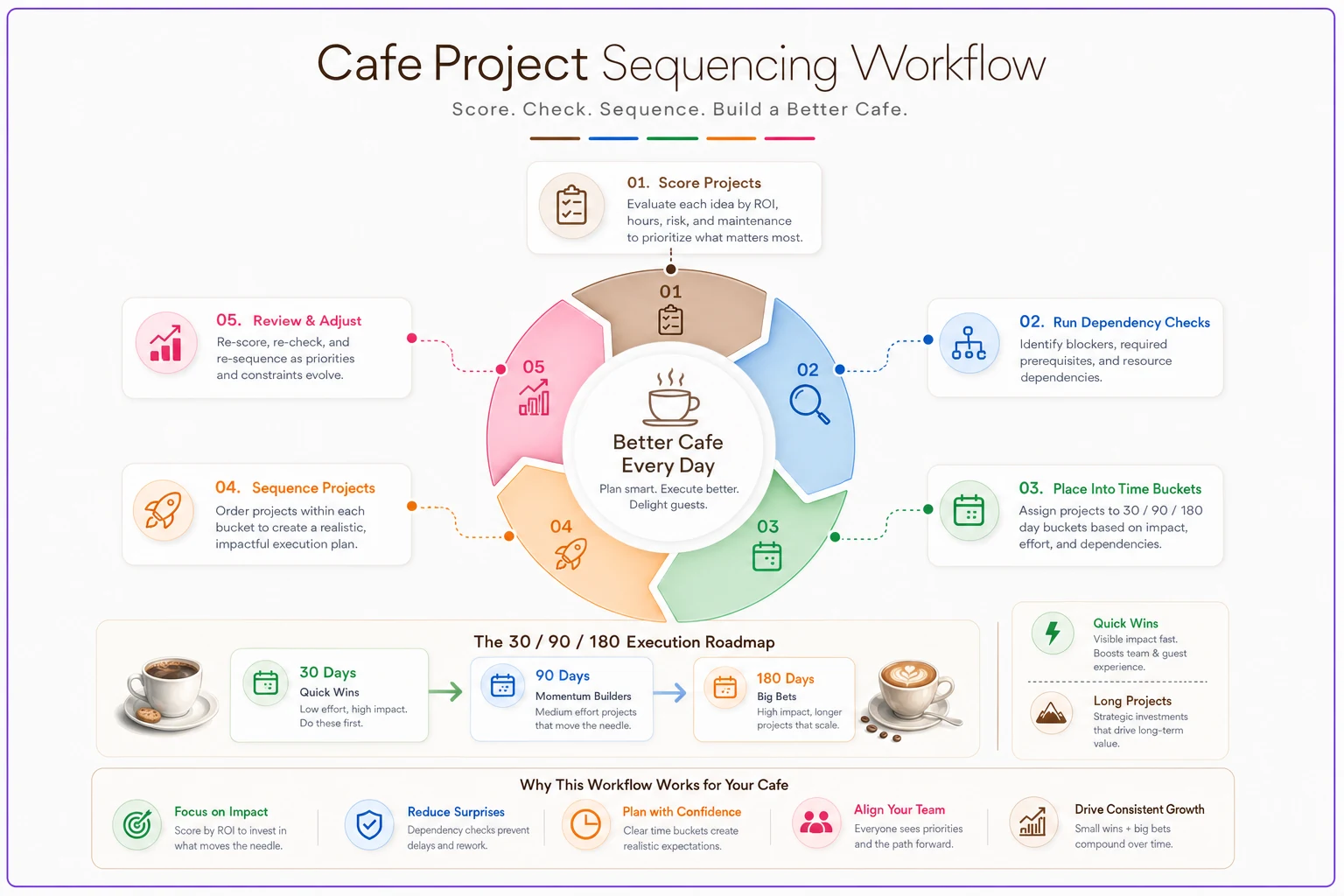
30 / 90 / 180 sequencing
A sorted list tells you what's valuable. It doesn't tell you what order to build in, because some projects depend on others, and doing everything at once burns out your team. That's what the time buckets are for.
The sequencing rules
-
30-day bucket = high score + low dependency + fast payback. Quick wins. They should fund momentum and ideally free up time or cash you can reinvest. Rule: nothing goes here if it takes more than about a week of calendar time.
-
90-day bucket = high score but needs a foundation first, OR medium-effort projects. Things that depend on a 30-day item being done, or that need staff habits formed before they'll stick.
-
180-day bucket = high ROI but high effort or high coordination. Multi-week builds, anything touching multiple sites, anything requiring new systems integration.
The non-obvious rule: a project's score can be high but still belong in the 180 bucket because of dependencies. You don't move it up just because it scored well. Sequencing respects order of operations. Reliable data reconciliation almost always has to come before fancy reporting, no matter how much you want the dashboards — if your numbers don't reconcile, the dashboard just shows you wrong numbers faster. Getting your POS, inventory, scheduling and accounting to sync cleanly is a foundation project, not a quick win.
The dependency check
Before you finalize buckets, run each 30-day and 90-day item through one question: does this depend on data, a habit, or a system that isn't in place yet? If yes, it drops a bucket. This single check prevents the most common sequencing mistake — starting a project that was always going to stall because its prerequisite didn't exist.
Three archetype roadmaps
Same rubric, very different results depending on size. Here's how priorities actually shake out across three cafe types.
Archetype 1: Solo operator (owner behind the counter)
You are the operation. Your scarcest resource is your own hours, so time-saving ROI beats almost everything. Complex projects score badly for you because maintenance burden lands entirely on one person.
30 days:
-
Nightly cash + waste close-out routine (5-minute version). Tiny effort, stops small leaks, builds a daily rhythm.
-
Standardize your ordering into a fixed weekly template. Getting ordering into a predictable purchase-to-stock flow is the single biggest COGS lever when you're solo.
90 days:
-
Set real par levels for your top 10–15 perishables so you stop over-ordering.
-
Build a simple weekly P&L habit so you're seeing margin, not just the bank balance.
180 days:
-
A basic financial model linking your operational levers to profit. For a solo shop this feels heavy, which is exactly why it's at 180 — do it once the daily habits are running.
What doesn't make the solo list: anything with high ongoing maintenance. A fancy loyalty integration or a custom app scores low because there's nobody but you to babysit it.
Archetype 2: Single site with staff
Now you have a team, which changes the math. Failure-risk becomes about adoption — will staff actually use it? Projects that depend on consistent human behavior get riskier, and projects that reduce coordination friction get more valuable.
30 days:
-
Role-based shift close checklists (cash, waste, prep-for-tomorrow). Low effort, big consistency payoff.
-
Fix the one recurring staff error that costs you most — often it's milk waste or incorrect modifier ringing.
90 days:
-
Reconciliation routine across POS and inventory, now that more hands mean more discrepancies.
-
A repeatable scheduling approach to close coverage gaps without over-staffing.
180 days:
-
Full financial model tying every operational lever to your P&L. At single-site-with-staff scale, this is where you start making decisions from numbers instead of gut.
The pattern shift here: a solo owner scores maintenance burden brutally, but a single site can absorb slightly higher-maintenance systems because the work spreads. That bumps some 180 items up into 90.
Archetype 3: Two to five sites
Coordination is your real bottleneck now, not any single task. The scorecard's failure-risk factor starts to dominate, because any project that can't be consistently executed across every site will create more chaos than it solves. A system that works perfectly at Site A and gets ignored at Site C is a net negative — it fragments your data.
30 days:
-
Standardize one high-variance process across all sites (usually the shift close or cash handling). Pick the process where sites differ most.
-
Centralize where operational data lives so you're not comparing apples to oranges across locations.
90 days:
-
Reconciliation across sites. Multi-site is where small sync errors compound into real money, so this is urgent rather than just foundational.
-
Vendor and ordering standards so each site isn't negotiating its own prices.
180 days:
-
Tiered standards and decision-rights documentation — what each site manager controls versus what's centralized.
-
A consolidated multi-site financial model.
The big reframe for multi-site: a project's score should include a "does it survive replication" penalty. A great idea that only works when the owner personally runs it scores low at this scale, because you can't be in five places. Projects that work without you in the room are the ones worth building.
When this framework is a bad idea
Skip it if your list is under five items. If you've got three obvious things to fix, just fix them. The overhead of scoring isn't worth it.
Don't use it during an actual emergency. If your walk-in died and you're losing inventory by the hour, that's not a prioritization question. Deal with it. The framework is for planned improvement time, not crisis response.
Don't let it override a legal or safety issue. Food safety and compliance items don't go through the rubric. They're non-negotiable and go straight to the top regardless of ROI score. The scorecard is for discretionary projects only.
One behavioral warning: the rubric only works if you're honest in the scoring columns. Owners who secretly want a particular project will inflate its ROI to justify it. The notes column — where you write the actual dollar figure — is the only thing that keeps you honest. No number, no high ROI score.
A real scenario
A single-site cafe with six staff had a project list of about 18 items and had been "about to" rebuild their inventory system for the better part of a year. It kept getting bumped because every week something more urgent came up.
When they ran the four-factor scorecard, two things surfaced immediately. First, the inventory rebuild scored lower than expected — high ROI, sure, but brutal on hours-to-implement and maintenance, which parked it at 180 days. Second, a boring project they'd been ignoring — a tightened nightly close with waste logging — scored a 32. Fast, cheap, low-maintenance, and it addressed a leak they'd been eating blind.
They ran the close-out fix in the 30-day window. Within a couple of months, nightly waste logging had cut pastry and milk over-prep noticeably — somewhere in the $400–$600/month range — and the daily numbers finally gave them the data they needed to do the inventory project properly later. The sequencing mattered as much as the scoring: the quick win generated the information that de-risked the bigger project.
What changed wasn't effort. They weren't working harder. They'd just stopped letting urgency pick their projects for them.
Keeping the roadmap alive
The last failure point is drift. Owners build a solid roadmap, follow it for six weeks, then slide back into reactive mode the next time something breaks. The fix is lightweight: re-score the list once a month, move completed items off, and add anything new that's accumulated. Ten minutes. Scores shift as your business changes — a project that scored a 19 when you were solo might score a 31 once you have staff to maintain it.
Rescore your list once a month — ten minutes is enough to keep the roadmap current.
The biggest reason roadmaps survive is that someone owns each line. That's what the "owner" column is for. A project with no name next to it is a project that won't happen, no matter how high it scored.
A cafe ops prioritization framework isn't about being more organized. It's about making sure the hours you spend improving the business go toward improvements that actually move the P&L — instead of whatever happened to be on fire that morning. Score honestly, sequence by dependency, respect your own scale, and the next thing you build will almost always be the right one.
Ready to brew operational excellence?
Join hundreds of coffee shops using Coffehq to boost efficiency, reduce waste, and elevate customer satisfaction.