

Most cafes don't get taken out by one giant catastrophe. They get chipped away at. A walk-in that drifts two degrees warm for a week nobody noticed. A grinder that's been "kind of making that noise" since March. A chargeback that came in 40 days after the sale, tied to a receipt nobody can find. A vendor that quietly started shorting your oat milk order and nobody flagged it until you ran out on a Saturday.
None of these is a crisis on its own. Together, they're a compliance and resilience problem that lives in the gap between "we sort of check that" and "we can prove we checked that." When something does go wrong—an inspection, a customer complaint that escalates, a card network dispute, equipment that dies mid-rush—the difference between a bad day and a closed cafe is whether you have evidence, a clear owner, and a response you've actually rehearsed.
That's the real job of a cafe risk and compliance blueprint. Not a binder that sits in the office. A system that ties together the five things that reliably bite independent operators—food safety, equipment health, payment and chargeback defense, vendor performance, and incident response—into something a two- or three-person team can actually run without hiring anyone.
Here's how these pieces connect, where they break as you grow, and what a low-burden version actually looks like.
Why these five risks are really one system
Operators tend to treat these as separate departments in their heads. Food safety is the health-inspector thing. Equipment is the repair-guy thing. Chargebacks are the bank thing. Vendors are the ordering thing. Incidents are the "oh no" thing.
In a real cafe, they share the same failure mode: nobody owns the verification, so nobody has the evidence, so when it matters you're improvising.
Here's how they bleed into each other:
-
Your espresso machine's temperature stability isn't just an equipment issue—it's a food-safety issue when it's brewing under-temp, and a vendor issue when your service contract says "48-hour response" and the tech shows up in six days.
-
A chargeback isn't just a payments problem—it's a records problem. The dispute is winnable if you have the timestamped order, the pickup confirmation, and the signed receipt. It's a loss if all you have is "I think that was the guy who ordered two lattes."
-
A refrigeration failure at 2 a.m. is an equipment event, a food-safety event, an inventory event, and if you're not careful, a customer-safety event the next morning when someone serves the milk anyway.
Once you see them as one system, the design goal gets clearer. You don't need five programs. You need one lightweight loop that produces pass/fail checks, evidence, and a triggered response across all five domains—running on the same cadence, owned by the same roles.
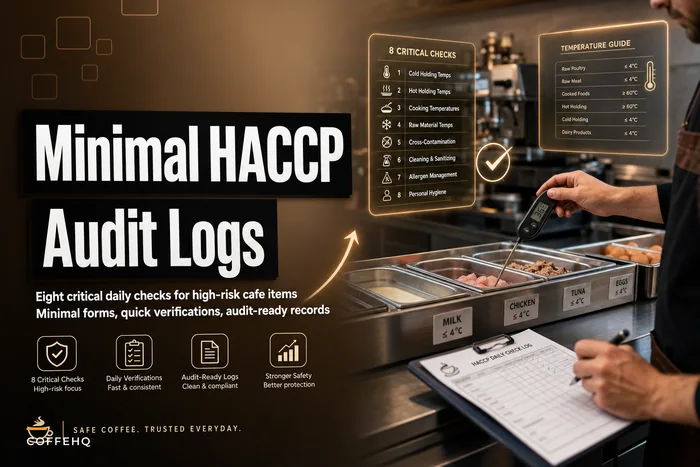
If you already run food-safety checks, you've got a head start on the structure. The minimalist HACCP approach with 8 critical checks and audit-friendly logs is essentially the food-safety column of this table done well. The blueprint just extends that same discipline to equipment, payments, and vendors.
The core building block: pass/fail acceptance tests
The most useful shift I've seen operators make is moving from vague standards ("keep things clean," "watch the equipment") to binary acceptance tests. Something either passes or it fails. No judgment calls at 7 a.m. from a barista who's slammed.
Keep every order and shift perfectly aligned.
Coffehq helps you manage orders, inventory, and staff schedules seamlessly.
- Unified order processing
- Real-time inventory updates
- Staff shift coordination
No credit card required
An acceptance test has three parts: the check, the threshold, and what happens on a fail. That third part is where most cafe checklists fall apart—they tell you to check the temp but not what to do when it's wrong.
Here's what a slice of the acceptance-test layer looks like across the five domains:
| Domain | Acceptance test | Pass condition | On fail |
|---|---|---|---|
| Food safety | Walk-in temp at open | ≤ 40°F (log reading) | Move product to backup fridge, photo-log temp, tag affected SKUs, call service |
| Food safety | Sanitizer concentration | Within strip range | Remix, re-test, log both readings |
| Equipment | Espresso group temp stability | Within spec after warm-up | Pull from service, switch to backup workflow, open ticket |
| Equipment | Grinder dose consistency | ±0.5g over 5 pulls | Recalibrate, re-test, note in maintenance log |
| Payments | Daily batch reconciles to POS | Variance ≤ small threshold | Flag transaction, pull receipt copies, note before it ages |
| Vendor | Delivery matches PO | Qty + temp on receipt | Photo the discrepancy, reject/annotate, log against scorecard |
| Vendor | Service response time | Within contracted SLA | Timestamp the gap, log it, escalate per backup rule |
The point isn't this exact table—it's the format. Every risk in your cafe should be expressible as: here's the test, here's what "good" looks like, here's exactly what a staffer does when it isn't good—without needing to text you.
If you already run food-safety checks, you've got a head start on the structure. The minimalist HACCP approach with 8 critical checks and audit-friendly logs is essentially the food-safety column of this table done well. The blueprint just extends that same discipline to equipment, payments, and vendors.
Evidence is the part everyone skips (and then regrets)
A check that isn't recorded didn't happen. Not legally, not for a chargeback, not for a health inspector, not for an insurance claim.
The mistake I keep seeing: teams do the checks but capture nothing, or capture it in a way that's useless later. A temp written on a sticky note. A "yeah we cleaned it" in a group chat. A repair that happened but the invoice is in someone's truck.
Evidence doesn't need to be fancy. It needs to be timestamped, attributable, and findable. For a small cafe, it usually comes in three forms:
-
Photos — walk-in thermometer readings, delivery discrepancies, equipment failures, sanitizer strips, disposed product. A photo has a timestamp built in and takes four seconds.
-
Logs — temp logs, maintenance entries, batch reconciliation notes, SLA breach timestamps.
-
Receipts and records — vendor POs versus delivery receipts, service invoices, and for payments, the transaction records that actually win chargebacks.
Use the phone camera's timestamp and upload photos to a shared evidence folder immediately so they don't stay on staff phones.
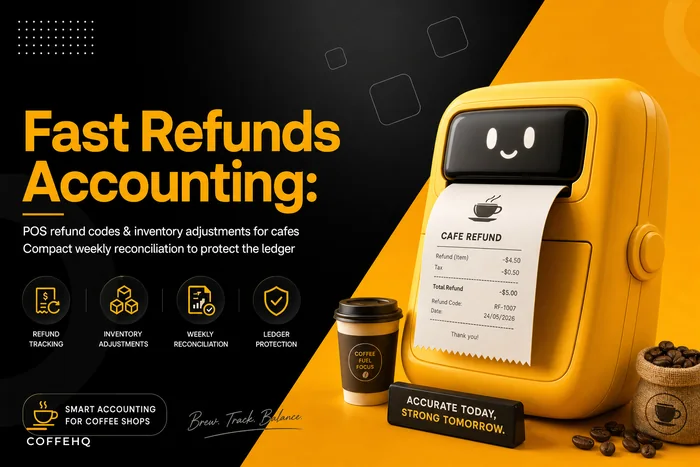
That last one matters more than most operators realize. Card disputes land weeks after the sale, and the window to respond is short. If your refund and record process is loose, you lose winnable disputes by default. Tightening that up connects directly to how you handle refund accounting for perishables with POS refund codes and clean ledger rules—the same clean records that keep your books straight are the ones that defend you against chargebacks.
A simple rule that works: if a check can fail in a way that costs money or triggers a regulator, it needs an evidence artifact attached. Everything else can be a checkbox.
The incident-triage calendar: how you respond before you're panicking
Acceptance tests catch problems. The triage calendar tells you who does what, and when, once a problem is caught—and it spreads the response load across a timeline instead of dumping everything on one manager the moment something breaks.
Two things layered together:
1. A recurring check cadence — the rhythm of when tests run.
2. A triggered response timeline — what happens in the minutes, hours, and days after a fail.
For the cadence, a small cafe realistically runs on something like:
-
Open (every shift) walk-in/reach-in temps, sanitizer, espresso warm-up check, POS/terminal boot test.
-
Mid-day (daily) grinder dose spot-check, hand-wash and prep-surface reset, quick equipment listen-and-look.
-
Close (every shift) batch reconcile to POS, deep-clean verification, temp re-log, disposal log for anything pulled.
-
Weekly vendor delivery accuracy review, chargeback check, maintenance ticket review, evidence-folder spot audit.
-
Monthly full equipment acceptance tests, vendor SLA scorecard, food-safety self-audit, review of every incident from the month.
For the triage side, the real value is the timed response. A refrigeration failure isn't "handle it whenever." It's:
-
0–15 min move product, log temps with photos, isolate affected SKUs.
-
15–60 min call service, open a ticket, start the SLA clock, notify the owner.
-
Same day decide dispose vs. hold based on time-at-temp, document the decision.
-
Next day confirm repair or backup plan, update inventory, close the incident with evidence attached.
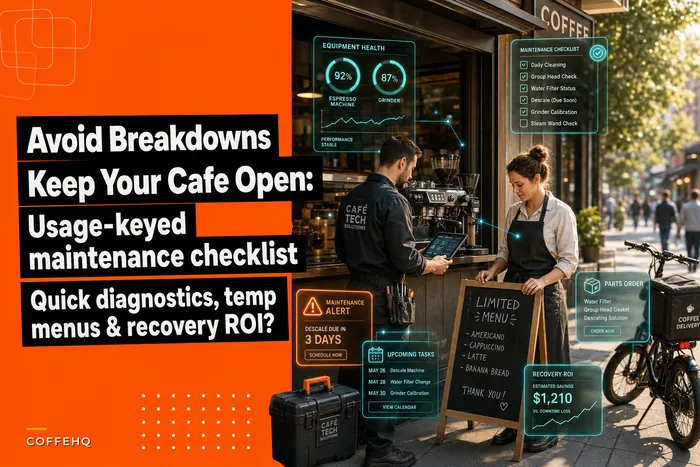
This is where the equipment side earns its keep. The response steps above are the exact muscle memory built by a real preventive-maintenance checklist and downtime recovery playbook—the triage calendar just makes sure someone's actually running that playbook on a clock instead of remembering it exists after the fact.
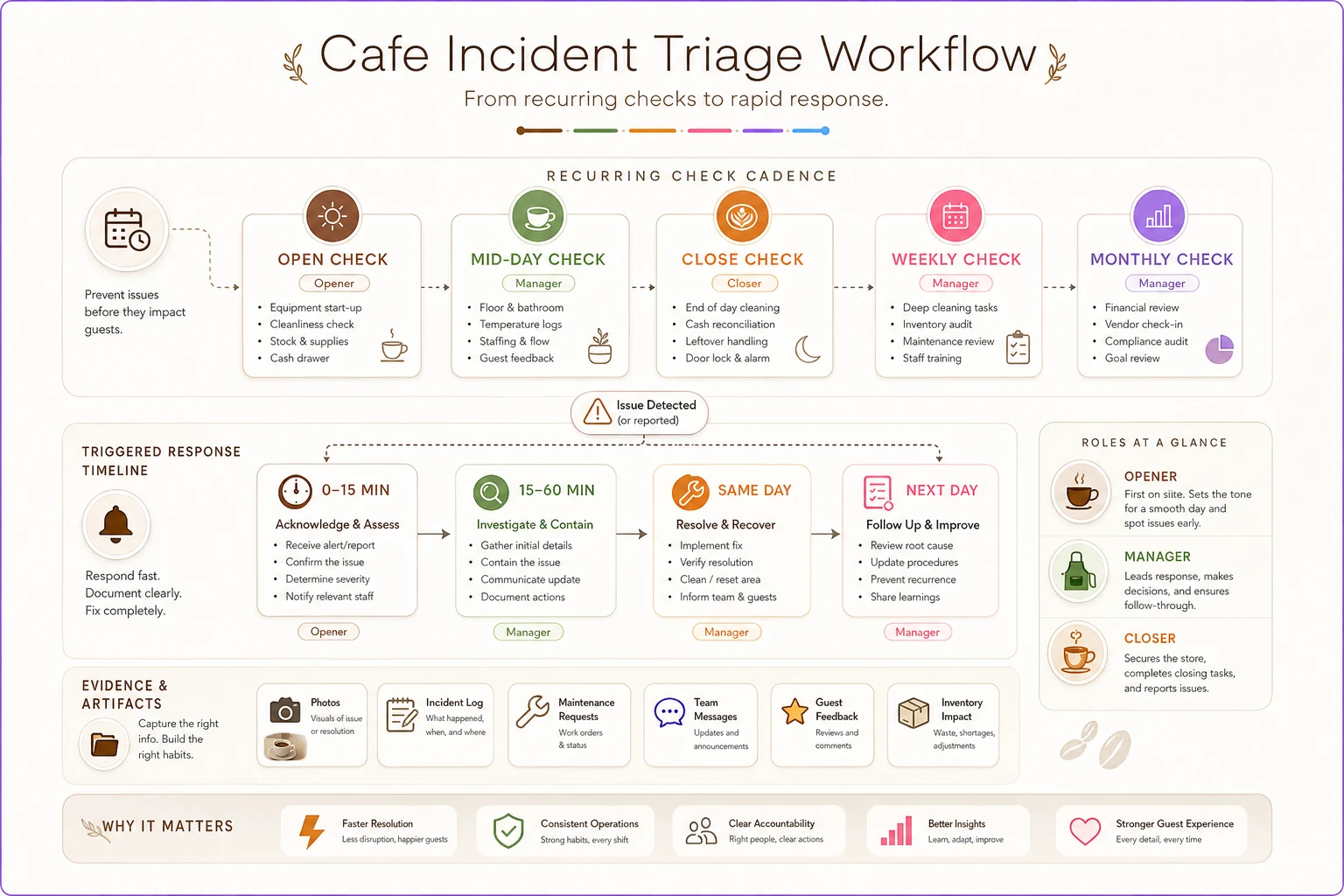
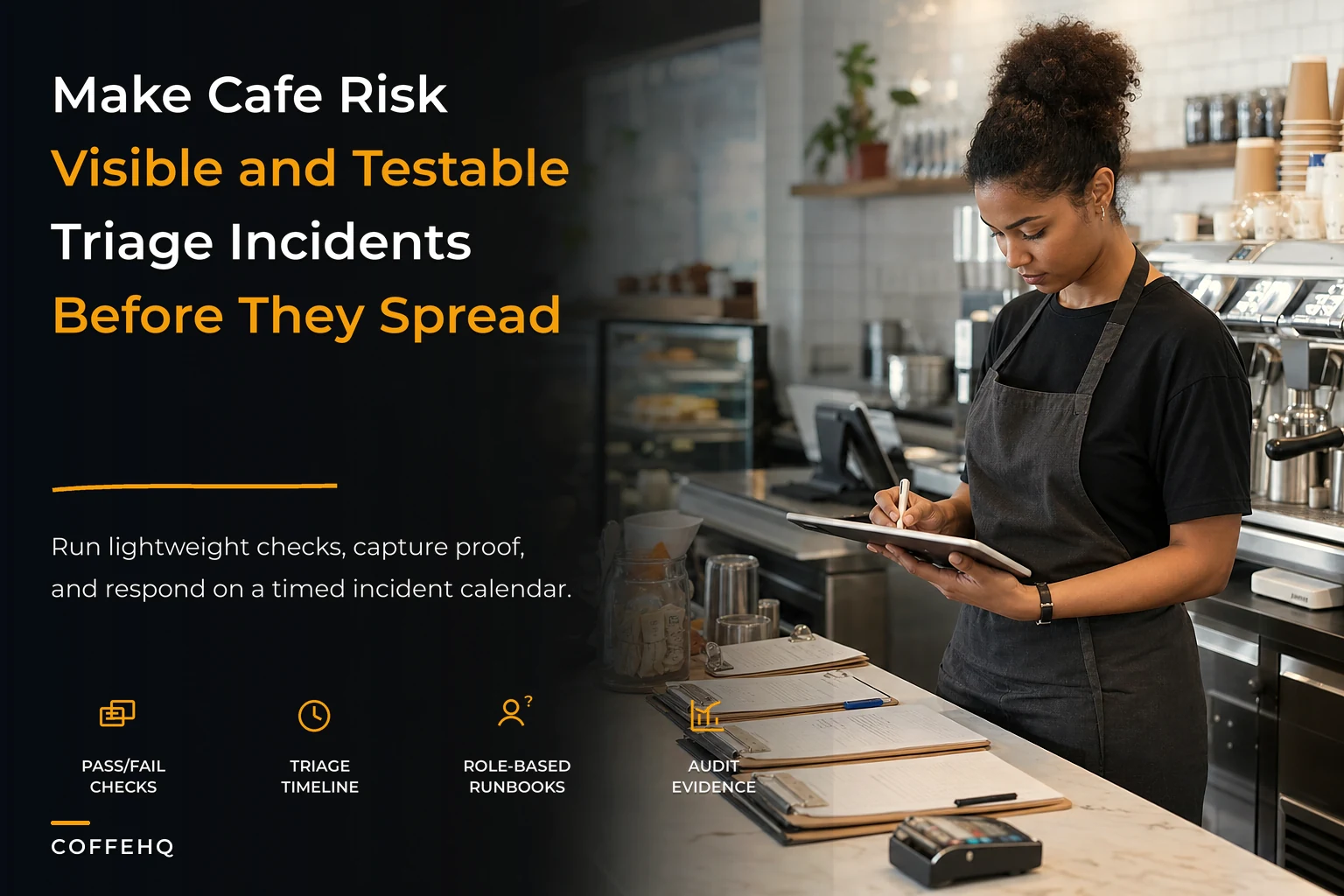
A simple visual of the cadence feeding the timed response makes it easy for staff to see their part in the loop.
Role-based runbooks so it's not all on the manager
Most compliance systems quietly depend on one person—usually the owner or a single senior manager. That person goes on vacation, and the whole thing stops.
A durable blueprint assigns every check and every triage step to a role, not a name. For a small team, roles usually collapse into three:
-
Opener — owns open-shift acceptance tests and evidence capture. Runs the test, logs the result, executes the on-fail step, escalates if it's above their line. Doesn't diagnose.
-
Closer / shift lead — owns close-shift checks, batch reconciliation, and same-day incident documentation.
-
Manager / owner — owns weekly and monthly audits, vendor scorecards, chargeback responses, and any escalation the shift roles can't resolve.
The runbook for each role should fit on a card. Not a manual. If a new hire can't read it and execute during a rush, it's too long.
A pattern worth stealing: the on-fail step in every runbook should end with either "resolved—log it" or "escalate to [role]." No dead ends where a staffer is left guessing. That one rule keeps a small team from either ignoring problems or blowing up the owner's phone for things they could've handled themselves.
Vendor SLAs belong in the same system
Operators tend to treat vendors as a handshake relationship until something goes sideways—a milk shortage, a service tech who ghosts, a supplier who quietly raised prices. By the time it's a pattern, you've lost real money and you can't prove any of it.
Folding vendors into your acceptance-test framework fixes this. Two tests do most of the work:
-
Delivery acceptance every order gets checked against the PO for quantity, quality, and temperature at receipt, with a photo on any discrepancy. That becomes your evidence when you renegotiate.
-
Service SLA acceptance every service call gets a timestamp. Requested time vs. arrival time vs. resolution time. When a contract says "next business day" and reality says three days, you now have a logged pattern instead of a vague grievance.
Those logged patterns feed a monthly scorecard—exactly the mechanism behind contract-lite vendor governance with scorecards, backup rules, and a one-page risk matrix. The blueprint's contribution is making vendor performance a routine test result rather than a special project you only run when you're already frustrated.
What breaks as you grow
At one location, this whole system can live in a manager's head and on a clipboard. It works because the same person sees everything.
Add a second location, or even push past a certain shift volume, and the informal version collapses in predictable ways:
-
Verification drift. Location A runs the checks; Location B does them "mostly." You don't find out until an inspection or an incident exposes the gap.
-
Evidence fragmentation. Photos are on three people's phones, logs are on paper at one site and a spreadsheet at another, service invoices are wherever. During a dispute or audit, assembling the record takes hours you don't have.
-
Escalation confusion. With one manager, everyone knows who to call. With two sites and multiple shift leads, "who owns this incident" gets murky fast.
-
No cross-site pattern visibility. A grinder problem at one site and a vendor short at another might share a root cause, but nobody's looking across locations.
This is the point where the system needs to move off memory and paper into something shared—somewhere checks, evidence, and escalations live in one place every role can see. That's less about buying software for its own sake and more about the reality that resilience doesn't survive on trust once you're past one location. If you're thinking about how your underlying systems hold up under that kind of load—including during outages—the technology resilience blueprint for keeping cafes open during outages covers the infrastructure side of this same problem.
An AI-assisted operational platform earns its keep in the boring, high-frequency parts: prompting the right role to run the right check at the right time, flagging when a batch doesn't reconcile or a delivery came in short, keeping evidence attached to the incident it belongs to instead of scattered across phones and notebooks, and surfacing patterns across shifts and sites that nobody catching manually from paper logs. The goal isn't to automate judgment—it's to remove the coordination overhead that makes small teams quietly abandon compliance work when things get busy.
A real scenario
A two-site independent cafe—roughly 15 staff total—kept getting hit with the same slow bleed. Chargebacks they mostly lost because records were a mess, running somewhere in the few-hundred-dollars-a-month range between both shops. A walk-in at the second location that had failed at least twice without anyone documenting the product loss. A dairy vendor who'd been shorting orders for months that nobody had formally tracked.
They didn't hire anyone. They built the acceptance-test layer above, assigned it to opener/closer/manager roles, and started attaching photo evidence to every fail. Within a couple of months, three things shifted. Chargeback wins went up—not on everything, but enough to matter—once they could produce timestamped order and pickup records. The documented vendor shortages gave them leverage to claw back credits and eventually move part of their volume. And the walk-in issue got repaired properly because now there was a paper trail that forced the service SLA to be honored.
Nothing dramatic in any single number. The owner's rough estimate was a few thousand dollars a year recovered, plus the harder-to-price benefit of not lying awake wondering what was quietly failing at the site they weren't standing in.
When this makes sense—and when it doesn't
Worth building: you're running more than one shift you don't personally supervise, you've been burned by at least one preventable incident, or you're at or approaching a second location. The moment you can't personally see every check, you need the system.
Probably overkill: if you're a single owner-operator behind the counter for every open hour, a full role-based blueprint is more structure than you need. Run the food-safety and equipment checks, keep clean records for chargebacks, and skip the role runbooks until you have staff to assign them to.
Who should skip this entirely: anyone hoping to buy a binder and call it done. This is a running system. If nobody owns the weekly and monthly audits, it decays into decoration within a month—the exact failure mode it's designed to prevent.
The one-page version
Strip everything above down to what actually has to exist:
-
Acceptance tests for each of the five domains, each with a pass condition and an on-fail step
-
Evidence rule any check that can cost money or trigger a regulator gets a photo, log, or receipt attached
-
Triage calendar shift / daily / weekly / monthly cadence, plus timed response steps for the incidents most likely to hit you
-
Role runbooks opener, closer, manager—each fits on a card, each on-fail step ends in resolve-and-log or escalate
-
Weekly and monthly audit entries reconciliation review, vendor scorecard, incident review, evidence spot-check
The cafes that stay resilient aren't the ones with the fewest problems. They're the ones where every problem hits a test, produces evidence, and triggers a known response—before it becomes the thing that closes the doors. Build the loop once, keep it low-burden enough that a busy team actually runs it, and the small stuff stops adding up.
The cafes that stay resilient aren't the ones with the fewest problems. They're the ones where every problem hits a test, produces evidence, and triggers a known response—before it becomes the thing that closes the doors. Build the loop once, keep it low-burden enough that a busy team actually runs it, and the small stuff stops adding up.
Ready to brew operational excellence?
Join hundreds of coffee shops using Coffehq to boost efficiency, reduce waste, and elevate customer satisfaction.